


Widows blown engine....diagnosed!!!


Former Vendor
Joined: Feb 2005
Posts: 15,228
Likes: 2,529
From: Anaheim

Like I said...It will be interesting to see the rest of the pieces. While anything can break, I've never seen a 928 valve (other than the previously mentioned 968 TRW intake) break.
It is also hard to imagine a valve "floating" at 6,000 rpms, unless a valve spring broke...and again...I've never seen a stock 928 valve spring break.
There's an interesting story inside that engine.
It is also hard to imagine a valve "floating" at 6,000 rpms, unless a valve spring broke...and again...I've never seen a stock 928 valve spring break.
There's an interesting story inside that engine.

Thread Starter
Race Director
Joined: Sep 2004
Posts: 16,271
Likes: 82
From: Stockton, CA
Like I said...It will be interesting to see the rest of the pieces. While anything can break, I've never seen a 928 valve (other than the previously mentioned 968 TRW intake) break.
It is also hard to imagine a valve "floating" at 6,000 rpms, unless a valve spring broke...and again...I've never seen a stock 928 valve spring break.
There's an interesting story inside that engine.
It is also hard to imagine a valve "floating" at 6,000 rpms, unless a valve spring broke...and again...I've never seen a stock 928 valve spring break.
There's an interesting story inside that engine.

Archive Gatekeeper
Rennlist Member
Rennlist Member

Joined: Sep 2002
Posts: 18,763
Likes: 3,932
From: Irvine, CA
Which cams? Enough additional lift at the occasional 7000 rpm where coil bind might be occurring? I am about as far from an engineer as is possible but hammering on 20+ year old stock springs and retainers might kill a valve, no?
EDIT: I'm really confused by that pic of the valve carnage- the two areas you're pointing to are parallel to the long axis of the block- how can one be an exhaust and one an intake valve?
EDIT: I'm really confused by that pic of the valve carnage- the two areas you're pointing to are parallel to the long axis of the block- how can one be an exhaust and one an intake valve?
Thread Starter
Race Director
Joined: Sep 2004
Posts: 16,271
Likes: 82
From: Stockton, CA
 )...while I know exactly which cams they are.... I do not think its right to say.....
 I must admit from my limited understanding I would think a spring failure causing valve failure would be an INTAKE valve...since they always throw a further distance or for longer duration...however this instance is the opposite....which is quite odd.....
Even still the "lift and duration" of the cams in question is still quite mild...very mild really....to cause this type of failure....which I consider very bad luck....

yes I have been drinking....quite a bit really....cheers
Thread Starter
Race Director
Joined: Sep 2004
Posts: 16,271
Likes: 82
From: Stockton, CA
Which cams? Enough additional lift at the occasional 7000 rpm where coil bind might be occurring? I am about as far from an engineer as is possible but hammering on 20+ year old stock springs and retainers might kill a valve, no?
EDIT: I'm really confused by that pic of the valve carnage- the two areas you're pointing to are parallel to the long axis of the block- how can one be an exhaust and one an intake valve?
EDIT: I'm really confused by that pic of the valve carnage- the two areas you're pointing to are parallel to the long axis of the block- how can one be an exhaust and one an intake valve?
DAMM YOU ARE GOOD....they are both exhaust valve (holes anyway)....my bad...they are both outboard from the block...nice catch Doc!!!!!
While I respect your 928 engine carnage knowledge....I also FEEL YOUR PAIN..that I KNOW comes from many nights
 followed by

Three Wheelin'
Joined: Feb 2002
Posts: 1,663
Likes: 3
Rob:
I suspect the cams are the ones I did for Sean last year, being the Elgin regrind, slightly "hotter" than the OEM GT cams. The intake lift is 0.414" with 260 degrees duration seat to seat, 218 degrees at 0.050 lift. The exhaust cam is 0.370" of lift and 246 degrees duration seat to seat. I don't recall the spec at 0.050".
I ran these same cams in my GTS for many thousand miles of fun driving as has Dennis Kao in his highly tuned 5.0 liter. The velocity and acceleration specs of these cams have been checked for compatibility with the 928 valve train and are well within requirements for both mass and lifter diameter. As a fun fact, both IN and EX profiles are actually cam profiles from other direct acting overhead cam engines. All in all, I do not believe the issue is likely coil bind, but do suspect valve float or possibly lifter seal problems.
As Greg mentions, it will be interesting to learn more as Sean and Brian post the info.

I suspect the cams are the ones I did for Sean last year, being the Elgin regrind, slightly "hotter" than the OEM GT cams. The intake lift is 0.414" with 260 degrees duration seat to seat, 218 degrees at 0.050 lift. The exhaust cam is 0.370" of lift and 246 degrees duration seat to seat. I don't recall the spec at 0.050".
I ran these same cams in my GTS for many thousand miles of fun driving as has Dennis Kao in his highly tuned 5.0 liter. The velocity and acceleration specs of these cams have been checked for compatibility with the 928 valve train and are well within requirements for both mass and lifter diameter. As a fun fact, both IN and EX profiles are actually cam profiles from other direct acting overhead cam engines. All in all, I do not believe the issue is likely coil bind, but do suspect valve float or possibly lifter seal problems.
As Greg mentions, it will be interesting to learn more as Sean and Brian post the info.
Archive Gatekeeper
Rennlist Member
Rennlist Member
Joined: Sep 2002
Posts: 18,763
Likes: 3,932
From: Irvine, CA
Brian-
I have some qualitative sense of what's going on but in no way do I really understand what may or may not have been going on in that engine that led to its going TU- I totally guessed at the valvetrain failure, just 'cause of the likely high revs involved. And I almost didn't guess it 'cause I have heard Greg say before how rare valvetrain failures are.
I have no doubt that Jim's cam grinds are well within what is appropriate for installed spring heights on an S4 using stock springs, even I can understand that math: coil bind + cam lift -spring perch + safety margin. .414 and .370 is comparable to my stroker's cams (.420 and .380) so that's a non issue. I can't pretend to begin to understand how cam lobe profiles affect the 'throw' of the lifter off the cam lobe, and whatever you do, just don't go all lobe separation angles on me...
Dumb question- what is a 'lifter seal' problem? something to do with the lifter collapsing at high rpm or something?
Other dumb question, 'cause I can't recall- Does the Black Widow have an accusump? Oiling is still the 800 lb gorilla in this discussion...
I have some qualitative sense of what's going on but in no way do I really understand what may or may not have been going on in that engine that led to its going TU- I totally guessed at the valvetrain failure, just 'cause of the likely high revs involved. And I almost didn't guess it 'cause I have heard Greg say before how rare valvetrain failures are.
I have no doubt that Jim's cam grinds are well within what is appropriate for installed spring heights on an S4 using stock springs, even I can understand that math: coil bind + cam lift -spring perch + safety margin. .414 and .370 is comparable to my stroker's cams (.420 and .380) so that's a non issue. I can't pretend to begin to understand how cam lobe profiles affect the 'throw' of the lifter off the cam lobe, and whatever you do, just don't go all lobe separation angles on me...
Dumb question- what is a 'lifter seal' problem? something to do with the lifter collapsing at high rpm or something?
Other dumb question, 'cause I can't recall- Does the Black Widow have an accusump? Oiling is still the 800 lb gorilla in this discussion...
Rennlist Member
Joined: Nov 2007
Posts: 1,002
Likes: 0
From: Edmonton,Alberta
Guys
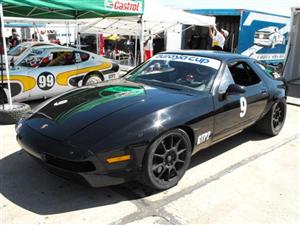
The engine that blew up was a used engine that I bought from Mark Anderson last spring and had about 30 race hours on it. All last season with a couple of Podium finishes. So pretty good if you asked me for a junk yard engine.
I live in Edmonton and my car is in California so rather than drag my car all the way back to the Great White North to fix it I found another junk yard motor to replace it, If I get 30 hours out of this one I will be happy.
I am building a 5.0 litre race engine and when I get back home I will pull this motor and install the properly built engine for this up comming race season.
I am also building a 6.0 liter stroker and I have a LS2 which I am considering building. I consider the junk yard motors dispsoable and only a stop gap until I can get a properly built race engine with a dry sump into the car. What can I say I'm a sucker for punishment and I love 928's
I will share my findings with the group when I get the engine opened up I am very curious to see inside
myself.
Mark my shifter is set up and I didn't shift into 2nd gear at 100MPH.Something just broke.
Thanks
Sean
The engine that blew up was a used engine that I bought from Mark Anderson last spring and had about 30 race hours on it. All last season with a couple of Podium finishes. So pretty good if you asked me for a junk yard engine.
I live in Edmonton and my car is in California so rather than drag my car all the way back to the Great White North to fix it I found another junk yard motor to replace it, If I get 30 hours out of this one I will be happy.
I am building a 5.0 litre race engine and when I get back home I will pull this motor and install the properly built engine for this up comming race season.
I am also building a 6.0 liter stroker and I have a LS2 which I am considering building. I consider the junk yard motors dispsoable and only a stop gap until I can get a properly built race engine with a dry sump into the car. What can I say I'm a sucker for punishment and I love 928's
I will share my findings with the group when I get the engine opened up I am very curious to see inside
myself.
Mark my shifter is set up and I didn't shift into 2nd gear at 100MPH.Something just broke.
Thanks
Sean
Rennlist Member
Joined: Nov 2007
Posts: 1,002
Likes: 0
From: Edmonton,Alberta
Jim
Thanks for chimming in. I don't think there is any problem with the cams. I probabally should have taken your advise and not installed them in a used engine. Your cams flow so well that i had to install costom chips to fatten the AF ratio I think the 7,000 rpm rev limit had more to do with the failure then the cams. Those cams are awesome and will be going in my built race engine.
7,000 RPM and the loose nut behind the wheel.
Thanks for chimming in. I don't think there is any problem with the cams. I probabally should have taken your advise and not installed them in a used engine. Your cams flow so well that i had to install costom chips to fatten the AF ratio I think the 7,000 rpm rev limit had more to do with the failure then the cams. Those cams are awesome and will be going in my built race engine.
7,000 RPM and the loose nut behind the wheel.
Thread Starter
Race Director
Joined: Sep 2004
Posts: 16,271
Likes: 82
From: Stockton, CA
my guess is a stock engine that was never opened (no reason too) was pushed hard and for some odd reason the exhaust valve let go....sure the occasional 7k doesn't help...but 30 hours on track isn't easy either.....thats almost 3 years of convential sprint racing!!!!

Addict
Lifetime Rennlist
Member
Lifetime Rennlist
Member
Joined: Feb 2009
Posts: 18,061
Likes: 10
If you float a valve and slightly bend it the engine may still run for a while but the constant hammering as the valve tries to close will then try to bend the valve back...... that second bending can snap off a valve head with expected results. Not that this is what happened here. Porsche as I recall put the 928 hydrolic lifters into one of their purpose built flat race engines and tested them to 7,500 RPM just to be sure that they worked.

Rennlist Member


Joined: Jun 2009
Posts: 3,067
Likes: 19
From: Somewhere, NC
Unless you're a 'Lemons' racer, I'd think any used motor would have to be gone through thoroughly & improvements made before putting it in the car... or you just enjoy swapping motors. Just sayin'.
GregBBRD, since you are frequenting this thread -would you please answer the PM's from the 'Virgin 1990' thread? Very much appreciated & thanks!
GregBBRD, since you are frequenting this thread -would you please answer the PM's from the 'Virgin 1990' thread? Very much appreciated & thanks!