



Oil consumption

Instructor
Joined: Sep 2004
Posts: 191
Likes: 1
From: SoCal, USA

I have 3,750 miles on my 997S since October 28th, '04. It consumed 1/2 quart of oil in the first 1,000 miles and has not moved down the gauge since. I broke in the car per the manual, more or less. Some good points made here about long-term effects of 0W-40 and easy break-in. Thanks for the education.
Miserable Old Bastard
Rennlist Member
Rennlist Member

Joined: Feb 2004
Posts: 14,168
Likes: 223
From: Los Angeles
I drive in a spirited manner but not overly agressive; broke the car in somewhat according to Porsche's recommendation but a little harder randomly and as the miles racked up. I added 1/2 qt. at 3,500 miles, another 1/2 at about 6,800 miles, and changed it at 9,800 (when I probably could have added another 1/2 quart. Bast on my past experiences, that seems about normal to me.

Racer
Joined: Nov 2004
Posts: 254
Likes: 0
From: Northwest PA
I have over 9000 miles on my 997. I actually followed Porsche's recommended breakin. I've had my car about 10 months now and have not had to add a drop of oil. I think I might have been a bit more agressive with the breakin if there were more discussions like this one 10 months ago, but back then everyone was saying to follow the manaul, so that's what I did. In any case all seems well as I've not added any oil or seen any leaks anywhere.

Pro
Joined: Aug 2001
Posts: 697
Likes: 0
From: New York City, Amagansett, N.Y.
Originally Posted by 1999Porsche911
Chris: I'm not saying that driving it hard is the cure all for burning oil, but it helps reduce or eliminate burning caused by rings that are not tight against the cylinder wall. However, for cars that are not broken in as I have advocated on this forum, but follow an "old lady" driving pattern, the potential for burning oil caused by rings/cylinders is greatly increased. Sometime, this can be corrected by driving the car to redline and coasting down to a slower speed while still in gear. Doing this frequently will most often start showing a reduction in the amount of oil passing the rings as the high heat and compression is helping the rings re-hone the cylinder walls.
Like anything else, there is never one answer for all circumstances..
Like anything else, there is never one answer for all circumstances..
Race Car
Joined: Apr 2004
Posts: 4,159
Likes: 8
From: Chicagoland
Originally Posted by Speed
199Porsche911: I say this respectfully and not antagonistically, but I've read your numerous posts on break-in and am amazed that you consider yourself more knowledgeable than the people who designed the cars. In my own experience, I've had a '99 and '02 911s, both of which I broke in according to the manual, both of which were daily drivers and had more than 55k miles when I traded them in. In both instances, my oil consumption was minimal. Indeed, in the three years I owned the '99 996, I never had occasion to add oil between the scheduled 15k mi. services.
The biggest mistake is that Porsche pushes the 0w40 oil in all driving conditions. Even many dealers change your oil using a heavier weight. MB has even changed their recommendation to avoid 0w40 in hot climates due to excessive wear of the bearings. Why did Porsche originally recommend 15W40 in the 996? Was that a mistake?
The recommendation for oil changes every 15,000 miles is also not acceptable for all kinds of driving. Oil gets dirty. Dirt damages engines.
Not encouraging variable speeds and high rpm during breakin is also a cause of oil usage in the 911's. These engine were not designed to burn ANY oil, yet Porsche's "HINT" for breakin procedure actually encourages oil burning.
The design of the cooling system in the 3.4 996's sucks. Their superior design of the engine to run at temps of 190 = 195 can not be obtained in hot weather with modifications.
The point I am making is these engineers have learned their trade primarily from books and theory studies. Many of us have learned ours by actuallly doing and subsequently learned what is good and what is bad for an engine. Of course these are my opinions, but they are based on more than 35 years of first hand experience.
It should be noted that sometimes you just get a good or a bad engine and no amount of abuse or care will have major effect on the engine in the short term. As miles increase, your care or lack of care will start rearing it's head.
Rennlist Member
Joined: Nov 2004
Posts: 3,705
Likes: 1
From: Raleigh NC
i run the car hard... i have changed it 2 times .... 6500 miles on car. but i have done several DE events. I dont see oil drop, for what i do with the car. i did notice the dealer over filled it prior to my last DE event. .... i still beleive in a dipstick!!!!!
Rennlist Stories
The Best Porsche Posts for Porsche Enthusiasts

Stunning Porsche 356A Super GT Speedster Auction Fails to Meet Reserve
Verdad Gallardo
Every Era of 911 Owner Explained in One Sentence
Verdad Gallardo
Thinking of Buying a Porsche? Do These 10 Things First
Joe Kucinski
Pixar Pals Turned Into 1-of-1 Porsches!
Michael S. Palmer
Theon Goes Full Carbon Fiber With Stunning New Build
Verdad Gallardo
Genius Porsche-Themed Gifts That'll Make Any Dad or Grad Smile
Joe Kucinski
10 Used Porsches Are Selling for Way Too Cheap
Joe Kucinski
Tuner Is Converting Porsche 911s Into Shooting Brakes
Verdad Gallardo
This Coachbuilt Creation Is A Modern Take on the Legendary Porsche 917
Verdad Gallardo
Racer
Joined: Mar 2005
Posts: 371
Likes: 0
"The point I am making is these engineers have learned their trade primarily from books and theory studies. Many of us have learned ours by actually doing and subsequently learned what is good and what is bad for an engine. Of course these are my opinions, but they are based on more than 35 years of first hand experience."
How do you account for virtually every car maker since the Model T suggests some break in period at least on their higher performance cars?
My theory on this from someone who has no engineering background and knows very little about cars.
When two pieces of metal are independently machined and then mated together at the factory you are going to have microscopic burrs and scratches resulting in an imperfect match. The break-in period, as I understand it, is supposed to do a final machining to bring these two pieces together into one smooth working environment.
The two break in options basically come down to two approaches:
1. Fast.
2. Slow.
Again, from a novice, it seems logical that if you choose option 1. and accelerate the process and give the car more RPMs heat, etc, you are going to be left with more imperfections when all is said and done then if you use a slower methodical approach.
How do you account for virtually every car maker since the Model T suggests some break in period at least on their higher performance cars?
My theory on this from someone who has no engineering background and knows very little about cars.
When two pieces of metal are independently machined and then mated together at the factory you are going to have microscopic burrs and scratches resulting in an imperfect match. The break-in period, as I understand it, is supposed to do a final machining to bring these two pieces together into one smooth working environment.
The two break in options basically come down to two approaches:
1. Fast.
2. Slow.
Again, from a novice, it seems logical that if you choose option 1. and accelerate the process and give the car more RPMs heat, etc, you are going to be left with more imperfections when all is said and done then if you use a slower methodical approach.

Instructor
Joined: Apr 2005
Posts: 178
Likes: 0
I followed recommended break-in for the most part (certainly under 5k for the first 2000 miles, half-dozen times 4200-5k) primarily to cover myself under warranty on a first year car, and because I was planning on changing stuff (intake, exhaust, & chip at the least) from the start. Oil consumption has been 1/2 quart.
I may step the weight up when I change it next week, but so far I am satisfied with the level of consumption.
Greg
2005 Carrera S Coupe, Lapis Blue Metallic, Carrera Classic Wheels, PCCB, Bose, Sport Shifter, Sport Seats
I may step the weight up when I change it next week, but so far I am satisfied with the level of consumption.
Greg
2005 Carrera S Coupe, Lapis Blue Metallic, Carrera Classic Wheels, PCCB, Bose, Sport Shifter, Sport Seats
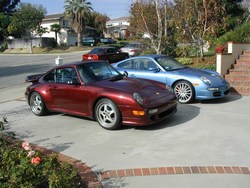
Addict
Rennlist
Lifetime Member
Rennlist
Lifetime Member
Joined: Jul 2001
Posts: 1,157
Likes: 3
From: Miramar Beach, Florida
I added 1 quart at 3000 miles after driving 1100 miles to the Parade. The level was down one mark when we left.
I sort of followed the 4200 rpm recommendation, but did a lot of vigorous acceleration followed by compression braking in the first 500 miles. This technique has worked well for me in many new engines over the years.
I sort of followed the 4200 rpm recommendation, but did a lot of vigorous acceleration followed by compression braking in the first 500 miles. This technique has worked well for me in many new engines over the years.
 , now a little over 4k miles I have yet to add a full quart of 0-40w oil, so far I've put about 2/3s of a quart in.
Rennlist Member
Joined: Nov 2001
Posts: 1,286
Likes: 4
From: CA
Originally Posted by 1999Porsche911
Start driving your car harder. High acceleration and deceleration in gear. Get those rings to fit snuggly against the cylinder walls.
Even if you don't run it to redline, a few extended full throttle pulls in 3rd or 4th will help get the rings seated. The longer you wait, the less effective it'll be as the cylinder walls will lose their abrasive intial finish.
MC

Race Director

Joined: Mar 2006
Posts: 15,362
Likes: 199
From: Tampa
Talked to the service manager at my P-car dealer last Thursday about break in...telling him I am at 1000 miles and this do not go over 4200rpm is impossible. He laughed and said you are actually following the break in period? I said I am trying but it's impossible to get out into traffic on I-75 in Tampa with out going above 4200rpm so I told him I've had it to 5-6K a few times. He said no problem just drive the car and he has many customers that take a new Carrera, Boxster, Cayman straight to the track and never have engine problems. He aslo said oil burning to a certain amount is normal with Carrera engines.