When you click on links to various merchants on this site and make a purchase, this can result in this site earning a commission. Affiliate programs and affiliations include, but are not limited to, the eBay Partner Network.
Ok, I was able to use Durametric to log my 3.8L numbers. I did a few runs and used the correction factor for each run. I got ~282 g/s (corrected), which is very close to the Torque pro value (277 g/s corrected)
Durametric is quite accurate because I got ~6 readings per second (vs once per second for Torque pro).
Ok yes that helps. These are near perfect conditions that need hardly any correction. Near seal level, near 60F has no correction, and 50% humidity only makes about a 2g/s ( 0.010) correction, so we just need to confirm the ID of the Fabspeed which I suspect to be around 3.250in..
my kids decided my measure tape would be fun to play with and now it magicly disapeared. Cant get a perfect measurement. Looks like the factory piece is 3.75 inches. I believe the fabspeed unit to be 3.5.
i emailed fabspeed but it looks like they respond quickly when your gonna buy something but not so much when you have a tech question.
my kids decided my measure tape would be fun to play with and now it magicly disapeared. Cant get a perfect measurement. Looks like the factory piece is 3.75 inches. I believe the fabspeed unit to be 3.5.
i emailed fabspeed but it looks like they respond quickly when your gonna buy something but not so much when you have a tech question.
The factory's air box/maf housing looks big just looking at it, but I just measured it with an inside mic to be sure ( been a while since I had done that) . the ID right at the sensor hole is 3.322..
my kids decided my measure tape would be fun to play with and now it magicly disapeared. Cant get a perfect measurement. Looks like the factory piece is 3.75 inches. I believe the fabspeed unit to be 3.5.
i emailed fabspeed but it looks like they respond quickly when your gonna buy something but not so much when you have a tech question.
Yea, Fabspeed may have some explaining to do if they used a different size ID and are playing games with the DME. I just measured the stock air box/ maf housing , it does look bigger just looking at it, but using an inside mic right at the sensor hole is 3.322in..
I'm usually so into data like this and have been trying to find the time to do some pulls! Fingers crossed i'll get some time this weekend.
@Porschetech3 any interest in my using my PIWIS vs TorquePro to get the values? Or are we trying to keep the data consistent with the same app/similar readers?
Porschetech3 may know this. I've read the factory info about it but still do not quite get it.
In Durametric/PIWIS, there are two values returned. One is called "Mass Air Flow (HFM)" and the other "Mass Air Flow". These valuaes are different (not by alot) most of the time. I believe the former is what is measured by the hot film MAF sensor while the latter is including other flows such as the evap flow. No idea how the extra flows are measured after the MAF sensor. Perhaps derived from actual AFR the O2 sensors see?
The former correlates perfectly with the voltage signal of the MAF (another value reported by Durametric) while the latter does not entirely, especially at lower call flow rate.
I'm usually so into data like this and have been trying to find the time to do some pulls! Fingers crossed i'll get some time this weekend.
@Porschetech3 any interest in my using my PIWIS vs TorquePro to get the values? Or are we trying to keep the data consistent with the same app/similar readers?
If you could do both, that would be great !! Am mainly interested in accuracy, but you are elite in that you have PIWIS, not many people has that. The different bluetooth devices, apps, phones may have problems with sample rate, or spikes, but the data comes from the DME, so the data should be the same, but slow a sample rate will cause it miss the max maf, and a spike will, well be a spike. You can recognize a spike by running a log, the spike will be out of place, slow sample rate can be countered by doing pulls in 3rd gear so that max maf will be available for a longer period of time.
I try to stay with g/s and F because that's what posted by the OP. Also those are the default units used by the Torque pro app.
Durametric uses kg/hr and C by default.
g/s and kg/hr are both metric. Fahrenheit and inches aren't. I can understand using Fahrenheit since most of you Mericans have no idea how to relate to Celsius, just as the rest of the planet doesn't know how to relate to Farenheit but, why use inches when all those parts were made to metric dimensions? Most Americans know how to relate to millimeters because they were forced by the auto industry so just use it.
Porschetech3 may know this. I've read the factory info about it but still do not quite get it.
In Durametric/PIWIS, there are two values returned. One is called "Mass Air Flow (HFM)" and the other "Mass Air Flow". These valuaes are different (not by alot) most of the time. I believe the former is what is measured by the hot film MAF sensor while the latter is including other flows such as the evap flow. No idea how the extra flows are measured after the MAF sensor. Perhaps derived from actual AFR the O2 sensors see?
The former correlates perfectly with the voltage signal of the MAF (another value reported by Durametric) while the latter does not entirely, especially at lower call flow rate.
Does anyone have more info?
The Mass Air Flow (HFM) is the actual value from the MAF sensor.(HFM= Hot Film Module)
The Mass Air Flow other value is the default map in the DME, the DME uses this map if the MAF is unplugged or has a total failure, it also uses this map to check on the MAF performance. If the MAF sensor value gets to far from the default map, it sets a code.
The air from the evap system is not measured, but is predicted and adjusted for when the purge valve is active.
The air from the AOS has already been measured, and the blowby is recycled.
The Mass Air Flow (HFM) is the actual value from the MAF sensor.(HFM= Hot Film Module)
The Mass Air Flow other value is the default map in the DME, the DME uses this map if the MAF is unplugged or has a total failure, it also uses this map to check on the MAF performance. If the MAF sensor value gets to far from the default map, it sets a code.
The air from the evap system is not measured, but is predicted and adjusted for when the purge valve is active.
The air from the AOS has already been measured, and the blowby is recycled.
Thanks. That makes sense. The value I reported was the HFM so that's the correct one for this thread then.
So one can plot this measured vs spec'ed values and check if the MAF is healthy (i.e. expect a 45 degree straight line in the ideal case).
g/s and kg/hr are both metric. Fahrenheit and inches aren't. I can understand using Fahrenheit since most of you Mericans have no idea how to relate to Celsius, just as the rest of the planet doesn't know how to relate to Farenheit but, why use inches when all those parts were made to metric dimensions? Most Americans know how to relate to millimeters because they were forced by the auto industry so just use it.
You're asking a much bigger question than this thread
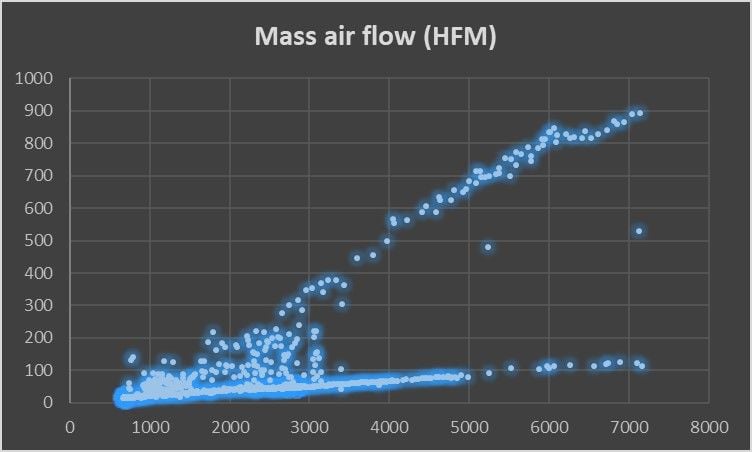
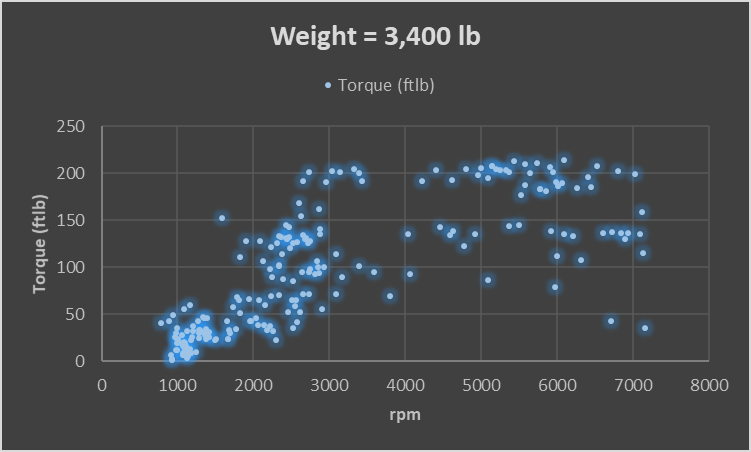
Cool plots from Durametric log (generated by Excel)
Just want to share some cool Excel plots you can do from Durametric log for my 3.8. This one is the measured air flow (kg/hr) vs rpm plot.
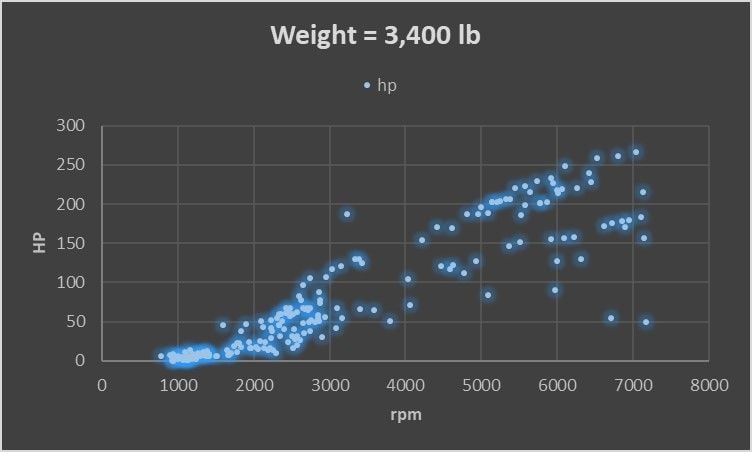
From the vehicle speed measurements (6 samples per second), assume a weight of the car you can compute the rwhp and torque (measurements were done on almost flat roads).
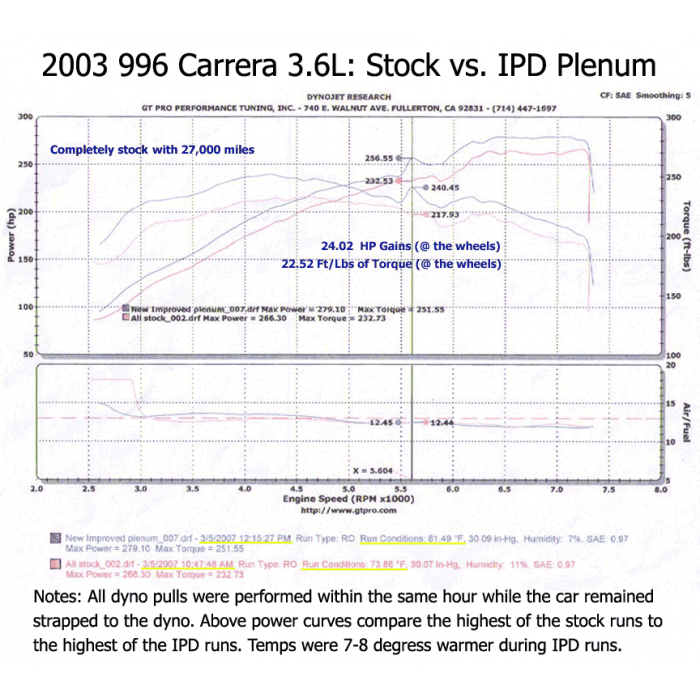
If you look at the upper envelope traced out by the dots, you'll see that these are pretty close to the IPD plenum dyno plot.
g/s and kg/hr are both metric. Fahrenheit and inches aren't. I can understand using Fahrenheit since most of you Mericans have no idea how to relate to Celsius, just as the rest of the planet doesn't know how to relate to Farenheit but, why use inches when all those parts were made to metric dimensions? Most Americans know how to relate to millimeters because they were forced by the auto industry so just use it.
Because I'm "old school" and all my precision Micrometers are USA made! Precision doesn't care whether you use English or metric units, just how well you use them..
Theon Goes Full Carbon Fiber With Stunning New Build
Slideshow: Built around a carbon-bodied 964 and a naturally aspirated 4.0-liter flat-six, this bespoke commission highlights how far the restomod formula has evolved.
Tuner Is Converting Porsche 911s Into Shooting Brakes
Slideshow: A Polish Porsche specialist is moving ahead with one of the most unusual 911 conversions in recent memory: a shooting brake version of the 991-generation sports car.
This Coachbuilt Creation Is A Modern Take on the Legendary Porsche 917
Slideshow: A Porsche Carrera GT has been transformed into a one-off coachbuilt machine that blends analog supercar engineering with styling inspired by the legendary 917 race cars.
Is This Convertible Cayenne A Steal, Or A Returnless Investment?
Slideshow: A heavily modified Porsche Cayenne convertible with faux wood trim and a long list of flaws recently sold at auction for surprisingly little money.
Porsche's Top 5 Most Questionable Naming Decisions
Slideshow: For a company obsessed with engineering precision, Porsche has occasionally named its cars in ways that left even loyal enthusiasts scratching their heads.
Pogea Racing's 964 Porsche 911 Reimagination Stands Out in a Crowded Field
Slideshow: Pogea Racing's latest Porsche 964 project blends carbon-fiber construction, modern chassis upgrades, and up to 500 horsepower while keeping the air-cooled 911 experience firmly analog.