When you click on links to various merchants on this site and make a purchase, this can result in this site earning a commission. Affiliate programs and affiliations include, but are not limited to, the eBay Partner Network.
I have some questions about the Cayenne e-hybrid charging process:
1. Is it ok to leave it plugged in during the whole night?
2. On PCM when I click on battery I can see some options for scheduled charging, does anyone know how it works? I looked for videos on youtube and didn't find anything about it...
I have some questions about the Cayenne e-hybrid charging process:
1. Is it ok to leave it plugged in during the whole night?
2. On PCM when I click on battery I can see some options for scheduled charging, does anyone know how it works? I looked for videos on youtube and didn't find anything about it...
Thank you.
In my experience the onboard scheduling is completely unreliable. Don’t use it unless you don’t mind waking up to an empty battery.
You’ll be better off with a third party charger. My Autel charger works well.
I have some questions about the Cayenne e-hybrid charging process:
1. Is it ok to leave it plugged in during the whole night?
2. On PCM when I click on battery I can see some options for scheduled charging, does anyone know how it works? I looked for videos on youtube and didn't find anything about it...
Thank you.
I left ours connected overnight, it stopped itself when full and the controller stayed on standby. The scheduling is used for charging at certain time frame when electricity rate is cheaper.
I have used the timer function for years in my 2016 and now my 2019. You can set the departure timer schedule up either in the Cayenne using the PCM or use your phone and the "My Porsche" app. Either way is pretty simple - I have the work week set for one depature tme and a later time on weekends. Using the My Porsche app allows you to set cabin temperature as well so when you come out the cabin is at temp and everything is preconditioned, which is supposed to be better for the battery pack. In order to use the Ay Posrche app you have to have a Porsche Connect account. Cayejne eHyrids used to come with five years of service - so if you bought new you should be good. Used purchases will have the remainder of the subscription. After that you can pony up some money to continue service. It's a great feature IMHO, getting in the Cayenne and it's nice and comfotable and the battery is fully charged. And no, leaving your Cayenne pluggged in will not cause any issues if charging at home. On the road at a publvc charger leaving your PHEV plugged after charging is completed is considered bad form.
everything is preconditioned, which is supposed to be better for the battery pack.
Minimizing the time that the battery is fully charged is said to be better for the battery. Hence the reason to delay charging until your departure. However, using onboard Porsche support, I came outside to an empty battery multiple times and gave up on it. It appears to work for some so I’d give it a try.
When I go to the timer/schedule options screen, I see 3 timers there, and there's a square where I can select which one is active, but for some reason the PCM let me check all three of them together and I find it a little bit confusing... I mean if I check all three of them which one will be active?
Is there a way to delete those timers/schedules and leave only one? I couldn't find any option to delete the unused timers/schedule...
I found some videos on Youtube, but only about the Taycan... and the options offered on the Taycan are much richer...
Is there a way to delete those timers/schedules and leave only one? I couldn't find any option to delete the unused timers/schedule…
Try this — Tap the schedule you wish to delete and swipe right to left. It will delete it.
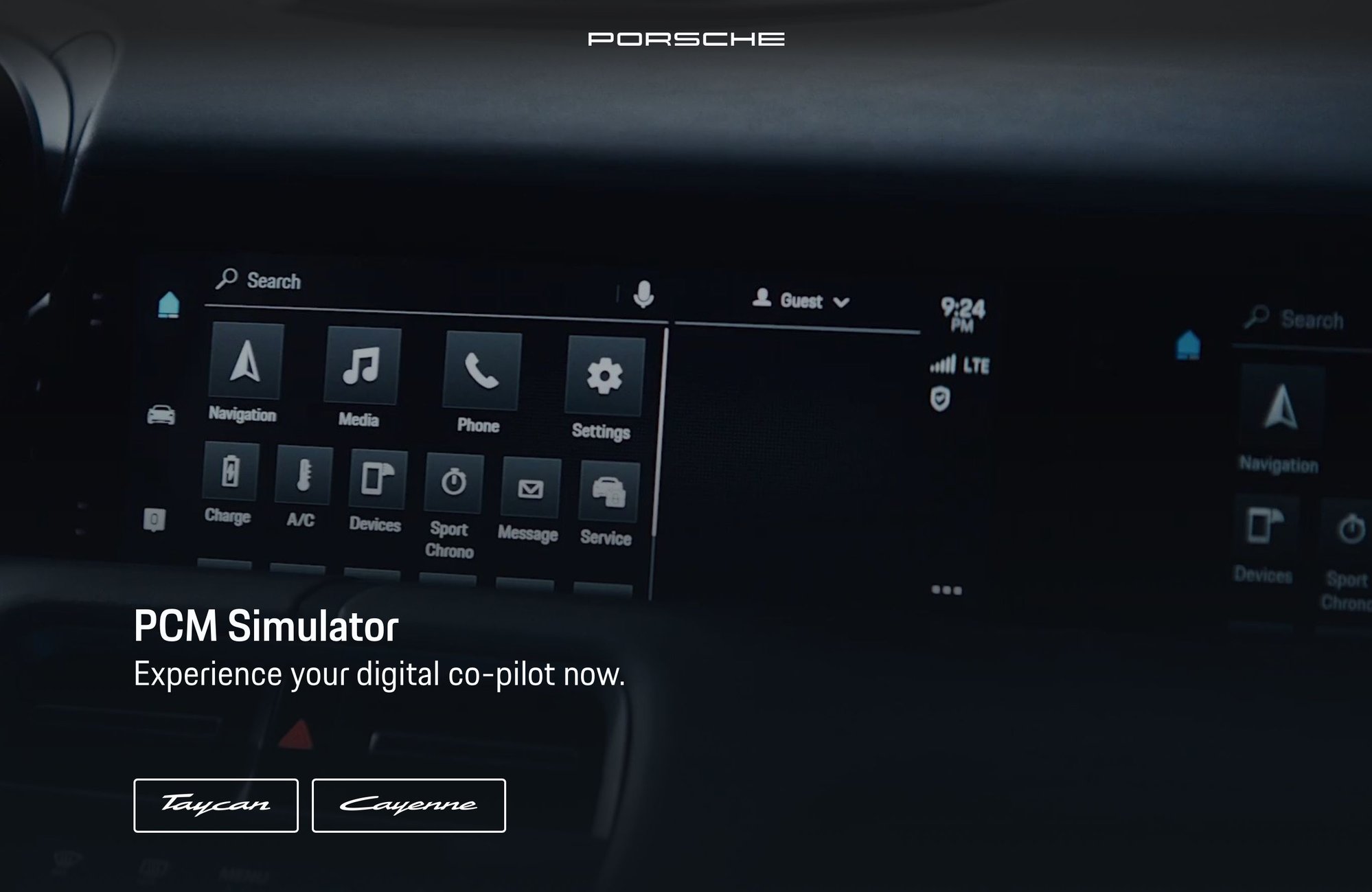
A good resource is the online PCM simulator. You can choose between Taycan and Cayenne. It is skewed towards the European market and features such as Sirius XM are not available. Otherwise, a great tool for poking around all the screens and learning the system.
Try this — Tap the schedule you wish to delete and swipe right to left. It will delete it.
A good resource is the online PCM simulator. You can choose between Taycan and Cayenne. It is skewed towards the European market and features such as Sirius XM are not available. Otherwise, a great tool for poking around all the screens and learning the system.
Thank you for the tip! I tried on my car, and unfortunately it's a little bit different, doesn't let me swipe and delete... and it also doesn't let me add more timers, I can see only three and that's it... Maybe there's some localized limitation in my county...
Tried rebooting the PCM (2 fingers on right upper corner) and still no success...
I can't remember where the departure time settings live in the 2019. In my 2016 I acccesed using sterring wheel controls in it was in the right jhand "gauge". I rememnber doing it on the 2019 before I got the Porsche Connect app running corectly/ I bought the 2019 used and all ready had my 2016 in the app so there were some initial set-up.
I have some questions about the Cayenne e-hybrid charging process:
1. Is it ok to leave it plugged in during the whole night?
2. On PCM when I click on battery I can see some options for scheduled charging, does anyone know how it works? I looked for videos on youtube and didn't find anything about it...
Thank you.
yes it's ok to leave _ANY_ EV plugged in - just because you're plugged does not mean power is flowing - in fact the flow of power is 100% controlled by the vehilce - not the EV charger (EVSE) - EVSE's are actually just fancy extension cords with a "relay" - power is not flowing if they are not plugged in (safety) - and when plugged in the car controls the flow of power…so the term "charger" is a common misnomer - EVSE stands for Electric Vehicle Supply Equipment - they do not charge the car - the AC/DC charger is inside the vehicle and it controls everything about charging the battery - the EVSE is just a raw power flow switch on/off
if you're looking for a metaphore - it's a water on/off valve _NOT_ a water "filter" - the EVSE just pass-through what ever raw AC power is coming from the grid to the vehicle's on board AC/DC converter, which then controls charging the battery - the EVSE is a simple dumb external off/off switch.
Porsche's charge schedule for eHybrid is terrible and simplistic - basically you tell it you want to leave @ 6 am - and it figures out when it needs to start charging the battery to "meet" the 6 am target departure time…it's twisted logic and I hate it…
mostly I simply plug the car in - and press the "schedule" button on the charge port (red light "off") and that will just start charging the car immediately…
if you want a deeper primer on EV charging in general these posts have been well recieved - while they talk mostly about hte Taycan - the core applies to _ALL_ EV's and EVSE's (including hybrids)
Thank you for the tip! I tried on my car, and unfortunately it's a little bit different, doesn't let me swipe and delete... and it also doesn't let me add more timers, I can see only three and that's it... Maybe there's some localized limitation in my county...
Tried rebooting the PCM (2 fingers on right upper corner) and still no success...
I am in europe and I have installed a 32A 3 phase supply for my 2024 cayenne e-hybrid. The cable that came with the cayenne is 16A so the dealer will exchange it to 32A since the connector is bit different.
Three questions:
1) With 32A in europe will the car charge faster? Dealer says so but from what I am reading here it will not - then again it might be different in Europe.
2) Does it make sense to look for a better cable/charger than the porsche one? I am quite technical so if I can gain something on this - even just better software monitoring - I would like to try.
3) Anybody knows who is the OEM for the porsche charger and cable for the cayenne e-hybrid? We are trying to do a zero carbon building at work and connecting to the car chargers is important - usually this is done by modbus or using the API by IP.
Last edited by silversurfer6; Oct 20, 2023 at 01:49 PM.
I am in europe and I have installed a 32A 3 phase supply for my 2024 cayenne e-hybrid. The cable that came with the cayenne is 16A so the dealer will exchange it to 32A since the connector is bit different.
Three questions:
1) With 32A in europe will the car charge faster? Dealer says so but from what I am reading here it will not - then again it might be different in Europe.
2) Does it make sense to look for a better cable/charger than the porsche one? I am quite technical so if I can gain something on this - even just better software monitoring - I would like to try.
3) Anybody knows who is the OEM for the porsche charger and cable for the cayenne e-hybrid? We are trying to do a zero carbon building at work and connecting to the car chargers is important - usually this is done by modbus or using the API by IP.
Old generation Cayennes can have either 3.2kW or 7.4kW (optional equipment) onboard charger. They only support two phases out of three phases. In a three phase setup, each phase can carry 7.2kW of power. Full utilisation of these three phases would hence charge the car at the rate of 22kW. However, I haven't seen any hybrid taking that much of power to charge. Even most of the EVs would accept only 11kW on a three-phase setup, so do new generation Cayennes. Nowadays, Taycans can be optionally equipped with 22kW onboard chargers to accept higher powered AC.
Maximum charge rate of the DCs does not apply to the AC. An EV can easily take 150kW on a DC charger, but hardly would accept above 11kW if it's not equipped with an advanced onboard charger. This is fully off-topic for a hybrid though, since they won't accept DC power either.
The standard UK wall plug would carry maximum current of 13A. That would charge the car practically around ~2kW.
The industrial 3-pin (monophase) blue coloured small socket could carry maximum current of 16A. That would charge around ~3.2kW. This is mostly the highest rate of charge for most of the E-Hybrid owners out there, if no optional onboard charger was equipped.
The industrial 3-pin (monophase) blue coloured large socket could carry maximum current of 32A. That would charge around ~7.2kW. Turbo S E-Hybrids in the UK are specced with 7.2kW onboard charger, they can benefit from this sort of high-speed charging.
The industrial 5-pin (three-phase) red coloured large socket could carry maximum current of 32A. That would charge around ~22kW, however Porsche chargers support up to 7.2kW, plugging in this cable would basically make it run as it is on a monophase 3-pin 32A outlet (7.2kW). New generation Cayennes apparently have 11kW for charging, as @daveo4porsche pointed out, which can utilise at least half of the available power.
Plugged in an AC charger you can find in the streets, or shops? It is mostly 22kW. However, your car would only charge with rate around ~3.2kW with entry-level onboard charger. Lucky, if you have the more advanced one, you'll only go up to 7.2kW.
In practice? We have an Audi e-tron, it has 75kWh battery pack. It supports 11kW AC (Type 2) and 150kW DC (CCS). Most of the UK homes don't have three-phase supply, unlike European installations. Hence, our wallpod only charges with 7.2kW. If we had three-phase supply, it would be 11kW, since it's maxed by the onboard charger. Have I missed that at any time, no, I haven't really.
Note that 22kW onboard chargers equipped to the cars are more problematic. Even Porsche themselves call their customers to limit the charging to below the maximum charging power to preserve the longevity of the onboard charger.
The onboard charger is integrated to your vehicle. Sometimes it's possible to retrofit. EVSEs don't have any charger integrated, they're there for mostly security purposes (or sometimes payment gates).
The batteries in these vehicles are charged by using direct current (DC). I don't remember from the school days if it's possible to charge a battery with alternative current (AC). You have to use an "rectifier" to convert AC to DC, which is done by the onboard charger. It's not an easy thing to do, you'll see these huge boxes looking like an American fridge in the charging stations (mostly sourced by ABB in the UK) to contain the required power-electronics. They're expensive and you can easily hit 200k£ mark for a simple 150kW DC charger. That's a huge WOW for a simple device to top up your miles, esp. compared to a petrol station.
We're always talking about 'up to's here, as you can see. This is because, you can hardly see an e-tron charging at 150kW rate, although it's the theoretical limit, at least persistently. It would be like, it's too hot, it's too cold, it's too humid, it'll basically throw any sort of excuse to charge it in a lower rate of power. It's too much 'up to's most of the time, making me sick about EVs.
Charging durations? 3.2kW charging rate, a battery with a practical capacity of 13.4kWh would charge in ~4 hours. Simple division, definitely not a rocket science. I'd assume that charging rate around ~2.8kW though, that what it's mostly in the practice.
Caveats
You can replace Cayennes with Panameras in this small article and you'd be still fine, though, Panamera TSEs don't come with an 7.2kW onboard charger in the UK as standard.
European supply is mostly 220V. British supply is 240V. Hence they call the European standard as 220-240V, or simply 230V. Three-phase mean voltages should be around 380-420V.
US supply is 110V, as far as I know. Double the amperages to get the US values, such as 13A -> 26A. I might be wrong.I was wrong. No experience with three-phase in Americas.
Take what I said as a grain of salt. I'm no means an expert on electricity. This is what I came up with over the years, entirely based on entry-level electronics courses in the college and my personal experience.
Last edited by i386_64; Oct 23, 2023 at 01:13 AM.
Reason: caveats, new generation cayennes
Cayennes can have either 3.2kW or 7.4kW (optional equipment) onboard charger. They only support two phases out of three phases. In a three phase setup, each phase can carry 7.2kW of power. Full utilisation of these three phases would hence charge the car at the rate of 22kW. However, I haven't seen any hybrid taking that much of power to charge. Even most of the EVs would accept only 11kW on a three-phase setup. Nowadays, Taycans can be optionally equipped with 22kW onboard chargers to accept higher powered AC.
Maximum charge rate of the DCs does not apply to the AC. An EV can easily take 150kW on a DC charger, but hardly would accept above 11kW if it's not equipped with an advanced onboard charger. This is fully off-topic for a hybrid though, since they won't accept DC power either.
The standard UK wall plug would carry maximum current of 13A. That would charge the car practically around ~2kW.
The industrial 3-pin (monophase) blue coloured small socket could carry maximum current of 16A. That would charge around ~3.2kW. This is mostly the highest rate of charge for most of the E-Hybrid owners out there, if no optional onboard charger was equipped.
The industrial 3-pin (monophase) blue coloured large socket could carry maximum current of 32A. That would charge around ~7.2kW. Turbo S E-Hybrids in the UK are specced with 7.2kW onboard charger, they can benefit from this sort of high-speed charging.
The industrial 5-pin (three-phase) red coloured large socket could carry maximum current of 32A. That would charge around ~22kW, however Porsche chargers support up to 7.2kW, plugging in this cable would basically make it run as it is on a monophase 3-pin 32A outlet (7.2kW).
Plugged in an AC charger you can find in the streets, or shops? It is mostly 22kW. However, your car would only charge with rate around ~3.2kW with entry-level onboard charger. Lucky, if you have the more advanced one, you'll only go up to 7.2kW.
In practice? We have an Audi e-tron, it has 75kWh battery pack. It supports 11kW AC (Type 2) and 150kW DC (CCS). Most of the UK homes don't have three-phase supply, unlike European installations. Hence, our wallpod only charges with 7.2kW. If we had three-phase supply, it would be 11kW, since it's maxed by the onboard charger. Have I missed that at any time, no, I haven't really.
Note that 22kW onboard chargers equipped to the cars are more problematic. Even Porsche themselves call their customers to limit the charging to below the maximum charging power to preserve the longevity of the onboard charger.
The onboard charger is integrated to your vehicle. Sometimes it's possible to retrofit. EVSEs don't have any charger integrated, they're there for mostly security purposes (or sometimes payment gates).
The batteries in these vehicles are charged by using direct current (DC). I don't remember from the school days if it's possible to charge a battery with alternative current (AC). You have to use an "rectifier" to convert AC to DC, which is done by the onboard charger. It's not an easy thing to do, you'll see these huge boxes looking like an American fridge in the charging stations (mostly sourced by ABB in the UK) to contain the required power-electronics. They're expensive and you can easily hit 200k£ mark for a simple 150kW DC charger. That's a huge WOW for a simple device to top up your miles, esp. compared to a petrol station.
We're always talking about 'up to's here, as you can see. This is because, you can hardly see an e-tron charging at 150kW rate, although it's the theoretical limit, at least persistently. It would be like, it's too hot, it's too cold, it's too humid, it'll basically throw any sort of excuse to charge it in a lower rate of power. It's too much 'up to's most of the time, making me sick about EVs.
Charging durations? 3.2kW charging rate, a battery with a practical capacity of 13.4kWh would charge in ~4 hours. Simple division, definitely not a rocket science. I'd assume that charging rate around ~2.8kW though, that what it's mostly in the practice.
Caveats
You can replace Cayennes with Panameras in this small article and you'd be still fine, though, Panamera TSEs don't come with an 7.2kW onboard charger in the UK as standard.
European supply is mostly 220V. British supply is 240V. Hence they call the European standard as 220-240V, or simply 230V. Three-phase mean voltages should be around 380-420V.
US supply is 110V, as far as I know. Double the amperages to get the US values, such as 13A -> 26A. I might be wrong. No experience with three-phase in Americas.
Take what I said as a grain of salt. I'm no means an expert on electricity. This is what I came up with over the years, entirely based on entry-level electronics courses in the college and my personal experience.
2024 Cayenne eHybrid's have a 11 kW onboard charger (models prior to 2024 had either 3.6 or 7.2 kW depending on options)
US supplies are either L1 of L2 - (L1 = 120V - L2 is 240 Volts)
North American mobile EV chargers (EVSE's) are limited to 50/40 amps (50 amp circuit breaker and 40 amp charge rate) 9.6 kW
11 kW charge rate (the max for the 2024 Cayenne eHybrid requires a hardwired (non-mobile) EVSE with a 60 amp breaker (48 amp charge rate).
North American L1 EVSE's are typically limited to 15 amp breakers and 12 amp chrage rate or 1.44 kW
you can purchase a range of L2 EVSE's from 16 amps (12 amp charge rate) to 100 amps (80 amp charge rate)
the included EVSE with the Cayenne from Porsche is a mobile EVSE and therefore limited to 9.6 kW charge rate with a NEMA 14-50/6-50 240V outlet
to achieve the maximum 11 kW charge rate requires either the Porsche Wall Charger or any other hardwired EVSE with a 60 amp circuit breaker.
Last edited by daveo4porsche; Oct 23, 2023 at 01:10 AM.
2024 Cayenne eHybrid's have a 11 kW onboard charger (models prior to 2024 had either 3.6 or 7.2 kW depending on options)
US supplies are either L1 of L2 - (L1 = 120V - L2 is 240 Volts)
North American mobile EV chargers (EVSE's) are limited to 50/40 amps (50 amp circuit breaker and 40 amp charge rate) 9.6 kW
11 kW charge rate (the max for the 2024 Cayenne eHybrid requires a hardwired (non-mobile) EVSE with a 60 amp breaker (48 amp charge rate).
North American L1 EVSE's are typically limited to 15 amp breakers and 12 amp chrage rate or 1.44 kW
you can purchase a range of L2 EVSE's from 16 amps (12 amp charge rate) to 100 amps (80 amp charge rate)
the included EVSE with the Cayenne from Porsche is a mobile EVSE and therefore limited to 9.6 kW charge rate with a NEMA 14-50/6-50 240V outlet
to achieve the maximum 11 kW charge rate requires either the Porsche Wall Charger or any other hardwired EVSE with a 60 amp circuit breaker.
I've included a screen shot of the US Cayenne eHybrid standard equipment eMobility seciton from the Prosche website (date/time with in a few min. of this posting)
Cayenne is listed as having an 11 kW on board charger - this is fed by a 40 amp (NEMA 6-50) Porsche Mobile Charger+ with a max charge rate of 9.6 kW - to achieve the 11 kW maximum (same as all Taycan produced to date) would require a Porsche Wall Charger or alternative fixed-wallmounted-hardwired North American EVSE with a 60 amp 240V circuit.
Picture is from the Porsche USA website.
NOTE; porsche mistaken listes the PMC+/PMCC as being 11 kW EVSE's and yet also refers to their power supply cables as 50/40 amp supply cables - both facts can not be true - the PMC+/PMCC are in fact 9.6 kW EVSE's (labels on the back of the PMC+/PMCC prperly document the 40 amp 9.6 kW limit) - but PCNA-marketing has always had trouble in this area - they can't seem to wrap their heads around two separate (but related) maximum capacities - there is the maximum capacity of the vehicle's onboard charger (AC/DC converter) and and separately the maximum capacity of the included L2 240V EVSE with the vehicle. For years they have listed the Taycan's maximum charge rate as 9.6 kW (which is 100% wrong) but matches the maximum capacity of the included north american mobile EVSE. They seem to have fixed that recently and now properly list the Taycan standard onboard charger as being 11 kW - but now also mistakenly document that the included PMC+ (optional PMCC) are also 11 kW EVSE's - which is both wrong and impossible given they are limited to 9.6 kW by the fact that they are mobile EVSE's limited to 50 amp NEMA plug sockets (40 amp maximum charge rate)…I have provided a detailed write up for PCNA and offerred to review their technical documentation - but they simply can not seem to wrap their heads around the vehicle's maximum charge limit as being different than their included standard Mobile EVSE's charge limit - and they always get it wrong and conflate the two values - never understanding they are in fact different and it's necessary for them to be different given electrical code limitations in North America.
Last edited by daveo4porsche; Oct 23, 2023 at 01:52 AM.
Theon Goes Full Carbon Fiber With Stunning New Build
Slideshow: Built around a carbon-bodied 964 and a naturally aspirated 4.0-liter flat-six, this bespoke commission highlights how far the restomod formula has evolved.
Tuner Is Converting Porsche 911s Into Shooting Brakes
Slideshow: A Polish Porsche specialist is moving ahead with one of the most unusual 911 conversions in recent memory: a shooting brake version of the 991-generation sports car.
This Coachbuilt Creation Is A Modern Take on the Legendary Porsche 917
Slideshow: A Porsche Carrera GT has been transformed into a one-off coachbuilt machine that blends analog supercar engineering with styling inspired by the legendary 917 race cars.
Is This Convertible Cayenne A Steal, Or A Returnless Investment?
Slideshow: A heavily modified Porsche Cayenne convertible with faux wood trim and a long list of flaws recently sold at auction for surprisingly little money.
Porsche's Top 5 Most Questionable Naming Decisions
Slideshow: For a company obsessed with engineering precision, Porsche has occasionally named its cars in ways that left even loyal enthusiasts scratching their heads.
Pogea Racing's 964 Porsche 911 Reimagination Stands Out in a Crowded Field
Slideshow: Pogea Racing's latest Porsche 964 project blends carbon-fiber construction, modern chassis upgrades, and up to 500 horsepower while keeping the air-cooled 911 experience firmly analog.




 Cayenne e-hybrid charging schedule