






928 Block Thoughts

Rennlist Member

Joined: Dec 2001
Posts: 25,186
Likes: 105

Originally Posted by SwayBar
Brendan, can you please knock-off the politically correctness (..PC) CRAP? If you want PC, go move to Europe where the continent is a literal train-wreck as a result of way too much PC. But in the meantime, please keep it off of this board!
This is one of the most interesting threads on this forum in a LONG time, with LOTS of good information being shared which we wouldn't have otherwise.
This is one of the most interesting threads on this forum in a LONG time, with LOTS of good information being shared which we wouldn't have otherwise.
Secondly, I personally know and have great respect for the guy making YOUR engine, and the people surrounding him. There was nothing PC or otherwise about my post. There is nothing un-PC about making engineering assumptions based on info from 20 years ago - its just simply not a good idea.
And as Greg has stated, my shadenfruede comment was early - we won't even know what hit us when Greg turns his shadenfruede up to 11. I'll b e looking for your comments when that happens.
Its the internet people - nobody should be getting offended or even talking like there IS such a thing as PC. I sure as hell wasn't. This is a crotch-grabbing, spitting on the ground locker room with a bunch of guys throwing BS around, with small amount of diamond-like technical info to be sifted out.
Addict
Rennlist Member
Rennlist Member
Joined: Jun 2002
Posts: 3,322
Likes: 32
Well Greg, there is much good info provided, some pics would also be appreciated. I am aware of one destroyed engine, that being the first Kelly Moss engine, it had steel sleeves from recollection and then the 2nd version was modified to use Nicasil. It used a fully counterweighted crank of a 3.75" stroke.
I raised an issue on this board about piston speed in the strokers years ago. My concern was the rod to stroke ratio and resultant peak piston speed. This piston speed at about 7000 rpm was exceeding an F1 engine at the time, it may still do I haven't looked at it recently. This aspect must place enormous strains on things like the conrods their bolts and the resultant mass forces that are being transferred through the crank to block to keep this all together.
Through my studies of what I saw and read, (particurlary good info in Race Engine Technology magazine) The Nascar guys and of course the F1 guys were all trying to lighten everything up and make things more slippery and improve certain angles in the engine.
If there is some engineers on this board they could do some quite detailed calcs for us, I have done some basic ones and then tried to be as conservative as possible in many areas to make things last. So what has been done, Honda journeled crank, these journals should be around 30% lighter than the 2.1" that is currently employed. The rods that attach to those journals are stronger than the 2.1" rods as they are smaller in diameter at 1.888" and as such more stable, they also have less friction, as I mentioned before 7 hp more at 7000 rpm.
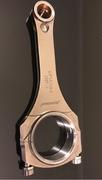
The rods themselves weigh in a 542 grams, bolts are basically bullet proof and the pistons are also light at around 400 grams excluding the pin which is slightly smaller than the original. All up the piston and rods are 500 grams lighter than stock and about 250 grams lighter than most stroker bits. This of course is not counting the lighter big end crank pin and the lighter the crank can be made because of this significant weight saving.
The other aspect is the rod to stroke in my case around 1.75 to 1 and the stock ratio was 1.90 to 1 so I am slightly worse off here but nothing like 1.56 to 1. This should reduce skirt loadings too and will allow my 2 valve heads to breath better due to a more even piston acceleration, this aspect may prove to be significant. It may be significant in 2 ways, the one I have just outlined and two, if the stroker design is to change in the future due to this cracking problem of high output strokers, you can achieve the same if not more air pumped by fixing the issues I have outlined and revving the engine more.
This will make more power garenteed until you get to about 7500 to 8000 rpm as frictional issues may come into play, (however you will have addressed a lot of this along the way) cam timing is a given that it will need altering.
My bet is that my engine revving to 7500 rpm has less stresses in it than a stock one does at 6500. I also went conservative with the piston size in using 4.060" this just removes 1.5 mm from the walls and as long as the block is properly selected should be fine. I hope.
Cheers Greg
I raised an issue on this board about piston speed in the strokers years ago. My concern was the rod to stroke ratio and resultant peak piston speed. This piston speed at about 7000 rpm was exceeding an F1 engine at the time, it may still do I haven't looked at it recently. This aspect must place enormous strains on things like the conrods their bolts and the resultant mass forces that are being transferred through the crank to block to keep this all together.
Through my studies of what I saw and read, (particurlary good info in Race Engine Technology magazine) The Nascar guys and of course the F1 guys were all trying to lighten everything up and make things more slippery and improve certain angles in the engine.
If there is some engineers on this board they could do some quite detailed calcs for us, I have done some basic ones and then tried to be as conservative as possible in many areas to make things last. So what has been done, Honda journeled crank, these journals should be around 30% lighter than the 2.1" that is currently employed. The rods that attach to those journals are stronger than the 2.1" rods as they are smaller in diameter at 1.888" and as such more stable, they also have less friction, as I mentioned before 7 hp more at 7000 rpm.
The rods themselves weigh in a 542 grams, bolts are basically bullet proof and the pistons are also light at around 400 grams excluding the pin which is slightly smaller than the original. All up the piston and rods are 500 grams lighter than stock and about 250 grams lighter than most stroker bits. This of course is not counting the lighter big end crank pin and the lighter the crank can be made because of this significant weight saving.
The other aspect is the rod to stroke in my case around 1.75 to 1 and the stock ratio was 1.90 to 1 so I am slightly worse off here but nothing like 1.56 to 1. This should reduce skirt loadings too and will allow my 2 valve heads to breath better due to a more even piston acceleration, this aspect may prove to be significant. It may be significant in 2 ways, the one I have just outlined and two, if the stroker design is to change in the future due to this cracking problem of high output strokers, you can achieve the same if not more air pumped by fixing the issues I have outlined and revving the engine more.
This will make more power garenteed until you get to about 7500 to 8000 rpm as frictional issues may come into play, (however you will have addressed a lot of this along the way) cam timing is a given that it will need altering.
My bet is that my engine revving to 7500 rpm has less stresses in it than a stock one does at 6500. I also went conservative with the piston size in using 4.060" this just removes 1.5 mm from the walls and as long as the block is properly selected should be fine. I hope.
Cheers Greg

Thread Starter
Former Vendor
Joined: Feb 2005
Posts: 15,228
Likes: 2,530
From: Anaheim
I'll try and get some pictures and upload them. There are a few problems with that. I'm not sure the cracks will show up and I'm not sure how to get pictures onto this site. May need some help/clues. How much resolution should I use? How do I get pictures from me to here? Sorry for being so dumb about this.
I agree that the lighter the bottom end components are, the easier this will be on the block. This is one reason I prefer the 6 counterweighted crankshafts. We are using a very light, custom rod in our latest engines. This significantly reduces the amount of Mallory needed to balance the crank, also.
As far as detonation is concerned, we have that pretty much under control. One of the nice things about using the stock fuel injection system is that the knock sensors still work and we can monitor the quanity of knocks. We know how many knocks it takes before the engine starts "pounding" out the rod bearings....which is the first thing that happens, especially when using Porsche rod bearings, as Mark A. has been doing for years. These babies are soft and fragile! They loose their crush and start to self destruct very easily. The Chevy sized Clevite "H" series bearing is a very hard bearing with relative high eccentricity. They don't "pound out" nearly as easily as the Porsche bearing, but probably need to be used selectively.
Any significant detonation will also show up on the head gasket immediately. Certainly we've seen that before and know what it does and look like. You don't need to work on very many 944s with hairdriers on them before you see that raise its ugly head.
I do like some of the aftermarket fuel injection systems, but most people write off an engine or two before they get it adjusted properly. This is really true whenever a hairdrier is used. Probably true for a belt driven puffer also. I would be a whole hell of a lot happier if one of the aftermarket guys would employ the knock sensors.
Don't forget the help.
gb
I agree that the lighter the bottom end components are, the easier this will be on the block. This is one reason I prefer the 6 counterweighted crankshafts. We are using a very light, custom rod in our latest engines. This significantly reduces the amount of Mallory needed to balance the crank, also.
As far as detonation is concerned, we have that pretty much under control. One of the nice things about using the stock fuel injection system is that the knock sensors still work and we can monitor the quanity of knocks. We know how many knocks it takes before the engine starts "pounding" out the rod bearings....which is the first thing that happens, especially when using Porsche rod bearings, as Mark A. has been doing for years. These babies are soft and fragile! They loose their crush and start to self destruct very easily. The Chevy sized Clevite "H" series bearing is a very hard bearing with relative high eccentricity. They don't "pound out" nearly as easily as the Porsche bearing, but probably need to be used selectively.
Any significant detonation will also show up on the head gasket immediately. Certainly we've seen that before and know what it does and look like. You don't need to work on very many 944s with hairdriers on them before you see that raise its ugly head.
I do like some of the aftermarket fuel injection systems, but most people write off an engine or two before they get it adjusted properly. This is really true whenever a hairdrier is used. Probably true for a belt driven puffer also. I would be a whole hell of a lot happier if one of the aftermarket guys would employ the knock sensors.
Don't forget the help.
gb
Three Wheelin'
Joined: Aug 2006
Posts: 1,765
Likes: 3
From: Atlanta
For pics:
There's a "manage attatchements" box below where you type in replies that allows you to choose pics on your computer to upload with your post, there is a file size limit (about 64k?), you'll find out the exact limit by the message when you try a big file. Some XP versions can resize pics viewed in Windows Explorer, using MS paint to 'stretch and skew' is another way of making pics smaller, then there are picasa and whatever software that comes with a camera should allow easy resizing and maybe trimming too.
If you'll email the full res pics to me at msimard"at"simardtool.com I'll be glad to trim, resize them and post 'em, I wouldn't mind seeing the full size pics anyway.
There's a "manage attatchements" box below where you type in replies that allows you to choose pics on your computer to upload with your post, there is a file size limit (about 64k?), you'll find out the exact limit by the message when you try a big file. Some XP versions can resize pics viewed in Windows Explorer, using MS paint to 'stretch and skew' is another way of making pics smaller, then there are picasa and whatever software that comes with a camera should allow easy resizing and maybe trimming too.
If you'll email the full res pics to me at msimard"at"simardtool.com I'll be glad to trim, resize them and post 'em, I wouldn't mind seeing the full size pics anyway.
Man of many SIGs
Rennlist Member
Rennlist Member
Joined: May 2005
Posts: 8,724
Likes: 12
From: Florida, USA
Sterling, can you elaborate on the Ti rods? I have often wondered if this was an option available to 928 engine builders. I realize that your application isn't in a stock rod configuration but the info and costs would be interesting to many people here on the list.
Three Wheelin'
Joined: Aug 2006
Posts: 1,765
Likes: 3
From: Atlanta
Here's the theoretical type of block cracks possible and what they could possibly tell, please comment away:
1-A crack in the center of the TB journal. Presumably that's from a catostrohic spun bearing failure which should not be be considered as a block strength issue but a maintenance issue(?).
2-Cracks in between the big and small studs of the lower cradle. That would indicate the clamping force of the studs is overcome by the rotational forces etc of the crankshaft. that's common on the main caps of American stock V8 engines in racing and I would think the Porsche cradle design is a good method but if that clamping force were overcome this could happen. Jim, do you think the Porsche development cradle issue could be along that line?
3-Cracks going from the main journal at a 45 degree angle inline with a cylinder bank and up into the cylinder. If a crack starts at the journal in the block and goes in that direction, it suggests forces from the stroke direction of the opposing blank and IMHO has strong implications for detonation even light unconsidered detonation going on over time.
1-A crack in the center of the TB journal. Presumably that's from a catostrohic spun bearing failure which should not be be considered as a block strength issue but a maintenance issue(?).
2-Cracks in between the big and small studs of the lower cradle. That would indicate the clamping force of the studs is overcome by the rotational forces etc of the crankshaft. that's common on the main caps of American stock V8 engines in racing and I would think the Porsche cradle design is a good method but if that clamping force were overcome this could happen. Jim, do you think the Porsche development cradle issue could be along that line?
3-Cracks going from the main journal at a 45 degree angle inline with a cylinder bank and up into the cylinder. If a crack starts at the journal in the block and goes in that direction, it suggests forces from the stroke direction of the opposing blank and IMHO has strong implications for detonation even light unconsidered detonation going on over time.
Last edited by Mike Simard; Feb 21, 2007 at 10:29 AM.
Rennlist Stories
The Best Porsche Posts for Porsche Enthusiasts
9 Features and Characteristics That Only Porsche People Understand
Verdad Gallardo
I've Written 500 Rennlist Articles: Here's How Porsche Has Changed Along the Way
Joe Kucinski
10 Most Unnecessary Porsches Ever Built (And Why We Love Them)
Verdad Gallardo
Porsche 911 GT3 S/C vs 718 Spyder RS: 10 Categories, One Winner
Joe Kucinski
This Builder Is Turning Heads With Its Slantnose 911 Creation
Verdad Gallardo
Porsche 911 GT3 Artisan Edition Pays Homage to Japanese Culture
Verdad Gallardo
Porsche Reveals Coupe Variant of the Electric Cayenne With a Fresh Look
Verdad Gallardo
10 Porsche Colors That Have More Personality Than Most People
Verdad Gallardo
Guntherwerks' Final Speedster Creation Is the Ultimate Porsche Restomod
Verdad Gallardo
Rennlist Member
Joined: Jan 2006
Posts: 975
Likes: 2
From: central cal
Greg, do you have a Zyglo kit? That would help show the cracks, even without the UV. Another question- did the cracked blocks you have employ full-length head studs that were anchored into the main webs, or shorter head bolts instead?
Steve
Steve

Rennlist Member
Joined: Feb 2002
Posts: 7,060
Likes: 42
From: Cambridge England
Greg
If you use a SharkTuner on the engine you will be able to datalog knocks on individual cylinders with varying load/rpm. Usually detonation starts on one or two pots well before the others follow.
You can then back off the advance is specific load areas to reduce knocks. The stock knock system and standard map does save disasters, but once knock occurs, and igntrion has been retarded, the recovery time to normal mapped advance is 10-15seconds.
Didn't mean to hyjack this very interesting thread. Better these concerns are brought out for public debate.
If you use a SharkTuner on the engine you will be able to datalog knocks on individual cylinders with varying load/rpm. Usually detonation starts on one or two pots well before the others follow.
You can then back off the advance is specific load areas to reduce knocks. The stock knock system and standard map does save disasters, but once knock occurs, and igntrion has been retarded, the recovery time to normal mapped advance is 10-15seconds.
Didn't mean to hyjack this very interesting thread. Better these concerns are brought out for public debate.
Addict
Rennlist Member
Rennlist Member
Joined: Jun 2003
Posts: 9,386
Likes: 72
From: Helsinki, Finland
Wasn't GTS 8 counter weight crank introduced to make engine run more smoothly? Pistons and conrods aren't heavier than in other versions. I would think 8 version should save block little instead of making it suffer more by not transmitting so much movement from combustion into block. Could be totally wrong thinking but that's why factory did it I think.

Addict
Rennlist Member
Rennlist Member
Joined: Jun 2003
Posts: 9,386
Likes: 72
From: Helsinki, Finland
Originally Posted by svp928
Vilhuer, I think the extra counterweight makes it easier to balance for longer stroke without adding "heavy metal" to the existing counterweights..
Three Wheelin'
Joined: Aug 2006
Posts: 1,765
Likes: 3
From: Atlanta
Actually the middle counterweights of a 8CW crank have nothing to do with the overall balancing and whether metal needs to be added, they merely help in keeping the crank more stable in it's tendency to rotate about the middle in a rotary plane. The best way I've heard to explain that tendency is to turn a bicycle uside down and get the pedals turning, the wobbling of the bike is like what a crank sees, if you were to ad wieghts opposite of each pedal on each side it would be like having a 8cw crank. Of course that's just one little aspect of the tough life a crank has and it makes the overall rotating mass higher, I personally went with a 8cw crank because of concern for health of the whole bottom end and from hearing that Bob Devore broke cranks.