When you click on links to various merchants on this site and make a purchase, this can result in this site earning a commission. Affiliate programs and affiliations include, but are not limited to, the eBay Partner Network.
Hi,
I'm new here and have a problem with the fuel pump on my 1985 928s
the pump doesn't run with the ignition in the on position,
When I connect the pump directly to the battery the pump runs, the car starts and drives well.
I've checked the fuel pump fuse and it is ok.
Ive changed the 'fuel pump relay with a genuine Porsche part, still no power to the fuel pump.
i've got constant 12v with the ignition off on relay pin number 30.
i've got 12v to relay pin number 86 with the ignition on.
I've jumpered relay pin 30 to relay pin no 87. The pump doesn't run.
Other information.
I have replaced the LH relay and EZF relay.
i have replaced the EZF ECU and the EZF relay with genuine Porsche parts
The battery is new.
The MAF sensor has been rebuilt.
The in-tank fuel and external fuel pumps and filters have been replaced with genuine Porsche parts.
The car was running rough prior to going into a workshop for some body repairs.
I will look to see if there is a hidden kill switch in the pump wiring between the pump relay and the pump
Any help is appreciated.
remove the RR aft interior liner screw to expose the grounding point,
make sure the connection is free of corrosion and the bolt is tight
NOTE use deoxit 100 on all electrical connections
Are you sure it's supposed to? Some of these cars only run the fuel pump when they see crankshaft rotation and why they crank a bit longer than normal. My 79 CIS car primes the pump with key on, but my 84 Euro S doesn't.
This is on my list to mitigate any leaking fuel on a hot exhaust.
I found the below pre pump on PartsGeek.com for about $1k.
Does this "pre" pump replace the fuel pump?
Any thoughts on if this is worth proactively doing to prevent any fire hazards? How realistic are the odds of fuel leakage if i just replaced the fuel pump and fuel filter?
Any thoughts on difficulty of installation?
Any installations instructions available? Is this what some enthusiasts recommend proactively replacing the fuel pump with?
That is the in-tank pump designed to help prevent cavitation in the main fuel pump that is possibly only needed in more onerous circumstances such as a hot climate presents. It delivers a low head to help push fuel into the external main pump and most certainly does not replace it.
A lot of these pumps are failing with age, they are very expensive to replace and many of us have removed the pump replacing it with a strainer module instead. My own experience is that if cornering hard right with a low fuel inventory and pulling uphill the main pump stutters when trying to accelerate hard when the ambient temps are in the 40C range when the fuel gets hot and thus pushes the fuel closer to its boiling point. For most owners this is not going to be a problem but it is a system limitation of sorts.
As the in-tank pump ages, its performance will drop off and it would seem reaches a point where in practical terms it is not doing anything positive hence when removed it is not missed.
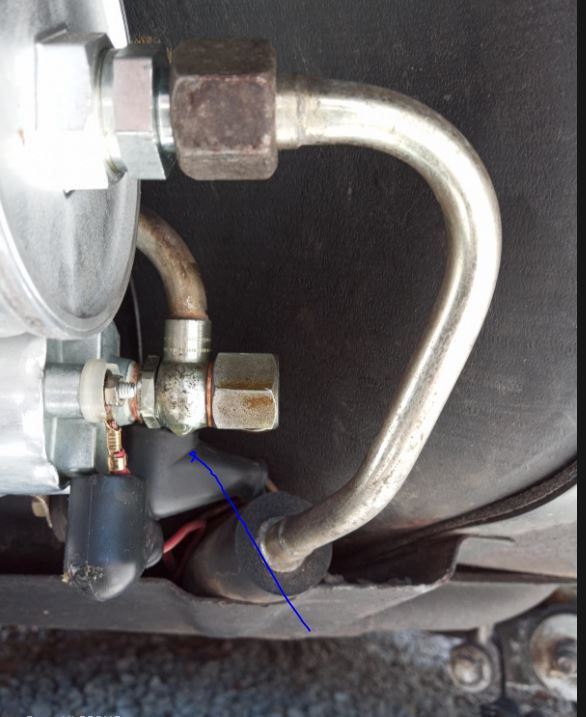
Can anyone help with why my fuel pump is dripping?
they are bot very slight leaks/drips but i want them resolved.
the crust washer is new/good.
the hose clamp is tight.
the fuel pump is new.
I have a crank no start problem so i replaced the fuel pump among other things.
Any ideas on why i have 2 drips/leaks would be much appreciated.
is the pipe clogged?
is the fuel filter backed up?
Is that rubber hose the factory part with the right size metric ends or are you using SAE sized hose and trying to clamp it tightly? If the latter, that's problem #1.
From the banjo fitting, it looks like things have not been fitted quote right and there's an angle at that fitting. With those being metal pipes that don't have any give, they need to be squarely aligned and tightened to seal. If that's as good as you can get them, Metric Hilti Bonded Sealing washers from Amazon instead of metal crush washers will resolve the leaks.
Is that rubber hose the factory part with the right size metric ends or are you using SAE sized hose and trying to clamp it tightly? If the latter, that's problem #1.
From the banjo fitting, it looks like things have not been fitted quote right and there's an angle at that fitting. With those being metal pipes that don't have any give, they need to be squarely aligned and tightened to seal. If that's as good as you can get them, Metric Hilti Bonded Sealing washers from Amazon instead of metal crush washers will resolve the leaks.
I agree with Pete on both accounts. And to me it even looks like the inner copper crushwasher is missing all together. Take it apart and change all the crushwashers to new ones..




 928 fuel pump problem