When you click on links to various merchants on this site and make a purchase, this can result in this site earning a commission. Affiliate programs and affiliations include, but are not limited to, the eBay Partner Network.
I'm not really interested in getting into the physics of this....I'll just keep it as simple as possible, for the non-ME people or the ME people that were not involved in this area of expertise.
Think about what plane the damper attaches to the crankshaft, what energy/harmonics the damper is trying to absorb, and what plane that energy/harmonics is being generated in.
The crankshaft in an engine is a "wave" of movement as each piston/connecting rod forces the crankshaft to move. The crankshaft does not "act" like the solid part it appears to be, it actually deforms and returns to its original shape, continuously. This creates a "wave" in the crankshaft, which varies with load and rpms, causing the "nose" of the crankshaft to move up and down, considerably. This movement is so dramatic, that it can actually be easily observed. Open your hood, run the engine, and watch the front damper/pulley. Vary the rpms. At some rpms the front damper/pulley will appear to spin perfectly straight (unless you have a bent pulley) and at other rpms, the damper/pulley will look terribly bent. This is not an illusion, but actually the difference of the "wave" (movement) that is generated by the change in rpms. (If you were to do this before you install one of my hubs/dampers and do it again, afterwords, it is really easy to "see" how much more "movement" my damper absorbs....it's one of those "duh" moments, in life.
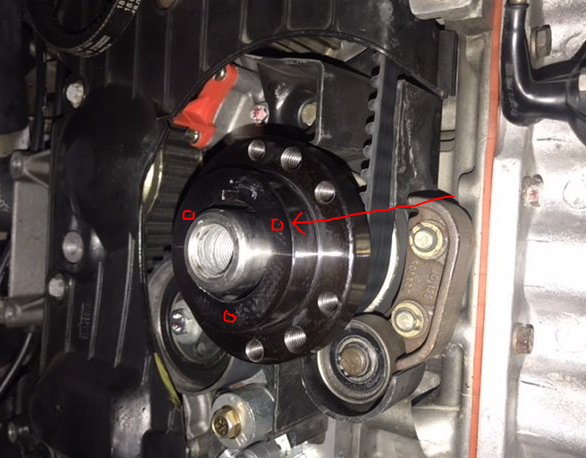
A press fit damper hub essentially becomes a part of the crankshaft.....the crankshaft can not "move" up and down inside the hub.....the two are essentially one piece. The actual damper is attached to the hub with tapered hardware, from the front, which also essentially makes the hub/damper one piece. There's no independent movement of any of the pieces (unless that hardware becomes loose.)
A slide fit damper allows the crankshaft to move around inside the damper. There is a loss of transfer of a percentage of the harmonic/frequency wave. Yes, it is "clamped down" by the front bolt, but no amount of torque on that bolt will keep the nose from moving inside the damper.
Thanks for the "lesson", but it appears to me you misunderstand what is happening and the purpose of the damper. You speak of "planes, waves and up & down movements", which imply the concern is that combustion loads are bending the crankshaft and the damper helps resolve this issue. You never mention the real nature of the problem, which is crankshaft twist. While I agree there are forces which have a tendency to bend the crank occur during combustion, these forces are counteracted by the main bearings. However, these same forces, by acting at a distance from the rotational axis of the crank, also generate torque (surprise) which cause twisting (rotational displacement) in the crankshaft; it is this twisting phenomenon which makes the damper necessary. I'm not going any further on this other than to suggest those interested review the article below, which I just found on your damper manufacturers website. I also attached a whitepaper I wrote and posted here 9 months ago regarding Porsches torque tube vibration damper, which acts in a similar way to the torsional damper, but for bending vibration, not twisting.
I also have a suggested improvement on your hub design for your consideration, which may or may not be feasible: add 3 equally spaced threaded holes about the center - jacking screws could be added prior to hub removal - just evenly tighten each screw, which would bare against the TP retainer & sprocket, to drive off the hub.
@Geza : That's a great write up on what's going on, thanks for sharing it again. I missed it the first time you posted it. I have been interested in this damper for quite a while, but it's currently low on the priority pareto. The past few exchanges have been very interesting, technically, and I'm glad that you and GB are having a discussion.
What's wrong with pulling the hub via the threaded holes where the damper bolts to the hub now? My balancer puller has 2-3-4 bolts options, should work great without hub mods.
Thanks for the "lesson", but it appears to me you misunderstand what is happening and the purpose of the damper. You speak of "planes, waves and up & down movements", which imply the concern is that combustion loads are bending the crankshaft and the damper helps resolve this issue. You never mention the real nature of the problem, which is crankshaft twist. While I agree there are forces which have a tendency to bend the crank occur during combustion, these forces are counteracted by the main bearings. However, these same forces, by acting at a distance from the rotational axis of the crank, also generate torque (surprise) which cause twisting (rotational displacement) in the crankshaft; it is this twisting phenomenon which makes the damper necessary. I'm not going any further on this other than to suggest those interested review the article below, which I just found on your damper manufacturers website. I also attached a whitepaper I wrote and posted here 9 months ago regarding Porsches torque tube vibration damper, which acts in a similar way to the torsional damper, but for bending vibration, not twisting.
I also have a suggested improvement on your hub design for your consideration, which may or may not be feasible: add 3 equally spaced threaded holes about the center - jacking screws could be added prior to hub removal - just evenly tighten each screw, which would bare against the TP retainer & sprocket, to drive off the hub.
For simplicity, I just said the crank moves...you want to say it twists, which is true.
Different words, same exact thing.
Look....I try and help people with legitimate questions, but I'm really missing what your point is, in this thread.
Are you simply interested in arguing or do you have a point to make about my product?
'Cause you are being fairly nit-picky, about something I sell a large quantity of, with fantastic results.
If you want to make your own....have at it, but I've really got stuff to do for people that want my pieces and expertise.
Last edited by GregBBRD; Jul 13, 2020 at 07:24 PM.
What's wrong with pulling the hub via the threaded holes where the damper bolts to the hub now? My balancer puller has 2-3-4 bolts options, should work great without hub mods.
Nothing is wrong with pulling it off using a puller; I was just making a suggestion on providing an integral feature which would allow removal without the special tool. It's a DFM (design for manufacturing) thing - If I was peer reviewing this design, I would have suggested it. I suspect we've all come across times during our wrenching on 928s when we said "if they just did this" it would have made things easier.
For simplicity, I just said the crank moves...you want to say it twists, which is true.
Different words, same exact thing.
Look....I try and help people with legitimate questions, but I'm really missing what your point is, in this thread.
Are you simply interested in arguing or do you have a point to make about my product?
'Cause you are being fairly nit-picky, about something I sell a large quantity of, with fantastic results.
If you want to make your own....have at it, but I've really got stuff to do for people that want my pieces and expertise.
A quick glance through discussion shows how I asked some relevant questions about your product, was practically accused of trying to steal the design, highlighted the benefits of your design, attempted to clarify your misunderstandings & misstatements for the benefit of the community (who generally revere your work, words and opinions) and suggested a potential design enhancement.
Nit-picky, perhaps - just trying to put out accurate information for the community - trust me, it's not for my benefit. Example - in the post regarding this years Frenzy gathering, discussion centered around the legal aspects of a waiver - I know jack about this subject and appreciated the efforts by those who do to clarify things. Just trying to do the same thing here about subjects I am knowledgeable about.
Something else for you to consider: the motions you noted on the OEM damper show it is doing its job - what you are seeing is the inertia weight resonating, allowing the absorption of vibratory energy. The inertia weight on the ATI damper is hidden from view - you can't see it resonating, but it does, similarly.
Nothing is wrong with pulling it off using a puller; I was just making a suggestion on providing an integral feature which would allow removal without the special tool. It's a DFM (design for manufacturing) thing - If I was peer reviewing this design, I would have suggested it. I suspect we've all come across times during our wrenching on 928s when we said "if they just did this" it would have made things easier.
Yahbut.... Greg's hub as it is will come off with a flat bar across the nose of the crank with a couple bolts, a standard free-rent puller from the parts store if you don't have one already, etc. Adding tapped holes for jack screws would require that you be comfortable with three weak spots in an area where you really want a solid clamp on the crank nose.
The factory damper is a zero-zero fit (zero clearance, zero interference), depending entirely on the clamping force applied by the crank nose bolt and washer, with the pulleys sandwiched between. Greg's hub is not zero-zero, has a slight interference so that it has a better chance of transmitting all the torsional vibrations to the hub, relying less on the nose bolt. Take a look at some cranks and see where there's slight galling, and a hard-to-remove factory damper from running with less than full clamping. To maintain that consistent interference fit with the improved hub, I'm pretty sure I wouldn't want holes where you indicated.
A whole lot of thought and testing has gone into the hub improvements. This is not Version A, it's Version 0.
Nothing is wrong with pulling it off using a puller; I was just making a suggestion on providing an integral feature which would allow removal without the special tool. It's a DFM (design for manufacturing) thing - If I was peer reviewing this design, I would have suggested it. I suspect we've all come across times during our wrenching on 928s when we said "if they just did this" it would have made things easier.
Well, I didn't ask you for a peer review and have absolutely no plans on doing so, in the future. I make over 100 separate products for use on our 928's....and there's about 20 more coming along, quite nicely....none of which have required your input.
This particular product is long, long done and works perfectly, with no plans for any changes.
However, if we were doing a peer review on this part, and you, as a very junior engineer to me, were sitting across the table, I'd quickly respond with the following statement:
Chevy (I'm not going to bother listing all the automotive companies, just this one example with millions and millions of crankshaft dampers), has been putting on front crankshaft dampers on for about 75 years. A huge majority of these dampers are such a tight fit that Chevy didn't bother to even thread the end of the crankshaft for a retaining bolt....completely a friction fit. And not a single one of those dampers have holes in them to facilitate removal. Therefore, damper pulling and installation tools are super common....almost every mechanic on the planet owns both.
Followed by the following questions:
1. The bolts, in your idea to remove this damper, need to be how long and what diameter?
2. Where is anyone going to get high enough quality hardware, that long and that diameter?
3. Do we need to furnish that hardware to prevent someone picking up a "Grade 2" set of bolts from Home Depot and instantly "snapping them off", inside the hub?
4. What part of the engine are these bolts going to be damaging while these bolts thread in? Will we need to furnish that belt thrust washer because we suggest this as a method for removal, or just tell people to have one on hand to replace the one that gets ruined?
5. Are you aware that almost every auto parts store that loans tools has this very common puller?
6. If, over the years, a slight amount of corrosion occurs and the forces required to remove the damper goes way up (likely) and the "removal" bolt/bolts break off, in the hub, while someone is doing this.....who buys a new hub (keeping in mind that we suggest this as a removal method.)
7. Thanks for your suggestion.
8. Can you run off and get all of us a refill on coffee?
9. And can you dump that trash, on the way?
Seriously, I don't see that you are adding a single thing to this thread.....certainly nothing positive.
You clearly started out hoping I would provide you with all the knowledge required to build your own hub....
As I politely worded, in my very first response to you....I don't see how that benefits me or why I would do that.
Please go find something else to do, besides filling this thread, with trash.
I'm interested in this product, and have a few questions:
What is the material and finish of the custom hub?
How was the particular damper selected - Did you work with ATI to determine a damper solution that matched the vibration characteristics of a particular 928 engine configuration?
Are there different ATI dampers specified for different 928 engine types?
Thanks.
Don't question Greg's choice. If he made it, it's been designed right and works as good as but more likely better than original design