





Spontaneous Fires

Thread Starter
Racer

Joined: Aug 2013
Posts: 256
Likes: 11
From: Bay Area, CA
 Spontaneous Fires
Was curious if any of you waiting on Macan EV deliveries have any concern over the recent high profile EV fires (Korea, Portugal, etc)? My delivery date is in October and my wife is getting a little antsy. Accidents, incorrectly installed chargers, modifications, I understand. But for the fire in Korea for example, the car wasn't charging, just sitting, and it spontaneously ignited (a Mercedes). Folks over there are making a commotion about battery brands but is that really it given the battery Mercedes used is from a company Mercedes has invested deeply in. I think the statistics all suggest this is rare and nothing to worry about. But for someone who intends to park their car in their garage at night, a spontaneous EV car fire in my garage at night or while on a trip is a bit unnerving. This will be our very first EV.
Again, just curious if any of you have thoughts about this?
My bad if this has already been discussed somewhere. I didn't see anything really here or in the Taycan forum. If there's another thread, let me know and I'll go there. Thanks.
Again, just curious if any of you have thoughts about this?
My bad if this has already been discussed somewhere. I didn't see anything really here or in the Taycan forum. If there's another thread, let me know and I'll go there. Thanks.

Nordschleife Master
Joined: Jun 2011
Posts: 6,493
Likes: 4,890
From: Santa Cruz, CA
Was curious if any of you waiting on Macan EV deliveries have any concern over the recent high profile EV fires (Korea, Portugal, etc)? My delivery date is in October and my wife is getting a little antsy. Accidents, incorrectly installed chargers, modifications, I understand. But for the fire in Korea for example, the car wasn't charging, just sitting, and it spontaneously ignited (a Mercedes). Folks over there are making a commotion about battery brands but is that really it given the battery Mercedes used is from a company Mercedes has invested deeply in. I think the statistics all suggest this is rare and nothing to worry about. But for someone who intends to park their car in their garage at night, a spontaneous EV car fire in my garage at night or while on a trip is a bit unnerving. This will be our very first EV.
Again, just curious if any of you have thoughts about this?
My bad if this has already been discussed somewhere. I didn't see anything really here or in the Taycan forum. If there's another thread, let me know and I'll go there. Thanks.
Again, just curious if any of you have thoughts about this?
My bad if this has already been discussed somewhere. I didn't see anything really here or in the Taycan forum. If there's another thread, let me know and I'll go there. Thanks.
Combustion-Powered Vehicles Are 29 Times More Likely To Catch Fire
Combustion-Powered Vehicles Are 29 Times More Likely To Catch Fire
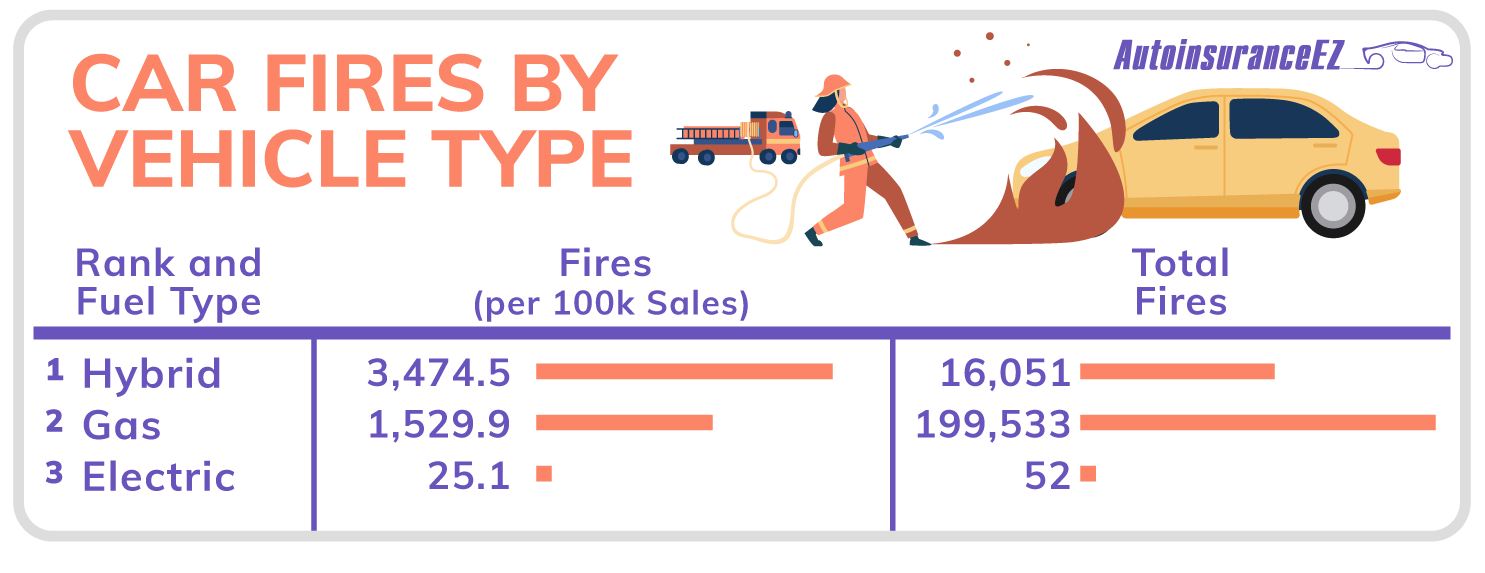
According to MSB data, there are nearly 611,000 EVs and hybrids in Sweden as of 2022. With an average of 16 EV and hybrid fires per year, there's a 1 in 38,000 chance of fire. There are a total of roughly 4.4 million gas- and diesel-powered passenger vehicles in Sweden, with an average of 3,384 fires per year, for a 1 in 1,300 chance of fire. That means gas- and diesel-powered passenger vehicles are 29 times more likely to catch fire than EVs and hybrids.
Ford recalls nearly 519,000 U.S. vehicles over fire risks
Last edited by daveo4porsche; Aug 25, 2024 at 11:37 PM.

Rennlist Member

Joined: Nov 2016
Posts: 1,548
Likes: 856
From: Waterloo, Ontario, Canada
https://www.motortrend.com/features/...bout-ev-fires/
https://www.cnbc.com/2022/11/24/ford...iter%20engines.
Ford recalls nearly 519,000 U.S. vehicles over fire risks
I find such comparisons rather disingenuous because:
1. The average EV is much younger (and accordingly in better condition) than the average ICE vehicle. It would be better to compare fire rates for vehicles of similar age, rather than average 13 year old ICE cars vs average 3 year old EVs.
2. The concern is fires when parked, rather than fires on the road. If a car catches fire on the road, the driver can just stop and it and get out, and the car can safely burn outside. If a car catches fire in your garage, you won’t see it, you may be asleep, and it will set your house on fire. Most EV fires seem to take place while parked, while most ICE fires are in vehicles being driven.
3. When an EV does catch fire, putting out the fire is much more difficult than putting out an ICE vehicle fire.
Nordschleife Master
Joined: Jun 2011
Posts: 6,493
Likes: 4,890
From: Santa Cruz, CA
I find such comparisons rather disingenuous because:
1. The average EV is much younger (and accordingly in better condition) than the average ICE vehicle. It would be better to compare fire rates for vehicles of similar age, rather than average 13 year old ICE cars vs average 3 year old EVs.
2. The concern is fires when parked, rather than fires on the road. If a car catches fire on the road, the driver can just stop and it and get out, and the car can safely burn outside. If a car catches fire in your garage, you won’t see it, you may be asleep, and it will set your house on fire. Most EV fires seem to take place while parked, while most ICE fires are in vehicles being driven.
3. When an EV does catch fire, putting out the fire is much more difficult than putting out an ICE vehicle fire.
1. The average EV is much younger (and accordingly in better condition) than the average ICE vehicle. It would be better to compare fire rates for vehicles of similar age, rather than average 13 year old ICE cars vs average 3 year old EVs.
2. The concern is fires when parked, rather than fires on the road. If a car catches fire on the road, the driver can just stop and it and get out, and the car can safely burn outside. If a car catches fire in your garage, you won’t see it, you may be asleep, and it will set your house on fire. Most EV fires seem to take place while parked, while most ICE fires are in vehicles being driven.
3. When an EV does catch fire, putting out the fire is much more difficult than putting out an ICE vehicle fire.
factually EV's are less likely to catch fire than ICE vehicle's - the difference is not risk - it's headlnes…but not actual risk - there is no data to indicate otherwise.
there are hundreds of ICE vehicle fires every day in North America but they don't make headlines.
Rennlist Member
Joined: Nov 2016
Posts: 1,548
Likes: 856
From: Waterloo, Ontario, Canada
so you choose to ignore the data to fit a preconceived narrative - got it!
factually EV's are less likely to catch fire than ICE vehicle's - the difference is not risk - it's headlnes…but not actual risk - there is no data to indicate otherwise.
there are hundreds of ICE vehicle fires every day in North America but they don't make headlines.
factually EV's are less likely to catch fire than ICE vehicle's - the difference is not risk - it's headlnes…but not actual risk - there is no data to indicate otherwise.
there are hundreds of ICE vehicle fires every day in North America but they don't make headlines.
I’m not anti-EV, I actually like EVs and am considering buying one. It’s just that these apples to oranges comparisons rub me the wrong way because if you compare stats for vehicles of similar age and parked in a garage (and charging in case of EVs under typical use), I’m pretty confident the frequency of ICE vehicle fires is not 29x higher and is probably lower than for EVs, though I haven’t seen any data for such a comparison.
Nordschleife Master
Joined: Jun 2011
Posts: 6,493
Likes: 4,890
From: Santa Cruz, CA
EV's have been with us since 2011 or slightly earlier - LiON batteries are everywhere - hybrids have LiON batteries, so there are EV's that are over 12 years old now and a growing population - between all the EV's world wide, and all the hybrid's I think if there was a systemic problem with LiON batteries being driven or simply parked it would've shown up by now…but like anything they are not immune to problems, but there is no data pointing any increased risk - in fact that data that does exist points to a much lower case of fires for EV's - the motortrend aritcle is just one analysis - over and over again any data that is analyzed finds no increased risk, but rather a decrease vs. risk levels we all find acceptable for ICE vehicles…https://www.wlwt.com/article/park-ou...-risk/43675949
Park outside': GM recalls 40,000 pickup trucks to fix fire risk
the data at this site is illuminating
https://www.honestjohn.co.uk/the-lat...re-statistics/
The Annual Number of Electric Car Fires
171,500 car fires year - or 469 car fires a day in North America vs. 500 battery fires _EVER_ - so the total number of battery fires ever is the same as the daily fire rate for ICE vehicles - 60% of which start in garages or parking lots…
there is no data to indicate EV's are greater risk vs. ICE vehicle's parked or otherwise - if there was I'm positive someone would be publishing it in 80 point font for the world to see.
EV car fire statistics are noise when compared to ICE vehicle fires…and even when consdiering fleet size - the EV fire statistics are orders of magnitude "less" vs. the likely hood an ICE fire…
US Car Fire Statistics
I welcome any data driven analysis showing an increased risk for EV's vs. ICE vehicles - to date no such analysis has been presented - and of the data I have seen over the years EV's would have to get substantially worse just to "equal" the level of risk we all tolerate for ICE vehicle's
now there are headlines that would make you think otherwise, but that's not a trend, that's an incident.
Park outside': GM recalls 40,000 pickup trucks to fix fire risk
the data at this site is illuminating
https://www.honestjohn.co.uk/the-lat...re-statistics/
The Annual Number of Electric Car Fires
- EV sales could increase by 80% by 2030.
- Electric car fires accounted for just 0.4% of total car fires in Norway from 2013 to 2015.
- 24 EV fires were reported in Sweden in 2023.
- Fewer than 500 EV battery fires have ever been verified globally, out of around 20 million EVs currently on the road worldwide.
171,500 car fires year - or 469 car fires a day in North America vs. 500 battery fires _EVER_ - so the total number of battery fires ever is the same as the daily fire rate for ICE vehicles - 60% of which start in garages or parking lots…
About 60% of vehicle fires occur in parking lots or residential garages
EV car fire statistics are noise when compared to ICE vehicle fires…and even when consdiering fleet size - the EV fire statistics are orders of magnitude "less" vs. the likely hood an ICE fire…
US Car Fire Statistics
- Roughly 213,000 cars catch fire in the United States every year.
- The total annual number of highway vehicle fires in the US has decreased from 1980 to 2020.
- Approximately 600 cars go up in flames every day in the US.
- In 2022, vehicle fires accounted for 13% of all fires in the US.
- As of August 16, 2023, the New York City Fire Department put out 108 fires started by Li-Ion batteries.
- A study conducted by the NTSB reveals that 3 to 5 electric cars caught fire in the US while charging between 2019 and 2022.
I welcome any data driven analysis showing an increased risk for EV's vs. ICE vehicles - to date no such analysis has been presented - and of the data I have seen over the years EV's would have to get substantially worse just to "equal" the level of risk we all tolerate for ICE vehicle's
now there are headlines that would make you think otherwise, but that's not a trend, that's an incident.
Last edited by daveo4porsche; Aug 26, 2024 at 01:15 AM.
Thread Starter
Racer
Joined: Aug 2013
Posts: 256
Likes: 11
From: Bay Area, CA
Like I mentioned, the stats say it’s rare and nothing to worry about. And I agree.
But looking at the world metrics link, the various causes seem mostly to be tied to incidents while driving, or while the engine is hot, or doing something to cause it (cooking?). which is what I would expect for an ICE car.
What seems to have rattled folks recently is the spontaneous fires while sitting parked and off, days after being driven, and while not charging. Not sure if they ever proved the ship that sunk was a Taycan that caught fire spontaneously. I haven’t seen a metric on idle fires but I was only interested in those spontaneous ones.
Still going to take delivery of my EV, but just curious about peoples’ thoughts on this.
But looking at the world metrics link, the various causes seem mostly to be tied to incidents while driving, or while the engine is hot, or doing something to cause it (cooking?). which is what I would expect for an ICE car.
What seems to have rattled folks recently is the spontaneous fires while sitting parked and off, days after being driven, and while not charging. Not sure if they ever proved the ship that sunk was a Taycan that caught fire spontaneously. I haven’t seen a metric on idle fires but I was only interested in those spontaneous ones.
Still going to take delivery of my EV, but just curious about peoples’ thoughts on this.
Last edited by Zero911; Aug 26, 2024 at 04:07 AM.
Trending Topics
Nordschleife Master
Joined: Jun 2011
Posts: 6,493
Likes: 4,890
From: Santa Cruz, CA
Like I mentioned, the stats say it’s rare and nothing to worry about. And I agree.
But looking at the world metrics link, the various causes seem mostly to be tied to incidents while driving, or while the engine is hot, or doing something to cause it (cooking?). which is what I would expect for an ICE car.
What seems to have rattled folks recently is the spontaneous fires while sitting parked and off, days after being driven, and while not charging. Not sure if they ever proved the ship that sunk was a Taycan that caught fire spontaneously. I haven’t seen a metric on idle fires but I was only interested in those spontaneous ones.
Still going to take delivery of my EV, but just curious about peoples’ thoughts on this.
But looking at the world metrics link, the various causes seem mostly to be tied to incidents while driving, or while the engine is hot, or doing something to cause it (cooking?). which is what I would expect for an ICE car.
What seems to have rattled folks recently is the spontaneous fires while sitting parked and off, days after being driven, and while not charging. Not sure if they ever proved the ship that sunk was a Taycan that caught fire spontaneously. I haven’t seen a metric on idle fires but I was only interested in those spontaneous ones.
Still going to take delivery of my EV, but just curious about peoples’ thoughts on this.
About 60% of vehicle fires occur in parking lots or residential garages
EV fire risk is is "no worse" than ICE fire risk is what the data is telling all of us - it's just more novel and therefore gets more coverage.
Rennlist Stories
The Best Porsche Posts for Porsche Enthusiasts
10 Porsche Colors That Have More Personality Than Most People
Verdad Gallardo
Guntherwerks' Final Speedster Creation Is the Ultimate Porsche Restomod
Verdad Gallardo
10 Reasons I Hate Going to the Porsche Dealership (& the 1 Reason I Stay)
Joe Kucinski
Porsche Shakes Up The Nürburgring Lap Record Table Once Again
Verdad Gallardo
6 Ways the Porsche 911 GT3 S/C Redefines Performance
Joe Kucinski
10 Wildest Homologation Specials Porsche Ever Sold
Verdad Gallardo
Super Rare RUF BTR III Comes Out of Hibernation, Looking For a New Home
Verdad Gallardo
10 Porsche Opinions That Can Start a Fight
Joe Kucinski
One-Off Porsche 911 S/T Takes Inspiration From Famous '70s Race Car
Verdad Gallardo
RL Community Team
Rennlist Member
Rennlist Member

Joined: Sep 2005
Posts: 18,841
Likes: 14,799

Instructor
Joined: Feb 2024
Posts: 202
Likes: 131
Maybe they should update the data:
https://www.motor1.com/news/731339/r...-vehicle-fire/
A vehicle fire broke out at Rivian damaging about 50 vehicles. Bad news for Rivian and its customers
https://www.motor1.com/news/731339/r...-vehicle-fire/
A vehicle fire broke out at Rivian damaging about 50 vehicles. Bad news for Rivian and its customers
Nordschleife Master
Joined: Jun 2011
Posts: 6,493
Likes: 4,890
From: Santa Cruz, CA
Maybe they should update the data:
https://www.motor1.com/news/731339/r...-vehicle-fire/
A vehicle fire broke out at Rivian damaging about 50 vehicles. Bad news for Rivian and its customers
https://www.motor1.com/news/731339/r...-vehicle-fire/
A vehicle fire broke out at Rivian damaging about 50 vehicles. Bad news for Rivian and its customers
Instructor
Joined: Feb 2024
Posts: 202
Likes: 131
My point was not to say that there is a systemic problem with EV and fire.
Just saying that, because of the very small number of EV fires, one event (as you say, probably one fire that propagated to 50 nearest cars, but actually, 50 cars are totaled) creates a visible impact on the stats.
Still not a trend, obviously… and fortunately!
My future Macan is in the parking lot, I do not want this kind of event to become a trend
Just saying that, because of the very small number of EV fires, one event (as you say, probably one fire that propagated to 50 nearest cars, but actually, 50 cars are totaled) creates a visible impact on the stats.
Still not a trend, obviously… and fortunately!
My future Macan is in the parking lot, I do not want this kind of event to become a trend
RL Community Team
Rennlist Member
Rennlist Member
Joined: Sep 2005
Posts: 18,841
Likes: 14,799
The one that that does concern me about EV fires is that they are more difficult to put out than regular gasoline fires.
So to be fair to the ICE Luddites, while EV fires may be more rare, their impact do tend to be larger than a comparable ICE car fire.
That's a real concern, and something everyone should be aware of and focus on.
The whole "world is falling" because EV blow up like a stick of dynamite in a fire pit, however, is just brain farts.
So to be fair to the ICE Luddites, while EV fires may be more rare, their impact do tend to be larger than a comparable ICE car fire.
That's a real concern, and something everyone should be aware of and focus on.
The whole "world is falling" because EV blow up like a stick of dynamite in a fire pit, however, is just brain farts.
Thread Starter
Racer
Joined: Aug 2013
Posts: 256
Likes: 11
From: Bay Area, CA
Yeah, that's my primary concern, damage to the home while parked in the garage. I guess I could always park it in the driveway. Although a spontaneous fire with an ICE car would be damaging enough as well. Just never once thought about this until the recent events that have been covered extensively by media. Again, I don't think there's been anything conclusive on the Felicity Ace tanker ship but never heard of a cargo ship going down due to a car fire before. Then these recent incidents with a tremendous loss of vehicles in each case.
Anyhow, glad to hear your thoughts. I take delivery of a Ice Grey Macan EV in October and I'm very much looking forward to it.
Anyhow, glad to hear your thoughts. I take delivery of a Ice Grey Macan EV in October and I'm very much looking forward to it.