When you click on links to various merchants on this site and make a purchase, this can result in this site earning a commission. Affiliate programs and affiliations include, but are not limited to, the eBay Partner Network.
I noticed that on the highway when I coast the battery voltage will read as high as 15.0...but when you roll on throttle it can dip down into the 12s.
I would have suspected the opposite.
Purely a curiosity question but does anyone know (or want to interwebs speculate) what systems draw on battery when giving gas?
Your Cayenne is equipped with a variable-voltage (smart) alternator. It operates differently than the fixed-voltage alternators you may be familiar with.
During normal driving and particularly during acceleration, the charging current of the generator is restricted and the vehicle electrical system uses the battery supply. This shows on your instrument panel as lower voltage.
As a result, the engine has to supply less power to charge the battery, which directly results in lower fuel consumption. The battery is mainly charged by the usually otherwise lost braking energy during the braking operation.
During braking, the generator power is increased in a targeted manner in order to feed the recuperated energy into the battery. The increased generator power acts with a braking torque on the crankshaft via a drive belt. This leads to vehicle deceleration and therefore supports the conventional brake system. This shows on your instrument panel as higher voltage.
Read all the gory details on page 2.26 of the Porsche After Sales Training document, “Advanced Electrical Systems” , attached.
This is great! Thanks for asking the question (I had the same whenever seeing the battery gauge in my car”s display) and special thanks for the detailed answer and the document. Good stuff!
Is it possible to tell the state of charge (empty, half full, full) of the 12V battery by looking for a pattern of how the battery voltage fluctuates ? Or even determines if the 12V battery is near the end of life ?
@Schnave, Porsche provides allows the driver to monitor the voltage in real time but the coolant temperature provided is a constant value ( at least in my 970.2 and 991.1). The purpose of the steady coolant temperature is to avoid customer complaints (forum information). Why wouldn’t they do the same with the volt meter to avoid complaints. Are they are showing off the recuperation function?
Not sure why, but I’m grateful that Porsche trusts us with an accurate, fluctuating voltage display. (Small victories)😀
FYI, Porsche has also graced us with an accurate, fluctuating oil pressure gauge. The Cayenne is equipped with a variable output oil pump. The gauge fluctuates quite a bit, depending on oil temp, engine RPM, and engine torque. Read all about it here: https://rennlist.com/forums/cayenne-...-pressure.html
Is it possible to tell the state of charge (empty, half full, full) of the 12V battery by looking for a pattern of how the battery voltage fluctuates ? Or even determines if the 12V battery is near the end of life ?
I think there are too many variables affecting the voltage to diagnose battery health while the engine is running. Voltage is set by the ECU according to many factors, as stated in my previous post.
The best time to check your battery might be BEFORE you start it. You can get a rough idea of the battery’s state-of-charge (SOC) by its voltage after sitting overnight (24 hours is better). Before starting, turn the key nub one click or press the start button with foot OFF the brake to enable accessory mode. Wait a moment for the instrument panel to boot up and then observe the voltage reading.
Use the chart below to determine approximate SOC. NOTE: I’ve included a chart that shows both AGM and LFP voltages for the benefit of all users on the forum:
As you can see by the chart, anything above, say, 12.6V or so should be fine. If you let your Cayenne sit parked for a while, this voltage will decrease due to parasitic draw from alarm system, commo checks with Porsche Connect, listening for approaching key fobs, etc, which is normal.
You may wish to install a Bluetooth battery monitor. About the size of a matchbox, it is a simple 2 or 3 minute installation using only a 10mm wrench. Download the free app to see current voltage, cranking voltage, charging system tests, and historical graphs of your battery voltage (while within Bluetooth range). Plus, it will give you an alert (within Bluetooth range) when your voltage goes below a user configurable voltage.
For instance, in the chart below, you can see how my (newly converted) AGM battery discharged from 12.83V over a period of 5 days to 12.67V. Note the small voltage drops when I opened the door and the larger drop when I opened the rear hatch.
The voltage then varied quite a bit while I drove the vehicle, resulting in a good charge up to 12.84V.
There are many different vendors for Bluetooth battery monitors. I am pleased with the product in the link below and have installed three of them. If you have several vehicles with monitors installed, the app will connect to the one with the strongest signal. You can name each monitor and manually select the one to display on the app.
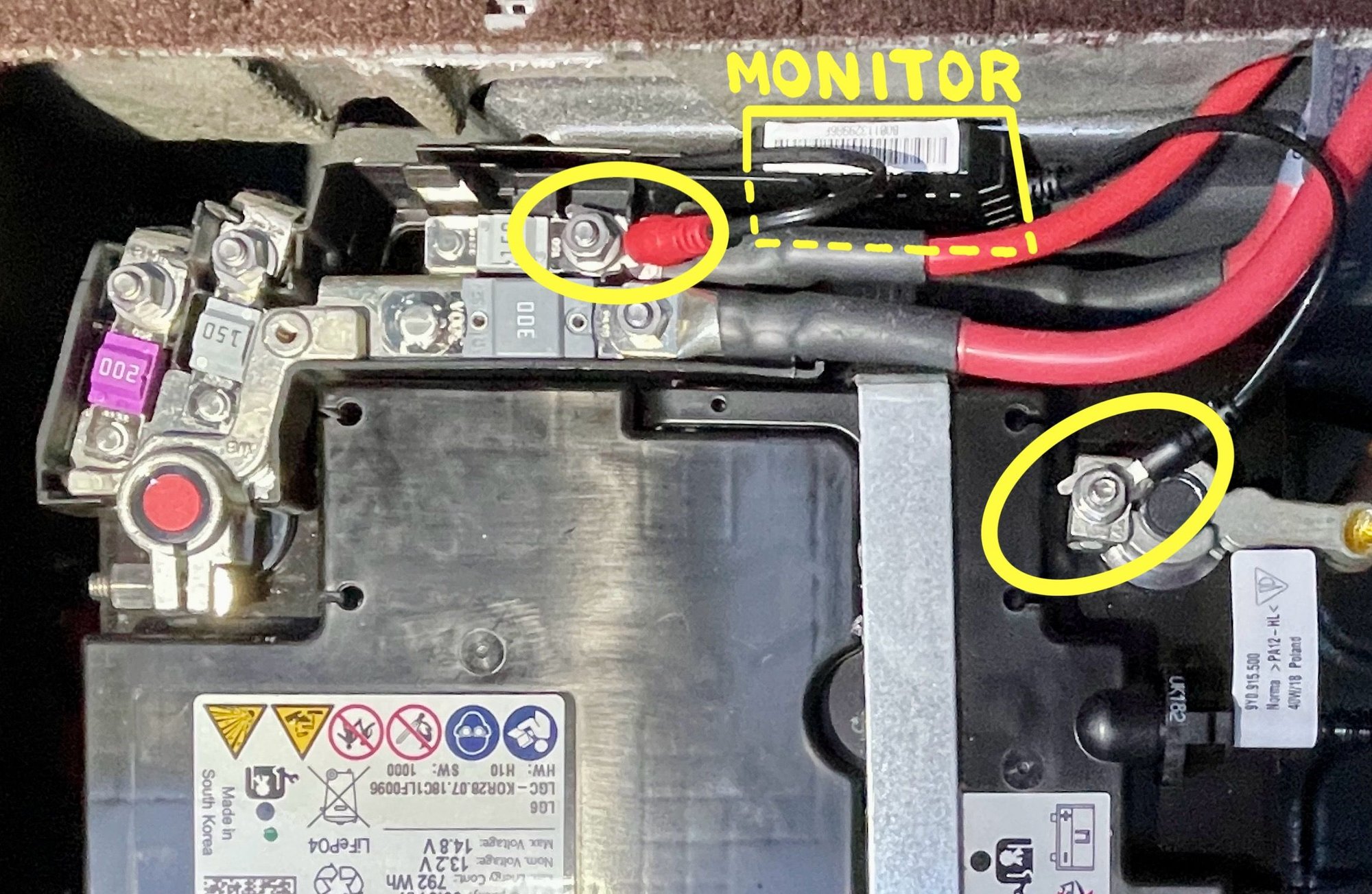
Here’s what the battery monitor looks like when installed. Note this is the installation of the Antigravity Lithium Battery Monitor on my old LFP battery (R.I.P.). Installation is the same for AGM, but a different AGM specific monitor (and app) is required. See this thread for lots more info about battery monitors, screen shots and discussion:
@Schnave do you still have the fusible link installed, from the LiFePO4 --> AGM conversion? I don't think I see your latest LIN connection in this photo.
@Schnave do you still have the fusible link installed, from the LiFePO4 --> AGM conversion? I don't think I see your latest LIN connection in this photo.
That photo was from my old LFP battery (R.I.P.). You shamed me into taking photos of the new AGM battery monitor! 😀 And while I was at it, I changed out the cabin air filter and posted details here: https://rennlist.com/forums/cayenne-...l#post19638491
Here’s the new setup, pictured below. I stacked the monitor’s positive connector on top of the 12V fusible link connector. It is hard to see the fuse in the photo.
The negative connector is attached to the lug under the carpet. I posted in another thread how the AGM conversion negative post wouldn’t work without modification. The nut is captured to prevent it from falling off, but prevents anything from being inserted underneath it, as I posted here: https://rennlist.com/forums/cayenne-...l#post19488131





 Why does voltage change?