When you click on links to various merchants on this site and make a purchase, this can result in this site earning a commission. Affiliate programs and affiliations include, but are not limited to, the eBay Partner Network.
Sorry if this is redundant and not sure if it has been mentioned but in a couple of other 997's I've owned, I have found double clutching works well to get into finicky 1st gear.
Usually when these transmissions are warmed up they should shift into 1st gear without much effort.
Sorry if this is redundant and not sure if it has been mentioned but in a couple of other 997's I've owned, I have found double clutching works well to get into finicky 1st gear.
Usually when these transmissions are warmed up they should shift into 1st gear without much effort.
Man, I haven't heard a mention of double-clutching in a long time.
Double clutching also came in handy with the worn Tranny Syncros in the 911SC's.
And you don't even need a clutch to drive a 911SC if clutch cable breaks. By using RPM's you can up and downshift smoothly w/o grinding to get to shop.
Not recommended for long drives because you have to start car in 2nd gear.
Ask me how I know
Last edited by groovzilla; Dec 12, 2022 at 03:57 PM.
My 997.1 S has the factory short shifter, its notoriously difficult to get into first gear while cold. Double clutching or shifting into third then back into first usually works until the transmission is warm. When it warms up it shifts into first without difficulty.
I realize this is a thread about 1st gear but I had difficulty getting into reverse. What I found out was that shift linkage ends were worn, couldn't tell externally by visual but once I got them off the innards were worn. I replaced them with Function-First Shifter Cable Ends now it's as smooth as a well oiled rifle.
That is a good information, when transmission/oil was warm, did the shifting problems into reverse dissapear or was ist still difficult?
Reverse: I am getting a reverse gear jam now... not often but it is starting to happen. Darn, there is continual wear going on in there.
Tricks to get into first: We all have our tricks. Double clutching, going into 2nd before 1st, going into 3rd-2nd-1st, making a deliberate "L" and not moving at an angle... many tricks. Just a pain. In short, when I arrive at a red light, I get it into 1st quickly and then to neutral so I know I won't be holding up traffic and cussing.
Wear: Something is wearing in there ... change the fluid to what Porsche prescribes, PTX, every 30K miles and stop or slow the wear.
PTX - Does it work? I does for some and not for others... I don't know why. When I first tried it, it changed my car from almost un-drivable (when hot) to almost OK. I was a hair away from taking the car to the dealer for diagnostics and repair. Changing every 30K makes the car livable for me.
Alternatives to PTX? - First, PTX is spec'd in my owner's manual and not only does it spec the oil, but notes its specifications such as the GL number. For years, there was no substitute I could find with the exact specs... the GL number was the issue. Today, I understand there are maybe two others now... can't remember the makers. I have no information if these work. As I understand it, Porsche specs a very particular formulation and properties for this oil... it must be slippery enough but sticky enough to spin up the synchros. I would love to try other oils and forumulations but I don't have a lift. I think... I have an active imagination... that I would like to try a slippery-er oil... maybe that would help. I dunno.
Peace
Bruce in Philly (now Atlanta)
Last edited by Bruce In Philly; Dec 13, 2022 at 09:54 AM.
Not a wear problem in the transmission (probably). Hard going into a gear means the synchro's are doing their job. The only thing in the trans that "wears" is the synchros, (outside of an actual bearing or gear tooth failure). Typically when synchros do wear out, you will get gear grinding when shifting since the synchros cannot effectively stop the faster spinning gear for proper engagement. Since the Aisin trans has triple synchros on the lower gears and one of them is hardened steel instead of ole timey brass ,I would look elsewhere first.
How old is the clutch? How about the shift cables and especially the ends as mentioned above. The entire clutch release system is the first thing to go over completely.
I’ve had this issue with my 997 since I bought it this spring. I have the factory short shifter. New transmission fluid didn’t help. But oddly it felt less noticeable this fall when the weather was chillier. It’s been a few weeks since I’ve driven the car, but once I get some winter tires and take it out again, I’ll see if it’s still feeling smoother.
Not a wear problem in the transmission (probably). Hard going into a gear means the synchro's are doing their job. The only thing in the trans that "wears" is the synchros, (outside of an actual bearing or gear tooth failure). Typically when synchros do wear out, you will get gear grinding when shifting since the synchros cannot effectively stop the faster spinning gear for proper engagement. Since the Aisin trans has triple synchros on the lower gears and one of them is hardened steel instead of ole timey brass ,I would look elsewhere first.
How old is the clutch? How about the shift cables and especially the ends as mentioned above. The entire clutch release system is the first thing to go over completely.
I had a clutch put in, no difference before/after.
I've pre-emptively replaced the transmission end bushings in two friends' cars. Each said the shifting felt better after the change (Function First parts). The OEMs were plastic. The new parts are metal. My concern was to prevent an on the road failure. The better shifting, IMHO, was merely a side benefit.
To Bruce; Try changing gears with the engine off. Then start it and go through changing gears. Shut it off and go thru the gears again. Report results in a 4 dimension spread sheet.
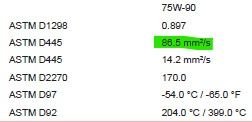
As mentioned above, the motul gear 300 seems to have made a large improvement in cold gear selection for me. It also has a superior numbers on paper compared with ptx in almost all measurable areas.
This is understandable, because the Motul 300 has a lower viscosity than the PTX at lower temperatures. And as we all notice, the problem with first gear disappears when the transmission is warm!
I have to revise my post. I did some research on that and found that Motul has changed the formulation of Gear 300 75W-90. I compared the datasheet 06/2021 to 05/2022, the current product has no advantage in low temperature viskosity to Mobilube PTX anymore. That is disappointing.