




C4 vs. CS and car width
Thread Starter
Racer

Joined: Sep 2001
Posts: 391
Likes: 87
From: Coconut Grove, FL
 C4 vs. CS and car width
Curious...just realized that the 993 C4 (which I had) was the same width in rear as the C2, but the S was wider (whether 2 or 4). In contrast, the 997 CS is the same width as the C, but the C4 or C4S are wider. I guess width is pure design element, not functional difference.

Banned
Joined: Feb 2005
Posts: 1,638
Likes: 0
Originally Posted by kocsis
I guess width is pure design element, not functional difference.


Three Wheelin'
Joined: Dec 2002
Posts: 1,564
Likes: 2
From: Chicago
Probably not
Originally Posted by MMD
Geez, I wish I knew what it was but I have to believe there's a cold and logical functional engineered reason for the additional width.

Rennlist Member
Joined: Feb 2004
Posts: 5,535
Likes: 469
From: Los Angeles
-The 997 GT3 is apparently based on the C4 platform but with the narrow body.
-Wider rear tires aren't necessary on an AWD car; in fact, the opposite would be true with power being distributed more evenly and weight being a bit more balanced F/R.
-Even given the above, wider rear tires will fit within the standard narrow body (as on the 997 GT3).
-The wider body is so very subtle, and doesn't have any other design elements separating it from the narrow body.
So I don't get it either, and not sure why it would be a marketing thing. My original thought was that they were just introducing the wider body with the C4/C4S, which would eventually be available on 2WD models.
-Wider rear tires aren't necessary on an AWD car; in fact, the opposite would be true with power being distributed more evenly and weight being a bit more balanced F/R.
-Even given the above, wider rear tires will fit within the standard narrow body (as on the 997 GT3).
-The wider body is so very subtle, and doesn't have any other design elements separating it from the narrow body.
So I don't get it either, and not sure why it would be a marketing thing. My original thought was that they were just introducing the wider body with the C4/C4S, which would eventually be available on 2WD models.
Trending Topics
Rennlist Stories
The Best Porsche Posts for Porsche Enthusiasts
Porsche Reveals Coupe Variant of the Electric Cayenne With a Fresh Look
Verdad Gallardo
10 Porsche Colors That Have More Personality Than Most People
Verdad Gallardo
Guntherwerks' Final Speedster Creation Is the Ultimate Porsche Restomod
Verdad Gallardo
10 Reasons I Hate Going to the Porsche Dealership (& the 1 Reason I Stay)
Joe Kucinski
Porsche Shakes Up The Nürburgring Lap Record Table Once Again
Verdad Gallardo
6 Ways the Porsche 911 GT3 S/C Redefines Performance
Joe Kucinski
10 Wildest Homologation Specials Porsche Ever Sold
Verdad Gallardo
Super Rare RUF BTR III Comes Out of Hibernation, Looking For a New Home
Verdad Gallardo
10 Porsche Opinions That Can Start a Fight
Joe Kucinski
Rennlist Member
Joined: Feb 2004
Posts: 5,535
Likes: 469
From: Los Angeles
Originally Posted by Chris C.
Just a guess, but maybe the wider body is needed for the front drive train, thus the C4s and turbo share the same body. ??
Advanced

Joined: May 2006
Posts: 56
Likes: 24
From: East Rockaway, NY
I'm not questioning the logic or marketing reason. When shopping for the car, I looked at the tire dimensions at c2 and c4. don't know Porsche's reason.
From the website:
c4 = 235/40 ZR 18 front, 295/35 ZR 18 rear
c2 = 235/40 ZR 18 front, 265/40 ZR 18 rear
From the website:
c4 = 235/40 ZR 18 front, 295/35 ZR 18 rear
c2 = 235/40 ZR 18 front, 265/40 ZR 18 rear

Rennlist Member
Joined: Jun 2001
Posts: 4,083
Likes: 54
From: dune acres, Indiana
Widening the track with the same wheelbase has inherant cornering benefits. That of itself requires wider bodywork.
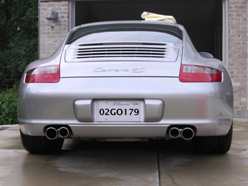
Apart from that, lower and wider have always had stylistic impact. The rear view, or'hips" of the car also seems to have an anthropomorphic, subliminal impact on perception of styling. What was the last tall, skinny car you liked?
Apart from that, lower and wider have always had stylistic impact. The rear view, or'hips" of the car also seems to have an anthropomorphic, subliminal impact on perception of styling. What was the last tall, skinny car you liked?

Burning Brakes
Joined: Feb 2006
Posts: 1,128
Likes: 0
From: Chicago area, IL USA
In my opinion, the wide rear tires / track points to the fact that Porsche (unlike Audi and Subaru) designed the AWD cars to have a solid rear-wheel bias and act more like the RWD cars... the inherent delay in moving the torque split to the front (due to the viscous interaxle diff) allows the C4S to actually yaw like a RWD vehicle. In my experience, when the rear gets loose, the delay to get sufficient power to the front to overcome the power oversteer is just long enough to make it fun. <g>
Now, with the electronically controlled interaxle diff in the new Turbo, things will be very different in terms of total capabilities... however, I'll assume that Porsche still intends the 997 Turbo to act like a RWD car as much as possible.
I drove a buddies highly-modded Audi S4, and it was basically impossible to get the tail out under acceleration - and his car sports over 400hp. I can do this in the stock C4S all day long.
Plus, it looks cool. <g>
-don
Now, with the electronically controlled interaxle diff in the new Turbo, things will be very different in terms of total capabilities... however, I'll assume that Porsche still intends the 997 Turbo to act like a RWD car as much as possible.
I drove a buddies highly-modded Audi S4, and it was basically impossible to get the tail out under acceleration - and his car sports over 400hp. I can do this in the stock C4S all day long.
Plus, it looks cool. <g>
-don
Rennlist Member
Joined: Jun 2001
Posts: 4,083
Likes: 54
From: dune acres, Indiana
don,
When you make the rear tires big relative to the front, you make the car understeer. That was Porsche's intention, since they want you to crash looking forward at what you are going to hit, rather than backward. If Porsche wanted more tail out attitude, they would keep the rear tires skinny.
With different driving techniques, you can make almost anything get the tail out. In most cars, acceleration out of a corner shfts weight to the rear and also causes understeer.
Are you referencing low speed acceleration and turning to get the tail out? At track speeds, I'm not sure that works. The tail comes out under trail braking. At least on my X50 AS
When you make the rear tires big relative to the front, you make the car understeer. That was Porsche's intention, since they want you to crash looking forward at what you are going to hit, rather than backward. If Porsche wanted more tail out attitude, they would keep the rear tires skinny.
With different driving techniques, you can make almost anything get the tail out. In most cars, acceleration out of a corner shfts weight to the rear and also causes understeer.
Are you referencing low speed acceleration and turning to get the tail out? At track speeds, I'm not sure that works. The tail comes out under trail braking. At least on my X50 AS
