When you click on links to various merchants on this site and make a purchase, this can result in this site earning a commission. Affiliate programs and affiliations include, but are not limited to, the eBay Partner Network.
This issue started when we connected a Durametric to a 1998 996 track car and observed the P0102 code (which returns immediately when cleared). As a diagnostic aid, we swapped a MAF from the same model year Boxster (my track car) into the 996 and observed the same code.
The diagnostic procedure for this code recommends checking out the wiring harness, so next we thoroughly inspected the 996 wiring harness. First with a multimeter and then by unwrapping the wires from the MAF to the ECU to check for wire damage. I am an experienced tech and am 99.9% sure that there are no opens or shorts in the wiring harness.
Next we connected the Durametric to the Boxster and observed the same code. It seems that the code is present in both cars regardless of which MAF is installed.
We obtained a third MAF and installed it in the 996. The result was the same P0102 code (in both cars).
Digging in a little deeper with the Durametric we observed the Air Mass (V) and Hot Film MAF (kg/h) values. With the engine running, the Air Mass voltage is a steady 1 volt and the Hot Film MAF value fluctuates at about 18 kg/h. We verified the 1 volt value by backprobing the MAF with the engine running. I am very confused at this point and I think it odd that my Boxster would run seemingly normal.
Here are two questions that I'm hoping someone can answer ...
Should the Air Mass voltage fluctuate with the engine running?
If the MAF is bad, where are the observed air flow (kg/h) values coming from?
I think it unlikely that we have three bad MAF sensors, but we don't know where else to turn.
So many things here that don't add up. Makes giving precise diagnostics impossible. A few thoughts that may sort out some on this.
1 a code P0102 means the MAF is not connected
2 there is a "specified MAF value" and an " actual MAF value" make sure you know the difference and are not confusing the two.
3 list the actual parts numbers of the MAF you are "testing with" compared to the ones that work
4 show a picture of the actual screen shot of the values
5 test each wire of the MAF connector for continuity
Honestly, I am not sure of the difference between the "Spec. Air Mass" and an "Air Mass" values (will research tomorrow), but you can see in the attached screenshot that they vary together. Given that the Hot Film MAF value is fixed at 1 volt, I am still confused as to what is causing these values to increase with engine RPM.
All three MAF sensors have the same part number (996.606.123.00). The current working theory is that all three are bad (as unlikely as that might be) so we don't have a good part to reference.
In the attached screenshot you can see the Air Mass and Spec. Air Mass values changing while the Hot Film MAF value is fixed at 1 volt. This seems wrong to me, but the three MAF sensors I have are behaving the same.
With the car running, I again used a thin wire to back probe pin 5 on the MAF and the Durametric and Fluke multimeter values agree.
We had only checked out the wiring on the 996, so I did go through the Boxster wires with a multimeter and everything checks out
.
Was able to find a data sheet for Bosch MAF sensors. The data sheet (attached) includes an internal wiring diagram that is shown below.
I had to get some help from a EE friend of mine, but the essence of our conversation was that pin 5 should output a voltage relative to the airflow across the sensor. I believe that this answers my question about the voltage being fixed at 1 volt. However, this doesn't help me to understand how we could have three bad sensors. I've been fixing cars since the 70s and I've learned not to trust the easy answer.
I also dug into the difference between Spec. Air Mass and Air Mass. I found this in a post on another site.
In answer to part of your original question, "Spec." is short for Specific. ie a specific mass flow rate (Kg/hr) calculated from a volumetric flow (cu.m/hr) at standard conditions.
I expect that this value would be important for someone fixing lean (or rich conditions).
IMHO the MAF sensor is one engine management component you can't screw around with. Buy a brand new OE Porsche MAF sensor correct for your year/model. Seen and read many threads about the MAF sensor. It really is key to almost all of the DME engine functions. I know it is expensive, but this is one not to cut corners on. Just my opinion.
IMHO the MAF sensor is one engine management component you can't screw around with. Buy a brand new OE Porsche MAF sensor correct for your year/model. Seen and read many threads about the MAF sensor. It really is key to almost all of the DME engine functions. I know it is expensive, but this is one not to cut corners on. Just my opinion.
I have heard the thought output by DB above before. Would anyone care to hazard a guess as to why the part in a Porsche box and associated tax, would be different than an identical part that has the exact same Bosch and Porsche part numbers stamped on them, in a factory sealed box and labeled on the parts and boxes "Made in Germany" be different?
Quality control. I have read many threads on here about replacing the MAF sensor with Bosch and so on. All I'm saying is this is one component you can't go all el cheapo on. That is, if you want it to work right.
I think what he is saying is many have tried 2-3 of the bosch parts but have only got the car to run correctly with porsche branded version. Read into what u will... not saying that its the issue in this case but it has been in multiple others.
Hot filament mass air flow sensor with electronics built in. My theory is over time the filament deteriorates, as do the built in electronics. I cleaned my MAF sensor several times and then gave up. I bought an OE Porsche MAF sensor and never looked back. That was over 10 years ago. So, for my 99 996 (built 7/98) 23 years of running and one replacement MAF sensor. 147K miles.
There was a tiny bit of progress today. We obtained a fourth MAF with unknown history. This sensor did not fix the problem, but at least it failed differently. What was different is that the engine will not run with this sensor. I know what you are thinking ... how can "not running" be characterized as progress? It is necessary to keep in mind that with the other sensors installed the engine was happy to run (while setting the P0102 code). I believe that the engine ran because the ECU was in limp-in mode. Not running is different behavior.
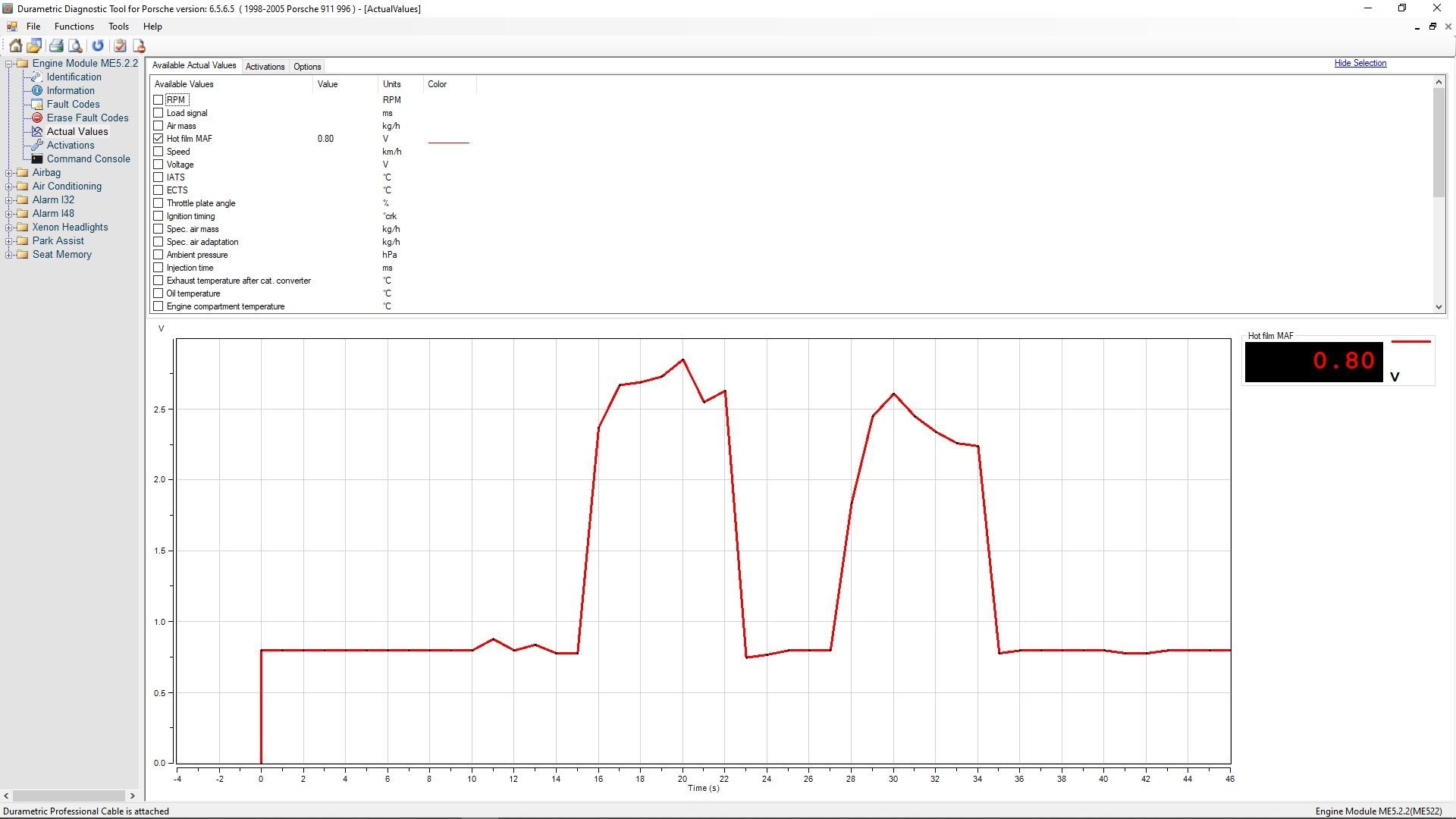
We conducted another test. With the ignition on, engine not running, and Durametric connected, we blew air across the sensor (like blowing out a candle). The result was a change in voltage as shown in the attached screen grab. I was pleased to observe that the ECU was at least able to show the Hot Film MAF value changing. Previous attempts at this same test did not change this value.
Here is my theory. This sensor looks functional to the ECU so it does not go into limp-in mode. However, the output (pin 5) is so far out of range that the engine won't run.
Also, remember that I was confused as to where the Air Mass data was coming from. I now believe that this data is the result of the ECU being in limp-in mode. The ECU would know about things like displacement, RPM, temperature, etc. With all that data it would be relatively easy to calculate an approximate value for Air Mass ... accurate enough to allow one to get home anyway.
This Builder Is Turning Heads With Its Slantnose 911 Creation
Slideshow: A small Polish tuner has reimagined the Porsche 911 Slantnose for the modern era, blending 1980s nostalgia with widebody tuning culture and serious performance upgrades.
Porsche 911 GT3 Artisan Edition Pays Homage to Japanese Culture
Slideshow: Porsche has created a Japan-only 911 GT3 Artisan Edition that blends track-ready hardware with design cues inspired by traditional Japanese craftsmanship.
Porsche Reveals Coupe Variant of the Electric Cayenne With a Fresh Look
Slideshow: Porsche's latest electric Cayenne Coupe blends dramatic styling with supercar acceleration, turning the brand's midsize SUV into a 1,139-horsepower flagship.


 P0102 code