When you click on links to various merchants on this site and make a purchase, this can result in this site earning a commission. Affiliate programs and affiliations include, but are not limited to, the eBay Partner Network.
The main oil pumps on m96/7 engines are some of the largest I have seen on passenger car engines...
Its common knowledge that spur gear pumps rotate at a maximum speeds of 3000rpm and can produce a max pressure of 3000 psi.
Our oil pumps are driven by the IMS and runs at 1/3 engine speed and have a by-pass/pressure valve to regulate pressure....( Gt3 has a by-pass valve and also has a safety valve set at 9 bar to keep from bursting the oil filter or worse if the by-pass valve fails)
Our oil return pumps are Gerotor style and driven by the camshafts at 1/2 engine speed...one in each head and they have no by-pass , so the values given are actual flow of oil/air at given speed/RPM less 15% efficiency loss
Here is the specs for the main oil pump in speeds, flow in cc per minute, flow in gallons per minute, flow in quarts per minute, flow in quarts per second ,actual flow given ( theoretical flow in parenthesis at 100% VE)
Engine speed (rpm) oil pump speed (rpm) CC's per min GPM QPM QPS
Remember that it is common to use oil pressure as a Proxi for oil flow. It is more accurate to say that the oil pressure is the "resistance to flow"( but doesn't always represent the amount of flow)....This means that at whatever RPM the oil pressure plateaus at, you can look at the flow chart above and see the actual maximum oil flow through the engine because the "resistance to flow" has caused the by-pass to open and no more increase in oil flow ...the flow will stabilize at that GPM....
Example ::#1 .. if your engine is fairly cold with 5w-50 and the oil pressure plateaus at 2k RPM because of resistance to flow , that will equal 3.9 gallons of oil going through the bearings per minute, and will stay at 3.9 gallons even at 4k RPM, the by-pass will just open more to allow the excess flow to recirculate back to the oil pump inlet.This means that 3.9 gallons is leaving the Sump and going through the bearings, but 7.8 gallons is going through the pump..( 3.9 gallons is recirculated back to the inlet side of the gears over and over and over)
Example #2:: ;; if your engine is hot with 5w-50 and the oil pressure finally plateaus at 6k RPM when the by-pass opens, this equals 11.7 gallons per minute of oil leaving the Sump and going through the oil pump and bearings...at 7k RPM the by-pass valve will be recirculating 1.9 gallons per minute...
I realize that it can get a lot more in depth than this, but didn't want to give TMI for various reasons..
Last edited by Porschetech3; Jul 20, 2023 at 04:59 AM.
I think you meant to say 2/3 engine speed. Does your flow data also need to get adjusted (doubled)?
Under racing conditions the flow of the scavenge pump is not known, because the oil in the heads is usually kept from the pump's inlets due to G force.
I think you meant to say 2/3 engine speed. Does your flow data also need to get adjusted (doubled)?
Yes, I think the flow numbers need to be doubled and if so it's quite incredible since the oil filters most people use are only rated for a max of 11 gallons per minute....I'll verify this...
Originally Posted by CTS
Under racing conditions the flow of the scavenge pump is not known, because the oil in the heads is usually kept from the pump's inlets due to G force.
Chris
I agree that under most circumstances, especially race/track conditions, the actual oil flow returned is not known due to it constantly changes per second with the vehicle dynamics.
What we do know is, what the maximum possible is.( actual volume flow per pump x 2 ) and it explains why "overfilling" makes such a big difference...More oil available to be returned simply means more oil gets returned....
And also explains why "some" engines show drops and some don't. An engine with loose cam bearings or 24 loose bores for the lifters for instance will have more oil volume leaving the sump, but under track conditions can't return enough oil unless it is "overfilled" so that more oil is available to return...
Last edited by Porschetech3; Jul 21, 2023 at 01:02 AM.
An engine with loose cam bearings or 24 loose bores for the lifters for instance will have more oil volume leaving the sump, but under track conditions can't return enough oil unless it is "overfilled" so that more oil is available to return...
I'm really sorry to hear that. Were you logging oil temp and pressure data by chance? Would you mind providing a few more details such as:
Oil:
Oil Fill Level:
Hours or miles since last change:
Sump:
Center Radiator?:
Tires:
Track:
Any details about the engine itself such as age, mileage etc.
Oil: Motul 300V 15w-50
Oil Fill Level: Roughly halfway u the stick. Anymore and it can smoke. This is with 2qt deep sump
Hours on oil: Roughly 5 hours
Sump: BRS 2qt, EBS X51 style baffle with horizontal plate, 997 return tubes
Center Radiator: Yes, 3 CSF Rads
Tires: Federal FZ 201-M (comparable to NT01)
Track: Watkins Glen
Engine was used when I got it, so not sure on mileage. Its from a 2001 boxster S.
Fwiw, I see regular oil pressure drops down to 15 psi in many turns. Most times its while off the throttle or maintenance throttle. At WGI of course, going up the toe of the boot and around the carousel, you are full throttle early and there pressure was low. So if I'm honest, this is likely the combination of a thousand cuts (laps) causing eventual damage.
Oil: Motul 300V 15w-50
Oil Fill Level: Roughly halfway u the stick. Anymore and it can smoke. This is with 2qt deep sump
Hours on oil: Roughly 5 hours
Sump: BRS 2qt, EBS X51 style baffle with horizontal plate, 997 return tubes
Center Radiator: Yes, 3 CSF Rads
Tires: Federal FZ 201-M (comparable to NT01)
Track: Watkins Glen
Engine was used when I got it, so not sure on mileage. Its from a 2001 boxster S.
Fwiw, I see regular oil pressure drops down to 15 psi in many turns. Most times its while off the throttle or maintenance throttle. At WGI of course, going up the toe of the boot and around the carousel, you are full throttle early and there pressure was low. So if I'm honest, this is likely the combination of a thousand cuts (laps) causing eventual damage.
The main oil pumps on m96/7 engines are some of the largest I have seen on passenger car engines...
Its common knowledge that spur gear pumps rotate at a maximum speeds of 3000rpm and can produce a max pressure of 3000 psi.
Our oil pumps are driven by the IMS and runs at 1/3 engine speed and have a by-pass/pressure valve to regulate pressure....( Gt3 has a by-pass valve and also has a safety valve set at 9 bar to keep from bursting the oil filter or worse if the by-pass valve fails)
Our oil return pumps are Gerotor style and driven by the camshafts at 1/2 engine speed...one in each head and they have no by-pass , so the values given are actual flow of oil/air at given speed/RPM less 15% efficiency loss
Here is the specs for the main oil pump in speeds, flow in cc per minute, flow in gallons per minute, flow in quarts per minute, flow in quarts per second ,actual flow given ( theoretical flow in parenthesis at 100% VE)
Engine speed (rpm) oil pump speed (rpm) CC's per min GPM QPM QPS
Remember that it is common to use oil pressure as a Proxi for oil flow. It is more accurate to say that the oil pressure is the "resistance to flow"( but doesn't always represent the amount of flow)....This means that at whatever RPM the oil pressure plateaus at, you can look at the flow chart above and see the actual maximum oil flow through the engine because the "resistance to flow" has caused the by-pass to open and no more increase in oil flow ...the flow will stabilize at that GPM....
Example ::#1 .. if your engine is fairly cold with 5w-50 and the oil pressure plateaus at 2k RPM because of resistance to flow , that will equal 3.9 gallons of oil going through the bearings per minute, and will stay at 3.9 gallons even at 4k RPM, the by-pass will just open more to allow the excess flow to recirculate back to the oil pump inlet.This means that 3.9 gallons is leaving the Sump and going through the bearings, but 7.8 gallons is going through the pump..( 3.9 gallons is recirculated back to the inlet side of the gears over and over and over)
Example #2:: ;; if your engine is hot with 5w-50 and the oil pressure finally plateaus at 6k RPM when the by-pass opens, this equals 11.7 gallons per minute of oil leaving the Sump and going through the oil pump and bearings...at 7k RPM the by-pass valve will be recirculating 1.9 gallons per minute...
I realize that it can get a lot more in depth than this, but didn't want to give TMI for various reasons..
I haven’t done the math, but generally speaking, do the scavenge pump flow more oil than the oil pump is delivering to the engine? I would assume an engine design would be setup so that scavenge pump volume is always greater than what a main oil pump can deliver.
An aside: hasn’t Porsche since changed to variable oil pump designs (997 maybe and later) so that less oil is bypassed and therefore more fuel efficient and less horsepower loss at high speed?
With a static design like my 996.1 engine, there are tradeoffs such as possible oil delivery issues at cold start and cold idle at lower RPMs, which is why my tensioners and chains rattle unless I drive off and keep revs at 2,000-3,000. Hot idle on my car is only 675RPM, which I think is fine for fuel economy, but not ideal for owners who start their car and let it idle to warm up.
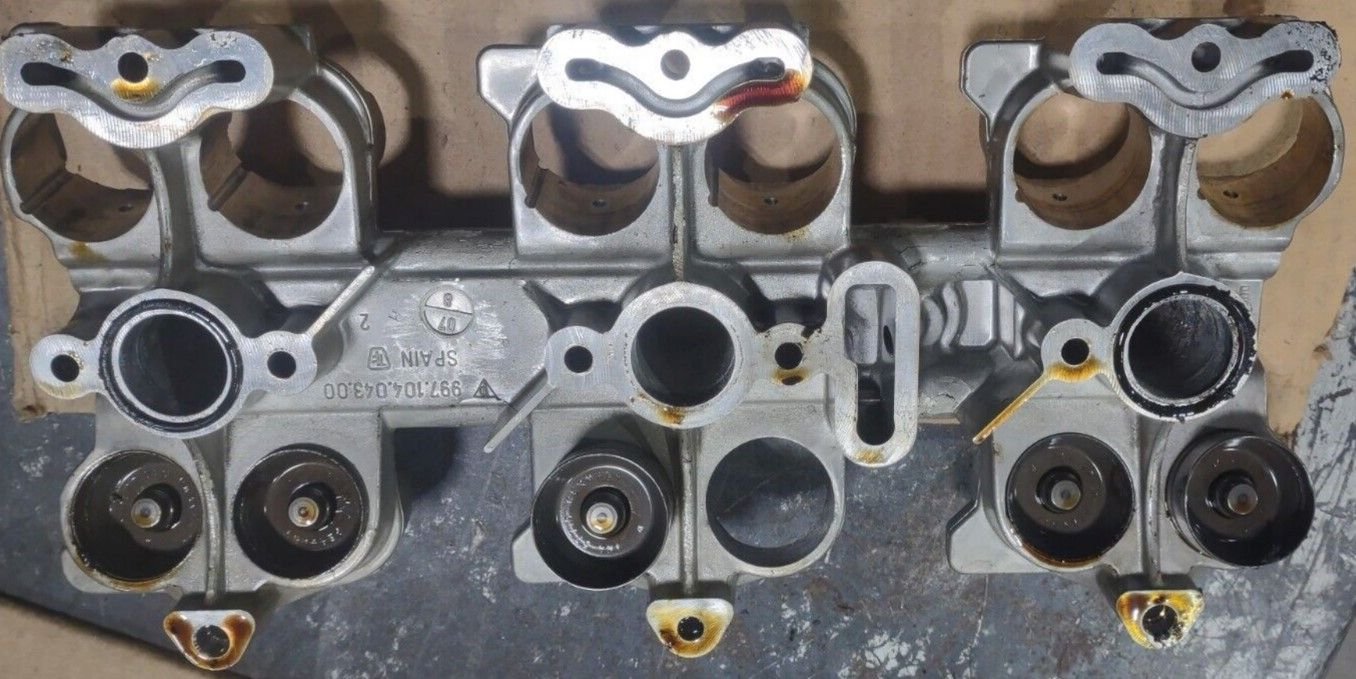
Restricting oil flow to lifters will certainly reduce churn. Here's the carrier for the 3.6l engine and the head with mating surfaces. Where would the limiter go? Also, this oil channel feeds the variocam solenoid and feeds something in the top of the heads. Need to make sure these don't require higher flow before modifying. The other question is, how much restriction is too much? At some point the flow will be low enough to not maintain pressure in the lifter. Seems it would need to be determined empirically.
From discussion about scavenge pump max volume and the pump always turning fast enough to pump that volume. Then thinking about how oil can get hung up in the head and the pump being fed oil in bits and drabs, then a flood, all I can see coming out of the pump is foam. The only time you would get clean oil pumping is if the inlet is always filled with oil, similar to the pickup tube in the sump. Overfilling to assure this would be the only way to get clean oil back to the sump.
Oil: Motul 300V 15w-50
Oil Fill Level: Roughly halfway u the stick. Anymore and it can smoke. This is with 2qt deep sump
Hours on oil: Roughly 5 hours
Sump: BRS 2qt, EBS X51 style baffle with horizontal plate, 997 return tubes
Center Radiator: Yes, 3 CSF Rads
Tires: Federal FZ 201-M (comparable to NT01)
Track: Watkins Glen
Engine was used when I got it, so not sure on mileage. Its from a 2001 boxster S.
Fwiw, I see regular oil pressure drops down to 15 psi in many turns. Most times its while off the throttle or maintenance throttle. At WGI of course, going up the toe of the boot and around the carousel, you are full throttle early and there pressure was low. So if I'm honest, this is likely the combination of a thousand cuts (laps) causing eventual damage.
Quadcammer - sorry if I missed this, but which AOS were you running (stock, Motorsports, UAOS)?
I haven’t done the math, but generally speaking, do the scavenge pump flow more oil than the oil pump is delivering to the engine? I would assume an engine design would be setup so that scavenge pump volume is always greater than what a main oil pump can deliver.
On the m96/m97 there is 7 main bearings, 6 rod bearings, and 6 piston squirters in the "bottom end" and in the "top end" there is 16 cam bearings , 24 lifters, 3 chain tensioners ,and vario-cam actuators...Plus 1 end of the IMS that gets oil
The " bottom end" just drains down to the sump with gravity force ( doesn't go to the return pumps)and yes it has oil scrapers and windage trays and is well away from any sump oil as to not effect horsepower or to whip up the oil as with any proper set-up, the "top end" oil is what goes to the return pumps to get back to the Sump...
The general rule of thumb for bearing clearance lubrication is one thousandths clearance for every one inch of journal diameter...the journal size in the bottom end is much bigger than any journal size in the top end, so you will have about 60% of the oil volume going to the bottom end and just gravity force draining it back to the sump and about 40% of the oil volume going into the top end that must be pumped back to the sump by the two return pumps...( If the bearing clearance is to spec or built to spec).
And yes, restricting the oil flow to the top end as shown here by Apex996 designed by CTS is a good idea when building a race engine and most/all race engines have restricted top end oiling..
On simple push rod motors you can buy restricted push rods in .020" , .030", .040", and .050" restrictions, stock is .100"..Back in the old days before these products were available we used to cut "pipe cleaners" and stuff them into the push rods to restrict them..
Last edited by Porschetech3; Jul 22, 2023 at 04:49 PM.