


Resonance flap delete?

Thread Starter
Racer

Joined: Oct 2016
Posts: 367
Likes: 95
From: cote du rhone
 Resonance flap delete?
Hi all,
Been searching the forum for some information if there is any real downside to removing it from the m96 engine. I'm thinking of the flap that sits in the tube which connects left and right side intake. Looking at the x51 kit for the 997 the resonance flap seams to have been removed (just google '997 x51 plenum' and pictures will appear).
While searching the forum there seams to be more evidence it's beneficial to remove it rather than keep it for 993 and 964 at least.
Been searching the forum for some information if there is any real downside to removing it from the m96 engine. I'm thinking of the flap that sits in the tube which connects left and right side intake. Looking at the x51 kit for the 997 the resonance flap seams to have been removed (just google '997 x51 plenum' and pictures will appear).
While searching the forum there seams to be more evidence it's beneficial to remove it rather than keep it for 993 and 964 at least.

Rennlist Member

Joined: Aug 2006
Posts: 9,213
Likes: 1,907
From: Chicago, IL
I didn’t know of a resonance flap in the intake, only the resonator box on the air box, which is safe to remove of done properly.
If there is a flap in the intake, I’m guessing you don’t want to mess with it.
If there is a flap in the intake, I’m guessing you don’t want to mess with it.

Three Wheelin'
Joined: Aug 2018
Posts: 1,968
Likes: 228
Hi all,
Been searching the forum for some information if there is any real downside to removing it from the m96 engine. I'm thinking of the flap that sits in the tube which connects left and right side intake. Looking at the x51 kit for the 997 the resonance flap seams to have been removed (just google '997 x51 plenum' and pictures will appear).
While searching the forum there seams to be more evidence it's beneficial to remove it rather than keep it for 993 and 964 at least.
Been searching the forum for some information if there is any real downside to removing it from the m96 engine. I'm thinking of the flap that sits in the tube which connects left and right side intake. Looking at the x51 kit for the 997 the resonance flap seams to have been removed (just google '997 x51 plenum' and pictures will appear).
While searching the forum there seams to be more evidence it's beneficial to remove it rather than keep it for 993 and 964 at least.

Rennlist Member
Joined: Oct 2010
Posts: 7,704
Likes: 6,980
From: Alabama USA
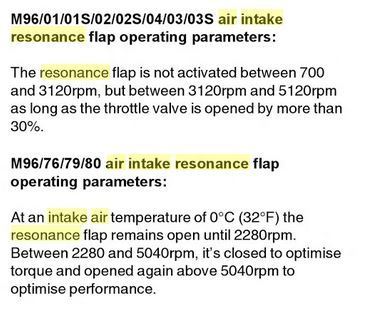
That butterfly changes the intake resonance (length of time and intensity sound pulse pressures to bounce from intake valve to atmosphere and back), long resonance promotes low rpm cylinder filling, short resonance promotes high RPM cylinder filling. It makes a 2 stage intake system, instead of being optimized at just one rpm, it is optimized at two.
Don't eliminate it..
Don't eliminate it..
Burning Brakes
Joined: Feb 2013
Posts: 776
Likes: 59
Originally Posted by Porschetech3
That butterfly changes the intake resonance (length of time and intensity sound pulse pressures to bounce from intake valve to atmosphere and back), long resonance promotes low rpm cylinder filling, short resonance promotes high RPM cylinder filling. It makes a 2 stage intake system, instead of being optimized at just one rpm, it is optimized at two.
Don't eliminate it..
Don't eliminate it..
What do you know about the helmholts resonator in the airbox, I did the delete then reversed it as I thought it ruined the throttle response , maybe I imagined it but it also effects resonance , or is it just to quieten the intake roar ??
Thanks Lee
Trending Topics
Rennlist Member
Joined: Oct 2010
Posts: 7,704
Likes: 6,980
From: Alabama USA
It definitely cancels the sound, and smooths the air pulses some, but the pulses are what "ram tunes" the intake , so pulses are good if timed properly, I have driven mine plugged and unplugged and can't feel the difference. never dyno tested them though.
Rennlist Stories
The Best Porsche Posts for Porsche Enthusiasts
9 Features and Characteristics That Only Porsche People Understand
Verdad Gallardo
I've Written 500 Rennlist Articles: Here's How Porsche Has Changed Along the Way
Joe Kucinski
10 Most Unnecessary Porsches Ever Built (And Why We Love Them)
Verdad Gallardo
Porsche 911 GT3 S/C vs 718 Spyder RS: 10 Categories, One Winner
Joe Kucinski
This Builder Is Turning Heads With Its Slantnose 911 Creation
Verdad Gallardo
Porsche 911 GT3 Artisan Edition Pays Homage to Japanese Culture
Verdad Gallardo
Porsche Reveals Coupe Variant of the Electric Cayenne With a Fresh Look
Verdad Gallardo
10 Porsche Colors That Have More Personality Than Most People
Verdad Gallardo
Guntherwerks' Final Speedster Creation Is the Ultimate Porsche Restomod
Verdad Gallardo
Three Wheelin'
Joined: May 2019
Posts: 1,739
Likes: 426
From: USA/Oregon
There was similar issue with the Honda S2000,, it had a tuned resonance intake air box,, and folks used ot delete it and do a CAI thinking they were getting more power,, turns out that removing the factory air box typically cost 5 to 10HP IIRC..  Honda spend cubic dollars developing the S2K engine and air system, and it showed.
Honda spend cubic dollars developing the S2K engine and air system, and it showed.
Thread Starter
Racer
Joined: Oct 2016
Posts: 367
Likes: 95
From: cote du rhone
Thanks for the replies.
When looking at the intake it seams not that optimised. When closing the flap the intake takes the shape of a horse shoe, and all cylinders on one bank have different (not the same) intake length. This would mean that only one cylinder would have optimal length at any time and it also means that the two others are running lean/rich since the full bank is regulated togheter, not single cylinders. And the fact that Porsche them self deleted it for the 997 X51 kit tells me that they found it not-that-useful. Deleting it on the 997 gives no CEL.
The flap have no DME feedback(at least on year 2000 model) so I highly doubt that it would give a specific CEL. I'm thinking of removing just the metal flap(it's fixated with two screws), not the whole mechanism. The only way for the DME to notice the absence of it would be via fuelling. Since many things can affect fuelling it can't distinguish if it's the flap or not which causes the fuelling difference. Hence, no specific CEL for the flap.
I have the intake off the car at the moment and noticed that the fauling from old oil was different on different cylinder intake(on the alu part which the injectors are attached to) leading me to think that they aren't getting the same amount of air. Then looking at the intake it's not symmetrical and becomes less symmetrical when the flap is closed. Have a look at the 993 Varioram system. That is better designed, symmetrical and matched intake length to all cylinders.
My concern with the current design is that it may cause lean running on certain cylinders, causing them to run too hot.
A lot of technical discussion on Rennlist goes like 'Don't change it, you car will blow up' or 'I think......but I have no idea actually'. Please, if you have knowledge and/or have experimented with this, please reply, otherwise refrain.
When looking at the intake it seams not that optimised. When closing the flap the intake takes the shape of a horse shoe, and all cylinders on one bank have different (not the same) intake length. This would mean that only one cylinder would have optimal length at any time and it also means that the two others are running lean/rich since the full bank is regulated togheter, not single cylinders. And the fact that Porsche them self deleted it for the 997 X51 kit tells me that they found it not-that-useful. Deleting it on the 997 gives no CEL.
The flap have no DME feedback(at least on year 2000 model) so I highly doubt that it would give a specific CEL. I'm thinking of removing just the metal flap(it's fixated with two screws), not the whole mechanism. The only way for the DME to notice the absence of it would be via fuelling. Since many things can affect fuelling it can't distinguish if it's the flap or not which causes the fuelling difference. Hence, no specific CEL for the flap.
I have the intake off the car at the moment and noticed that the fauling from old oil was different on different cylinder intake(on the alu part which the injectors are attached to) leading me to think that they aren't getting the same amount of air. Then looking at the intake it's not symmetrical and becomes less symmetrical when the flap is closed. Have a look at the 993 Varioram system. That is better designed, symmetrical and matched intake length to all cylinders.
My concern with the current design is that it may cause lean running on certain cylinders, causing them to run too hot.
A lot of technical discussion on Rennlist goes like 'Don't change it, you car will blow up' or 'I think......but I have no idea actually'. Please, if you have knowledge and/or have experimented with this, please reply, otherwise refrain.


Rennlist Member
Joined: Aug 2006
Posts: 9,213
Likes: 1,907
From: Chicago, IL
If the design goal is equal distribution of power across the cylinders, perhaps unequal length is how they achieve it?
In this case, I’m not a fluidynamics expert, and it’s complicated. Someone with powerful software and some time could probably redesign this engine to have better airflow given today’s parameters. After all, it’s been 20 years. That said, Porsche designers have also had 20 years, and that’s why they are creating engines that make 500-700HP and can somehow still pass emissions regulations.


Captain Obvious
Super User
Super User
Joined: Aug 2003
Posts: 22,846
Likes: 348
From: Cambridge, Ontario, Canada