

Flush Console Project Description


Nordschleife Master
Joined: Feb 2011
Posts: 8,199
Likes: 409

As to the lighter socket idea, why not just a USB port? Almost everything uses USB, and it's compact. You could easily add two.
Thread Starter
Basic Sponsor
Rennlist
Site Sponsor
Rennlist
Site Sponsor

Joined: Mar 2010
Posts: 812
Likes: 130
Actually I think it is a form of vinyl. I think the original consoles are made in a mold that has the reverse texture of the outer surface of the console. Then I think they spray the inside of the old with a heavy layer of vinyl, then put the plastic framework in it and finally inject it with some kind of rigid foam.
The consoles that are covered with leather by the factory are to ones that did not come out of the mold in perfect condition. They fixed the defects in them and then covered them in leather.
At least that is what I think.
__________________
ReDesign by FEATHER
by Jerry Feather
Producer for 928 of:
-Hatch Latch Receiver Liner--All Versions
-Replacement Heavy Duty Spare Tire Cover
-Flush Center Console Conversion
-Cowl Cover, Cowl Seal, & Shell Stickers--All versions
(RHD included)
-Aluminum Gas Cap Ratcheting Pawl
ReDesign by FEATHER
by Jerry Feather
Producer for 928 of:
-Hatch Latch Receiver Liner--All Versions
-Replacement Heavy Duty Spare Tire Cover
-Flush Center Console Conversion
-Cowl Cover, Cowl Seal, & Shell Stickers--All versions
(RHD included)
-Aluminum Gas Cap Ratcheting Pawl
Thread Starter
Basic Sponsor
Rennlist
Site Sponsor
Rennlist
Site Sponsor
Joined: Mar 2010
Posts: 812
Likes: 130
That is a good idea. I probably won't do it for myself, but I might put something like that inside my taller center console arm rest glove box. The first one of those I made is actually finished in this same leather and is inside the Silver S4.

Rennlist Member
Joined: Nov 2008
Posts: 161
Likes: 22
From: Toronto
console
I would love this for my car in any form you send it out, bare plastic or covered, I have my head unit already, just need to pull the console
please let me know when you are happy enough to send out pieces....
please let me know when you are happy enough to send out pieces....
Thread Starter
Basic Sponsor
Rennlist
Site Sponsor
Rennlist
Site Sponsor
Joined: Mar 2010
Posts: 812
Likes: 130
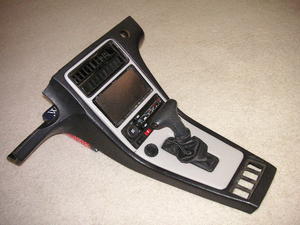
You probably feel like I do, that we are now at a significant mile post in this project. I even put one of the pictures in my Avatar to sort of celebrate.
You will probably notice, if you look back, that I have marked most of what is in the checklist I published on page three of this thread, as DONE. Now I think it is time for a new checklist. The items not completed in the previous one are included in this new one:
SECOND CHECLKLIST
1. Cut out rear AC control holes in leather and install controls with new plastic washers in back for spacers in place of the clock body in the original trim piece. (Requires four 3/16 inch spacers having a 1 inch hole, two for each side, in order the make up the thickness of the clock frame and of the original trim piece.) (DONE)
2. Refinish blocking in upper insert and install both AC Panels. (DONE)
3. Drill some large holes in NAV unit tray/rack for cooling. (DONE)
4. locate NAV unit in insert and in Console with tray/rack and mount rack in console with tiny flat head screws. (DONE)
5. Fabricate shifter boot base. (DONE)
6. Fabricate shifter boot. (DONE)
7. Assemble boot and base together and screw into lower insert. (DONE)
8. Finish out repairs to lower console mounting points.
8A. Fabricate, locate and install a substitute cross brace for the area at about the joint of the two inserts, or just below there, then remove the remaining plastic one still there, since it will be in the way of the AC panels. (DONE)
9. Test fit empty console in car.
10. Determine what under-console items need to be relocated for spacing of Nav unit and new location of other components, if any. ( See Keith Widom's thread.)
11. Move under-console items as necessary.
12. Study Nav unit installation instructions.
13. Permanently install console with NAV unit mounted in it.
14. Complete installation of the NAV unit. (This will have its own lengthly checklist and will not be covered further in this thread.) (You may need to hire professional help with this.)
15. Design and fabricate new method of connecting AC control panel to car's wiring harness.
16. Fabricate, locate, and install new air vent duct to face of air box under dash. (This Step is out of order and should be done before the permanent installation of the Console in the car as suggested above in Step 13.)
17. Clean out foam seal channel in back of air vent and install new seal material.
18. Install upper insert and complete connections.
19. Connect and install lower insert with boot installed.
20. Reinstall shifter handle and work top of boot up over bottom of handle. Fix it there by some method. (I haven't quite figured this out yet.)
21. Commence testing.
You will probably notice, if you look back, that I have marked most of what is in the checklist I published on page three of this thread, as DONE. Now I think it is time for a new checklist. The items not completed in the previous one are included in this new one:
SECOND CHECLKLIST
1. Cut out rear AC control holes in leather and install controls with new plastic washers in back for spacers in place of the clock body in the original trim piece. (Requires four 3/16 inch spacers having a 1 inch hole, two for each side, in order the make up the thickness of the clock frame and of the original trim piece.) (DONE)
2. Refinish blocking in upper insert and install both AC Panels. (DONE)
3. Drill some large holes in NAV unit tray/rack for cooling. (DONE)
4. locate NAV unit in insert and in Console with tray/rack and mount rack in console with tiny flat head screws. (DONE)
5. Fabricate shifter boot base. (DONE)
6. Fabricate shifter boot. (DONE)
7. Assemble boot and base together and screw into lower insert. (DONE)
8. Finish out repairs to lower console mounting points.
8A. Fabricate, locate and install a substitute cross brace for the area at about the joint of the two inserts, or just below there, then remove the remaining plastic one still there, since it will be in the way of the AC panels. (DONE)
9. Test fit empty console in car.
10. Determine what under-console items need to be relocated for spacing of Nav unit and new location of other components, if any. ( See Keith Widom's thread.)
11. Move under-console items as necessary.
12. Study Nav unit installation instructions.
13. Permanently install console with NAV unit mounted in it.
14. Complete installation of the NAV unit. (This will have its own lengthly checklist and will not be covered further in this thread.) (You may need to hire professional help with this.)
15. Design and fabricate new method of connecting AC control panel to car's wiring harness.
16. Fabricate, locate, and install new air vent duct to face of air box under dash. (This Step is out of order and should be done before the permanent installation of the Console in the car as suggested above in Step 13.)
17. Clean out foam seal channel in back of air vent and install new seal material.
18. Install upper insert and complete connections.
19. Connect and install lower insert with boot installed.
20. Reinstall shifter handle and work top of boot up over bottom of handle. Fix it there by some method. (I haven't quite figured this out yet.)
21. Commence testing.
Last edited by ReDesign by FEATHER; Jan 13, 2014 at 09:37 AM. Reason: add a step and clarification


Thread Starter
Basic Sponsor
Rennlist
Site Sponsor
Rennlist
Site Sponsor
Joined: Mar 2010
Posts: 812
Likes: 130
Thanks, Tom.
I haven't done much today on this, but I did get some plastic washers finished up so I could mount the rear AC controls. Here are a couple of pictures.
You might notice that the back of the **** bezels or trim rings, whatever they are, is curved to match the surface of the original trim piece. They match the curvature of the new trim piece very well.
Maybe later I'll get to work on the shifter boot base and give some thought to the shape and size of the boot itself.
I haven't done much today on this, but I did get some plastic washers finished up so I could mount the rear AC controls. Here are a couple of pictures.
You might notice that the back of the **** bezels or trim rings, whatever they are, is curved to match the surface of the original trim piece. They match the curvature of the new trim piece very well.
Maybe later I'll get to work on the shifter boot base and give some thought to the shape and size of the boot itself.
Thread Starter
Basic Sponsor
Rennlist
Site Sponsor
Rennlist
Site Sponsor
Joined: Mar 2010
Posts: 812
Likes: 130
I think I found the place to put the cross brace I have listed in step 8A in the SECOND CHECKLIST above. And, I think I know how and what to make it out of.
The NAV Tray/Rack is going to form one bit of cross bracing when it is permanently mounted in place, but I want a second brace of some sort at a different location. This bracing is somewhat important in order to keep the console from "splaying" itself open over time, since we are removing all of the original cross members with this conversion.
I think I will make the second brace out of a quarter inch, or maybe 3/8 inch, aluminum round bar cut and trimmed to just the right length and then drilled and tapped in each end so it can simply be screwed into place as shown in the picture:
The NAV Tray/Rack is going to form one bit of cross bracing when it is permanently mounted in place, but I want a second brace of some sort at a different location. This bracing is somewhat important in order to keep the console from "splaying" itself open over time, since we are removing all of the original cross members with this conversion.
I think I will make the second brace out of a quarter inch, or maybe 3/8 inch, aluminum round bar cut and trimmed to just the right length and then drilled and tapped in each end so it can simply be screwed into place as shown in the picture:
Thread Starter
Basic Sponsor
Rennlist
Site Sponsor
Rennlist
Site Sponsor
Joined: Mar 2010
Posts: 812
Likes: 130
It isn't much, but I did fab two shifter boot bases. I'm making two because I have decided to make one boot in gray and one in black so I can later decide which one I like best; or I suppose I can make it convertible and switch over from one to the other from time to time.
I used my large uni-bit to make the opening holes then used my disc sander to cut through to connect the holes then used it to finish the inside edges of the openings.
I'll use the sander to grind out the space between the holes in the insert in the same manner when I get to it.
I made these out of quarter inch ABS from a piece I had around here. I don't have much of that, but I think the 3/16 that I have so much of from spare tire cover fabrication, is just not heavy enough.
Before I put the boots on these I will test fit them with a piece of leather over all four edges just to be sure that I have allowed enough space for it. If not I can grind them down a little more with my sander.
After the boots are fabbed and attached with contact cement (leather to plastic) I'll locate and drill about 8 holes from under the insert and into the boot base that I can put screws in to mount the boots.
I might see if Doug is at work this evening and if so I might go over and have him help me work the boot up.
I used my large uni-bit to make the opening holes then used my disc sander to cut through to connect the holes then used it to finish the inside edges of the openings.
I'll use the sander to grind out the space between the holes in the insert in the same manner when I get to it.
I made these out of quarter inch ABS from a piece I had around here. I don't have much of that, but I think the 3/16 that I have so much of from spare tire cover fabrication, is just not heavy enough.
Before I put the boots on these I will test fit them with a piece of leather over all four edges just to be sure that I have allowed enough space for it. If not I can grind them down a little more with my sander.
After the boots are fabbed and attached with contact cement (leather to plastic) I'll locate and drill about 8 holes from under the insert and into the boot base that I can put screws in to mount the boots.
I might see if Doug is at work this evening and if so I might go over and have him help me work the boot up.
Thread Starter
Basic Sponsor
Rennlist
Site Sponsor
Rennlist
Site Sponsor
Joined: Mar 2010
Posts: 812
Likes: 130
Doug wasn't working last evening so I didn't go over. I did spend a little time working up a tentative pattern for the shifter boot since I don't remember exactly what I had done with that before and don't recall making a pattern; or at least I have no idea where it might be.
I also have figured out a way to finish the top of the boot where it mates to the bottom of the shifter handle for the Automatic cars, and how to fasten it. I'm not sure yet what I'm going to do with the 5-Speed ones. I think I have also figured out a way to stitch the boot up the front in such a way that will pass for a french seam all the way up.
Another problem that I have been working on is how to connect the HVAC control panel to its original five pin female connector. With the panel moved to its new lower position and into the insert rather than the console, the upper one or maybe two of the male pins on the side of it where the five pin femal connector connects are too close to the side of the insert for the connector to fit. Too, I am not yet sure that the connector will even reach to the new location.
One thought I have had is to make some short jumper wires with mating connectors on each end so that both issues will be resolved. The problem with that is that I annnot find any source for female wire connectors that are in the right angle or flag configuration so that at least the upper two can be connected under the edge or the side of the insert. The size is consistent with Bullet connectors that are .156 or .157 in diameter, which is very close to 5/32 and to 4mm. There is an abundance of straight connectors that would fit the male pins on the side of the Panel, but none that I can find that are in the right angle configuration, similar to the ones called "flag" in respect to the flat or spade style of connector. Straight wont work.
There are perhaps several other ways to do this, but it may be that the best way will be to take the female connector in the car apart and remove the wires so that the upper two can be put individualy onto the male pins, and then perhaps grind the upper end off of the body of the connector and put it back together with the other three female connectors inside so it can be plugged in that way. The female ends on the wires inside of the female connector are actually in the right angle configuration, so it might be the simplest way to go. It may involve grinding the barrel of the upper two connectors a little shorter so that they can be slipped up into positon, but we will see.
I still like the idea of the short jumper wires the best.
I also have figured out a way to finish the top of the boot where it mates to the bottom of the shifter handle for the Automatic cars, and how to fasten it. I'm not sure yet what I'm going to do with the 5-Speed ones. I think I have also figured out a way to stitch the boot up the front in such a way that will pass for a french seam all the way up.
Another problem that I have been working on is how to connect the HVAC control panel to its original five pin female connector. With the panel moved to its new lower position and into the insert rather than the console, the upper one or maybe two of the male pins on the side of it where the five pin femal connector connects are too close to the side of the insert for the connector to fit. Too, I am not yet sure that the connector will even reach to the new location.
One thought I have had is to make some short jumper wires with mating connectors on each end so that both issues will be resolved. The problem with that is that I annnot find any source for female wire connectors that are in the right angle or flag configuration so that at least the upper two can be connected under the edge or the side of the insert. The size is consistent with Bullet connectors that are .156 or .157 in diameter, which is very close to 5/32 and to 4mm. There is an abundance of straight connectors that would fit the male pins on the side of the Panel, but none that I can find that are in the right angle configuration, similar to the ones called "flag" in respect to the flat or spade style of connector. Straight wont work.
There are perhaps several other ways to do this, but it may be that the best way will be to take the female connector in the car apart and remove the wires so that the upper two can be put individualy onto the male pins, and then perhaps grind the upper end off of the body of the connector and put it back together with the other three female connectors inside so it can be plugged in that way. The female ends on the wires inside of the female connector are actually in the right angle configuration, so it might be the simplest way to go. It may involve grinding the barrel of the upper two connectors a little shorter so that they can be slipped up into positon, but we will see.
I still like the idea of the short jumper wires the best.
Last edited by ReDesign by FEATHER; Jan 9, 2014 at 10:39 AM.
Thread Starter
Basic Sponsor
Rennlist
Site Sponsor
Rennlist
Site Sponsor
Joined: Mar 2010
Posts: 812
Likes: 130
I have the things together that I'll need to take over to Doug's to work up the shifter boots. The pattern shown here is for half of the boot and will be stitched up in the front along the curved edge to the top. The top will be hemmed and will become a slot for what I have in mind to fasten it to the shifter handle.
I also have gathered up both the shifter handle from the Silver 928, which is an aftermarket simulated carbon fiber style, and one of the original handles, I think from my first S4. I notice that the bottoms are significantly different in shape, size and design, so I am going to have to adjust the pattern depending on which handle a user might have; assuming that one or more of the versions of any "kit" we come up with will include a boot.
The shape of the boot pattern is kind of odd, but I remember that there is a limitation on how much leather can be bunched up in front of the shifter when in the most foreward position. It can't be much as I recall, and I think only the two layers that I think this design will allow for; that is two layers, but including the seam up the front.
This shifter boot pattern is also somewhat taller than the one I recall doing before for Jimmy, but I don't think that will cause a problem with it kind of bunching up below the handle.
I have also test fit the boot base into the shifter recess to be sure that I have allowed enough space for the leather around the boot. It think these boots are just right. You might also notice that I have cut a sort of notch in the very front of the shifter bases with a rasp. That is to allow for the extra thickness of the leather at the seam up the front.
I have the gray leather and another black hide loaded in my truck ready for the trip to Doug's. The other hide is a little thinner and softer than the leather shown here. The leather shown here is a little heavier and is a more flat form/color of black than the other which is kind of glossy. I'm not sure yet which one I'll be using; but I think this more flat black will match the console and other black plastic or vinyl in the car better than the more glossy black.
I also have gathered up both the shifter handle from the Silver 928, which is an aftermarket simulated carbon fiber style, and one of the original handles, I think from my first S4. I notice that the bottoms are significantly different in shape, size and design, so I am going to have to adjust the pattern depending on which handle a user might have; assuming that one or more of the versions of any "kit" we come up with will include a boot.
The shape of the boot pattern is kind of odd, but I remember that there is a limitation on how much leather can be bunched up in front of the shifter when in the most foreward position. It can't be much as I recall, and I think only the two layers that I think this design will allow for; that is two layers, but including the seam up the front.
This shifter boot pattern is also somewhat taller than the one I recall doing before for Jimmy, but I don't think that will cause a problem with it kind of bunching up below the handle.
I have also test fit the boot base into the shifter recess to be sure that I have allowed enough space for the leather around the boot. It think these boots are just right. You might also notice that I have cut a sort of notch in the very front of the shifter bases with a rasp. That is to allow for the extra thickness of the leather at the seam up the front.
I have the gray leather and another black hide loaded in my truck ready for the trip to Doug's. The other hide is a little thinner and softer than the leather shown here. The leather shown here is a little heavier and is a more flat form/color of black than the other which is kind of glossy. I'm not sure yet which one I'll be using; but I think this more flat black will match the console and other black plastic or vinyl in the car better than the more glossy black.
Thread Starter
Basic Sponsor
Rennlist
Site Sponsor
Rennlist
Site Sponsor
Joined: Mar 2010
Posts: 812
Likes: 130
I have been trying to include a lot of details about this project in this thread and showing much of it with pictures. The main reasons are first that there are several individuals who expressed the desire to have some kind of basic starter kit in order to do this conversion on their own, so I think it will be helpful to show much of the process here because I really don't expect to provide a lengthy set of instructions with such a basic kit. The other reason is probably the same, but that is to show those who had expected to do this conversion on their own just what is actually involved in order for them to determine if they are actually equiped and capable of doing it on their own.
There are, however, some details that I am probably leaving out, not on purpose, but just because they sort of happen as it goes along and I neglect to make note of them. One of those is shown in the picture I have in this post of the front surface of the lower insert. Here I show where I have cut two notches in the front panel of the insert, one at each end. The purpose of those is to allow more flexibility in the sides of the insert which must flex inward in order to install that insert after the upper insert is in place.
I had been installing the lower insert in the console during this project mainly by placing it in the console much foreward of its final location and then sliding it rearward into its position. That works fine and does not involve much flex of the sides of the insert. However, in future practice the upper insert will likely always be in place, so the lower insert will need to be inserted and removed vertically from its position, so the sides need to flex more.
This is a simple detail, but one worth including here.
There are, however, some details that I am probably leaving out, not on purpose, but just because they sort of happen as it goes along and I neglect to make note of them. One of those is shown in the picture I have in this post of the front surface of the lower insert. Here I show where I have cut two notches in the front panel of the insert, one at each end. The purpose of those is to allow more flexibility in the sides of the insert which must flex inward in order to install that insert after the upper insert is in place.
I had been installing the lower insert in the console during this project mainly by placing it in the console much foreward of its final location and then sliding it rearward into its position. That works fine and does not involve much flex of the sides of the insert. However, in future practice the upper insert will likely always be in place, so the lower insert will need to be inserted and removed vertically from its position, so the sides need to flex more.
This is a simple detail, but one worth including here.
Thread Starter
Basic Sponsor
Rennlist
Site Sponsor
Rennlist
Site Sponsor
Joined: Mar 2010
Posts: 812
Likes: 130
I finally got over to Doug's place to work on the shifter boots. I first worked one up in the gray that I used to cover the inserts, and that one worked out so-so. Then I changed the pattern a little and worked one up in black and that one is quite a bit better. I think with a few of these and Doug's help with the sewing I will be able to get the pattern and the procedure down pretty good.
I will have to see how one of these, probably the black one, will work out in real life when I get some of this put into the car.
The pictures are in two posts.
I will have to see how one of these, probably the black one, will work out in real life when I get some of this put into the car.
The pictures are in two posts.