




Flush Console Project Description
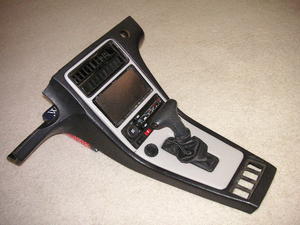
Thread Starter
Basic Sponsor
Rennlist
Site Sponsor
Rennlist
Site Sponsor

Joined: Mar 2010
Posts: 812
Likes: 130

We closed the office at noon today so I got to do a little more on this project.
What I am doing is kind of catch-up since I don't like where the upper insert was going with the spacing. Since we moved the two AC panels down just a hair over an eighth of an inch that gives us more material to put between the upper units.
What I did was work over the router jig for the first two holes some so that the upper opening moves up just a tiny bit, less than a 32nd I think, and then with a 3/16 inch spacer put back into the top of that jig it moves the bottom hole down exactly where we want it--right at the bottom of the insert. The result is that there is enough added spacing so that I can get about 5/16inch at the top and bottom of the Double DIN opening. I had already worked that jig over to move that hole, so now I think the openings will come out just right.
What I did was cut the top and bottom holes then spend some time doubling them and the middle hole in the process, so when the glue cures I'll re-rout the first two holes then open up the middle hole.
After I did that I spent a little time working up a form that I can use to make the piece of ABS that will be used to fill the gap left at the top of the Vent assembly when I cut it out and left the top area with the mounting holes. I made the form out of wood and then formed a piece of plastic over it with the heat gun. It came out fairly close, but if I can't get it to fit nicely I'll make another form and try again. That is the nature of this kind of project. That piece, when it is finished, will be glued both to the top of the vent ***'y with goat tuff glue and then to the inside of the upper edge of the upper insert with ABS glue.
With the vent assembly glued in that will give quite a bit of strength to that part of the insert, and then I think I'll try to glue in a horizontal piece of about eighth inch ABS to stiffen the lower cross piece since I have reduced the weight of the inside doublers from 3/16 to 3/32, as mentioned before. to allow for more projection of the components out the front.
What I am doing is kind of catch-up since I don't like where the upper insert was going with the spacing. Since we moved the two AC panels down just a hair over an eighth of an inch that gives us more material to put between the upper units.
What I did was work over the router jig for the first two holes some so that the upper opening moves up just a tiny bit, less than a 32nd I think, and then with a 3/16 inch spacer put back into the top of that jig it moves the bottom hole down exactly where we want it--right at the bottom of the insert. The result is that there is enough added spacing so that I can get about 5/16inch at the top and bottom of the Double DIN opening. I had already worked that jig over to move that hole, so now I think the openings will come out just right.
What I did was cut the top and bottom holes then spend some time doubling them and the middle hole in the process, so when the glue cures I'll re-rout the first two holes then open up the middle hole.
After I did that I spent a little time working up a form that I can use to make the piece of ABS that will be used to fill the gap left at the top of the Vent assembly when I cut it out and left the top area with the mounting holes. I made the form out of wood and then formed a piece of plastic over it with the heat gun. It came out fairly close, but if I can't get it to fit nicely I'll make another form and try again. That is the nature of this kind of project. That piece, when it is finished, will be glued both to the top of the vent ***'y with goat tuff glue and then to the inside of the upper edge of the upper insert with ABS glue.
With the vent assembly glued in that will give quite a bit of strength to that part of the insert, and then I think I'll try to glue in a horizontal piece of about eighth inch ABS to stiffen the lower cross piece since I have reduced the weight of the inside doublers from 3/16 to 3/32, as mentioned before. to allow for more projection of the components out the front.
__________________
ReDesign by FEATHER
by Jerry Feather
Producer for 928 of:
-Hatch Latch Receiver Liner--All Versions
-Replacement Heavy Duty Spare Tire Cover
-Flush Center Console Conversion
-Cowl Cover, Cowl Seal, & Shell Stickers--All versions
(RHD included)
-Aluminum Gas Cap Ratcheting Pawl
ReDesign by FEATHER
by Jerry Feather
Producer for 928 of:
-Hatch Latch Receiver Liner--All Versions
-Replacement Heavy Duty Spare Tire Cover
-Flush Center Console Conversion
-Cowl Cover, Cowl Seal, & Shell Stickers--All versions
(RHD included)
-Aluminum Gas Cap Ratcheting Pawl

Addict
Rennlist Member
Rennlist Member
Joined: Sep 2010
Posts: 13,583
Likes: 1,044
From: Boulder Creek, CA
Watching with great interest as well...
On the opening for a Double Din radio..and you are also leaving room for leather..leave room ALSO for the idea that some head units have a face that opens..and they dont all go "out" before they open, so the frame of the face needs 1/64 or so for the face frame to rotate out of the opening..past the leather wrapped around it...too.
I have an alpine unit that gets stuck on an aftermarket DoubleDin kit for Mazdas..because they didnt leave enough room for that slim face frame rotation from inside the opening.
On the opening for a Double Din radio..and you are also leaving room for leather..leave room ALSO for the idea that some head units have a face that opens..and they dont all go "out" before they open, so the frame of the face needs 1/64 or so for the face frame to rotate out of the opening..past the leather wrapped around it...too.
I have an alpine unit that gets stuck on an aftermarket DoubleDin kit for Mazdas..because they didnt leave enough room for that slim face frame rotation from inside the opening.
Thread Starter
Basic Sponsor
Rennlist
Site Sponsor
Rennlist
Site Sponsor
Joined: Mar 2010
Posts: 812
Likes: 130
Thanks Jeff. That helps confirm for me that the last thing I did to the jig for the Double DIN opening was to open up the hole in my mill by about .025 on each side and about.040 along the top and the bottom was the correct thing to do. I did that just for the exact reason you are suggesting.
One of the double DIN units I have to work with, the one shown above in the picture with the tan leather inserts, is in that insert very snug. However while studying it closely I noticed that its face also articulates outward. I also studied the plastic face trim that came with it and could tell that ihe opening needs to be slightly larger.
Now, I hope it doesn't leave an unsightly gap arount the unit. We will soon see, I think.
There has always been an allowance for the addition of leather on these inserts, both on the outside and wraping aroung the inside of each opening. That too is one of the reasons for my reducing the thickness of the doubler material on the insides and increasing it on the outsides. The leather that I commonly use comes is thickness of about .045, give or take about .005. That is just over one mm and is leather that is rated at about 2.5 to 2.6 oz per sq ft.
And a very Happy New Year to all of you watching this.
One of the double DIN units I have to work with, the one shown above in the picture with the tan leather inserts, is in that insert very snug. However while studying it closely I noticed that its face also articulates outward. I also studied the plastic face trim that came with it and could tell that ihe opening needs to be slightly larger.
Now, I hope it doesn't leave an unsightly gap arount the unit. We will soon see, I think.
There has always been an allowance for the addition of leather on these inserts, both on the outside and wraping aroung the inside of each opening. That too is one of the reasons for my reducing the thickness of the doubler material on the insides and increasing it on the outsides. The leather that I commonly use comes is thickness of about .045, give or take about .005. That is just over one mm and is leather that is rated at about 2.5 to 2.6 oz per sq ft.
And a very Happy New Year to all of you watching this.
Last edited by ReDesign by FEATHER; Jan 1, 2014 at 12:24 PM.
Thread Starter
Basic Sponsor
Rennlist
Site Sponsor
Rennlist
Site Sponsor
Joined: Mar 2010
Posts: 812
Likes: 130
In the pictures with post 61 just above, you can see if you study them closely, the modification I made to the jig for the top and bottom holes. Look closely at the wood member marked "top" and you can just barely make out the mortice I cut in that member on the inside just above the aluminum plate. That allows for the insert to be moved upward 3/16 inch to cut the bottom hole which is now going to end up as a three sided slot rather than a hole. Then with the strip of 3/16 inch ABS I am holding in my hand for one of the pictures, put into the mortice the insert fits downward that much farther so that the opening can be cut where we want it. That makes it very simple and not too difficult to keep track of, particuplarly if I get more in the habbit of making some of these.
In looking at these pictures mentioned, I notice that the AC panels don't look like they are quite flush with the bottom of the insert. In real life when I did them they seemed to be just perfect. When I go out to work on this a little later I'll double check that fit and if needed I will fashion something that is just the right thickness to put in the mortice to push the insert down a tiny bit to accomodate. Whatever I put in the mortice will result in moving the bottom opening/slot upward just that amount; and since I still have these two openings to rout out again with their doublers in place, if I move the opening upward any it wont show up as a mistake.
When I finish my coffee and get cleaned up a bit I'm going out to make some more progress.
In looking at these pictures mentioned, I notice that the AC panels don't look like they are quite flush with the bottom of the insert. In real life when I did them they seemed to be just perfect. When I go out to work on this a little later I'll double check that fit and if needed I will fashion something that is just the right thickness to put in the mortice to push the insert down a tiny bit to accomodate. Whatever I put in the mortice will result in moving the bottom opening/slot upward just that amount; and since I still have these two openings to rout out again with their doublers in place, if I move the opening upward any it wont show up as a mistake.
When I finish my coffee and get cleaned up a bit I'm going out to make some more progress.
Thread Starter
Basic Sponsor
Rennlist
Site Sponsor
Rennlist
Site Sponsor
Joined: Mar 2010
Posts: 812
Likes: 130
Now that I think I am getting very close to having these openings where I want them and having a decent amount of trim show between the three components I am studying these pictutres some and then thinking that even though I have now about 5/16 inch of trim at the top and at the bottom of the Double DIN unit, since the top trim will be partly covered up by the Air Vent Grill, I may want to have a little less trim at the bottom so that when they are all mounted the exposed bit of leather trim will appear more nearly equal top and bottom than they will with the top partly covered by the vent.
I still want to have enough trim width each place to be able to glue on another doubler edgeways along the bottom trim strip and still allow for at least minimal spacing behind it. The Double DIN units require about 1/16 inch more space behind the insert than what comes through and the AC panels have at least an eighth or more behind the insert than what shows in the front.
I guess I'll just have to mock it up starting at the bottom and wortk my way up to see jsut how little trim width I can get by with.
I still want to have enough trim width each place to be able to glue on another doubler edgeways along the bottom trim strip and still allow for at least minimal spacing behind it. The Double DIN units require about 1/16 inch more space behind the insert than what comes through and the AC panels have at least an eighth or more behind the insert than what shows in the front.
I guess I'll just have to mock it up starting at the bottom and wortk my way up to see jsut how little trim width I can get by with.
Thread Starter
Basic Sponsor
Rennlist
Site Sponsor
Rennlist
Site Sponsor
Joined: Mar 2010
Posts: 812
Likes: 130
Well, I got about a two and a half hour session in on this this morning and have the upper insert pretty well cut out to where I want it. I first took a little more material out of the top member of the center opening jig and then found that it was too much, so I have to put a spacer back in. Then I opened up the center hole and I think it is right where I want it, given the previous discussion about its spacing.
I had also opened up the previous holes trimmng the doubler material I had put around them. The only glitch is some chewing the router did along the top where there was some chatter induced. I think I'll be able to fill that up with ABS Glue when I get to glueing the gap filler into the top.
Then I glued in the Vent ***'y and am letting it cure. My Goat Tuff Glue is getting a little old and very thick so I had to heat it up a few times to use it. I think I got the job done and have mocked up the results to this point on the kitchen table with the NAV unit sort of in place.
In one of the pictures my finger is pointing to the gap at the end of the AC panels that needs to have a doubler in the insert and that will be where the screws go to hold them infrom the back. The picture after that shows the relation of the face surface that will mount to the back of the face of the insert and the mounting surface that is recessed further, about 5/16 inch.
Then I turned my attention to the console itself. There is some delamination shown along the botton edge and I have poured, then blown gently, in some glue and then clamped the edges closed with a piece of bar stock to hold the outside true. I also fixed the delamination at the trailing edge near the switch opening and clamped that closed. I will do the other bottom edge when this glue cures.
I had also opened up the previous holes trimmng the doubler material I had put around them. The only glitch is some chewing the router did along the top where there was some chatter induced. I think I'll be able to fill that up with ABS Glue when I get to glueing the gap filler into the top.
Then I glued in the Vent ***'y and am letting it cure. My Goat Tuff Glue is getting a little old and very thick so I had to heat it up a few times to use it. I think I got the job done and have mocked up the results to this point on the kitchen table with the NAV unit sort of in place.
In one of the pictures my finger is pointing to the gap at the end of the AC panels that needs to have a doubler in the insert and that will be where the screws go to hold them infrom the back. The picture after that shows the relation of the face surface that will mount to the back of the face of the insert and the mounting surface that is recessed further, about 5/16 inch.
Then I turned my attention to the console itself. There is some delamination shown along the botton edge and I have poured, then blown gently, in some glue and then clamped the edges closed with a piece of bar stock to hold the outside true. I also fixed the delamination at the trailing edge near the switch opening and clamped that closed. I will do the other bottom edge when this glue cures.
Last edited by ReDesign by FEATHER; Jan 1, 2014 at 04:25 PM.
Thread Starter
Basic Sponsor
Rennlist
Site Sponsor
Rennlist
Site Sponsor
Joined: Mar 2010
Posts: 812
Likes: 130
Now there is probably a little more space around the Nav unit than might really be needed, but one thing that will result is that I will be able the file the corners finished and down to a small radius rather the square and sharp which makes them pretty hard to finish in leather. It doesn't really like to do the sharp corners too well.
Next I am going to go out and see if I can find the aluminum material that I cut out before to make the mounting tray for the NAV unit. If not, I'll make some more. Then I have to work on fitting the insert and NAV unit into the console. That will involve glueing in some material to build up the bottom edge where the radk will mount and then where to insert will rest.
The next to the last picture here shows where we are going to have an issue with hooking up the AC control unit to its original wiring since the plug or connector will no longer go there. I have been looking on-line to try to find some pin connectors, both male and female, that can be used to make the transition from these pins to the connector with little jumper wires. At least that is my thought on it at this point. The pins measure .057 in in diameter, I think.
The last picture shows the gap that will be filled with the little piece I made yesterday. I'll glue that in a little later when I am sure the vent ***'ty is cured inb place.
Next I am going to go out and see if I can find the aluminum material that I cut out before to make the mounting tray for the NAV unit. If not, I'll make some more. Then I have to work on fitting the insert and NAV unit into the console. That will involve glueing in some material to build up the bottom edge where the radk will mount and then where to insert will rest.
The next to the last picture here shows where we are going to have an issue with hooking up the AC control unit to its original wiring since the plug or connector will no longer go there. I have been looking on-line to try to find some pin connectors, both male and female, that can be used to make the transition from these pins to the connector with little jumper wires. At least that is my thought on it at this point. The pins measure .057 in in diameter, I think.
The last picture shows the gap that will be filled with the little piece I made yesterday. I'll glue that in a little later when I am sure the vent ***'ty is cured inb place.
Rennlist Stories
The Best Porsche Posts for Porsche Enthusiasts

Porsche Reveals Coupe Variant of the Electric Cayenne With a Fresh Look
Verdad Gallardo
10 Porsche Colors That Have More Personality Than Most People
Verdad Gallardo
Guntherwerks' Final Speedster Creation Is the Ultimate Porsche Restomod
Verdad Gallardo
10 Reasons I Hate Going to the Porsche Dealership (& the 1 Reason I Stay)
Joe Kucinski
Porsche Shakes Up The Nürburgring Lap Record Table Once Again
Verdad Gallardo
6 Ways the Porsche 911 GT3 S/C Redefines Performance
Joe Kucinski
10 Wildest Homologation Specials Porsche Ever Sold
Verdad Gallardo
Super Rare RUF BTR III Comes Out of Hibernation, Looking For a New Home
Verdad Gallardo
10 Porsche Opinions That Can Start a Fight
Joe Kucinski
Thread Starter
Basic Sponsor
Rennlist
Site Sponsor
Rennlist
Site Sponsor
Joined: Mar 2010
Posts: 812
Likes: 130
I went back out to the shop and then relaminated the other side of the console. Then I decided to switch to a different console because the one I have been working with is a bit skewed, probably from being out of any 928 for so long. The one I switched to has already been modified some and relaminate, but it still needs the rear mounting points rebuilt and a doubler put under the top mounting flange. The Upper insert fits the opening much better.
Then I worked up the NAV mounting tray that I have discussed. I found one of the pieces of material that I think I had cut before and marked it and folded it up. Then I have placed it in the console and taken some pictures so you can see where the shelves it will be mounted to need to be built up for it. Then, when it is mounted in the console the upper insert will rest on its mounting flange along with some of the original boss at the bottom of the edges of the original recess.
Then I worked up the NAV mounting tray that I have discussed. I found one of the pieces of material that I think I had cut before and marked it and folded it up. Then I have placed it in the console and taken some pictures so you can see where the shelves it will be mounted to need to be built up for it. Then, when it is mounted in the console the upper insert will rest on its mounting flange along with some of the original boss at the bottom of the edges of the original recess.

Drifting

Joined: Mar 2013
Posts: 3,475
Likes: 471
From: Earth
I went back out to the shop and then relaminated the other side of the console. Then I decided to switch to a different console because the one I have been working with is a bit skewed, probably from being out of any 928 for so long. The one I switched to has already been modified some and relaminate, but it still needs the rear mounting points rebuilt and a doubler put under the top mounting flange. The Upper insert fits the opening much better.
Then I worked up the NAV mounting tray that I have discussed. I found one of the pieces of material that I think I had cut before and marked it and folded it up. Then I have placed it in the console and taken some pictures so you can see where the shelves it will be mounted to need to be built up for it. Then, when it is mounted in the console the upper insert will rest on its mounting flange along with some of the original boss at the bottom of the edges of the original recess.
Then I worked up the NAV mounting tray that I have discussed. I found one of the pieces of material that I think I had cut before and marked it and folded it up. Then I have placed it in the console and taken some pictures so you can see where the shelves it will be mounted to need to be built up for it. Then, when it is mounted in the console the upper insert will rest on its mounting flange along with some of the original boss at the bottom of the edges of the original recess.
if you could sell this piece and this piece alone I would take it as it sits.... no garantees for fitmit..... nothing else.... let me know.. I don't need the lower.... Just this part as you have it pictured...
Thread Starter
Basic Sponsor
Rennlist
Site Sponsor
Rennlist
Site Sponsor
Joined: Mar 2010
Posts: 812
Likes: 130
Sterrling, probably when we get to the end of this project we will be able to go back over the process and identify the segments of the conversion that lend theselves to perhaps various stages for differing levels of installation kits, or most likely, basic starter kits for others to work with in doing their own conversion. That might well include a Double DIN rack or tray, if that is what you are referring to here.
As to your PM, I am not too sure exactly what you have in mind because you have chosen to use none of the terminology that I have been trying to use to describe this stuff. Nevertheless, I think we will get to where you likely want to go at some point.
As to your PM, I am not too sure exactly what you have in mind because you have chosen to use none of the terminology that I have been trying to use to describe this stuff. Nevertheless, I think we will get to where you likely want to go at some point.
Thread Starter
Basic Sponsor
Rennlist
Site Sponsor
Rennlist
Site Sponsor
Joined: Mar 2010
Posts: 812
Likes: 130
I didn't fabricate these recently, but I did some time ago when I was doing this development. However, I saw them in one of the pictures above so I thought I would lay them out a take a couple of pictures, particularly since the question came up a few days ago about the gap being created between the air vent and the heater box under the dash with the air vent ***'y being cut out of the console and glued into the upper insert.
These are what I came up with. One is the prototype and the other is one waiting for the formation of the gusset and glueing it in. These are sort of a transition duct.
I will peobably have to redesign these when I get to the installation stage of this thread project, or at least resize one to fit where the air vent is going to end up.
These are what I came up with. One is the prototype and the other is one waiting for the formation of the gusset and glueing it in. These are sort of a transition duct.
I will peobably have to redesign these when I get to the installation stage of this thread project, or at least resize one to fit where the air vent is going to end up.
Thread Starter
Basic Sponsor
Rennlist
Site Sponsor
Rennlist
Site Sponsor
Joined: Mar 2010
Posts: 812
Likes: 130
I have continued to wonder about the projection, or lack of it, of the AC panel out in front of the bottom of the upper insert. I can tell that in the pictures on page one of this thread where I show the tan and the black ones of these, that the two panels project about a 32nd of an inch, and that seem about right, or at least adequate. However, when I double the back side of the bottom of the upper insert where I am putting both panels it seems that there will be no projection at all.
By calculation, the face of the upper AC panel projects almost exactly .200 inch. The thickness of the plastic as formed is pretty close to a 16th inch. (Actually now that I measure it it is about .080 in.) Then, with the .093 doubler glued in back and the thickness of leather estimated at .045 in, with two thicknesses of leather, one in front and one in back, the total comes out to just over a quarter inch which means no projection of the face but rather some recess of about a 16th inch. Part of that coud be cured by leaving out the wrap-around part so it is not all the way in the back, but that leaves a potential of the leather coming loose later.
What I should have done is study the tan version of the upper insert which is just a prototype that did not work, but is still around here, so I have. What I discovered is that I did not double the bottom opening, at least in the area immediately around the opening. I had left that un-doubled so that when it was covered with leather and the leather wrapped around to the inside and the back of the inside it left the total thickness still thin enough to allow the face to come through as shown.
For the extra strength back there there is still going to be the mounting material which is fairly thick, and along the top of the bottom opening, or actually along the bottom of the middle opening, I had put a piece of ABS edgeways just below the opening. I think I will do that again with this version of the project; so I have thought it through overnight and will glue up another one later today. That should not delay this project much, if any, since I can still go ahead with some more of the items on the checklist. Particularly the build-up of the inside of the console and finalize the shape of the gap filler for the top of the air vent ***'y.
Then I will get to see just how tuff the Goat Tuff glue is because I am going to have to break the Air Vent out of the upper insert I have been working on. I think I did that with the tan one also, so it is not impossible.
By calculation, the face of the upper AC panel projects almost exactly .200 inch. The thickness of the plastic as formed is pretty close to a 16th inch. (Actually now that I measure it it is about .080 in.) Then, with the .093 doubler glued in back and the thickness of leather estimated at .045 in, with two thicknesses of leather, one in front and one in back, the total comes out to just over a quarter inch which means no projection of the face but rather some recess of about a 16th inch. Part of that coud be cured by leaving out the wrap-around part so it is not all the way in the back, but that leaves a potential of the leather coming loose later.
What I should have done is study the tan version of the upper insert which is just a prototype that did not work, but is still around here, so I have. What I discovered is that I did not double the bottom opening, at least in the area immediately around the opening. I had left that un-doubled so that when it was covered with leather and the leather wrapped around to the inside and the back of the inside it left the total thickness still thin enough to allow the face to come through as shown.
For the extra strength back there there is still going to be the mounting material which is fairly thick, and along the top of the bottom opening, or actually along the bottom of the middle opening, I had put a piece of ABS edgeways just below the opening. I think I will do that again with this version of the project; so I have thought it through overnight and will glue up another one later today. That should not delay this project much, if any, since I can still go ahead with some more of the items on the checklist. Particularly the build-up of the inside of the console and finalize the shape of the gap filler for the top of the air vent ***'y.
Then I will get to see just how tuff the Goat Tuff glue is because I am going to have to break the Air Vent out of the upper insert I have been working on. I think I did that with the tan one also, so it is not impossible.
Thread Starter
Basic Sponsor
Rennlist
Site Sponsor
Rennlist
Site Sponsor
Joined: Mar 2010
Posts: 812
Likes: 130
I decided to change the outside doublers also while I am at it. One thing I noticed when fitting the upper insert into the console is that the outside doublers that fit into the slots inside the console were allowing the insert to raise up a tiny bit, maybe a 16th of an inch, so I decided to make the next ones a little taller. I did some more measuring and calculating and came up with a width of .470 in. I have cut some of that material and glued it on a new pair of inserts.
Another thing I changed about those doublers is the thickness. I had gone from .090 material to .120 material before and even with that thickness it occurs to me that when the leather is glued down the sides of the inserts that will be taking up about .050 of the thickness. So, I also discovered that the material that I have been using for spare tire covers that is called out as 3/16 in. is actually only about .170 thick, so not too much more than 5/32 in. Given that actual thickness I decided to use that material for the doublers that go into the console slots. The slots are about .100 or a little more, so with the leather on the sides above the doublers the remaining thickness will be about .120 in. I will see how that works when the glue sets and cures some.
While that glue is setting up I spent a little time with the console. I made a doubler for the top two mounting holes and glued it on. Then I made some doublers for the rear mounting holes and glued them on. When those cure I will cut some small patches and fill in the parts of the original mounting tabs with some more ABS.
You will notice that I tapered the flat surface of the trailing end of these patch doublers so that they will not interfere with the slot that goes along the bottom edge of the console sides which is where the two closure panels fit into.
Then I started to fill in the places along the upper bottom of the recess where the tray or rack for the Double DIN will be mounted. I started with some small strips of 1/8 inch material and have that glued in and clamped. When that cures I'll add a layer of 3/32 inch material on top of it and glue it in with ABS glue. The first ones are glued to the console plastic with my Goat Tuff Glue. Likewise with all the other patches that are glued to the console plastic.
Another thing I changed about those doublers is the thickness. I had gone from .090 material to .120 material before and even with that thickness it occurs to me that when the leather is glued down the sides of the inserts that will be taking up about .050 of the thickness. So, I also discovered that the material that I have been using for spare tire covers that is called out as 3/16 in. is actually only about .170 thick, so not too much more than 5/32 in. Given that actual thickness I decided to use that material for the doublers that go into the console slots. The slots are about .100 or a little more, so with the leather on the sides above the doublers the remaining thickness will be about .120 in. I will see how that works when the glue sets and cures some.
While that glue is setting up I spent a little time with the console. I made a doubler for the top two mounting holes and glued it on. Then I made some doublers for the rear mounting holes and glued them on. When those cure I will cut some small patches and fill in the parts of the original mounting tabs with some more ABS.
You will notice that I tapered the flat surface of the trailing end of these patch doublers so that they will not interfere with the slot that goes along the bottom edge of the console sides which is where the two closure panels fit into.
Then I started to fill in the places along the upper bottom of the recess where the tray or rack for the Double DIN will be mounted. I started with some small strips of 1/8 inch material and have that glued in and clamped. When that cures I'll add a layer of 3/32 inch material on top of it and glue it in with ABS glue. The first ones are glued to the console plastic with my Goat Tuff Glue. Likewise with all the other patches that are glued to the console plastic.
Last edited by ReDesign by FEATHER; Jan 3, 2014 at 11:15 AM.

Pro
Joined: May 2003
Posts: 700
Likes: 0
From: Hamilton, Ontario, Canada
radiused corners in the trim
Now there is probably a little more space around the Nav unit than might really be needed, but one thing that will result is that I will be able the file the corners finished and down to a small radius rather the square and sharp which makes them pretty hard to finish in leather. It doesn't really like to do the sharp corners too well
When we make plastic laminate counters and we have an inside corner, we actually leave a small radius in the top layer of plastic laminate to minimize the potential for cracking. I have seen squared laminate corners in the counters crack into the counter itself once settling in house occurred.
With the vibration of a moving vehicle and the little material left as support once routing has occurred, that is a crack waiting to happen if you don't leave a slight radius. IMHO
Great job and keep up the good work.