

..


Drifting
Joined: Aug 2003
Posts: 2,259
Likes: 3
From: Camarillo, CA, USA

I don't see any advantage of the string jig over just using the front and rear wheel hubs as reference. Can you explain the advantages?
According to the owner's manual for the string jig, you first need to align the jig using the front and rear rims. With the method described by Earl here...
http://members.rennlist.com/captearl...ALIGNMENT.html
..., he uses the rims as reference for the 4 wheel alignment. His method does require tedious measurement considerations in order to make the front and rear toe gages correct. So, seems that both methods arrive at the same result.
According to the owner's manual for the string jig, you first need to align the jig using the front and rear rims. With the method described by Earl here...
http://members.rennlist.com/captearl...ALIGNMENT.html
..., he uses the rims as reference for the 4 wheel alignment. His method does require tedious measurement considerations in order to make the front and rear toe gages correct. So, seems that both methods arrive at the same result.

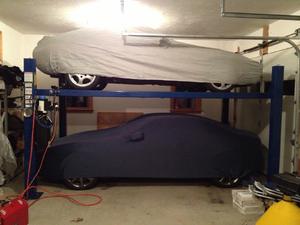


Under the Lift
Lifetime Rennlist
Member
Lifetime Rennlist
Member

Joined: Mar 2002
Posts: 18,648
Likes: 52
From: Buckeye, AZ
I now use toe plates for the front wheel toe. Very quick and easy. Essentially no setup, unlike lasers and strings. Only issue is that I had to modify the plates to work with wheels that have prominent centers or spokes. However, it seems to me that toe plates aren't applicable to the rear wheels, unless someone has thought of a clever way to determine toe on the individual rear wheels. Strings, if set accurately cover this well.
I like the idea of the camber/caster gauge. The only problem is detemining the levelness of the floor. I know the gauges can be zero'd on the floor, but that gives you a spot reading rather than the levelness over the span of the front wheel track. Most garage floors have high and low spots. How would do you deal with that? [Nevermind: I see the gauge owner's manual has a procedure using a long piece of aluminum box tubing to span the wheel track and set the gauge.]
I like the idea of the camber/caster gauge. The only problem is detemining the levelness of the floor. I know the gauges can be zero'd on the floor, but that gives you a spot reading rather than the levelness over the span of the front wheel track. Most garage floors have high and low spots. How would do you deal with that? [Nevermind: I see the gauge owner's manual has a procedure using a long piece of aluminum box tubing to span the wheel track and set the gauge.]
Trending Topics
Under the Lift
Lifetime Rennlist
Member
Lifetime Rennlist
Member
Joined: Mar 2002
Posts: 18,648
Likes: 52
From: Buckeye, AZ
As for the camber/caster gauge. To measure the caster you have to take measurements of the wheel at full left and full right lock. Which means it needs to turn easily, which means turntables, which mean they will provide an inherently flat surface. If you are concerned about the levelness of your floor, just calibrate against the turntable before you drive onto it.
In my case I used the boards to provide the leveling surface that the turntables sit on. Now I use a four post lift which, again, provides a flat surface to calibrate the gauge against.
Unless you have an obvious dip in your garage floor, I wouldn't worry about it. If there is any doubt, you can just shine a flashlight along the floor in the dark and the shadows will highlight the low spots.
If you're worried about one side being lower than the other, again, it doesn't matter as long as you calibrate the meter at the spot you're using it. I see above that you found some of the manufacturer's suggestions for calibration. But if your garage floor is that wavy or tilted, you probably have problems with tools and parts rolling around...
Personally, when I did it on the floor with the boards, I calibrated against both sides of a steel beam to calibrate the gauge to a true vertical (by doing it on both sides it takes the average to determine true vertical). My garage floor was laser leveled at installation so while it is not "perfect", it is very close. I bet yours is too.
In my case I used the boards to provide the leveling surface that the turntables sit on. Now I use a four post lift which, again, provides a flat surface to calibrate the gauge against.
Unless you have an obvious dip in your garage floor, I wouldn't worry about it. If there is any doubt, you can just shine a flashlight along the floor in the dark and the shadows will highlight the low spots.
If you're worried about one side being lower than the other, again, it doesn't matter as long as you calibrate the meter at the spot you're using it. I see above that you found some of the manufacturer's suggestions for calibration. But if your garage floor is that wavy or tilted, you probably have problems with tools and parts rolling around...
Personally, when I did it on the floor with the boards, I calibrated against both sides of a steel beam to calibrate the gauge to a true vertical (by doing it on both sides it takes the average to determine true vertical). My garage floor was laser leveled at installation so while it is not "perfect", it is very close. I bet yours is too.

Chronic Tool Dropper
Lifetime Rennlist
Member
Lifetime Rennlist
Member
Joined: Oct 2001
Posts: 20,506
Likes: 564
From: Bend, Oregon
Bill--
If you read through the manual for the camber gauge, they offer suggestions for determining and neutralizing the uneven floor syndrome. The method has a piece of aluminum square stock for a beam, and a couple spacers, so you can put the spacers where the tires go, beam on top of those, and zero the angle gauge so it includes the floor angle. Manual recommends using linoleum floor tiles as shims to get things more even.
You've seen the laser fixtures I use. I'm thinking of adding the angle finder module to what I have now, instead of using the bubble level and the drill bits for calculating caster.
Pete Loeding was just over to return a too, and we did a quick-and-dirty front alignment using the lasers and bubble level. Took the best part of an hour all in, and hopefully will get him down the road with all the wheel going in roughly the same direction. I still need to find a set of turn/slip plates so there isn't so much rolling of the car to release tension after each adjustment.
Bulvot--
Thanks for the links to the tools. A few of those pieces will help me refine the methods I've been using. keep up the great work!
If you read through the manual for the camber gauge, they offer suggestions for determining and neutralizing the uneven floor syndrome. The method has a piece of aluminum square stock for a beam, and a couple spacers, so you can put the spacers where the tires go, beam on top of those, and zero the angle gauge so it includes the floor angle. Manual recommends using linoleum floor tiles as shims to get things more even.
You've seen the laser fixtures I use. I'm thinking of adding the angle finder module to what I have now, instead of using the bubble level and the drill bits for calculating caster.
Pete Loeding was just over to return a too, and we did a quick-and-dirty front alignment using the lasers and bubble level. Took the best part of an hour all in, and hopefully will get him down the road with all the wheel going in roughly the same direction. I still need to find a set of turn/slip plates so there isn't so much rolling of the car to release tension after each adjustment.
Bulvot--
Thanks for the links to the tools. A few of those pieces will help me refine the methods I've been using. keep up the great work!