When you click on links to various merchants on this site and make a purchase, this can result in this site earning a commission. Affiliate programs and affiliations include, but are not limited to, the eBay Partner Network.
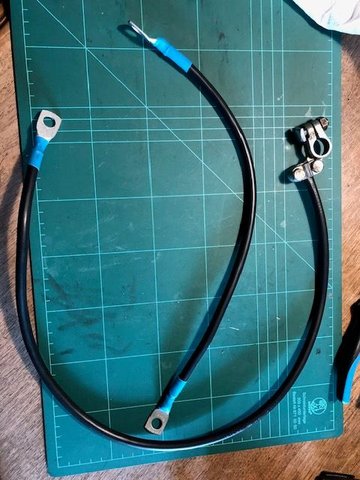
I made a new one from welding wire (2 gauge) and terminated the area between the standard sheathing and the lugs with adhesive lined heat shrink. I figure that should be pretty corrosion protected.
Hello
I replaced mine with cables made out of standard parts assembled with a good crimping tool. The ends are sealed with heat shrink. So far no problems. Most important is of course to clean the ground points.
Cheers.
Good point. So it should just be replaced every 3 years or so.
Not at all- I changed mine when it was about 20 years old and it was still perfectly serviceable.
I see no harm in removing the strap say every 5 years to clean the terminals. The main strap in the rear hatch is more problemmatical. At the time I checked the engine strap i pulled back the heat shrink on the main earth strap and quite a number of the wire strands were fractured- I fluxed both ends and heated them up over the gas cooker flame and ran some solder in. Worked OK until I got a new one from Roger.
Last edited by FredR; Jul 12, 2024 at 01:32 PM.
Reason: removed dumb comment
do you all wrap your engine ground strap in anything to help keep it from corroding?
Either naked or completely sealed is fine, but nothing in between. As supplied, it is easy to check and won't corrode unless exposed to road salts, And if perfectly sealed then it stays dry and won't corrode. The problem is that if you wrap it, or use insulated cable but don't seal the terminals, and there is a tiny leak anywhere, then it will corrode and you can't inspect it.
An ohmmeter is not helpful, they measure resistance by passing milliamps of current and measuring millivolts. The starter current is a few hundred amps. The best option is to measure the voltage drop while cranking, should be only a few tenths of a volt from block to chassis.
An ohmmeter is not helpful, they measure resistance by passing milliamps of current and measuring millivolts. The starter current is a few hundred amps. The best option is to measure the voltage drop while cranking, should be only a few tenths of a volt from block to chassis.
Jim,
That is a fair point- the average half decent multimeter can only resolve about 100 milli ohms whereas we are looking for values around the single digit miilli ohms mark or so I would think. I take the point of view that if while cranking the voltage drops below the 10 to 11 volts mark there is something wrong- either the battery is duff or the path to earth could be the issue not to mention other faults. Check that the battery voltage [no load] is healthy at around 12.6 to 12.8 volts and if it is start looking elsewhere.