When you click on links to various merchants on this site and make a purchase, this can result in this site earning a commission. Affiliate programs and affiliations include, but are not limited to, the eBay Partner Network.
So this winter I found that the upper ball joints were loose and decided to replace them through Roger. I got them installed and decided since I was in there I would change the lower ball joints and tie rod ends since I would have to get it aligned anyway. Now I decide to measure the ride height and adjust to stock ride height (since I would have to get it aligned anyway). Ride heights for the front were hovering about 130-135 mm and the rear height was around 140-145 mm. After freeing up the front adjusters, I was able to raise the front to 179-180 mm and the rear with ¾ tank of gas to 173 mm. finally after about 200 miles of driving and adjusting it was time for the alignment.
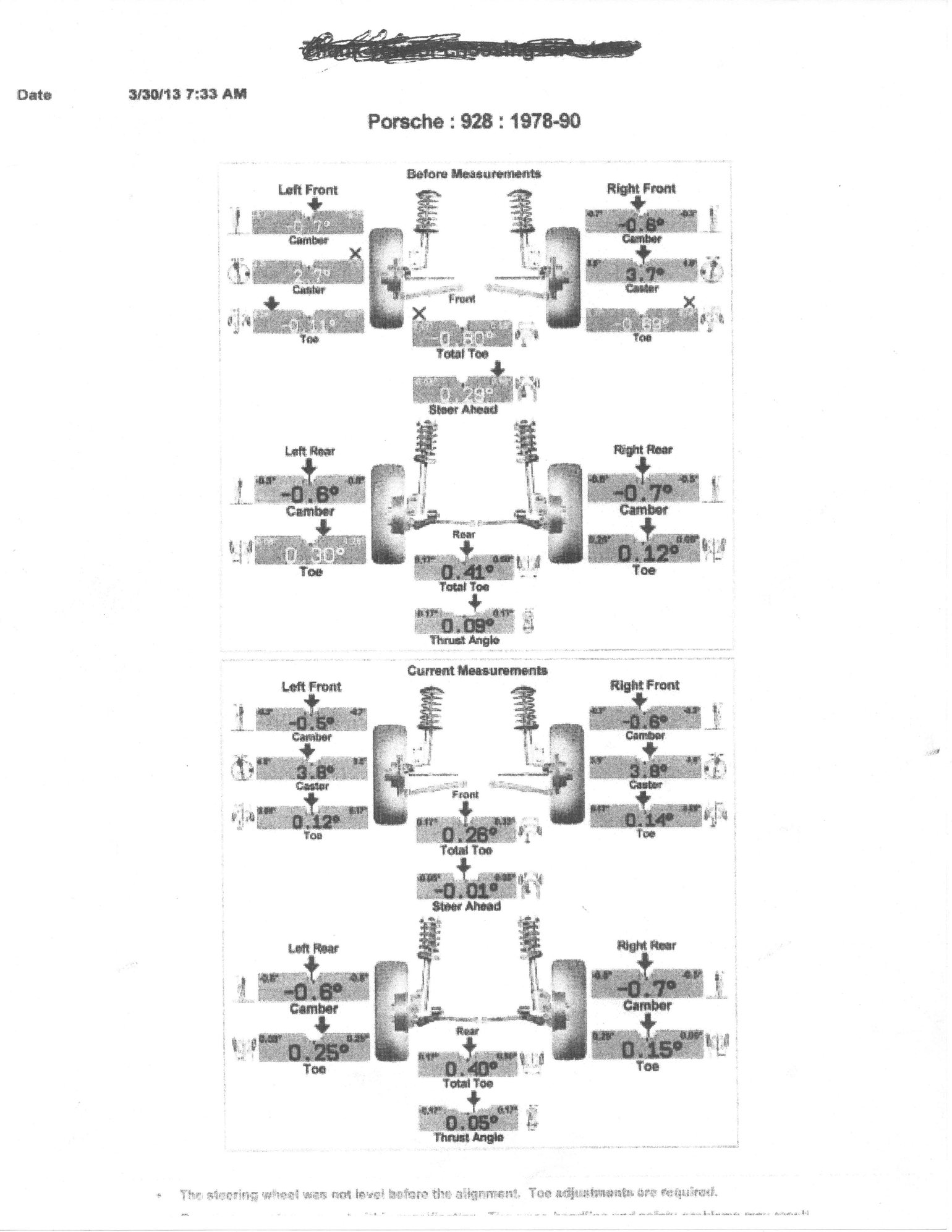
So this is the alignment prior to the changing of the front end parts and height adjustment (Before and after adjustments)So this is the alignment prior to the changing of the front end parts and height adjustment (Before and after adjustments)
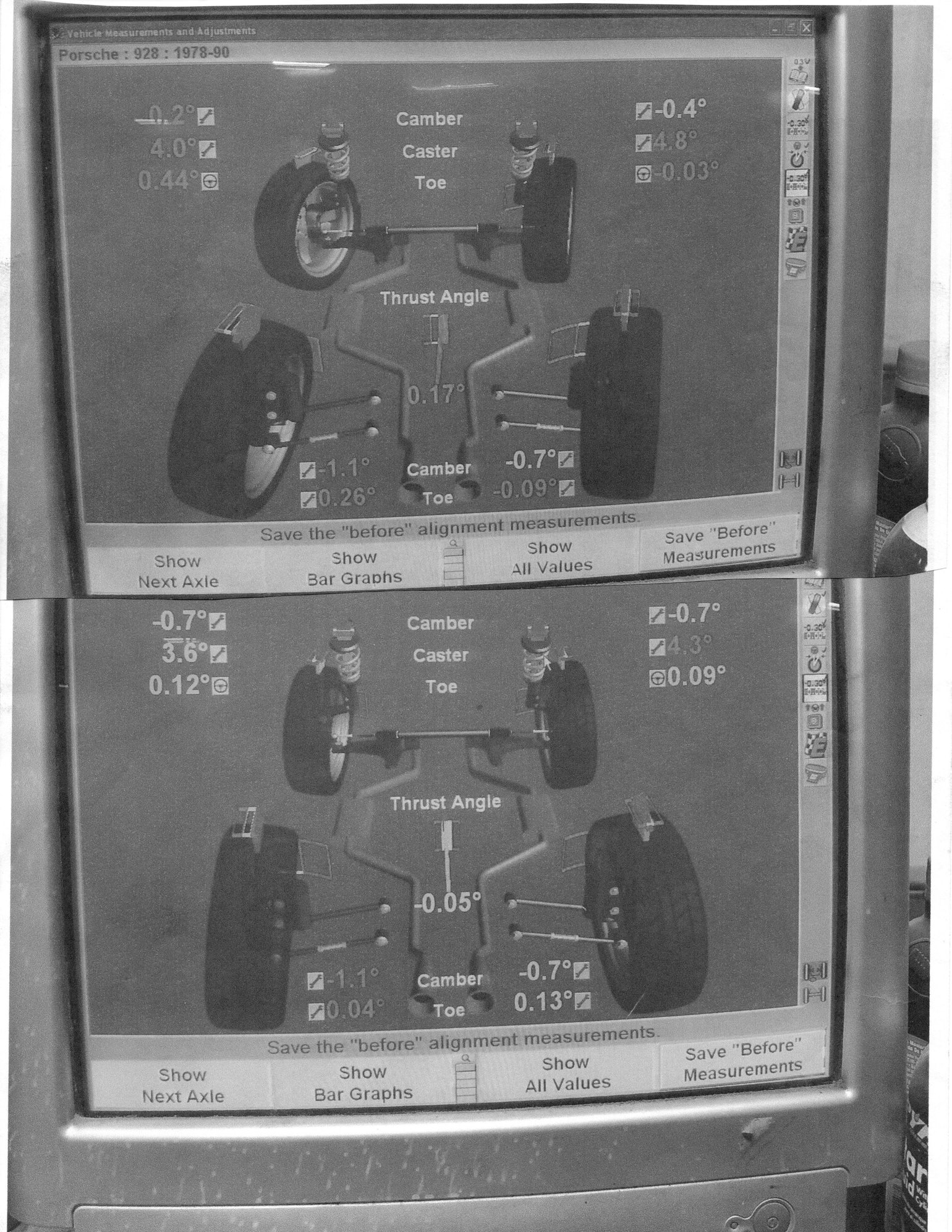
And this is the alignment (Before and after) after all the changes and ride height adjustment. I expected tghe front to be out but didn't expect the big change in the back left. (Darker numbers are red)
The tech said that he could not get the numbers into spec.
One thing I must mention is that the rear lower control arm (928-331-043-06) drivers side has some damage to it on the flat bar. Would that have such an extreme effect on the suspension change when changing the ride height? Also put in the Moog lower ball joints. (See front right caster numbers).
Last edited by Geo55; May 6, 2020 at 09:16 PM.
Reason: Add comment from tech
usually the rear UPPER dog bone bushing sag and prevent the camber from being able to be adjusted
If the flat blade is bent then you should consider replacing the control arm as well as the 4 dog bone bushings
Gee. Never seen that, before!
90% of the 928's we do have too much caster in the right front and too much camber in the left rear....at stock or near stock ride heights. It gets boring to see.
Your alignment tech is a lazy butt....or had another car sitting there waiting to be done. Both of these "issues" are very simple things to "repair" and we do it on an almost daily basis.
BTW....A "straight" left rear lower control arm will push the bottom of the tire out....increasing the negative camber. I doubt it is bent very much....and minor tweaks can simply be bent back with a big lead filled plastic hammer with the arm between two blocks of wood (easier to do, when the arm is removed.) "Folds" from idiot tow truck operators require replacement of the arm.
Certainly, as Stan suggests, replace the rear upper control arm bushings (although this is generally not enough of a change to repair the issue.)
Simply look at the rear camber eccentric an see which way it need to go to get more positive camber....most likely the aluminum edge on the rear suspension cross member will be "hammered" in the direction things need to move. This comes from limp wristed alignment guys not torquing the rear eccentrics to the proper torque. Be creative.. and move the eccentric.
Thanks Greg, So correct me if I'm wrong, but he could adjust the camber by kinda bypassing the eccentric and adjusting its location to where it needs to be then just torquing it to spec? Same with the Toe? I will also look at the upper bushings which will probably need replacing. Thank you for your input and knowledge. Much appreciated.
Thanks Greg, So correct me if I'm wrong, but he could adjust the camber by kinda bypassing the eccentric and adjusting its location to where it needs to be then just torquing it to spec? Same with the Toe? I will also look at the upper bushings which will probably need replacing. Thank you for your input and knowledge. Much appreciated.
Not sure about the rear toe...my guess is that once the camber didn't work, he gave up on toe?
Definitely start with the upper bushings....most are "toast".
Yes, you can put a small "come along" on the control arm, loosen the eccentric, and simply winch it as far as possible, with the eccentric at max. Torque the bolt to spec...big time tight. (I don't do our alignments, but as I recall, the torque is ~160 ft.lbs.)
If that's not enough, a little bit of cutting with a die grinder to elongate the hole works miracles...still need the come along to move the eccentric over.
Porsche changed the front caster numbers to 4.5 and made the change retroactive, to "get around" the front caster problem, in the later models. They also increased the power steering assist to compensate for the increased caster. (I like as little caster as possible....just enough to allow the steering wheel to return to center.)
Therefore, your front caster isn't actually "out of specification"....and a little bit more caster on the right side is always needed to "deal" with the crown of the roads.
However, the same thing works on the front...and you can "relieve" the eccentric a bit, if necessary. I'd make an effort to get it at 4.0 or slightly under.
Raising the ride height reduces the camber range a little and as mentioned the upper arm bushes compress to a permanent set with age.
From what I can gather you are saying that you could not get the rear camber less [i.e. closer to vertical] than minus 1.1. Personally I would have set the other side at minus 1.1 as I reckon the stock camber is not enough for the cornering forces modern rubber can generate. Thus to my mind a stock alignment for stock rubber is minus 1 degree front and rear. I run with even hmore camber but then I have much wider rubber.
I am surprised at the rear left toe adjuster range- in my experience the rear needs 0.15 degrees each side to give good drive out of tight bends. When I had the rear camber problem I did not have a toe issue on the rear adjusters.
When I go to the alignment shop I take my torque wrench and set the rear lower arm bolts and the front camber and caster bolts myself. Tightening the rear toe adjuster isa bit of a bugger as one canot get a torque wrench in there- usually end up with two spanners- one acting as extended leverage.
A reminder that Carl offers a steel repair insert for the rear crossmember where the aluminum is damaged around the adjusters. More rear camber isn't a bad thing with modern tires, as Fred points out. The blade on the bent arm moves the numbers towards toed-out, as the effective radius-arm length is less and the wheel is closer to the gearbox. Straighten the arm or replace it to solve.
Well you can see tbe problem with the rear camber adjusters.
I had a problem getting one of the dog bone nuts and I had to do something to improve access but for the life in me I cannot remember what it was I removed. After I cleared the way I was able to get a conventional 1/2 inch drive socket on it and it came no issue. Before that I tried to remove it with an open ended wrench but it felt as though I was going to round the nut.
I have a feeling it was the exhaust I dropped out of the way if that makes sense
The twist in the control arm blade is interesting. I'm more used to seeing a parallel bend in the middle towards the rear, where a tie-down or recovery strap was looped to pull the car backwards. Curious to see if the nut on the backside of the adjuster bolts was actually loosened and the steel inside the bushing bushing freed enough to move. The adjuster rotates inside that sleeve, and the sleeve also needs to be able to move relative to the casting. Same for both the camber and toe adjusters. The casting gets munged when the adjuster cam is working too hard, or as Greg mentioned the bolt isn't tightened enough once adjusted.
I work on my "lifetime-of-dry-climate, never driven in the rain, always in a climate-stable garage" 928, and conveniently forget about the corrosion challenges other face in the soggier corners of the 928 world.
Yeah, you need a rear control arm...that one looks both bent and beat on.
The camber eccentrics are textbook.Caused by limp wristed people working on the car, as I said.You can remove the bolt and hammer the aluminum back flat and regain about 75% of the potential adjustment range back. Then start with all of my tricks.
If your rear toe turns out to be an issue, this is caused by a completely different issue and a completely different conversation.....you know what you need to do, right now.
I will get those things in the works. Since it was the same guys that did the alignment last time, I will ask them when I see them next what the torque specs are for those eccentrics are. They apparently was able to get the alignment last time, but never tightened them down. Is there a secret way to get the dog bones out without lowering the rear axle cross support?
Thank you everyone for joining in and sharing your knowledge.
I will get those things in the works. Since it was the same guys that did the alignment last time, I will ask them when I see them next what the torque specs are for those eccentrics are. They apparently was able to get the alignment last time, but never tightened them down. Is there a secret way to get the dog bones out without lowering the rear axle cross support?
Thank you everyone for joining in and sharing your knowledge.
The inner bolt has the head captive in the rear cross member. You should be able to just remove the nut. The outer is a nut on a bolt.
With the corrosion on your hardware, you might want to spray the hardware with PB Blaster, before you start.
Awesome Greg! I had the whole thing out to do the super bearings but didn't think to change the bushings then and couldn't remember how they were mounted. Thank you.
Porsche's Top 5 Most Questionable Naming Decisions
Slideshow: For a company obsessed with engineering precision, Porsche has occasionally named its cars in ways that left even loyal enthusiasts scratching their heads.
Pogea Racing's 964 Porsche 911 Reimagination Stands Out in a Crowded Field
Slideshow: Pogea Racing's latest Porsche 964 project blends carbon-fiber construction, modern chassis upgrades, and up to 500 horsepower while keeping the air-cooled 911 experience firmly analog.
Talos Takes Your 991 Porsche 911 GT3 to the Next Level for a Cool $1.13 Million
Slideshow: Talos Vehicles has transformed the Porsche 911 GT3 RS into a carbon-bodied, race-inspired machine that costs well over $1 million before the donor car is even included.
9 Vehicles Porsche Helped Engineer that Aren't Porsches
Slideshow: Long before engineering consulting became trendy, Porsche was quietly helping other automakers build everything from supercars to economy hatchbacks.
9 Features and Characteristics That Only Porsche People Understand
Slideshow: Some brands build cars. Porsche builds traditions, obsessions, and a few habits that stopped making sense decades ago but somehow became part of the charm.





 Alignment aliment syndrome AAS