When you click on links to various merchants on this site and make a purchase, this can result in this site earning a commission. Affiliate programs and affiliations include, but are not limited to, the eBay Partner Network.
So, in looking at my pressure valve in the back of the fuel distributor that controls the system pressure to the WUR and in the lower chambers of the fuel distributor and comparing that to one I see for sale on eBay, they are the same, except mine looks to have an additional beefed up spring outside the normal thin spring. Is this why my fuel pressure readings are so high or is this additional larger spring normally present and just not part of the ebay item. It almost looks like someone increased the fuel pressure from the FD to the WUR to try and compensate for an issue they may have been having with the car at some point.
Below is a picture from the eBay item that's for sale
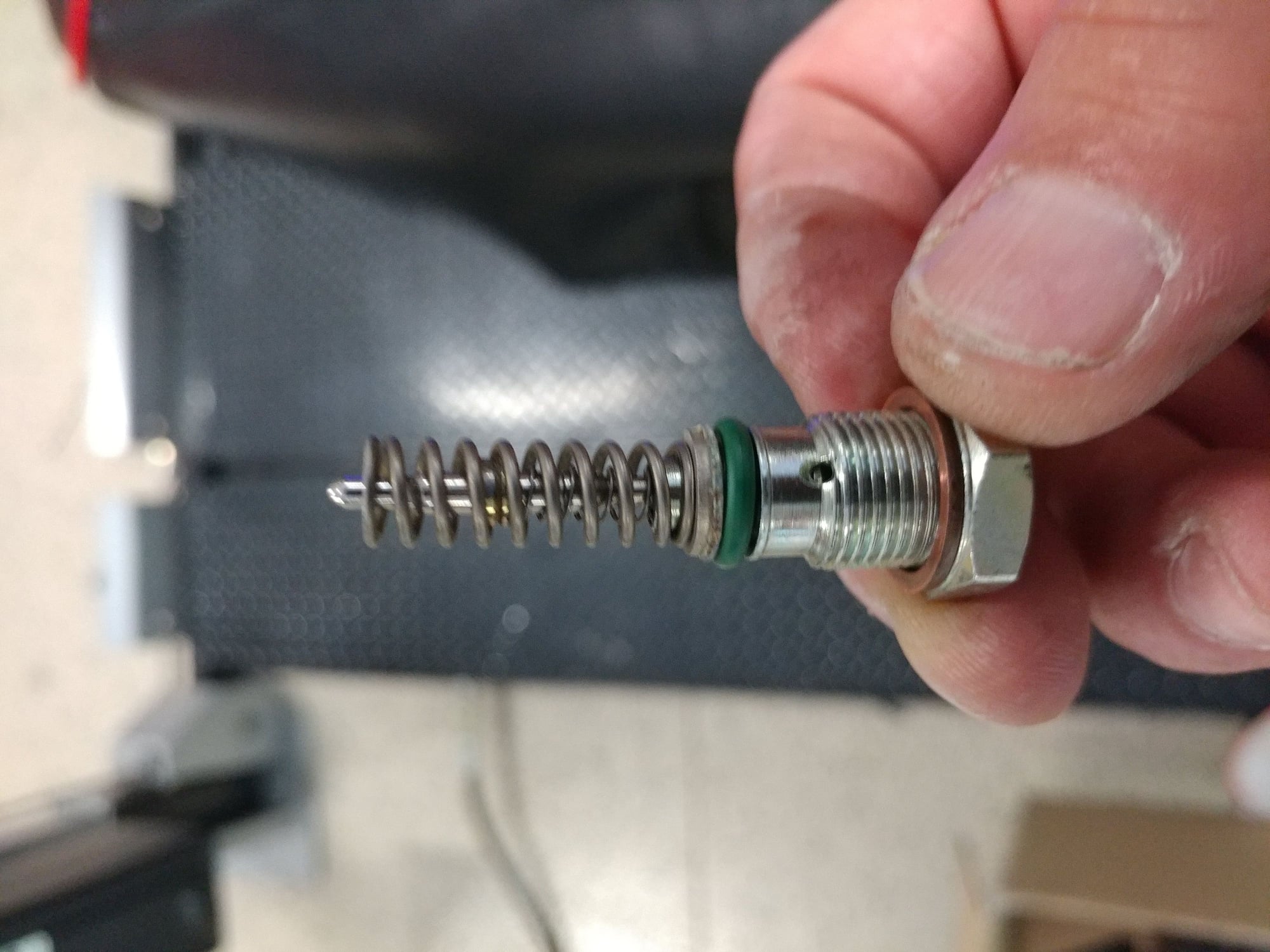
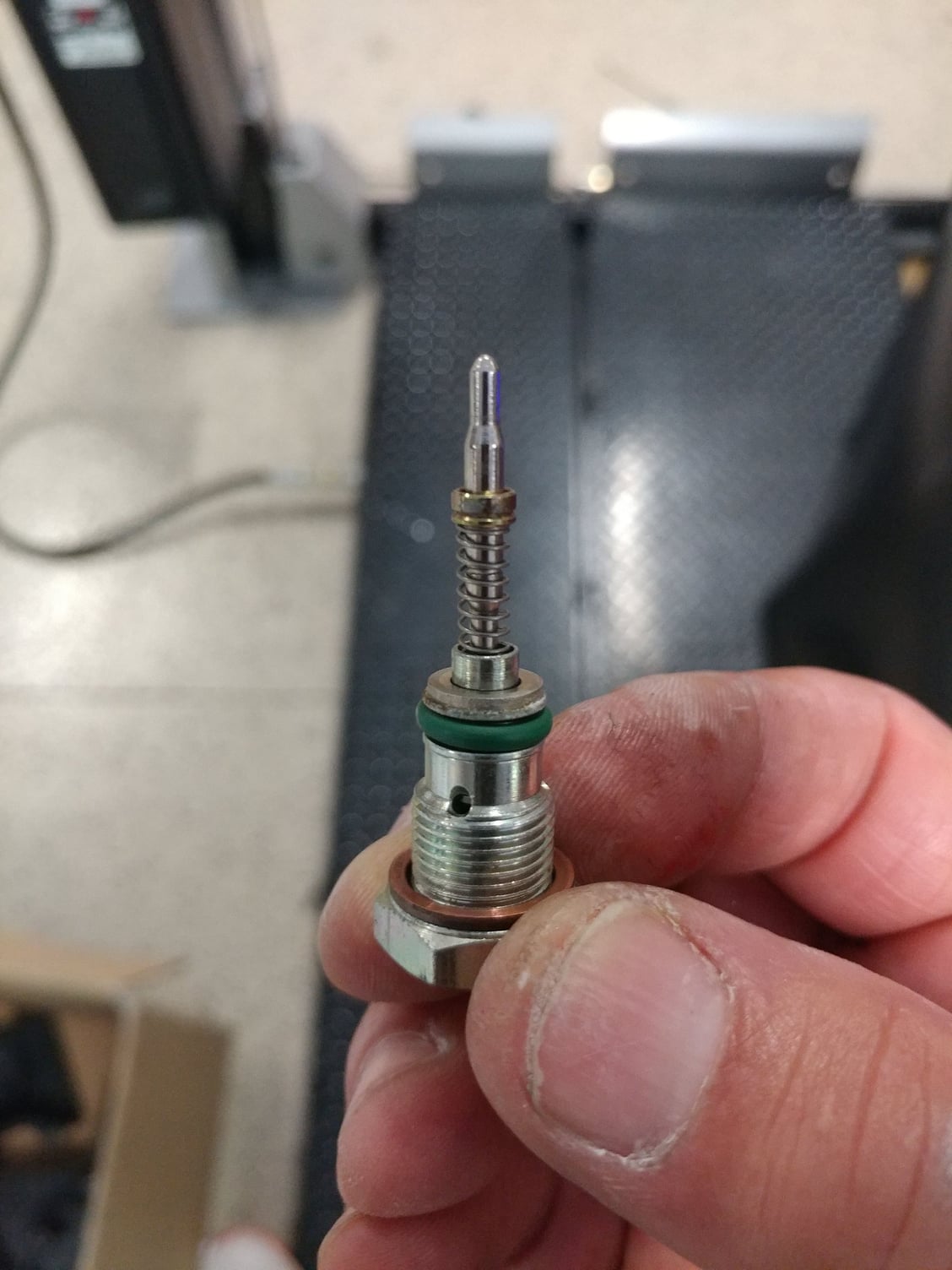
and here are the pictures of the one I removed from my FD yesterday. One picture shows it with both springs installed and the other with only the one spring, which then makes it look like the eBay item.
That second spring is a serious one compared to the normal one and would certainly explain my super high fuel pressure if it's not supposed to be there.
Should I take this pressure adjuster screw back out and try it with the extra spring removed? My problem is that I don't know what my fuel pressure was when my 4.5L car was running well as I never needed to check it - because it had been running well. It may have been way to high all along and just never caused an issue, so I don't know why it would now. Carl says that he didn't do anything to modify the fuel pressure to the WUR as part of the supercharger installation, since everything seemed to work the way it was - he changed the WUR, but didn't do anything in the FD.
So, in looking at my pressure valve in the back of the fuel distributor that controls the system pressure to the WUR and in the lower chambers of the fuel distributor and comparing that to one I see for sale on eBay, they are the same, except mine looks to have an additional beefed up spring outside the normal thin spring. Is this why my fuel pressure readings are so high or is this additional larger spring normally present and just not part of the ebay item. It almost looks like someone increased the fuel pressure from the FD to the WUR to try and compensate for an issue they may have been having with the car at some point.
Below is a picture from the eBay item that's for sale
and here are the pictures of the one I removed from my FD yesterday. One picture shows it with both springs installed and the other with only the one spring, which then makes it look like the eBay item.
That second spring is a serious one compared to the normal one and would certainly explain my super high fuel pressure if it's not supposed to be there.
Should I take this pressure adjuster screw back out and try it with the extra spring removed? My problem is that I don't know what my fuel pressure was when my 4.5L car was running well as I never needed to check it - because it had been running well. It may have been way to high all along and just never caused an issue, so I don't know why it would now. Carl says that he didn't do anything to modify the fuel pressure to the WUR as part of the supercharger installation, since everything seemed to work the way it was - he changed the WUR, but didn't do anything in the FD.
I've been trying to stay out of this entire discussion, but it might be worth mentioning that there's another piston inside the fuel distributor, which the assembly in you fingers pushes on. It's that piston which actually moves and controls the fuel pressure. If there was a little bit of moisture somewhere, when you removed the fuel distributor, that piston could be frozen in the bore.
You should probably make the effort to remove and inspect that piston.
There's a small "O-ring" on that piston that seals it against the orifice that bypasses the fuel pressure, BTW. If the "O-ring" goes bad, fuel pressure will be incorrect.
BTW...your "plunger" assembly is correct. There's not an "extra" spring there. Fuel pressure is determined by the "shim" at the base of the big spring. Those "shims" come in various thicknesses, so you can set the system pressure correctly.
I've been trying to stay out of this entire discussion, but it might be worth mentioning that there's another piston inside the fuel distributor, which the assembly in you fingers pushes on. It's that piston which actually moves and controls the fuel pressure. If there was a little bit of moisture somewhere, when you removed the fuel distributor, that piston could be frozen in the bore.
You should probably make the effort to remove and inspect that piston.
There's a small "O-ring" on that piston that seals it against the orifice that bypasses the fuel pressure, BTW. If the "O-ring" goes bad, fuel pressure will be incorrect.
BTW...your "plunger" assembly is correct. There's not an "extra" spring there. Fuel pressure is determined by the "shim" at the base of the big spring. Those "shims" come in various thicknesses, so you can set the system pressure correctly.
Glad to have you back in - "Every time I try to get out, they pull me back in"
Good to know that big spring slipped over the top is correct. Thanks. How do I get to that internal piston you're speaking of. Obviously I need to remove all the fuel line connections, but then how does the FD come off and how much of it needs to come apart to get to it? Any chance spraying some light penetrating oil into the hole where the pressure screw is and the injector outlets or introducing some Marvel Mystery Oil might free things up without major disassembly?
For what its worth, I like K-Jetronic. Its brilliant and an absolute anvil once its set up. Just feed it fresh fuel and its happy. It Achilles heal is old gas and varnish. We topped out at 460 WHP/541 BHP on our 16v K-jet race car before we changed to race a 32v motor instead. It ran well for us, although in my video for Pikes Peak you can hear the fuel/air ratio was all wrong in the last few turns at 14,000 feet. But then, every fuel delivery system had that issue then.
Looking at the record - no other Fuel Injection system spanned as many years as K-Jet, and through many Government regs and changes. And remember that in the case of the 1989 Porsche 911 Turbo (the 930) - the car that Porsche used to get back the moniker of "worlds fastest production car" from Ferrari - they chose K-Jet. Think about that. The year was 1988/89, and Porsche certainly had access to the Bosch LH-Jetronic system, but they opted for K-Jetronic for their Ferrari beater. I like it.
Wasn't that a 930 in the movie Bad Boys II? Worlds fastest production car. A K-Jet was in that car.
Bad Boys 1 had the black Porsche Turbo - "this is a faster f'n car" - it was a Ferrari in BB2. The Porsche Turbo was a '94 964 Turbo 3.6 - the only year of the 3.6 in the Turbo prior to the 993 generation arriving, which is when it became a Twin Turbo. I don't know what fueling system was used in that 94 964 Turbo. The last run of 964 Turbos were the limited edition Flachbau cars that had exposed lay down headlights similar to the 928 and 968 - think there were around 50 of these only. The rarest of these were the couple that had the Flachbau code based on the production date, but were built with the traditional 911 fenders and upright lights and I think there were only a couple of these.
Glad to have you back in - "Every time I try to get out, they pull me back in"
Good to know that big spring slipped over the top is correct. Thanks. How do I get to that internal piston you're speaking of. Obviously I need to remove all the fuel line connections, but then how does the FD come off and how much of it needs to come apart to get to it? Any chance spraying some light penetrating oil into the hole where the pressure screw is and the injector outlets or introducing some Marvel Mystery Oil might free things up without major disassembly?
Maybe stupid, but I wonder if you can remove that piston by applying suction with your Mityvac. MMO probably wouldn't hurt either.
Good luck,
Dave
I bet some water or cleaning fluid got into the FD while it was off and I was cleaning things before reinstallation. I'm going to pursue this plunger inside the FD to see if I can get it lubricated and moving to get the baseline fuel pressure back into the range. Between that and the potentially switched connectors on the cold start valve and thermo switch, maybe we're closer than we think to getting this resolved.
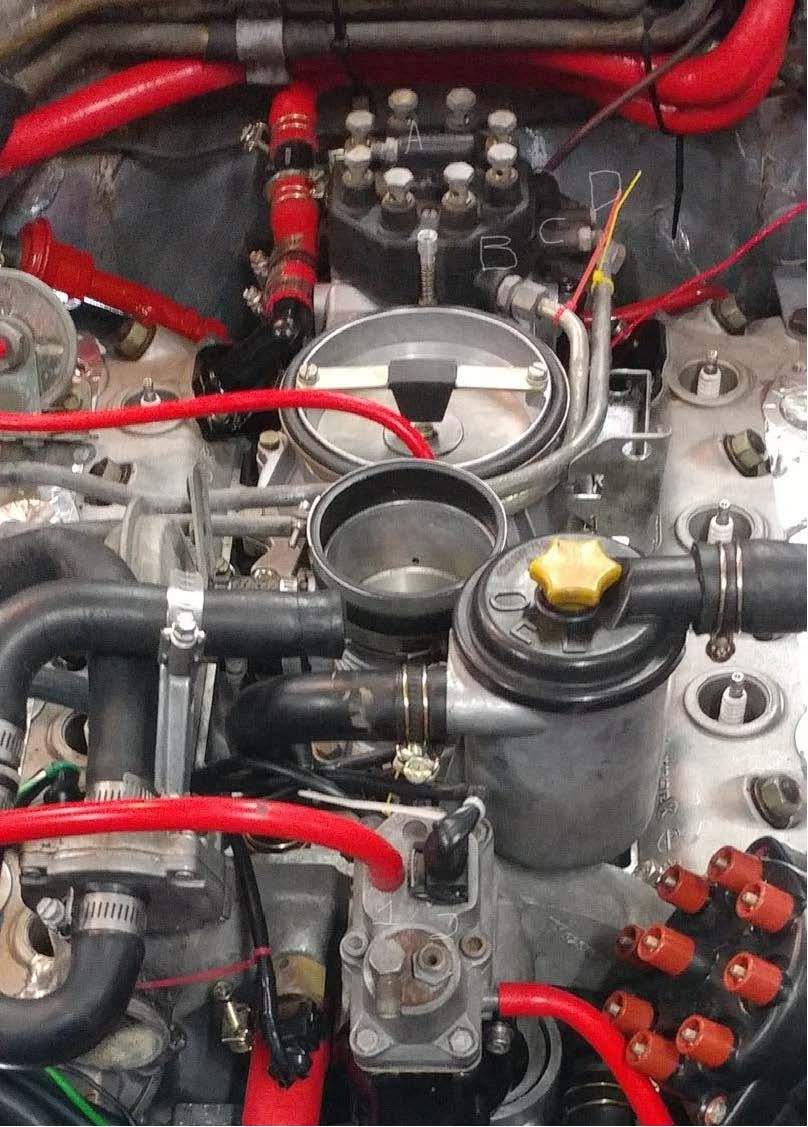
As I go through removal and further testing of the FD, it would help me a lot if someone could look at the photo of the FD and WUR below, where I've labelled the inputs and outputs with letters and numbers (they're faint but there if you look closely) to let me know which are which for the 928 K-Jet I have, as different CIS systems I've seen seem to have them labelled differently, even on L-Jet.
FD
A - connected to WUR
B - has red wire tie on it - is this the input from the Fuel pump or the return from the FD back to the tank
C - has yellow wire tie on it - is this the input from the Fuel pump or the return from the FD back to the tank
D - connected to WUR
WUR
1 - connected to FD
2 - connected to FD
On my car, the D line on the FD went to the 1 on the WUR and the A line on the FD went to the 2 on the WUR, so they cross over from one side to the other. Is that correct as I've seen a drawing someone did of their system that shows them not crossing sides. Is 1 or 2 on the WUR the input where the system pressure should be stable and which is the output back to the FD where the pressure should be changing based on temperature.
Once I remove the FD so I can see what's going on, is there a good way to try and lubricate and free that pressure plunger without disassembling it, like with compressed air (which port should I blow in from) or with the Mityvac supplying vacuum as Dave suggested might work?
I bet some water or cleaning fluid got into the FD while it was off and I was cleaning things before reinstallation. I'm going to pursue this plunger inside the FD to see if I can get it lubricated and moving to get the baseline fuel pressure back into the range. Between that and the potentially switched connectors on the cold start valve and thermo switch, maybe we're closer than we think to getting this resolved.
As I go through removal and further testing of the FD, it would help me a lot if someone could look at the photo of the FD and WUR below, where I've labelled the inputs and outputs with letters and numbers (they're faint but there if you look closely) to let me know which are which for the 928 K-Jet I have, as different CIS systems I've seen seem to have them labelled differently, even on L-Jet.
FD
A - connected to WUR
B - has red wire tie on it - is this the input from the Fuel pump or the return from the FD back to the tank
C - has yellow wire tie on it - is this the input from the Fuel pump or the return from the FD back to the tank
D - connected to WUR
WUR
1 - connected to FD
2 - connected to FD
On my car, the D line on the FD went to the 1 on the WUR and the A line on the FD went to the 2 on the WUR, so they cross over from one side to the other. Is that correct as I've seen a drawing someone did of their system that shows them not crossing sides. Is 1 or 2 on the WUR the input where the system pressure should be stable and which is the output back to the FD where the pressure should be changing based on temperature.
Once I remove the FD so I can see what's going on, is there a good way to try and lubricate and free that pressure plunger without disassembling it, like with compressed air (which port should I blow in from) or with the Mityvac supplying vacuum as Dave suggested might work?
Thanks.
The internal residual fuel pressure frequently forces the piston out of the fuel distributor. The pistons sre known to come out and drop down (getting lost) while people are looking at the spring assembly. If you can't just stick in a small "stick magnet" and pull out the plunger, it's not a good thing.
Since this piston regulates incoming fuel pressure, if you remove the incoming fuel pressure line and blow with compressed air into the fuel distributor, that piston should "leave a dent", in your firewall
If the piston is stuck/frozen and will not move, that will be your system fuel pressure issue.
There's one other thing to check. If you replaced the fuel deed and return hoses on the passenger side of the engine bay, it us possible to "swap" the two hoses, if you are not paying attention. This generally results is a very "ballooned" fuel filter, which crabs the weld and leaks fuel (from "dead headed" fuel pressure.)
However, if the filter doesn't break the weld and leak, feeding fuel pressure backwards through the system would do some really crazy things!
The quick way to check this is to simply look at the fuel filter....of it looks like a "pregnant" filter, you've swapped the two lines.
The internal residual fuel pressure frequently forces the piston out of the fuel distributor. The pistons sre known to come out and drop down (getting lost) while people are looking at the spring assembly. If you can't just stick in a small "stick magnet" and pull out the plunger, it's not a good thing.
Since this piston regulates incoming fuel pressure, if you remove the incoming fuel pressure line and blow with compressed air into the fuel distributor, that piston should "leave a dent", in your firewall
If the piston is stuck/frozen and will not move, that will be your system fuel pressure issue.
Good to know that is ferrous and I can retrieve it with a magnet. Considering I had the pressure spring screw out the other day and the piston didn't come out on it's own (had a rag below it to catch any fuel drips and it would have ended up in the rag), maybe it is in-fact stuck. I'll work on retrieving that tonight to see what it looks like. Anything else behind it I need to be aware of coming out with it or getting lost?
There's one other thing to check. If you replaced the fuel deed and return hoses on the passenger side of the engine bay, it us possible to "swap" the two hoses, if you are not paying attention. This generally results is a very "ballooned" fuel filter, which crabs the weld and leaks fuel (from "dead headed" fuel pressure.)
However, if the filter doesn't break the weld and leak, feeding fuel pressure backwards through the system would do some really crazy things!
The quick way to check this is to simply look at the fuel filter....of it looks like a "pregnant" filter, you've swapped the two lines.
I'll check this too, but didn't replace those lines, just disconnected them and reconnected them. Before removing them, I color coded them with wire ties also - red to red and yellow to yellow, I also don't think those lines can be reversed the way they come apart as the connections aren't the same on both lines in the same orientation.
Here they are on the old motor color coded before removal.
and here's the K-Jet system after removal where you can see the end connectors being different from each other.
Porsche's Top 5 Most Questionable Naming Decisions
Slideshow: For a company obsessed with engineering precision, Porsche has occasionally named its cars in ways that left even loyal enthusiasts scratching their heads.
Pogea Racing's 964 Porsche 911 Reimagination Stands Out in a Crowded Field
Slideshow: Pogea Racing's latest Porsche 964 project blends carbon-fiber construction, modern chassis upgrades, and up to 500 horsepower while keeping the air-cooled 911 experience firmly analog.
Talos Takes Your 991 Porsche 911 GT3 to the Next Level for a Cool $1.13 Million
Slideshow: Talos Vehicles has transformed the Porsche 911 GT3 RS into a carbon-bodied, race-inspired machine that costs well over $1 million before the donor car is even included.
9 Vehicles Porsche Helped Engineer that Aren't Porsches
Slideshow: Long before engineering consulting became trendy, Porsche was quietly helping other automakers build everything from supercars to economy hatchbacks.
9 Features and Characteristics That Only Porsche People Understand
Slideshow: Some brands build cars. Porsche builds traditions, obsessions, and a few habits that stopped making sense decades ago but somehow became part of the charm.