When you click on links to various merchants on this site and make a purchase, this can result in this site earning a commission. Affiliate programs and affiliations include, but are not limited to, the eBay Partner Network.
I'm sensing some "apology" in this space, and a concern that this isn't as good as it should be - on the contrary I believe these results are excellent and would make any Tesla fan boy jealous. This data tells me what we all expected - the Taycan charging is industry leading.
To understand this we need some perspective:
Temperatures: below 60 degrees (55 was reported in your report) - that's "cold" from a LiON battery perspective.
Comparing this charge rate to the industry benchmark (Tesla superchargers) - there are 3 maximum charge rates in the Tesla world:
now these are maximum charge rates and only in "ideal" circumstances - we know the Tesla taper is pretty steep and you'll only get these maximum charge rates at ideal temperatures and low SOC-% on the battery - V2 are the majority superchargers in the wild, and therefore lets focus on the 120 kW maximum rate…
you only get this rate at like below 30% battery - after it starts to taper - thursday evening @ Vacaville supercharger SOC below 20% I was only able to get 89 kW to start on a 120 kW supercharger @ 45 degrees-F in my Model 3 - no where near the maximum rate, proably all due to temperature.
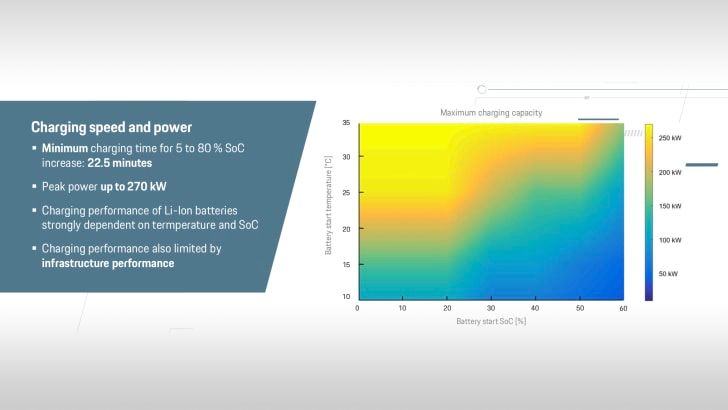
@Sonnen Porsche 's data is showing a sustained 165 kW charge rate (which is 45 kW MORE than Tesla's maximum V2 rate) with battery state above 10% and on a "cold" day…this is a superior charging result and reflects on just how far ahead Porsche is in this space with regards to charging ability with their battery technology. rather than sheepish apologies
Spoiler
I am not sure if this is because the car was above a 10% charge, this is a very early production car, this station has some issues, or something else as I can only report what I saw at this one station
this is a charging result on a brisk winter day that would make any reasonable Tesla fan boy very jealous! And we know the Taycan can sustain the higher charge rates much much deep in to the battery's SOC than Tesla
this is an excellent result! No apologies necessary - tell your Tesla fan boy's to put that in to their charge port and smoke it! Even at a V3 supercharger on a sub 60 degree day there is _NO_ way a Model 3 (S and X are limited to 120 or less even at V3) would do 165 kW and even it if did - it wouldn't last long due to the much more aggressive taper in the supercharger curves.
in fact the charge rate exactly matchs porsche published "heat map" for SOC vs. Temperature for 60 degree or less weather - 60f is about 15C - please see charge below…
and the charge taper in nearly ideal condition see - below the Taycan maintain a near maximum charge rate much deeper into the SOC %'age than the Model 3 which tapers very very aggressively
the Taycan charging at 165 kW is a spectacular result and would/should be the envy of nearly any Tesla fan boy! Don't apologize - this is a clear win for the Taycan.
I know you get some feedback on the forums cause you're a dealer and some will take your results with a grain of salt cause ya'know "sales" - and other have cautioned you about claims because you are lacking data - however in this case you have demonstrated, documented, and have personal experience about just how much better the Taycan is at charging vs. Tesla. It's a clear and unambiguous victory and a remarkable result in real world conditions. As a sales representative this is brag worthy and shoudl make any Taycan customer proud and please to know they have the best charging EV in the industry right now and your results prove that beyond a shadow of a doubt.
Now they are going to need it because of the Taycan's crappy range - no I kid- we kid because we love!!!
this result makes me as a taycan customer (ordered w/deposit) feel much better, and I'm looking forward to having the best charging EV currently available, really stupendous result vs. the Model 3 at this time - and there is no way a Model 3 sitting next you on that same day at a V3 supercharger would've charged nearly as fast - Taycan wins hands down.
Not apologizing but I was hoping to see around 270KW at first and then the taper down at around 50% to a lower number but perhaps the temperature and the battery temp affected that number?
most definitely - 165 kW sustained charging rate on temps 60 degrees or lower is a spectacular result vs. any competition currently on market. Your result is completely in line with expectations given temperatures and really honestly best in the industry right now for real world conditions - we should revisit this on a nice 72 degreee day - I'm pretty sure we'll see nearly 270 kW.
The 12% buffer on the Taycan battery is there to unlock down the road so that the car is a viable product for 10 years. The expectation is that the battery pack will loose approx 7-10% of its range after a certain time frame and then Porsche can unlock that percentage to keep the range the same as when the car was new. The range I showed is from a 83 KWH usable battery and the technology is already 3 years old in this car as Porsche tests and test and tests. 100 prototypes driving a million miles each in all types of conditions. I am sure Taycan 2.0 will see better battery technology and efficiency and I hope the ability to paddle shift the regen to maximize range.
Think more in terms of SSDs. Over provisioning.
You laptop may have a 250GB SSD in it but that said SSD actually have another 10-15GB 'unused'. The controller rotates the cells used to even out the wear on them. But at any given time you can only use 250GB of them.
Same idea in the battery. Say there is 100 cells inside, at any given time you are only using 88 of them, 1-88 first, then it could be 2-89, 3-90, etc. The unused cells would likely be kept at around 50% SoC, where lithium battery can last the longest.
You laptop may have a 250GB SSD in it but that said SSD actually have another 10-15GB 'unused'. The controller rotates the cells used to even out the wear on them. But at any given time you can only use 250GB of them.
Same idea in the battery. Say there is 100 cells inside, at any given time you are only using 88 of them, 1-88 first, then it could be 2-89, 3-90, etc. The unused cells would likely be kept at around 50% SoC, where lithium battery can last the longest.
agreed. I think it’s a mistake to assume the 12% is a simple and linear top buffer.
Same idea in the battery. Say there is 100 cells inside, at any given time you are only using 88 of them, 1-88 first, then it could be 2-89, 3-90, etc. The unused cells would likely be kept at around 50% SoC, where lithium battery can last the longest.
Not so easy to do with a BEV battery. Remember, a BEV battery has parallel connected cells (Tesla M3 - 46, type 21700) provide the Ahr rating, and 96 of those are in series
to provide about 400V & the needed kWh rating. To do what's suggested, the switching system becomes overly complex with reduced battery reliability.
Not so easy to do with a BEV battery. Remember, a BEV battery has parallel connected cells (Tesla M3 - 46, type 21700) provide the Ahr rating, and 96 of those are in series
to provide about 400V & the needed kWh rating. To do what's suggested, the switching system becomes overly complex with reduced battery reliability.
That's for Tesla. But who says VAG is following the same design? I don't have numbers handy to say one way or another.
But VAG uses different style of battery than Tesla, in individual modules, in Audi's case, the 'spare' capacity roughly equals to 4 modules out of the 36 total. each cell is 60Ah and 12 of these sits in a module. To those Germans, its pretty simple to engineer a solution to rotate 4 modules in and out. Or in the Taycan's case, 33 modules with 12 cells each. Math's a bit trickier here as the reserve equals around 3.4 modules, it could just be the round up round down and becomes 3 modules in reserve. Tesla doesn't do it doesn't means others can' do it.
Or it could also be a much simpler thing, Porsche just charge each cell to only 90% capacity instead of the full 100%. And in the Audi's case, slightly less than 90%.
Either way, it's pretty obvious the Germans are prioritizing battery longevity over ultimate capacity.
Or it could also be a much simpler thing, Porsche just charge each cell to only 90% capacity instead of the full 100%. And in the Audi's case, slightly less than 90%.
That's for Tesla. But who says VAG is following the same design? I don't have numbers handy to say one way or another.
But VAG uses different style of battery than Tesla, in individual modules, in Audi's case, the 'spare' capacity roughly equals to 4 modules out of the 36 total. each cell is 60Ah and 12 of these sits in a module. To those Germans, its pretty simple to engineer a solution to rotate 4 modules in and out. Or in the Taycan's case, 33 modules with 12 cells each. Math's a bit trickier here as the reserve equals around 3.4 modules, it could just be the round up round down and becomes 3 modules in reserve. Tesla doesn't do it doesn't means others can' do it.
No - they don't save 'spare' modules to be used later. That makes no sense.
Or it could also be a much simpler thing, Porsche just charge each cell to only 90% capacity instead of the full 100%. And in the Audi's case, slightly less than 90%.
Either way, it's pretty obvious the Germans are prioritizing battery longevity over ultimate capacity.
That is what they all do. At 0% from the drivers point of view, is never 0% at the battery. The cells would be quickly destroyed if they were fully discharged. So all manufacturers design their battery management systems to leave some buffer at the bottom to prevent it from happening. Similar at 100% charge.
Individual Li-ion cells are in the 3.6-3.8V range (depending on chemistry and SOC). A bunch of them, if my calculations are right 198 in the Taycan, are connected in a series string to achieve the desired pack voltage. Then a number of strings are connected in parallel to achieve the desired capacity. Since the Taycan uses 396 large individual cells, there are only 2 parallel strings. (By comparison the Model 3 75 kWh pack uses much smaller cells, and contains 96 cells in series x 46 parallel strings.)
No - they don't save 'spare' modules to be used later. That makes no sense.
That is what they all do. At 0% from the drivers point of view, is never 0% at the battery. The cells would be quickly destroyed if they were fully discharged. So all manufacturers design their battery management systems to leave some buffer at the bottom to prevent it from happening. Similar at 100% charge.
Individual Li-ion cells are in the 3.6-3.8V range (depending on chemistry and SOC). A bunch of them, if my calculations are right 198 in the Taycan, are connected in a series string to achieve the desired pack voltage. Then a number of strings are connected in parallel to achieve the desired capacity. Since the Taycan uses 396 large individual cells, there are only 2 parallel strings. (By comparison the Model 3 75 kWh pack uses much smaller cells, and contains 96 cells in series x 46 parallel strings.)
Yes capacity (Ah) is much larger, per cell, in a pouch. But voltage per cell about the same. Think for a moment - the alkaline AAA cell batteries in your TV remote are 1.5 volts - just like the D cell batteries in your old flashlight. Difference is capacity per cell. Same with Li-ion.
Yes capacity (Ah) is much larger, per cell, in a pouch. But voltage per cell about the same. Think for a moment - the alkaline AAA cell batteries in your TV remote are 1.5 volts - just like the D cell batteries in your old flashlight. Difference is capacity per cell. Same with Li-ion.
Yes, most here know very basic flashlight battery "technology". No need to post your TV remote "knowledge"!
[QUOTE=Lorenfb;16386678
Pouch cells, much more capacity per cell than the Tesla 21700 cell![/QUOTE]
What are you trying to say? What matters is energy per volume and per mass. Per cell is a useless metric since the number of cells doesn't limit you in any way. Their size and weight does though
What are you trying to say? What matters is energy per volume and per mass. Per cell is a useless metric since the number of cells doesn't limit you in any way. Their size and weight does though
Are you bored tonight, i.e. need to nitpick old posts?