When you click on links to various merchants on this site and make a purchase, this can result in this site earning a commission. Affiliate programs and affiliations include, but are not limited to, the eBay Partner Network.
I'm not saying that they can't make changes with software only. Clearly they can. Yes, your car got faster. Yes, the brakes improved. But the "range" I believe they are just playing with the constant used to calculate range, for the most part. Although they are releasing more capacity. If you follow on the forums you'll see that if you have Scan My Tesla, you can view the true battery capacity.
Range is a factor of consumption and capacity. I don't believe they are releasing more capacity to boost range. Just changing the standard for consumption. When you say your car "increased it's range overnight", that was an increase of what the car stated range was. Did you actually test to see if the car could physically drive further?
Good point. I can't say I did. It would be nearly impossible for me to determine if in fact it really did go further just because the computer claims it would. I wonder if it would be an accurate test to do a before and after (and I mean immediately after like minutes) comparison of kW/h consumption on the same route. That would only tell me about efficiency though and not capacity. Could they in fact increase the efficiency of the drivetrain with an OTA as well as release hidden electrons?
Your point however is that they did neither, they just modified the algorithm that determines range giving the illusion of increased range via efficiency and/or capacity, correct?
Boy, that would be quite the scoop if you could prove it. Shame on Tesla if true.
but you can compared wh/mile - unless the wh/mile has gone down then range is unchanged - wh/mile is the truth (if accurately reported) - range going up/down if wh/mile doesn't change is simply more/less of the battery being made available…
to really determine if range has improved - there should be a measurable change in wh/mile.
but you can compared wh/mile - unless the wh/mile has gone down then range is unchanged - wh/mile is the truth (if accurately reported) - range going up/down if wh/mile doesn't change is simply more/less of the battery being made available…
to really determine if range has improved - there should be a measurable change in wh/mile.
Yes, I meant to say wh/m, not kW/h (or w/h) but if I understand your comment, if my consumption of let's say 250 wH/m drops to 240 wH/m, under identical conditions, wouldn't that only tell me my efficiency has improved? This wouldn't correlate to battery capacity increasing but would add to the range as long as battery capacity remained unchanged. We are speculating that either one or the other improved in order to increase the range.
I think Needsdecaf was on the right track with using the "scanmytesla" or some other OBDII tool to measure actual capacity. I will have to read up on the Tesla forums to see if anyone has done a comparison of a before and after OTA to see if the usable battery capacity increased from say 76kWh to 78kWh. I've heard though on other EV forums these numbers are a moving target so I don't know if they are sensitive, consistent or accurate enough to make a case one way or the other.
I'm sure there are some youtube videos out there of Tesla owners trying to conduct their own range comparisons but my guess is there are too many variables that would contaminate the data to have a margin of error that is more than the reported gains.
Regardless, I am in agreement that Tesla's EPA range numbers may be official and attainable but the Taycan's (and maybe even other brands) seem to be easier to attain or exceed the rated range. The point is that the Tesla range isn't necessary wrong or incorrect, it's just much less conservative that the Taycan's appears to be. The theories why have been hashed out numerous times so no point in rehashing again.
For all we know, Tesla could still be playing with the newly improved inverters (using SiC switching transistors) and their unique PMSRM motor to improve efficiency/power. The PWM waveforms that the inverters feed into the motors can be far more complex than a simple sine wave. Some tweaking as time goes on would be natural. As an example, the 2014 Cadillac ELR used the same physical drive train hardware as the Gen 1 Volt. Yet there were significant tweaks to the firmware to do exactly that. (Annoyingly, GM never bothered to offer the upgraded computer algorithms to Volt owners - keeping it as a "Cadillac exclusive".) In Teslas case, they would seem to have no problem just pushing the improvements out via OTA updates.
Another example would be the Jag I-Pace. They pushed out a big firmware range update last year. Unfortunately it takes a trip to the dealership to get it installed.
there there is really only two ways to increase range in the EV space…
improve wh/mile efficiency - this can be accomplished via hardware or software and combinations of both
somehow increase battery capacity - either by improving the battery or unlocking "reserve" capacity
there is a "fake" way to increase range - and that is to adjust the computer's estimated range that it "shows" as total range - this a false range increase and I wouldn't put it past Tesla that there is some of that going on as well. As @Needsdecaf stated you have to actually test the car to see if the range has increased or Elon's just adjusted the calculated constant that is displayed.
combinations of 1 & 2 may be in play - honestly we don't know. But if Tesla is unlocking additional capacity and then finding 1-10 wh/mile improvements with software/power tweaks then range could be increase with no change in hardware but simply changes in how the software engages the hardware…
we'll honestly never know. I believe Tesla's EPA numbers are achievable but only for the most diligent owner under ideal circumstances, which means you will come no where close to the maximum EPA range 98% of the time - where as other EV vendors are more conservative with their EPA numbers and they may represent numbers that require less diligence on the driver's part to achieve - it's quite clear the Taycan's EPA numbers are almost worse case scenarios and I would expect owners to only be worse than EPA in cold weather conditions.
Elon Musk;
"Weird that EPA would deny this. We have precise car logs that confirm it happened. Happy to provide them."
Somebody's lying.
Did you ever conclude that the Earnings Report was accurate in stating that the official EPA range is 391?
"We can confirm that EPA tested the vehicle " from your quote above.
Did you find their results to differ?
Elon Musk isn't credible.
EPA results match with BMS reports. Tesla must have some "dieselgate" code in their dyno mode. I will share the details later.
But aren't the Tesla range increase claims tested by the EPA? Seems like an easy class action lawsuit if they are simply changing how range is displayed and not actually increasing the range...
But aren't the Tesla range increase claims tested by the EPA? Seems like an easy class action lawsuit if they are simply changing how range is displayed and not actually increasing the range...
In some cases I know of Tesla simply lowered the number initially.
Model 3 for example got over 320mi range in the first EPA test. They released it with 310mi EPA rating. Later on they increased the rating to 322mi which was ok based on the very first test results. Of course EPA didn't mind. They obviously didn't even do a second test after the "range increase". // I might not remember the numbers correctly any more. The RWD got 336mi in the test and they released it with 310mi because the AWD version reached something less, and they wanted the same number for both. Initial multiplier for the AWD was less than 0.7. Later this got changed. Looked up the article see below.
Same for Model S. It was listed for months with 370mi although they got the 373mi approved before.
Now this is for the Monroney sticker. That's what EPA cares about. They do not have control over the numbers displayed on the instrument cluster.
CEO Elon Musk said at the time:
“There’s also some things we’ve been able to do for existing customers that are pretty cool. Tesla is as much a software company as a hardware company and we’ve been able to via firmware improve the range of the long-range rear wheel drive car from 310 miles to 325 miles. This will affect all customers including those that were all long range cars shipped to date and new cars. So both existing and new customers will get a 15 mile range increase from 310 to 325.”
Even Electrec knew it:
As we previously reported, Tesla has played with EPA ratings to advertise all Model 3 versions with 310-mile range even though the Long Range version was able to get more when they first launched Model 3.
Elon Musk;
"Weird that EPA would deny this. We have precise car logs that confirm it happened. Happy to provide them."
Somebody's lying.
Did you ever conclude that the Earnings Report was accurate in stating that the official EPA range is 391?
"We can confirm that EPA tested the vehicle " from your quote above.
Did you find their results to differ?
Trying to give a quick answer here.
There is a discrepancy between the battery capacity for EPA range per Tesla versus observed capacity in real life.
In EPA tests only cars that run 4000mi already can be tested. Since battery capacity usually drops about 1% during these miles, battery capacity is expected to be lower than nominal value. And there might be an additional 0.5%-1% loss when discharging it due to efficiency.
In the early 100D years several sources reported that Tesla's BMS says 102kWh nominal capacity and 4kWh bottom buffer. This was in line with the EPA measurement (about 99kWh delivered)
This is why I referred to 100D battery as 98kWh (usable when new). At this point Tesla did not have a top buffer.
They did use a bottom buffer.
- For EPA test the top buffer won't be part of the measurement, because the car won't allow to charge the battery higher than a specified SoC (even though it displays 100% on the instrument cluster).
- However the bottom buffer is included in the measurement because the test stops when the battery runs out of power, they don't stop the car at 0% SoC displayed at the instrument cluster. This 4kWh bottom buffer gives ~20mi extra.
A proof that they didn't use top buffer can be seen here:
above 95% the car charges with less than 5kW. Usually batteries don't accept high charge rate near 100% SoC because their voltage can't be raised higher.
// you can also see here that the battery took ~98kWh energy for a full charge = usable capacity.
However I suspect they added a top buffer sometime in the previous years, yet they still use it for the EPA test. However that isn't accessible for the car owner.
One proof of this top buffer is here:
near 100% SoC the battery still accepts 20kW power
Notice the BMS reports 96.5kWh nominal capacity and usable full pack is at 91.5kWh (so there is a bottom buffer of 4kWh)
// usually BMS reports the top buffer as well but not here, I don't know why.
Now Tesla says the difference comes from the door left open. My analysis shows they are lying.
Also Tesla's response isn't very logical:
- shouldn't the car go to sleep even with the door open and the key in the car? My car goes to sleep in 20min.
- if EPA left the door open (highly questionable) by accident they have no reason to hide it
- if EPA wants to screw the test they would have picked a less noticeable trick
I can only find one other explanation for the discrepancy but the charge speed at 100% makes it unlikely:
- if Tesla intentionally lowers the numbers in the BMS by 5%, then BMS will report 97kWh nominal capacity only and also the displayed consumption will be 5% lower. In this case the displayed usable energy is 92kWh but in reality it used 97kWh . And EPA messed up their measurements. Both of these conditions need to exist for this scenario to be true and it doesn't explain the charge rate. So very unlikely.
Now Tesla says the difference comes from the door left open. My analysis shows they are lying.
Also Tesla's response isn't very logical:
- shouldn't the car go to sleep only because the door is open and the key is in? My car goes to sleep in 20min.
No! Most vehicles never enter the sleep mode if the door is left open or the key is still in the ignition switch or the remote is in the vehicle.
Not entering the sleep mode can result in the a current demand from the 12V battery in excess of 20-30 amps, which then requires the
BEV's inverter to supply the 12V battery.
Sounds like your vehicle (?), requiring 20 minutes to enter the sleep mode, may have a problematic ECU keeping the CANs alive.
No! Most vehicles never enter the sleep mode if the door is left open or the key is still in the ignition switch or the remote is in the vehicle.
Not entering the sleep mode can result in the a current demand from the 12V battery in excess of 20-30 amps, which then requires the
BEV's inverter to supply the 12V battery.
Sounds like your vehicle (?), requiring 20 minutes to enter the sleep mode, may have a problematic ECU keeping the CANs alive.
Now I get the motivation why 400mi range is so important: "So when I claimed that we would have a 1,000-hp car or have over 400 miles of EPA five-cycle range, nobody believed it." possible motivation for the plaid as well.
Elon cares about numbers that help marketing. Like he releases a stupid one time performer 2.6s 0-60 car which overheats right away just so he can claim this number. Same for 400mi. He has to have the best numbers.
"just nine months from start of production" and coming from the designer of the Model S
"Lucid’s proven world-class battery technology and highly efficient power electronics enable over 400 miles of range (EPA estimate). Say goodbye to range anxiety. You now have the confidence to go wherever the journey takes you."
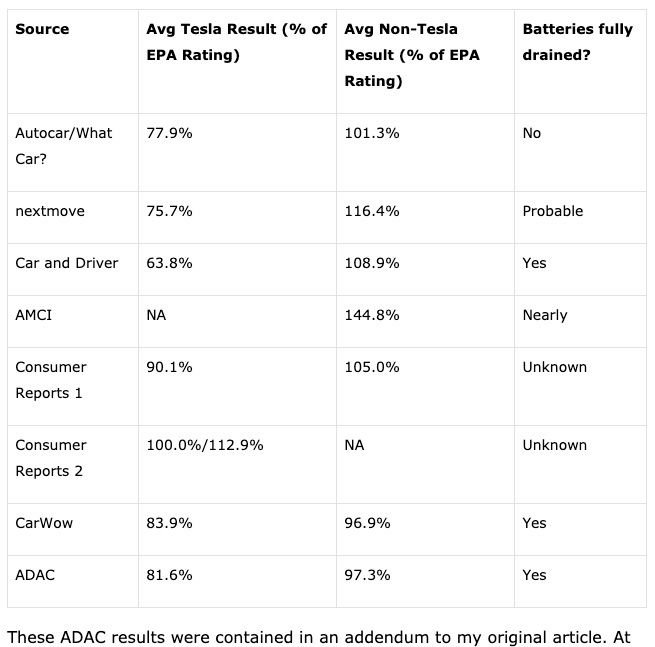
My recent article on the discrepancy between the Environmental Protection Agency ("EPA") range ratings for Tesla
and various independent tests has generated a lot of commentary. Below, I summarize my original results and present further
evidence - nearly all of which points in the same direction, namely that Tesla is "gaming" the EPA results.
"Gaming" may not be the same thing, nor have the same consequences, as "cheating" (a la Volkswagen in "Dieselgate")
but it is still bad news for Tesla. Tesla's share price, and its access to capital, reflect a mythical belief in the technological
prowess of the company. Absent this myth, the share price is greatly at risk.
However, it is highly suggestive that, across a wide range of tests (including the observations of experienced and reputable test drivers), the Teslas consistently and materially under-performed their EPA ratings and that it is uniquely the Teslas that suffer from this failure. Any single test can be criticized but the weight of evidence from all of them is clear, particularly when – with the narrow exception of one non-comparative test from Consumer Reports the details of which are not disclosed – the Tesla bulls have not been able to provide a single counter example from equivalent sources.
Tesla survives because of its continued access to the capital markets. This access is substantially based, in my opinion,
on the myth of its Tony Starkian technological advantages. Take away this myth, and the company becomes an under-scaled and
consistently unprofitable player, with very poor manufacturing, logistics and servicing capabilities, in a hugely competitive and
capital-intensive industry with thin margins and fundamental overcapacity (which is unlikely to disappear soon because of governmental support).
Like with the consumers, this message will also not remain buried forever. Although the timing of this market recognition is impossible to predict,
when it does occur, the Tesla share price will certainly not survive the revelation and, because of the continuous need to feed the cash incinerator,
perhaps not the company, either.