When you click on links to various merchants on this site and make a purchase, this can result in this site earning a commission. Affiliate programs and affiliations include, but are not limited to, the eBay Partner Network.
I got a new water pump last year. I'm hoping it came with new fluid. I haven't found any evidence of a leak anywhere. The front end radiators probably need a good cleaning though. It should reach 30K miles in the next few months and while I've changed the brake fluid and oil more frequently based on age (rather than mileage -- as did the prior owner from what I could tell), I've been told that the 30K mile maintenance check-up is fairly comprehensive.
-Eric
If the water pump was changed at the dealer the old fluid was captured and reused, unless you or whoever had the work done specified new coolant be used.
Get those radiators cleaned pronto. If they have not been cleaned in a while I believe the best course would be to have the bumper cover removed and the condensers unbolted and moved away some to give better access so all the trash/dirt can be removed.
Then afterwards every so often have the trash blown out when you have the car serviced.
Come on...really? I never would have known that. I've changed a water pump or two before and it never crossed my mind to re-use the old stuff. I guess I should know better when it comes to dealers. I'll have to check the receipt since I don't recall the itemization but the work was done by a local Porsche dealer.
The radiators do deserve a bumper-off cleaning. I've been meaning to do it for a while. I just have to find the time to do it. I'm assuming removing the bumpers is a relatively painless process...hopefully? Is it the kind of thing that should take a couple of hours for a first timer?
1) Without a dedicated oil temperature gauge, how does one know if they are getting elevated oil temperatures on a stock vehicle?
2) If the only way to do this is to add a sensor, where can a source be easily tapped? This question has been asked many times, but never seems to be satisfactorily answered.
there is an easy technique for doing this... you can determine oil temp by watchiing your oil pressure:
@ normal temp (needle strait and slightly to the right) you should be getting 4 BAR pressure @ 3000 rpm
if your engine temp is hotter then you won't get a full 4 BAR on 3000 rpm maybe 3.7 or so... (3.7 is still ok @ 3000 rpm - you are safe)
on the track the rule I use is that if I see the pressure drop to 3 bar when I'm driving in a strait away and my rpm is 3000 rpm I engage in a few cool down laps and then see what the pressure has gone up to... I usually find this does the trick as I have GT3 rad and hgh speed cooling fans enabled...
50 weight oil will give you much better pressure at the track than a 40 weight oil... I would NEVER use a 40 weight oil tracking as the heat things it out and your compromise oil pressure.
so next time your out for a drive do the 3000 rpm test and see where your pressure is at...
50 weight oil will give you much better pressure at the track than a 40 weight oil... I would NEVER use a 40 weight oil tracking as the heat things it out and your compromise oil pressure.
Its a band aid for running a 40 grade oil that has a proper viscosity index that can maintain film strength at higher temperatures and loads. I have found in exhaustive research that 50 grade oils reduce output and increase coolant temperatures simultaneously.
Thats just me and results may vary, but I don't go to a 50 grade until I alter the internal clearances of the engine for specific track application. That said, even our Grand Am engines (none of which have ever failed) still run XP9 which is a true 40 grade oil.
If using M1 the reason why you have to go to a 50 grade is because the oils all perform like a 40 grade at temperature, because they were never, ever developed to run over 212F. When we want to perform severe duty testing of any internally lubricated component, or an entire engine, thats the only time that I'll even consider running M1.
I hear what you're saying and many just don't have the time or luxury to keep switching back and forth between a dedicated track and street oil
This is where a 50 weight oil shows some value providing you keep the change intervals short.
Also a 50 weight oil like m1 or castrol or motul will flow better when hot because these 996 cars do run on the warm side at the track ... At those temps I would imagine there is little hp loss.
I have a 2006 caymanS with an M97 engine, with only 32,000 km (19,880 miles) and I found metal flakes in the oil filter. Check these two vids to see how much.
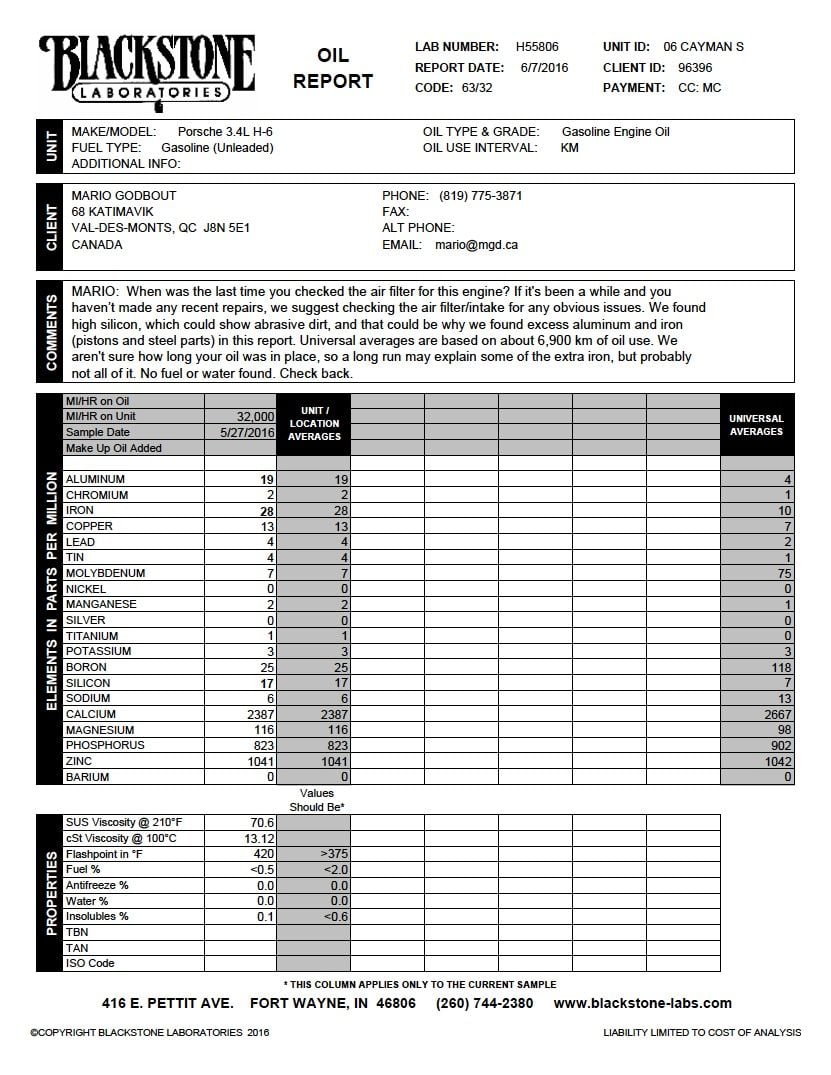
I had the oil analysis done but have no idea how to read this sheet and can't find anything useful online. Oil was changed a little over a year ago and was used for about 4,000 miles (best guess)
We checked the oil pan and found no debri. Tomorrow we will scope the cylinders. I just need to know which part of the engine is deteriorating? Yes I have the large internal IMS bearing. Is it time for an engine rebuild or replacement?
Any help would be greatly appreciated. Thanks
Originally Posted by Flat6 Innovations
Aluminum, iron and copper are all more than double what my acceptable levels are even in a 5K mile service interval. These are characteristic with camshaft/ lifter wear and the associated secondary wear that is catalyzed by this when the oil becomes material laden and bypasses the OEM oil filter at start up.
We usually see iron become elevated first, them aluminum, lead and then copper as this is the composition of the main and rod bearings. Blackstone doesn't know this, because they are not engine developers.
Copper= worn bearings, as there is no other copper within the engine's composition.
Without TBN or TAN values its hard to say how much corrosive wear that the materials could have been seeing on top of mechanical wear.
Sorry to say but it looks serious. Way too much iron and aluminum. The vids are not shown. Any pics of the debris. Ferrous or not?
I've attached an UOA of a failed engine that had its IMSB falling apart. Cringely was the owner and I bought the roller from him and currently rebuilding the engine. I sent a sample to Blackstone for an UOA just out of curiosity to see how the UOA looks on the oil.
Your engine has low miles. My thinking is it's quite salvageable if you disassemble it to locate the source of the debris. If you keep driving it, you may risk more damage and more expensive repair.
The Anti- wear package looks exactly like Canadian flavor M1 to me. Its text book. That said, the viscosity is too high at 100C, which can mean a few things.
The data on this one is not that bad. Yes, it is elevated some, but the values are not excruciating. Plus, you sent this to Blackstone, which never gets my vote.
I would drive 2K on a current oil service, then send the samples to ALS or Caterpillar for true data, which includes TAN and TBN values.
I would not tear anything down for values at these levels.
Yes, those are the end windings of a valve spring. Thats not what the UOA picked up, remember, any UOA will not pick up anything 30 micron or larger unless a particulate test is carried out.
Yes, those are the end windings of a valve spring. Thats not what the UOA picked up, remember, any UOA will not pick up anything 30 micron or larger unless a particulate test is carried out.
That's intereting to know. OP, I think you may want to add a magnetic drain plug.
Stunning Porsche 356A Super GT Speedster Auction Fails to Meet Reserve
Slideshow: One of the rarest Porsche 356 Speedsters ever built has resurfaced, offering a glimpse into a little-known chapter of the model's competition history.
Theon Goes Full Carbon Fiber With Stunning New Build
Slideshow: Built around a carbon-bodied 964 and a naturally aspirated 4.0-liter flat-six, this bespoke commission highlights how far the restomod formula has evolved.
Tuner Is Converting Porsche 911s Into Shooting Brakes
Slideshow: A Polish Porsche specialist is moving ahead with one of the most unusual 911 conversions in recent memory: a shooting brake version of the 991-generation sports car.
This Coachbuilt Creation Is A Modern Take on the Legendary Porsche 917
Slideshow: A Porsche Carrera GT has been transformed into a one-off coachbuilt machine that blends analog supercar engineering with styling inspired by the legendary 917 race cars.
Is This Convertible Cayenne A Steal, Or A Returnless Investment?
Slideshow: A heavily modified Porsche Cayenne convertible with faux wood trim and a long list of flaws recently sold at auction for surprisingly little money.


 I haven't found any evidence of a leak anywhere. The front end radiators probably need a good cleaning though. It should reach 30K miles in the next few months and while I've changed the brake fluid and oil more frequently based on age (rather than mileage -- as did the prior owner from what I could tell), I've been told that the 30K mile maintenance check-up is fairly comprehensive.