When you click on links to various merchants on this site and make a purchase, this can result in this site earning a commission. Affiliate programs and affiliations include, but are not limited to, the eBay Partner Network.
Skip - Do you have an idea what the ground clearance is going to look like ? The clearance issues brought about with deep sumps and the added weight of a skid plate (Yes, I know its not that heavy, and its very low on the car, but present none the less) would be nice to shed.
Skip - Do you have an idea what the ground clearance is going to look like ? The clearance issues brought about with deep sumps and the added weight of a skid plate (Yes, I know its not that heavy, and its very low on the car, but present none the less) would be nice to shed.
yep, ⬆︎ this. I have to run stock height b/c of the 2L deep sump and skid plate.
Skip - Do you have an idea what the ground clearance is going to look like ? The clearance issues brought about with deep sumps and the added weight of a skid plate (Yes, I know its not that heavy, and its very low on the car, but present none the less) would be nice to shed.
Yes, the UIDS V2.2 is 1 inch thick total, from the case mounting face to the bottom of the cover. I think most 2qt deep sumps are almost 2 inches from the case to the lowest part which is in the center of the sump near the drain plug.
So it will save almost an inch of ground clearance.
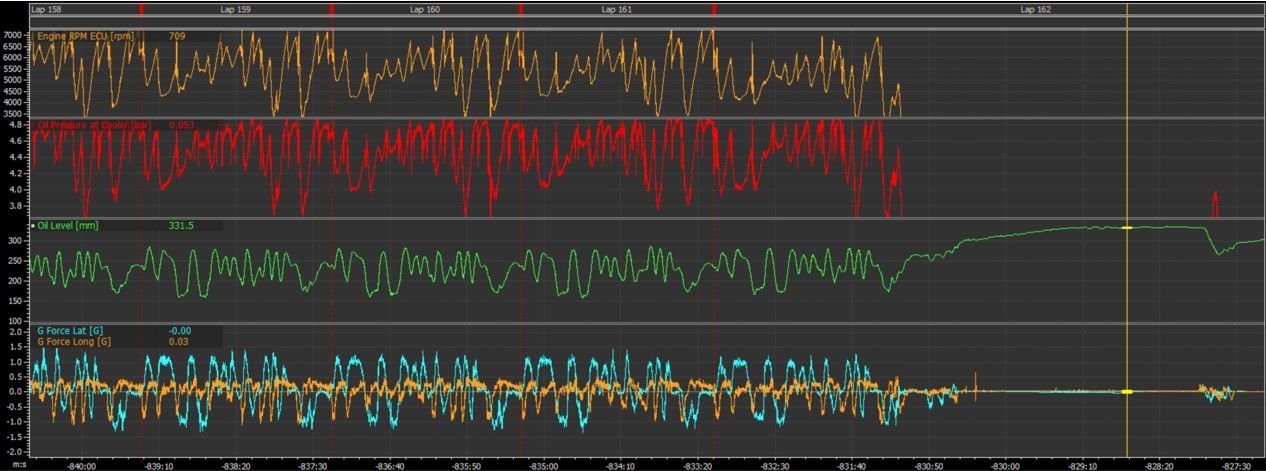
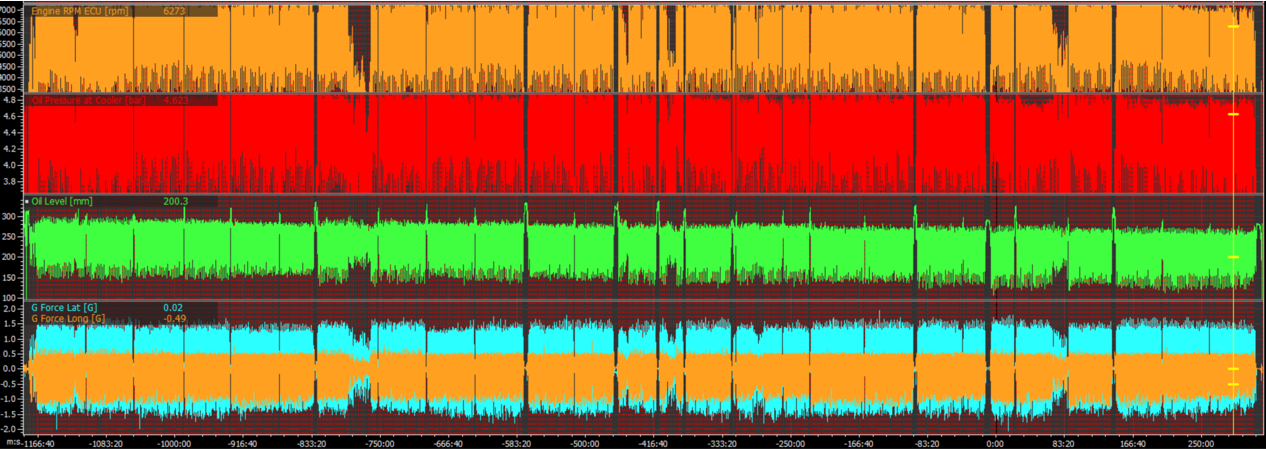
Chris at CTS was quite generous to share his data from the 24 hour run at Thunderhill in 2017. Data above is from this run that he published on his blog. Here is a plot of one lap of which there were 680. From top to bottom: RPM, Oil Pressure, Oil Level, Lateral & In-line Acceleration.
-It's immediately obvious that the pressure drop issue does not exist. Oil pressure follows RPM's very well. Lowest pressure seen is 3.6bar at 3500 RPM. There is no pressure loss due to braking or turning. There are, however, very fast spikes of pressure loss. A closer look shows these occur at around 5850 rpm when accelerating and 5600 when decelerating. The difference in RPM's is likely hysteresis of the mechanics. The drops are very fast, much less than a second, they only drop down to 4 bar(~60psi) or so, and are NOT due to air being pulled into the system. Certainly not a threat to the engine. Pointing this out to Chris, his quick reply was that this is from the variocam opening and closing. There is a brief blip in the oil pressure.
-The oil level(green) is a gauge in the dry sump oil tank. It seems to vary quite a bit. Looking at G's, we see it closely follows the lateral acceleration. This is oil sloshing around in the sump tank due to turns. Clearly the level never gets to a point where the pressure is affected. The size of the tank has been made large enough to not allow a dry pickup condition
If we zoom out to catch a rest stop for the car and driver, we see the oil level in the tank maximize. It tops out at around 330mm. The average level when running is about 230mm. If we know the size of the tank, we can easily calculate how much oil pumped into the engine and is just hanging around looking for an exit. I know the tank is cylindrical, but I don't know the diameter. The calculations for a 5" diameter tank and a 10" diameter tank would be 1.3quarts and 5.3quarts of oil lost in the engine, respectively. I need to check with Chris to get the diameter, if he's willing to share, to know the actual value. 5.3 quarts would be a lot of oil doing nothing and would explain why mediocre deep sumps don't work. It's all about the baffling and oil return getting to the pickup. An interesting point is how long it takes the tank to refill to equilibrium: 80 seconds... That's a really long time to have 'lost' oil.
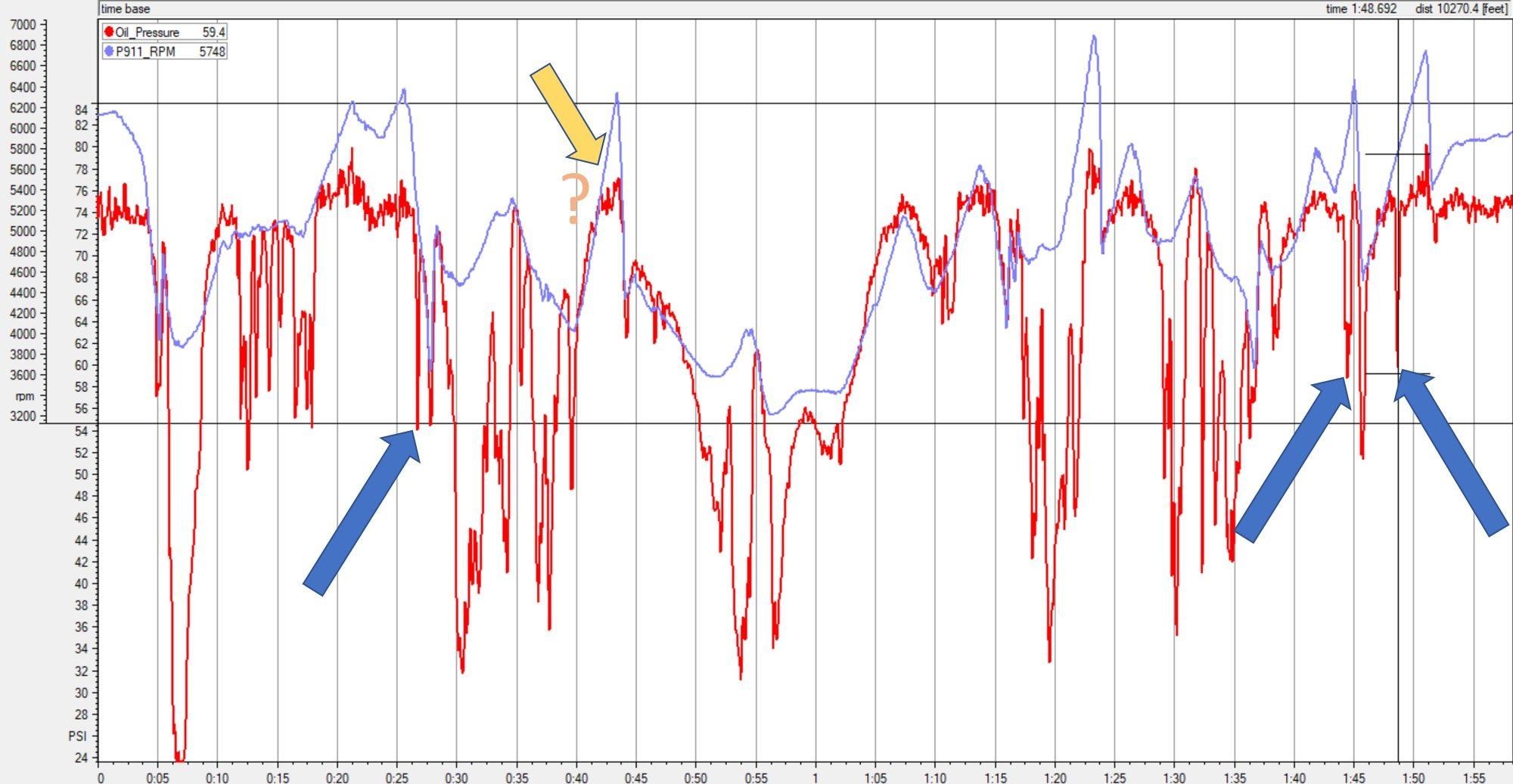
Going back to the Palmer plots, I wanted to see if we can see these fast pressure drop due to the variocam. Sure enough, they are there! Look to the blue arrows. The RPM's at which they occur are slightly different from Chris's car, no surprise. The yellow arrow shows one that seems to be missing. On some laps, there are none. Two things about this: data collection rate on the Aim is slower than the Motec, so it's possible to miss them, and other than diagnostics on the variocam, we really don't care about it relative our problem. So, it's interesting but of no consequence. The take away is that some of the sharp short not terrible low pressure drops we see are due to variocam. Noise.
Paul - looks like the sampling rate can be turned up - WAY up, from where it’s set now, which I believe to be 50HZ 20HZ... the aim SW limits a pressure sensor to 50HZ with the standard config setup, but, I can custom configure the sensor for a higher sampling rate. The limiting I’m guessing is for data storage reasons.
I can play with this if additional granularity is wanted / needed.
Last edited by zbomb; Jun 9, 2021 at 06:57 PM.
Reason: Not 50HZ - 20HZ
Correct. Yes, this is from one of Chris's Boxster's with his dry sump. Here's another interesting plot that shows the oil consumption across the run. The oil level drops across the entire run. Chris confirmed that this is the oil used by the engine, ~1.3 quarts. I guess I could use this to recalculate the 'lost oil'. Maybe after work today.
Data will set you free!!
Paul - looks like the sampling rate can be turned up - WAY up, from where it’s set now, which I believe to be 50HZ... the aim SW limits a pressure sensor to 50HZ with the standard config setup, but, I can custom configure the sensor for a higher sampling rate. The limiting I’m guessing is for data storage reasons.
I can play with this if additional granularity is wanted / needed.
I don't know that we need to change the sample rate. Chris was running his at 100Hz. What we should find out is where his pressure sensor is relative your sensor, just to think through how his pressure reading might be different. Whatever the difference, it's clear he's not pushing any air. I keep going back to Jake's statement that he used 6(or 8? or ??) sensors in different locations to figure out what was happening. [edit out erroneous statements] Since your sensor is after before the oil filter, if we discard the fact that we know the rod bearings will fail first, all we can say right now is the entire engine is at risk. Additional pressure sensors would fine tune that knowledge.
Last edited by golock911; Jun 10, 2021 at 01:53 AM.
If I recall from earlier in the thread, Chris placed the sensor at the cooler which is post filter and the last stop before heading into the mains.
Having a setup with sensors located pre and post consumption areas would give you a great picture of drop in those areas and also an idea if you could steal some excess capacity for other uses.
Paul, you are doing a great job with the data analysis !! Keep it up !!
I will start a new thread for the UIDS so that George can post updates on the CNC progress with pics [EDITED BY MODERATOR]. This thread should be kept clean and about the data. Once in car testing begins on the UIDS the data can be integrated back into this thread.
Last edited by foodbiker; Jun 9, 2021 at 01:51 PM.
Reason: No antagonistic comments
Golock911, that is some interesting data, to see the running oil level. My calculations shows that when the running oil level is 1cm below the minimum indication on the oil stick (the small dot) you can have a steady 1g lateral load, but not more(see picture in post #28). This data makes me think we should figure out a more precis way to measure the oil level so that the running oil level is high enough. The way it's written in the manual might be ok for street driving but for track I think this can be improved.
Correct. Yes, this is from one of Chris's Boxster's with his dry sump. Here's another interesting plot that shows the oil consumption across the run. The oil level drops across the entire run. Chris confirmed that this is the oil used by the engine, ~1.3 quarts. I guess I could use this to recalculate the 'lost oil'. Maybe after work today.
Data will set you free!!
Paul, there is a channel labeled "oil tank volume in quarts" or something similar. I carefully calibrated that (0 = dry tank) and it is accurate (on average or when the car is not moving). That will answer your question about how much oil the engine hides internally, which then sheds some light on my conclusion about the futility of trick sumps. Short answer, the engine is hiding about 3.5 quarts, even with the 3 additional scavenge points provided by the dry sump system. I don't know the exact amount hidden by a wet sump engine, I did test racing the engine with 15 quarts of oil in it, and it does not help much.
Also I need to correct the statement "The rod bearings fail first." I have never seen a failed rod bearing without the main bearing that feeds it being damaged, so the main bearings fail first, and the rod bearings don't fail before they are sent debris by the failing main bearing. Please keep in mind that I don't work on street engines and others' experience with this may be different.
And just to make the point: there is not a single event of abnormal oil pressure in this 25 hour race (also true for the sister car which also ran in this race). That is the standard I had to use in evaluating the system.
Thanks Chris for your corrections. I've lined out my erroneous statements above. I have no experience to make these kinds of statements. I only have knowledge from all my readings on the engines, and I misspoke. I will, in the future, pose these types of comments as questions unless I have direct experience with the issue.
Last edited by golock911; Jun 11, 2021 at 10:53 AM.
That will answer your question about how much oil the engine hides internally, which then sheds some light on my conclusion about the futility of trick sumps. Short answer, the engine is hiding about 3.5 quarts, even with the 3 additional scavenge points provided by the dry sump system. I don't know the exact amount hidden by a wet sump engine, I did test racing the engine with 15 quarts of oil in it, and it does not help much.
Your test with adding oil, what was the state of that engine (stock, rebuild, mods etc) and more importantly, had you check/replaced the scavenge pumps? My experience from before changing the pumps is similar to yours, oil fill level seamed to not make any difference. It was one of the first thing I tried when first seeing the problem. After changing them just going from 1/2 full to full made a noticeable difference.
Chris, thanks for sharing the data on your dry sump with Paul. The data suggests that it looks like you have build a robust solution given that it survived 25 hours with solid oil pressure. Nice work!
Realizing that it has been a few years since you developed the dry sump, and production innovation may have occurred to drive down costs, what would it take to produce and at what cost to make it sell-able?
Porsche's Top 5 Most Questionable Naming Decisions
Slideshow: For a company obsessed with engineering precision, Porsche has occasionally named its cars in ways that left even loyal enthusiasts scratching their heads.
Pogea Racing's 964 Porsche 911 Reimagination Stands Out in a Crowded Field
Slideshow: Pogea Racing's latest Porsche 964 project blends carbon-fiber construction, modern chassis upgrades, and up to 500 horsepower while keeping the air-cooled 911 experience firmly analog.
Talos Takes Your 991 Porsche 911 GT3 to the Next Level for a Cool $1.13 Million
Slideshow: Talos Vehicles has transformed the Porsche 911 GT3 RS into a carbon-bodied, race-inspired machine that costs well over $1 million before the donor car is even included.
9 Vehicles Porsche Helped Engineer that Aren't Porsches
Slideshow: Long before engineering consulting became trendy, Porsche was quietly helping other automakers build everything from supercars to economy hatchbacks.
9 Features and Characteristics That Only Porsche People Understand
Slideshow: Some brands build cars. Porsche builds traditions, obsessions, and a few habits that stopped making sense decades ago but somehow became part of the charm.