When you click on links to various merchants on this site and make a purchase, this can result in this site earning a commission. Affiliate programs and affiliations include, but are not limited to, the eBay Partner Network.
Porsche changed the IMS design in 2005. The problem was, nobody knows when. I can imagine they had a warehouse full of engines that they had built up and needed to use up before the design change. There is only one way to tell which one you have, pull the transmission. You may find the later model that has the IMS inside the cases or you might find the old kind. My VIN number is a June build and I'm unable to tell which one I've got. Its a bear because even if you budget the $4000 or so dollars it takes in Canada, you might find you have the newer kind in which case your bill suddenly got huge as splitting the cases is $$$. However, the not-so-bad news is that the later IMS has the lowest failure rate...
I just keep changing the oil more often and look for debris. Rumour has it that the bearing fails gradually and rarely craters. The factory oil change interval is too long to catch the bearing unless you are just lucky.
My past research coincides with xsbank in that we don't know exactly when in 2005 they switched to the stronger (but harder to replace) IMS bearing design. Rumour is they used both old and new style bearings for a brief overlapping period. Failures of the later design are very rare, so in general nobody bothers trying to replace those. The only conclusive way to be sure if a 2005 has the strengthened IMS bearing is to pull the transmission. Both base and S models were affected by the IMS bearing issue.
At least one good thing is that neither the base nor S Boxsters in 2005/2006 had bore scoring issues. Bore scoring affects mainly 2006-2008 Cayman S, 2007-2008 Boxster S, and non-Mezger 2005-2008 911 variants.
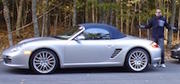
Point of reference, my early 2005 Boxster S, production completion date 2/2/2005, had the earlier, more readily serviceable, bearing.
I had it updated with LN Engineering product, along with rear main seal and such, shortly after acquiring the car. Was always part of my purchase consideration and plan.
Thanks everybody for the wonderful input and feedback!!!
A Porsche mechanic said that if the car is driven with a regular or higher mileage, we don't need to worry too much about the IMS issue since the IMS bearing would get lubricated when the car is being driven. So, he said the IMS issue is mainly a problem for low mileage car. Do you guys agree with the mechanic?
My past research coincides with xsbank in that we don't know exactly when in 2005 they switched to the stronger (but harder to replace) IMS bearing design. Rumour is they used both old and new style bearings for a brief overlapping period. Failures of the later design are very rare, so in general nobody bothers trying to replace those. The only conclusive way to be sure if a 2005 has the strengthened IMS bearing is to pull the transmission. Both base and S models were affected by the IMS bearing issue.
At least one good thing is that neither the base nor S Boxsters in 2005/2006 had bore scoring issues. Bore scoring affects mainly 2006-2008 Cayman S, 2007-2008 Boxster S, and non-Mezger 2005-2008 911 variants.
Hi Wizee, thanks for your reply and sharing. I just want to understand correctly when you said "Failures of the later design are very rare". For the "later design", do you mean the later production batch of the year 2005 Boxster or do you mean Boxster 987 vs 986?
Porsche changed the IMS design in 2005. The problem was, nobody knows when. I can imagine they had a warehouse full of engines that they had built up and needed to use up before the design change. There is only one way to tell which one you have, pull the transmission. You may find the later model that has the IMS inside the cases or you might find the old kind. My VIN number is a June build and I'm unable to tell which one I've got. Its a bear because even if you budget the $4000 or so dollars it takes in Canada, you might find you have the newer kind in which case your bill suddenly got huge as splitting the cases is $$$. However, the not-so-bad news is that the later IMS has the lowest failure rate...
I just keep changing the oil more often and look for debris. Rumour has it that the bearing fails gradually and rarely craters. The factory oil change interval is too long to catch the bearing unless you are just lucky.
Hi xsbank, thanks for your sharing. May I know how often you do the engine oil change then? Thanks
Hi Wizee, thanks for your reply and sharing. I just want to understand correctly when you said "Failures of the later design are very rare". For the "later design", do you mean the later production batch of the year 2005 Boxster or do you mean Boxster 987 vs 986?
Thanks
I'm quite sure he's referring to the 987 later 2005 and beyond design (including 2006 through 2008).
Thanks everybody for the wonderful input and feedback!!!
A Porsche mechanic said that if the car is driven with a regular or higher mileage, we don't need to worry too much about the IMS issue since the IMS bearing would get lubricated when the car is being driven. So, he said the IMS issue is mainly a problem for low mileage car. Do you guys agree with the mechanic?
Thanks
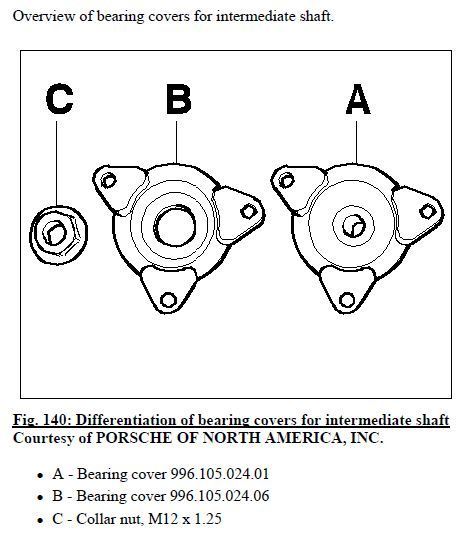
Not necessarily. I had an 06 Cayman S that had 138k miles on it when I bought in February 2013. In May 2013, the IMS bearing went in it at 145k miles. We caught it in time that no catastrophic damage was done to the engine (still necessitated a full engine disassembly and rebuild). I think my case may be one of the first confirmed failures of the larger, third generation bearing, but I have no way of proving that. It seems like I remember finding some literature or info online, probably from the LN Engineering/Flat 6 Motorsports groups, that you can determine which bearing you have by the size of the nut on the IMS. Of course this requires pulling the transmission. If you're motivated to do all that, knock yourself out. Just be prepared to discover you have the larger third generation bearing and you can't go any further unless you wanna rebuild. As someone who has been there, I suggest you change your oil regularly, get oil analysis, and drive your car and enjoy it. Hope this helps.
This oil change (Tuesday) will be at 5000 miles. 8000 km. I will see how it looks and what my new guy will charge and I may make it 5000 km.
Changing oil at less.than 5k is probably a waste. Virtually all of my Porsche or BMW mechanic friends agree that 5k is reasonable. Inspecting the filter and getting oil analysis will raise any red flags. If you want to inspect at shorter intervals, change the filter only between oil changes and inspect.
Not trying to resurrect a sore issue... just wanted to pass this along.
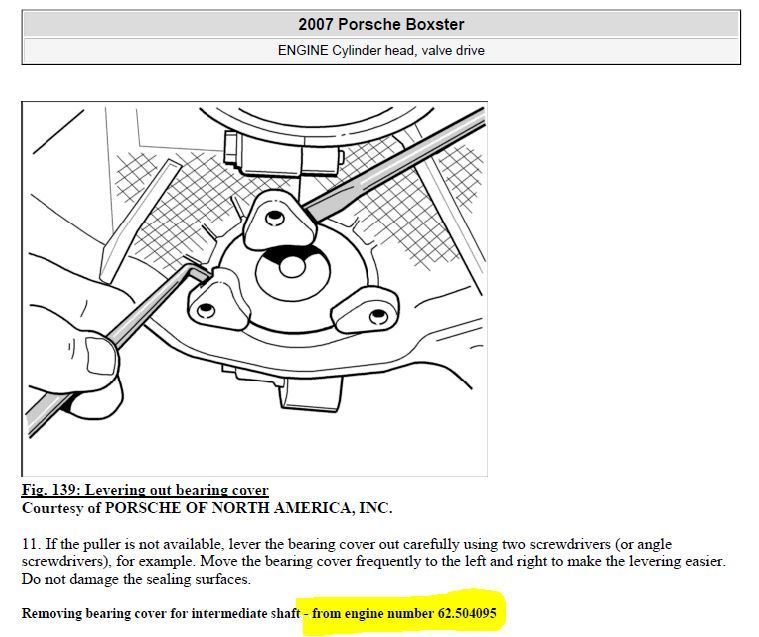
I recently picked up a 2007 service manual for the 987 series. See below for some scans etc. related to this very issue:
My Car: 2005 987.1 Boxster S, 70,000 miles, no IMS issue.
Date of Manufacture: March 1, 2005
Engine Number: M96/26 62.504389
According to 2007 Porsche 987 Service Manual, the SMALLER IMS bearing was used up to engine 61.504715 on the M96/25 engine and up to 62.504094 on the M96/26 engine. All engines from 61.504716 and 62.504094 onward have the LARGER IMS bearing according to the service manual.
Is this gospel? I don't know, but, since Porsche published it, I'd give it some reasonable amount of weight if you're not right up on those numbers.
Upon aquistion, I did a couple updates recommended by Charles at LN Engineering... low-temp thermostat, IMS Upgrade. Also did water pump, AOS, all fluids, etc.
Approaching 90k miles with almost undetectable oil consumption. This 3.2 rocks. Quite happy thus far.
Porsche's Top 5 Most Questionable Naming Decisions
Slideshow: For a company obsessed with engineering precision, Porsche has occasionally named its cars in ways that left even loyal enthusiasts scratching their heads.
Pogea Racing's 964 Porsche 911 Reimagination Stands Out in a Crowded Field
Slideshow: Pogea Racing's latest Porsche 964 project blends carbon-fiber construction, modern chassis upgrades, and up to 500 horsepower while keeping the air-cooled 911 experience firmly analog.
Talos Takes Your 991 Porsche 911 GT3 to the Next Level for a Cool $1.13 Million
Slideshow: Talos Vehicles has transformed the Porsche 911 GT3 RS into a carbon-bodied, race-inspired machine that costs well over $1 million before the donor car is even included.
9 Vehicles Porsche Helped Engineer that Aren't Porsches
Slideshow: Long before engineering consulting became trendy, Porsche was quietly helping other automakers build everything from supercars to economy hatchbacks.
9 Features and Characteristics That Only Porsche People Understand
Slideshow: Some brands build cars. Porsche builds traditions, obsessions, and a few habits that stopped making sense decades ago but somehow became part of the charm.


 IMS issue for early model 2005 Boxster