




ABS/Brake Pressure Problem

Thread Starter
Instructor
Joined: May 2006
Posts: 164
Likes: 1
 ABS/Brake Pressure Problem
Hey everyone,
I'm a long time member, but obviously not a regular poster. I recently finished the last phase of brake upgrades for my 1990 C2 race car, the key pieces being a larger MC (23.8) and new rear calipers and rotors (993). I already had been running 322mm front rotors with Big Black GTS calipers (as well as 4-pot rear calipers).
I have ended up with an issue with the pressure in the system that, for the life of me, I cannot seem to find any reference to here, on Pelican, in Adrian's book, or in the workshop manual. The symptom is this: when the car is started all is well, but after applying the brakes several times, the pressure in the system builds, but never relieves. Basically, the brakes stay 'on' at whatever level of pressure was last applied.
Resident brake guru Bill Verburg has been very helpful in suggesting various items to test/replace, all of which I've done:
- brakes have been bled MANY times;
- already have Goodridge stainless lines, and have spoken directly with their tech. guys to confirm the lines cannot swell internally;
- cleaned and rebuilt front calipers (have not rebuilt rears as they are new);
- replaced the new MC with ANOTHER new MC, just in case.
The issue is not just one of the circuits; BOTH the front and rear wheels are affected. Also, after the car sits for 30 mins, or so, the pressure is relieved enough to roll the car (even though the brakes still drag slightly).
I've not tried to find a Bosch hammer to bleed the ABS hydraulic unit yet, but my understanding is that air in the system would tend to minimize braking performance, not maximize it, and I can't drive the car more than a couple of miles before it will not move, so getting to a shop to use the hammer is not feasible at this point. Also, I do not know if the relays on top of the ABS hydraulic unit could be possible culprits, but would be interested in anyone's thoughts.
So... I am hoping some of the brain trust here may be able to point me in a new direction. Any thoughts or advice would be GREATLY appreciated!
Thanks in advance,
Dave
I'm a long time member, but obviously not a regular poster. I recently finished the last phase of brake upgrades for my 1990 C2 race car, the key pieces being a larger MC (23.8) and new rear calipers and rotors (993). I already had been running 322mm front rotors with Big Black GTS calipers (as well as 4-pot rear calipers).
I have ended up with an issue with the pressure in the system that, for the life of me, I cannot seem to find any reference to here, on Pelican, in Adrian's book, or in the workshop manual. The symptom is this: when the car is started all is well, but after applying the brakes several times, the pressure in the system builds, but never relieves. Basically, the brakes stay 'on' at whatever level of pressure was last applied.
Resident brake guru Bill Verburg has been very helpful in suggesting various items to test/replace, all of which I've done:
- brakes have been bled MANY times;
- already have Goodridge stainless lines, and have spoken directly with their tech. guys to confirm the lines cannot swell internally;
- cleaned and rebuilt front calipers (have not rebuilt rears as they are new);
- replaced the new MC with ANOTHER new MC, just in case.
The issue is not just one of the circuits; BOTH the front and rear wheels are affected. Also, after the car sits for 30 mins, or so, the pressure is relieved enough to roll the car (even though the brakes still drag slightly).
I've not tried to find a Bosch hammer to bleed the ABS hydraulic unit yet, but my understanding is that air in the system would tend to minimize braking performance, not maximize it, and I can't drive the car more than a couple of miles before it will not move, so getting to a shop to use the hammer is not feasible at this point. Also, I do not know if the relays on top of the ABS hydraulic unit could be possible culprits, but would be interested in anyone's thoughts.
So... I am hoping some of the brain trust here may be able to point me in a new direction. Any thoughts or advice would be GREATLY appreciated!
Thanks in advance,
Dave

Three Wheelin'
Joined: May 2009
Posts: 1,720
Likes: 5
From: West Sussex
Sounds like the pressure is not being fully released on each stroke.
Given that you have replaced the master cylinder.I wonder if the pedal is mis-adjusted. Meaning that the piston isnt fully retracting and allowing the fluid to return to the reservoir. Pump up the brakes until they lock up and then undo the clevis pin allowing the rod to fully extend and then replace the clevis - see if they are better again.
Abs has three modes; pressure build, hold and release. I can't quite see which mode it could be stuck in to cause your issue. But you could try it with the abs unplugged.
It would be useful to jack up all four corners and apply the brakes to see if all four wheels are binding. Sticky calipers and pinched or kinked lines can also cause this sort of issue but would not affect all four corners.
Given that you have replaced the master cylinder.I wonder if the pedal is mis-adjusted. Meaning that the piston isnt fully retracting and allowing the fluid to return to the reservoir. Pump up the brakes until they lock up and then undo the clevis pin allowing the rod to fully extend and then replace the clevis - see if they are better again.
Abs has three modes; pressure build, hold and release. I can't quite see which mode it could be stuck in to cause your issue. But you could try it with the abs unplugged.
It would be useful to jack up all four corners and apply the brakes to see if all four wheels are binding. Sticky calipers and pinched or kinked lines can also cause this sort of issue but would not affect all four corners.
Nordschleife Master
Joined: Feb 2011
Posts: 5,297
Likes: 6
From: Deep Downtown Carrier, OK
Dave, could you disable the ABS to eliminate that part of the equation?
I also would tend to think that the ultimate solution will be a minor mechanical one as Alex has mentioned. Should you need one, I have a spare ABS relay and a new in box pump you could borrow.
Must get your car on line so you can come down to Octoberfast at Hallett!!!!!!
I also would tend to think that the ultimate solution will be a minor mechanical one as Alex has mentioned. Should you need one, I have a spare ABS relay and a new in box pump you could borrow.
Must get your car on line so you can come down to Octoberfast at Hallett!!!!!!
Thread Starter
Instructor
Joined: May 2006
Posts: 164
Likes: 1
Alex - Thanks for the suggestions; I have checked to make sure there is still slight play in the brake pushrod, but I have not gone any further down that path. I also cannot promise the car was running and pressurized when I checked the linkage... 
KaiB - Thanks for the input, and the offer. I'm right there with you, my friend. I'd sell someone's grandmother to be able to hit the track in October! It'll probably be this weekend before I can dig into this more, but I'll ping you if I'm thinking of using all your spare parts...
Thanks guys, I appreciate it...
KaiB - Thanks for the input, and the offer. I'm right there with you, my friend. I'd sell someone's grandmother to be able to hit the track in October! It'll probably be this weekend before I can dig into this more, but I'll ping you if I'm thinking of using all your spare parts...
Thanks guys, I appreciate it...

Rennlist Member
Joined: Jun 2010
Posts: 1,710
Likes: 4
From: Detroit (Rock City); 1990 C4
Probably unlikely, but maybe the MC is simply flawed?
Thread Starter
Instructor
Joined: May 2006
Posts: 164
Likes: 1
Feral - Thanks for the thought. I have strongly suspected the MC might be defective, hence I bought a second one from Sunset 'just in case'.
Hey, nobody said racing (or playing with Porsches for that matter) was going to be cheap...
Hey, nobody said racing (or playing with Porsches for that matter) was going to be cheap...
Trending Topics
Nordschleife Master
Joined: Feb 2011
Posts: 5,297
Likes: 6
From: Deep Downtown Carrier, OK
Dave - does this occur when the engine is not running - or after startup?
I'm leaning to the vac can, its switch or something stupid like compatibility btw. the 964 vac can, and the new 993 M/C.
Have not researched this, but I do believe the release mechanism btw the two is different. If this is the case, your fix may be simple.
I'm leaning to the vac can, its switch or something stupid like compatibility btw. the 964 vac can, and the new 993 M/C.
Have not researched this, but I do believe the release mechanism btw the two is different. If this is the case, your fix may be simple.
Rennlist Stories
The Best Porsche Posts for Porsche Enthusiasts

10 Porsche Colors That Have More Personality Than Most People
Verdad Gallardo
Guntherwerks' Final Speedster Creation Is the Ultimate Porsche Restomod
Verdad Gallardo
10 Reasons I Hate Going to the Porsche Dealership (& the 1 Reason I Stay)
Joe Kucinski
Porsche Shakes Up The Nürburgring Lap Record Table Once Again
Verdad Gallardo
6 Ways the Porsche 911 GT3 S/C Redefines Performance
Joe Kucinski
10 Wildest Homologation Specials Porsche Ever Sold
Verdad Gallardo
Super Rare RUF BTR III Comes Out of Hibernation, Looking For a New Home
Verdad Gallardo
10 Porsche Opinions That Can Start a Fight
Joe Kucinski
One-Off Porsche 911 S/T Takes Inspiration From Famous '70s Race Car
Verdad Gallardo
Thread Starter
Instructor
Joined: May 2006
Posts: 164
Likes: 1
Indy and Kai – Thanks for the responses. My apologies for taking so long to get back to this…
Indy – I have not tried cracking a line at the MC. I did find a write-up here some time ago, and have cracked the bleeders on the calipers, and cracked the hard line connection at the inner wheel well. Both had an effect, but neither seemed to instantly relieve the dragging. I’ll try an MC line and post back…
Kai – I’ve been scratching my head about this as well, as a matter of fact. When I ordered the new vacuum canister (p/n 993-355-023-10) it came with the ‘pushrod’ assembly as part of it, and it all fit together with the o.e. bearing bracket sleeve no problem (I’ve read threads here where people had to modify the bracket sleeve because of the larger diameter of the 993 booster flange, but mine had no issues with this). So I’ve been wondering if the pushrod length is different (I’ve checked that the brake pedal pushrod is adjusted correctly, not binding, etc.) or the canister is otherwise not operating correctly. Also, as silly as it seems, I’ve been wondering if removing the clear plastic cap from the 993 booster assembly was NOT the right thing to do.
Trust me, I’ve been wracking my brain so hard on this I’ve started seeing Unicorns. No worries, though… I’ve named them all, and they’re quite tame…
Thanks, guys, I appreciate the help!
Dave
Indy – I have not tried cracking a line at the MC. I did find a write-up here some time ago, and have cracked the bleeders on the calipers, and cracked the hard line connection at the inner wheel well. Both had an effect, but neither seemed to instantly relieve the dragging. I’ll try an MC line and post back…
Kai – I’ve been scratching my head about this as well, as a matter of fact. When I ordered the new vacuum canister (p/n 993-355-023-10) it came with the ‘pushrod’ assembly as part of it, and it all fit together with the o.e. bearing bracket sleeve no problem (I’ve read threads here where people had to modify the bracket sleeve because of the larger diameter of the 993 booster flange, but mine had no issues with this). So I’ve been wondering if the pushrod length is different (I’ve checked that the brake pedal pushrod is adjusted correctly, not binding, etc.) or the canister is otherwise not operating correctly. Also, as silly as it seems, I’ve been wondering if removing the clear plastic cap from the 993 booster assembly was NOT the right thing to do.
Trust me, I’ve been wracking my brain so hard on this I’ve started seeing Unicorns. No worries, though… I’ve named them all, and they’re quite tame…
Thanks, guys, I appreciate the help!
Dave
Thread Starter
Instructor
Joined: May 2006
Posts: 164
Likes: 1
Kai - Thanks. Will do. Also, I forgot to respond to your earlier question about the car running or not; so far I've only focused on when it's running, but I'll check now that I've relieved pressure and see what happens when ignition is off.
Indy - The short answer is a definitive 'yes'. Cracking the outboard hard line at the MC (closest to the right front wheel) gives noticeable relief, but still some dragging; cracking the other hard line completely relieves the pressure. In both cases, there is an initial spurt of fluid at the connection, then it stops.
Seems like it must be the MC or booster...?
Thanks again guys.
Indy - The short answer is a definitive 'yes'. Cracking the outboard hard line at the MC (closest to the right front wheel) gives noticeable relief, but still some dragging; cracking the other hard line completely relieves the pressure. In both cases, there is an initial spurt of fluid at the connection, then it stops.
Seems like it must be the MC or booster...?
Thanks again guys.

Instructor
Joined: Apr 2010
Posts: 131
Likes: 1
From: Escondido, CA
Dave, have you checked MC return spring? It should return MC to initial position even without brake fluid.
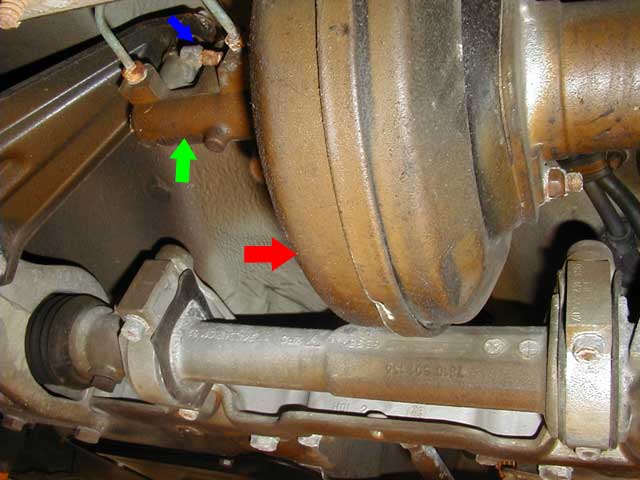
Note that 964 had return spring as part of MC. On 993 return spring is part of vacuum booster.
Maybe during swaps you either misplaced it or missed it out.
Here's pic by EricRSA:

From this thread.
https://rennlist.com/forums/964-foru...ery-slope.html
Oleg.
Note that 964 had return spring as part of MC. On 993 return spring is part of vacuum booster.
Maybe during swaps you either misplaced it or missed it out.
Here's pic by EricRSA:
From this thread.
https://rennlist.com/forums/964-foru...ery-slope.html
Oleg.

Thread Starter
Instructor
Joined: May 2006
Posts: 164
Likes: 1
perelet - excellent point. I will check and make sure.
Jason – the 993 MC does not have a bleed valve like the ‘quick fill’ 964 unit. I did not bench bleed the new MC, but I did hook up the supply lines, pressurize the system and bleed some fluid from each of the outlet ports before I hooked up the hard lines. I will say it was a heck of a lot nicer having the bleed port on the old MC…
I really appreciate the help everyone! I’ll post back when I know more…
Jason – the 993 MC does not have a bleed valve like the ‘quick fill’ 964 unit. I did not bench bleed the new MC, but I did hook up the supply lines, pressurize the system and bleed some fluid from each of the outlet ports before I hooked up the hard lines. I will say it was a heck of a lot nicer having the bleed port on the old MC…
I really appreciate the help everyone! I’ll post back when I know more…
Thread Starter
Instructor
Joined: May 2006
Posts: 164
Likes: 1
perelet, et. al. – observations and questions:
1. I did NOT remove the return spring from the original 964 MC (because it’s still on it!), but I recall a spring internal to the new 993 MC;
2. Does the return spring need to be swapped, and if so, how does one connect it to the 993 MC?
3. Is there a specific procedure for connecting the 993 MC to the new vac. canister that ensures any internal spring connection is functioning to create the return pressure in the system?
Given the obvious visual difference btw the two MC’s, it makes perfect sense that the lack of return spring on the MC could cause the effect I’m describing in my o.p.
Thanks for the leads, guys. I’ll keep at it…
1. I did NOT remove the return spring from the original 964 MC (because it’s still on it!), but I recall a spring internal to the new 993 MC;
2. Does the return spring need to be swapped, and if so, how does one connect it to the 993 MC?
3. Is there a specific procedure for connecting the 993 MC to the new vac. canister that ensures any internal spring connection is functioning to create the return pressure in the system?
Given the obvious visual difference btw the two MC’s, it makes perfect sense that the lack of return spring on the MC could cause the effect I’m describing in my o.p.
Thanks for the leads, guys. I’ll keep at it…