






Starter sounds horrible / no start

Thread Starter
Addict
Lifetime Rennlist
Member
Lifetime Rennlist
Member
Joined: Jul 2007
Posts: 4,539
Likes: 4
From: Germany
 Starter sounds horrible / no start
So I have a more pressing issue: the car won't start. The starter sounds horrible. Sounds just like it is trying to turn the engine over but there is a huge drag on the engine. The battery is charged completely. The engine does spin, but slowly.
So, what do you think? Is the starter done for, or is the engine dragging.
Warning: terrible sounds to be heard!!
So, what do you think? Is the starter done for, or is the engine dragging.
Warning: terrible sounds to be heard!!
Electron Wrangler
Lifetime Rennlist
Member
Lifetime Rennlist
Member

Joined: Mar 2002
Posts: 13,665
Likes: 621
From: Phoenix AZ
Measure the voltage at the jump post while trying to start - It seems to be rotating too slowly?
If the jump post voltage is too low (~<9v) - I'd suspect the ground strap or other connections at battery <-> starter
If the jump post voltage is too low (~<9v) - I'd suspect the ground strap or other connections at battery <-> starter

Chronic Tool Dropper
Lifetime Rennlist
Member
Lifetime Rennlist
Member
Joined: Oct 2001
Posts: 20,506
Likes: 566
From: Bend, Oregon
Try rolling the engine by hand with a breaker bar to make sure it actually wants to turn. Check the crankshaft endplay if it's at all stiff. Release the thrust loading, and see what kind of axial pressure is on is on the crank first, of course.
This hard cranking is one of the telltale signs of thrust bearing failure.
Of course it could just be the starter motor. But rolling the engine by hand is easier than pulling the starter.
This hard cranking is one of the telltale signs of thrust bearing failure.
Of course it could just be the starter motor. But rolling the engine by hand is easier than pulling the starter.

Nordschleife Master

Joined: Jun 2006
Posts: 6,297
Likes: 63
From: ɹəpun uʍop 'ʎəupʎs
Can you disconnect the starter solenoid circuit and see what the starter sounds like when its not engaging the engine? (or possibly just use jump leads to power the starter motor independently of the car)
Thread Starter
Addict
Lifetime Rennlist
Member
Lifetime Rennlist
Member
Joined: Jul 2007
Posts: 4,539
Likes: 4
From: Germany
I cannot easily reach the flex plate since I never work under my car in my garage. Whenever I need to do drive to a place where you can rent a car lift. I have checked the flex plate and end play a few times the last years and always came up with .2mm. Installed a Pklamp last year for extra measure. Maybe I can slip my USB scope through the bell housing spy hole to see if the clamp moved forward from last time.
Tell me about it! It sounds really nasty.
Thanks for the tip. I need to find out how our starters are wired then.
Trending Topics
Three Wheelin'

Joined: Dec 2011
Posts: 1,421
Likes: 211
From: NW Indiana
It's good to hear that you've checked the crankshaft end play in the past.
If it's not the starter, I'd start removing belts from accessories like the PS pump, A/C compressor, smog pump etc. Hopefully something as simple as a frozen bearing in one of them.
It could also be a water pump seizing up. I'd really avoid cranking it over until I found the cause.
If it's not the starter, I'd start removing belts from accessories like the PS pump, A/C compressor, smog pump etc. Hopefully something as simple as a frozen bearing in one of them.
It could also be a water pump seizing up. I'd really avoid cranking it over until I found the cause.
Rennlist Stories
The Best Porsche Posts for Porsche Enthusiasts

Porsche's Top 5 Most Questionable Naming Decisions
Verdad Gallardo
Pogea Racing's 964 Porsche 911 Reimagination Stands Out in a Crowded Field
Verdad Gallardo
6 Convertible Top MYTHS Most People Don't Understand!
Michael S. Palmer
2026 Porsche 911 Club Coupe is Spectacular, And Everything Wrong with the Porsche Market
Joe Kucinski
Talos Takes Your 991 Porsche 911 GT3 to the Next Level for a Cool $1.13 Million
Verdad Gallardo
9 Vehicles Porsche Helped Engineer that Aren't Porsches
Verdad Gallardo
9 Features and Characteristics That Only Porsche People Understand
Verdad Gallardo
I've Written 500 Rennlist Articles: Here's How Porsche Has Changed Along the Way
Joe Kucinski
10 Most Unnecessary Porsches Ever Built (And Why We Love Them)
Verdad Gallardo
Thread Starter
Addict
Lifetime Rennlist
Member
Lifetime Rennlist
Member
Joined: Jul 2007
Posts: 4,539
Likes: 4
From: Germany
Accessories and water pump crossed my mind, but I could spin the engine pretty easily by hand today. Heard a metalic noise coming from the direction of the starter, then all quiet. I assume the starter was stuck on the ring gear. Tomorrow the starter comes out to test. Didn't have the heart to crank it again and measure the voltage drop.
Team Owner
Joined: May 2004
Posts: 31,279
Likes: 4,248
From: Philly PA
Sadly, from the video your timing has been lost as there isnt any compression.
dont turn the engine over any more till you have the timing covers off and have verified the timing marks are all in alignment.
Once timing is verified , then check crank end play , then do a compression test.
NOTE the starter is good.
dont turn the engine over any more till you have the timing covers off and have verified the timing marks are all in alignment.
Once timing is verified , then check crank end play , then do a compression test.
NOTE the starter is good.
Team Owner
Joined: May 2004
Posts: 31,279
Likes: 4,248
From: Philly PA
Edit , Thanks Andy, I found the plugs are out info in post 7, sorry my bad.............
I think the plugs were out when the video was shot …..
^^^^that would be an important thing to include along with the video.
If thats the case , no plugs then , a flex plate release and crank end play check should be made .
NOTE a quick check would be to use a lamp cord dropped down the dipstick tube,
drip the oil onto a piece of black cardboard,
look at the sample in the sun with a magnifying glass,
if its full of metal then the thrust bearing has taken a dump
I think the plugs were out when the video was shot …..
^^^^that would be an important thing to include along with the video.
If thats the case , no plugs then , a flex plate release and crank end play check should be made .
NOTE a quick check would be to use a lamp cord dropped down the dipstick tube,
drip the oil onto a piece of black cardboard,
look at the sample in the sun with a magnifying glass,
if its full of metal then the thrust bearing has taken a dump
Thread Starter
Addict
Lifetime Rennlist
Member
Lifetime Rennlist
Member
Joined: Jul 2007
Posts: 4,539
Likes: 4
From: Germany
Sorry, didn't realize the sound without plugs would be a red flag for the knowledgeable here.
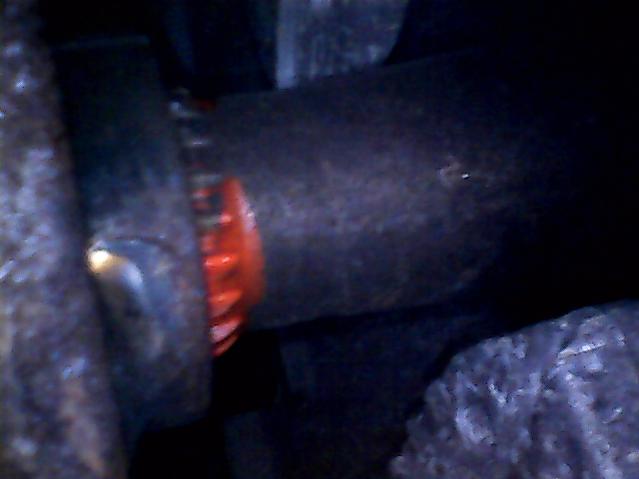
Anyway, I inspected the flex plate area with a USB scope. The flex plate looks straight and the spines on the torque shaft are the same as last year as indicated by the red paint. It´s the best I can do without a lift.
Still_2014_09_09_22_22_17_034.jpg
And the starter is out. What a pain once again to get to the allen head screws. I tried to test it by putting 12V directly top stud on the solenoid, nothing happened. Do I need to supply 12V to the small connector as well to trip the solenoid? Then I applied 12V to the bottom stud of the solenoid, out of 7 tries the motor spun twice, 5 times I got a great spark show without any movement. Not keen on sparks flying, is there another way to test this thing?
Anyway, I inspected the flex plate area with a USB scope. The flex plate looks straight and the spines on the torque shaft are the same as last year as indicated by the red paint. It´s the best I can do without a lift.
Still_2014_09_09_22_22_17_034.jpg
And the starter is out. What a pain once again to get to the allen head screws. I tried to test it by putting 12V directly top stud on the solenoid, nothing happened. Do I need to supply 12V to the small connector as well to trip the solenoid? Then I applied 12V to the bottom stud of the solenoid, out of 7 tries the motor spun twice, 5 times I got a great spark show without any movement. Not keen on sparks flying, is there another way to test this thing?
Team Owner
Joined: May 2004
Posts: 31,279
Likes: 4,248
From: Philly PA
the way the starter works is like this with the unit on the ground connect a negative jumper cable to one of the ears of the starter.
then with the positive lead connect it to the + stud ,l
take a small jumper wire and connect it to the + jumper cable clamp,
then touch the small 15 feed of the solenoid this will activate the starter.
Hold on to it when you do this.
NOTE its better to have the starter in a vice.
then with the positive lead connect it to the + stud ,l
take a small jumper wire and connect it to the + jumper cable clamp,
then touch the small 15 feed of the solenoid this will activate the starter.
Hold on to it when you do this.
NOTE its better to have the starter in a vice.