



Provent Part 2

Instructor
Joined: Nov 2007
Posts: 140
Likes: 0
From: Calgary, AB

This is an interesting thread, and Alan's comment about "a work in progress" is so true.
I thought I had a solution with a Provent 200 collecting each of the cam covers and filler neck (with Greg B's oil filler baffle) and then using an adjustable PCV valve to take the Provent outlet back to the intake, just keeping slightly negative crankcase pressure at idle. I added the extra check valves suggested by Herman K in his set up, and I have no backflow through the magical vent fitting attached to the elbow between the MAF and the TB.
This set up worked fine until the Provent 200 coalescer element finally got saturated with 2 months, after which the oily vapors start to go right through and I have the dreaded puddle of Mobil 15W-50 on the floor of the intake. Hence the spark knock thread. Sheesh!
A "higher-efficiency" Provent 200 coalescing element is available, but I haven't tried it.
Basic Provent 200 equipment is available from ID Parts in Massachusetts, and they have given me good service (no affiliation). www.idparts.com.
A gentle reminder again, readers; Be particularly careful to not confuse the Provent 200 kit with the Provent heavy-duty incontinence products sold under similar branding at http://www.elderstore.com/provent-br...for-women.aspx
I'm most impressed with Colin's evacuation pump setup, and that's what I'm waiting for now.
1) Can I draw through the crankcase filler port on the existing 5/8" connection into Colin's set-up?
2) Can I draw through the Provent to the new pump from Colin, keeping in mind that the Provent 200 has am integral vacuum-limiting port capsule on the outlet side?
3) Can I send the pump discharge into an unused bung on the X-Pipe, or will it upset the O2 sensor on the other bank?
Best/T
I thought I had a solution with a Provent 200 collecting each of the cam covers and filler neck (with Greg B's oil filler baffle) and then using an adjustable PCV valve to take the Provent outlet back to the intake, just keeping slightly negative crankcase pressure at idle. I added the extra check valves suggested by Herman K in his set up, and I have no backflow through the magical vent fitting attached to the elbow between the MAF and the TB.
This set up worked fine until the Provent 200 coalescer element finally got saturated with 2 months, after which the oily vapors start to go right through and I have the dreaded puddle of Mobil 15W-50 on the floor of the intake. Hence the spark knock thread. Sheesh!
A "higher-efficiency" Provent 200 coalescing element is available, but I haven't tried it.
Basic Provent 200 equipment is available from ID Parts in Massachusetts, and they have given me good service (no affiliation). www.idparts.com.
A gentle reminder again, readers; Be particularly careful to not confuse the Provent 200 kit with the Provent heavy-duty incontinence products sold under similar branding at http://www.elderstore.com/provent-br...for-women.aspx
I'm most impressed with Colin's evacuation pump setup, and that's what I'm waiting for now.
1) Can I draw through the crankcase filler port on the existing 5/8" connection into Colin's set-up?
2) Can I draw through the Provent to the new pump from Colin, keeping in mind that the Provent 200 has am integral vacuum-limiting port capsule on the outlet side?
3) Can I send the pump discharge into an unused bung on the X-Pipe, or will it upset the O2 sensor on the other bank?
Best/T

Three Wheelin'
Joined: Apr 2011
Posts: 1,778
Likes: 1
From: Singhampton, Ontario/London, Ontario
A gentle reminder again, readers; Be particularly careful to not confuse the Provent 200 kit with the Provent heavy-duty incontinence products sold under similar branding at http://www.elderstore.com/provent-br...for-women.aspx
LMAO!

Thread Starter


Joined: Nov 2009
Posts: 6,984
Likes: 18
From: Marysville WA
This is an interesting thread, and Alan's comment about "a work in progress" is so true.
I thought I had a solution with a Provent 200 collecting each of the cam covers and filler neck (with Greg B's oil filler baffle) and then using an adjustable PCV valve to take the Provent outlet back to the intake, just keeping slightly negative crankcase pressure at idle. I added the extra check valves suggested by Herman K in his set up, and I have no backflow through the magical vent fitting attached to the elbow between the MAF and the TB.
This set up worked fine until the Provent 200 coalescer element finally got saturated with 2 months, after which the oily vapors start to go right through and I have the dreaded puddle of Mobil 15W-50 on the floor of the intake. Hence the spark knock thread. Sheesh!
A "higher-efficiency" Provent 200 coalescing element is available, but I haven't tried it.
Basic Provent 200 equipment is available from ID Parts in Massachusetts, and they have given me good service (no affiliation). www.idparts.com.
A gentle reminder again, readers; Be particularly careful to not confuse the Provent 200 kit with the Provent heavy-duty incontinence products sold under similar branding at http://www.elderstore.com/provent-br...for-women.aspx
I'm most impressed with Colin's evacuation pump setup, and that's what I'm waiting for now.
1) Can I draw through the crankcase filler port on the existing 5/8" connection into Colin's set-up?
2) Can I draw through the Provent to the new pump from Colin, keeping in mind that the Provent 200 has am integral vacuum-limiting port capsule on the outlet side?
3) Can I send the pump discharge into an unused bung on the X-Pipe, or will it upset the O2 sensor on the other bank?
Best/T
I thought I had a solution with a Provent 200 collecting each of the cam covers and filler neck (with Greg B's oil filler baffle) and then using an adjustable PCV valve to take the Provent outlet back to the intake, just keeping slightly negative crankcase pressure at idle. I added the extra check valves suggested by Herman K in his set up, and I have no backflow through the magical vent fitting attached to the elbow between the MAF and the TB.
This set up worked fine until the Provent 200 coalescer element finally got saturated with 2 months, after which the oily vapors start to go right through and I have the dreaded puddle of Mobil 15W-50 on the floor of the intake. Hence the spark knock thread. Sheesh!
A "higher-efficiency" Provent 200 coalescing element is available, but I haven't tried it.
Basic Provent 200 equipment is available from ID Parts in Massachusetts, and they have given me good service (no affiliation). www.idparts.com.
A gentle reminder again, readers; Be particularly careful to not confuse the Provent 200 kit with the Provent heavy-duty incontinence products sold under similar branding at http://www.elderstore.com/provent-br...for-women.aspx
I'm most impressed with Colin's evacuation pump setup, and that's what I'm waiting for now.
1) Can I draw through the crankcase filler port on the existing 5/8" connection into Colin's set-up?
2) Can I draw through the Provent to the new pump from Colin, keeping in mind that the Provent 200 has am integral vacuum-limiting port capsule on the outlet side?
3) Can I send the pump discharge into an unused bung on the X-Pipe, or will it upset the O2 sensor on the other bank?
Best/T
the pump will need to see some oil for lubrication. so i would filter after the pump.
the discharge would mess up the O2 readings, so it would need to go in down stream of the sensor. also you would need to add a one way check valve as well.
Instructor
Joined: Nov 2007
Posts: 140
Likes: 0
From: Calgary, AB
Yes, Ducman, thanks for following up;
I agree with your comment about the pump lubrication, good call.
I am still curious about the destination of the evacuated fumes - the two O2 sensor bungs are each about a foot upstream of the common X connection, so pressure pulses from "new" crankcase O2 fumes could get down to the X and back up the other branch to where the O2 sensor is located?
Thanks/T
I agree with your comment about the pump lubrication, good call.
I am still curious about the destination of the evacuated fumes - the two O2 sensor bungs are each about a foot upstream of the common X connection, so pressure pulses from "new" crankcase O2 fumes could get down to the X and back up the other branch to where the O2 sensor is located?
Thanks/T
Electron Wrangler
Lifetime Rennlist
Member
Lifetime Rennlist
Member

Joined: Mar 2002
Posts: 13,662
Likes: 621
From: Phoenix AZ
...I am still curious about the destination of the evacuated fumes - the two O2 sensor bungs are each about a foot upstream of the common X connection, so pressure pulses from "new" crankcase O2 fumes could get down to the X and back up the other branch to where the O2 sensor is located?
Thanks/T
Thanks/T
Alan
Rennlist Stories
The Best Porsche Posts for Porsche Enthusiasts

Talos Takes Your 991 Porsche 911 GT3 to the Next Level for a Cool $1.13 Million
Verdad Gallardo
9 Vehicles Porsche Helped Engineer that Aren't Porsches
Verdad Gallardo
9 Features and Characteristics That Only Porsche People Understand
Verdad Gallardo
I've Written 500 Rennlist Articles: Here's How Porsche Has Changed Along the Way
Joe Kucinski
10 Most Unnecessary Porsches Ever Built (And Why We Love Them)
Verdad Gallardo
Porsche 911 GT3 S/C vs 718 Spyder RS: 10 Categories, One Winner
Joe Kucinski
This Builder Is Turning Heads With Its Slantnose 911 Creation
Verdad Gallardo
Porsche 911 GT3 Artisan Edition Pays Homage to Japanese Culture
Verdad Gallardo
Porsche Reveals Coupe Variant of the Electric Cayenne With a Fresh Look
Verdad Gallardo
Nordschleife Master
Joined: Apr 2003
Posts: 9,601
Likes: 39
From: Abbotsford B.C.
I'm most impressed with Colin's evacuation pump setup, and that's what I'm waiting for now.
1) Can I draw through the crankcase filler port on the existing 5/8" connection into Colin's set-up?
2) Can I draw through the Provent to the new pump from Colin, keeping in mind that the Provent 200 has am integral vacuum-limiting port capsule on the outlet side?
3) Can I send the pump discharge into an unused bung on the X-Pipe, or will it upset the O2 sensor on the other bank?
Best/T
1) Can I draw through the crankcase filler port on the existing 5/8" connection into Colin's set-up?
2) Can I draw through the Provent to the new pump from Colin, keeping in mind that the Provent 200 has am integral vacuum-limiting port capsule on the outlet side?
3) Can I send the pump discharge into an unused bung on the X-Pipe, or will it upset the O2 sensor on the other bank?
Best/T
2) No, my setup is a bolt on system. I will openly admit that I do not like the provent. I am providing a custom air oil separator in my kit so that there is no need for the Provent.
3) You could route the vapors into the exhaust, they make special fittings for that. If you do this though, do it post Catalytic converters so you dont damage them. With my system you can either vent to atmosphere, or back into the intake, the choice is yours. For cars currently consuming a lot of oil, I am going to recommend setting up a catch can off the outlet of the air oil separator for a short duration of time to ensure there is no continued oil ejection due to excessive amounts.
Nordschleife Master
Joined: Apr 2003
Posts: 9,601
Likes: 39
From: Abbotsford B.C.
The ONLY time you will smell anything is if you have broken compression rings. If you do not, there will be no real outlet of anything. I don't even see a mist coming out when the car is idling/running.
But if you have broken rings then you get smells due to the excess of unburnt components in the system.
But if you have broken rings then you get smells due to the excess of unburnt components in the system.
Nordschleife Master
Joined: Jan 2009
Posts: 5,609
Likes: 84
From: MA
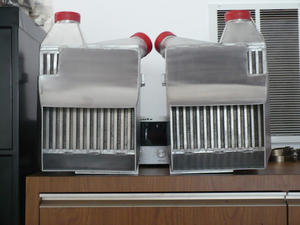
The only ways I can imagine that thing not working is if (a) the oil pan drain sees somehow a huge pressure that keeps the oil from draining and the separator fills with oil or (b) if the blowby gas flow is much, much more than the conservatively specified 200l/min. I'll be actively scavenging the bottom via turbo oil sumps, so I don't have the problem a. I can see a potential problem a if someone tries to drain the oil up from this separator, say to valve covers without a huge vacuum there, it must be drained down. If I have a problem b, then I have a problem regardless of the separator.
What problems have you had with that separator?
Last edited by ptuomov; Dec 22, 2013 at 03:34 PM.
Nordschleife Master
Joined: Apr 2003
Posts: 9,601
Likes: 39
From: Abbotsford B.C.
I have yet to find an off the shelf separator which works well enough for my uses.
The ProVent works OK until;
you increase the power output of the engine and the volume increases,
the air/oil you are trying to separate has too much volume of oil,
the air has a good content of water/humidity.
There is a reason that they include a check valve for the drain. It's because they can easily be overwhelmed with a liquid and then the coalescing element becomes clogged and becomes a large restriction. When this happens, the pressure in the crankcase builds and pushes the oil up the drain back and into the provent, filling it up and overflowing. If you run the check valve on the drain back, the crankcase can eventually get so plugged that it can pop a seal.
I've tried practically every air oil separator on the market today. None of them are able to separate to the extent that is needed on our engines. Should one baffle the hell out of the filler neck, you might be able to lower the oil output to an acceptable level to work with the provent. But the main reason for this kit will be for the high oil consumption GTS motors. They have a great deal of oil in the crankcase vapors and can become completely overwhelmed in as little as 200km. The Vacuum pump design also helps to pull oil out of the cloud, and given where we have to pull from, it will have a higher rate of en-trained oil. Should one not exceed 3,000RPM the provent would be the hot ticket likely. But my design parameters are to ensure that no one, regardless of their RPMs should see any oil ejection. My design actually should work better (up to a certain point obviously), the more gasses are passed through it.
The other problem I have with the provent is that the air inside of it can be stalled, meaning that it does not maintain the swirl effect that is important.
The ProVent works OK until;
you increase the power output of the engine and the volume increases,
the air/oil you are trying to separate has too much volume of oil,
the air has a good content of water/humidity.
There is a reason that they include a check valve for the drain. It's because they can easily be overwhelmed with a liquid and then the coalescing element becomes clogged and becomes a large restriction. When this happens, the pressure in the crankcase builds and pushes the oil up the drain back and into the provent, filling it up and overflowing. If you run the check valve on the drain back, the crankcase can eventually get so plugged that it can pop a seal.
I've tried practically every air oil separator on the market today. None of them are able to separate to the extent that is needed on our engines. Should one baffle the hell out of the filler neck, you might be able to lower the oil output to an acceptable level to work with the provent. But the main reason for this kit will be for the high oil consumption GTS motors. They have a great deal of oil in the crankcase vapors and can become completely overwhelmed in as little as 200km. The Vacuum pump design also helps to pull oil out of the cloud, and given where we have to pull from, it will have a higher rate of en-trained oil. Should one not exceed 3,000RPM the provent would be the hot ticket likely. But my design parameters are to ensure that no one, regardless of their RPMs should see any oil ejection. My design actually should work better (up to a certain point obviously), the more gasses are passed through it.
The other problem I have with the provent is that the air inside of it can be stalled, meaning that it does not maintain the swirl effect that is important.
Nordschleife Master
Joined: Jan 2009
Posts: 5,609
Likes: 84
From: MA
The oil drain has to be able to drain the oil to the sump, that's true for sure. The system that John is building now for my car guarantees that since, the replacementment fluid to the turbo oil sump system is taken from the ProVent drain.
If the drain works, I believe ProVent will separate pretty much any kind of likely mixture out of the crankcase at the rated volume flow. If the blowby exceeds the rated flow, then one needs to step up to a higher flow model, say 400.
I don't understand how the kilometers driven really impact the filter in a meaningful way. If the oil is clean and it's not picking up debris of any kind, the system either gets overwhelmed in a couple of minutes of hard driving or after a very, very long time as the filter element ages.
The only way in which the separator might fail after a set number of kilometers is if the oil drain isn't working and the drainline backs up. Then, you might have enough volume for oil for say 200km before it backs up all the way to the filter element.
Provent design would work worse, not better, with a swirl. The idea is not to get the oil to the sides, it's to get the oil drop thru the center. It's not a cyclone separator. The cyclone separator has a different operating principle, in which the mixture velocity is maintained. I a ProVent style separator, the velocity is reduced to the minimum.
If the drain works, I believe ProVent will separate pretty much any kind of likely mixture out of the crankcase at the rated volume flow. If the blowby exceeds the rated flow, then one needs to step up to a higher flow model, say 400.
I don't understand how the kilometers driven really impact the filter in a meaningful way. If the oil is clean and it's not picking up debris of any kind, the system either gets overwhelmed in a couple of minutes of hard driving or after a very, very long time as the filter element ages.
The only way in which the separator might fail after a set number of kilometers is if the oil drain isn't working and the drainline backs up. Then, you might have enough volume for oil for say 200km before it backs up all the way to the filter element.
Provent design would work worse, not better, with a swirl. The idea is not to get the oil to the sides, it's to get the oil drop thru the center. It's not a cyclone separator. The cyclone separator has a different operating principle, in which the mixture velocity is maintained. I a ProVent style separator, the velocity is reduced to the minimum.