
Heavy Steering


Rennlist Member
Joined: Jan 2004
Posts: 12,620
Likes: 8
From: Boulder Creek, CA

BK, I haven't tried checking the pressure directly. There may be a hydraulic shop near you that could do that if you take the loose pump to them. If you do this figure out the carnk-to-pump pully ratio so you can tell them what operating RPM the pump is designed for. You could also just rebuild it -- it's very easy, and the kit is cheap -- though getting the right kit was a challenge for me because my pump had been swapped with a rebuilt pump at some point, and I needed a kit for a later year.
Hilton, the PO(or their mechanic) may have put in a rack designed to go with a high pressure pump. IIRC the pumps were 75 bar through the early years and at some point they went to 100 bar.
sidehatch, floor to fender is not how ride height is measured -- the suspension designer knows nothing of this, they work with the geometry of how the wheel/suspension moves through space.
Early on, the spec called out a ride height adjustment that was to be measured in a way that did not specify the relative location of the ground -- it was only concerned with wheel position and therefore suspension angle relative to the chassis and accounted for different size wheels:
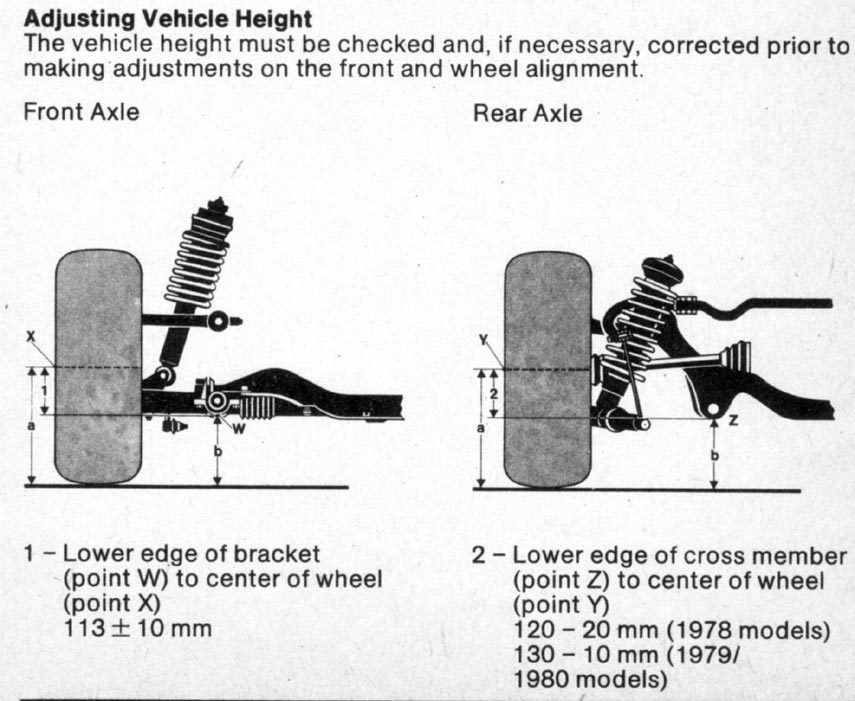
An easier method was detailed later on, where measurements to the ground were taken from the points shown below(black arrows). The actual spec varies somewhat from year to year, assumes a certain tire size, and is normally given in mm. What year is your car? You should put that info in your sig so people don't have to keep asking -- Please read through the "NEW VISITOR" topic at the top of the forum.
Hilton, the PO(or their mechanic) may have put in a rack designed to go with a high pressure pump. IIRC the pumps were 75 bar through the early years and at some point they went to 100 bar.
sidehatch, floor to fender is not how ride height is measured -- the suspension designer knows nothing of this, they work with the geometry of how the wheel/suspension moves through space.
Early on, the spec called out a ride height adjustment that was to be measured in a way that did not specify the relative location of the ground -- it was only concerned with wheel position and therefore suspension angle relative to the chassis and accounted for different size wheels:
An easier method was detailed later on, where measurements to the ground were taken from the points shown below(black arrows). The actual spec varies somewhat from year to year, assumes a certain tire size, and is normally given in mm. What year is your car? You should put that info in your sig so people don't have to keep asking -- Please read through the "NEW VISITOR" topic at the top of the forum.

Thread Starter
Advanced
Joined: Aug 2006
Posts: 55
Likes: 0
I think I have my answer now.
The steering is always ok on the road but really horrible in parking lot situations. Since I usually creep into parking spots the car is idling. As soon as I increase rpms to 1000 the steering eases and at 1200 rpm it is just right. Probably many owners with 5 speeds are slipping the clutch in this situation and do not feel any problems. With the auto box it takes a bit of 2 pedal work to raise the rpms but keep the speed in check.
Can anyone confirm if this is normal or is my pump a bit low on boost at idle speed?
Thanks, Brian
The steering is always ok on the road but really horrible in parking lot situations. Since I usually creep into parking spots the car is idling. As soon as I increase rpms to 1000 the steering eases and at 1200 rpm it is just right. Probably many owners with 5 speeds are slipping the clutch in this situation and do not feel any problems. With the auto box it takes a bit of 2 pedal work to raise the rpms but keep the speed in check.
Can anyone confirm if this is normal or is my pump a bit low on boost at idle speed?
Thanks, Brian