


Cat Temp. Warning


Thread Starter
Intermediate
Joined: Feb 2004
Posts: 39
Likes: 0
From: Saskatoon, Saskatchewan
 Cat Temp. Warning
A question: So I was emboiled in a small sprint with a heavily breathed upon Eagle Talon TSI (this thing was surprisingly fast!) I was in 2nd - redline shift into 3rd and a "Cat temp. too high" warning flashes  (scared the s**t out of me! I was not wanting to see red at this point). Anyhow, I of course had to back off and the warning immediately went away and stayed away.
So, any thoughts? Might the cat be a little plugged? Poor sensor? Other possibilities? By the way, ambient temperature was 0 C.
Thanks,
Greg
(scared the s**t out of me! I was not wanting to see red at this point). Anyhow, I of course had to back off and the warning immediately went away and stayed away.So, any thoughts? Might the cat be a little plugged? Poor sensor? Other possibilities? By the way, ambient temperature was 0 C.
Thanks,
Greg

928 Collector
Rennlist Member
Rennlist Member

Joined: Jan 2003
Posts: 17,270
Likes: 5
From: Seattle
Having never owned one of the fancy schmancy digital readout cars (only up to 87) I have never seen or heard of this warning, but have had 2 cat fires. You may have had the warning because of excess fuel being dumped, or because of an ignition issue. Cats do not overheat unless they get TONS of extra unburnt fuel, like a bad coil or limp-home etc.
Rennlist Member
Joined: Oct 2003
Posts: 7,210
Likes: 17
From: Nova Scotia
Now you've done it! - you've activated the Global Warming sensors that trip when street racing Rice cars. These are unique sensors installed in all Japanese market Porsches in an attempt to prevent interbreed fraternization in public places ...... 
For the Japan market, two thermal wells are present on the cats [see attached image]. The thermal sensors fitted to the outlet pipes of the cats activate the red alarm/alert icon in the pod if excessive discharge temps are reached. There is not an interlock shutdown feature that I am aware of, as in the '89+ cars noted below. Excessively rich mixtures are the more likely cause to trigger this alarm, but a failing cat could also do this. The sensors are ~70mm long x 4mm diameter and appear to be a simple bimetallic type as found in an oven.
The '89+ NA cars have similar sensors in the exhaust manifolds to activate in the reverse sense: if too low a temperature is sensed, the ignition monitoring relay shuts down the four fuel injectors of circuit 1 (red) or 2 (green).
For the Japan market, two thermal wells are present on the cats [see attached image]. The thermal sensors fitted to the outlet pipes of the cats activate the red alarm/alert icon in the pod if excessive discharge temps are reached. There is not an interlock shutdown feature that I am aware of, as in the '89+ cars noted below. Excessively rich mixtures are the more likely cause to trigger this alarm, but a failing cat could also do this. The sensors are ~70mm long x 4mm diameter and appear to be a simple bimetallic type as found in an oven.
The '89+ NA cars have similar sensors in the exhaust manifolds to activate in the reverse sense: if too low a temperature is sensed, the ignition monitoring relay shuts down the four fuel injectors of circuit 1 (red) or 2 (green).
Trending Topics
Thread Starter
Intermediate
Joined: Feb 2004
Posts: 39
Likes: 0
From: Saskatoon, Saskatchewan
Hmmm,
Thanks very much for the information - yes Garth this is the Japanese import!
So I guess that at redline I am getting an overly rich mixture. This particular escapade would likely have been the hardest my car has been flogged since I have had it and the alert has not shown up since. How should I be looking at addressing the rich mixture at WOT?
Greg
Thanks very much for the information - yes Garth this is the Japanese import!
So I guess that at redline I am getting an overly rich mixture. This particular escapade would likely have been the hardest my car has been flogged since I have had it and the alert has not shown up since. How should I be looking at addressing the rich mixture at WOT?
Greg

Inventor
Rennlist Member
Rennlist Member
Joined: Sep 2002
Posts: 10,212
Likes: 465
I would think that it may actually be a lean mix for overheat.
From the L-Jet Service Manual (1980):
From the L-Jet Service Manual (1980):
A - Idle contact
This contact is used to shut off the fuel supply when coasting.
B - Full throttle contact
At a throttle valve opening of approx. 30, the full throttle switch is tripped. The control unit turns the oxygen sensor off and enriches the fuel mixture by about 12. This lowers the exhaust temperature in order to protect the oxygen sensor and catalytic converter.
This contact is used to shut off the fuel supply when coasting.
B - Full throttle contact
At a throttle valve opening of approx. 30, the full throttle switch is tripped. The control unit turns the oxygen sensor off and enriches the fuel mixture by about 12. This lowers the exhaust temperature in order to protect the oxygen sensor and catalytic converter.
Inventor
Rennlist Member
Rennlist Member
Joined: Sep 2002
Posts: 10,212
Likes: 465
What seems obvious to the lay person is generally incorrect. 
Hot gasses in high volume, with excess oxygen (lean = unused oxygen) will generate enough heat to melt the ceramic substrate. A rich mixture, low in oxygen, will cool the cat.
Hot gasses in high volume, with excess oxygen (lean = unused oxygen) will generate enough heat to melt the ceramic substrate. A rich mixture, low in oxygen, will cool the cat.
Rennlist Member
Joined: Oct 2003
Posts: 7,210
Likes: 17
From: Nova Scotia
Originally Posted by PorKen
What seems obvious to the lay person is generally incorrect.
Hot gasses in high volume, with excess oxygen (lean = unused oxygen) will generate enough heat to melt the ceramic substrate. A rich mixture, low in oxygen, will cool the cat.
Hot gasses in high volume, with excess oxygen (lean = unused oxygen) will generate enough heat to melt the ceramic substrate. A rich mixture, low in oxygen, will cool the cat.
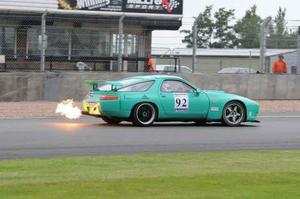
The odd wrinkle with the 928 emissions system is that excess unmetered air is pumped ( air pump) into the tail end of the cat: this would leave an enriched condition exposed to both heat and excess O2 = "flames"... and the last stage of the cat is the oxidation catalyst zone ...
So would it appear possible that either a too rich or too lean condition would potentially create some nasty heating ....
Greg - is your air pump still in service? ( mine was deleted by the PO, although the cat monitoring deal is intact)
Inventor
Rennlist Member
Rennlist Member
Joined: Sep 2002
Posts: 10,212
Likes: 465
The air pump bypass valve is controlled by manifold vacuum. Under vacuum the air pump is pushing air into the rear of the cat, to reduce nitrous oxides. With no vacuum (WOT), the bypass valve diverts the air into the lower air cleaner box.
At WOT, excess fuel does not burn, it evaporates and cools the exhaust.
At WOT, excess fuel does not burn, it evaporates and cools the exhaust.