When you click on links to various merchants on this site and make a purchase, this can result in this site earning a commission. Affiliate programs and affiliations include, but are not limited to, the eBay Partner Network.
1989 S4 Auto. Was equipped with an Andy keel supercharger. The intercooler leaked coolant into a couple of cylinders.
The owner went to start the car and heard a whump whump whump. Pulled spark plugs and coolant sprayed out. The car sat like that for 10 plus years until I got it and a few other cars from the owner.
Today I took the upper block to get the bores checked for out of round.
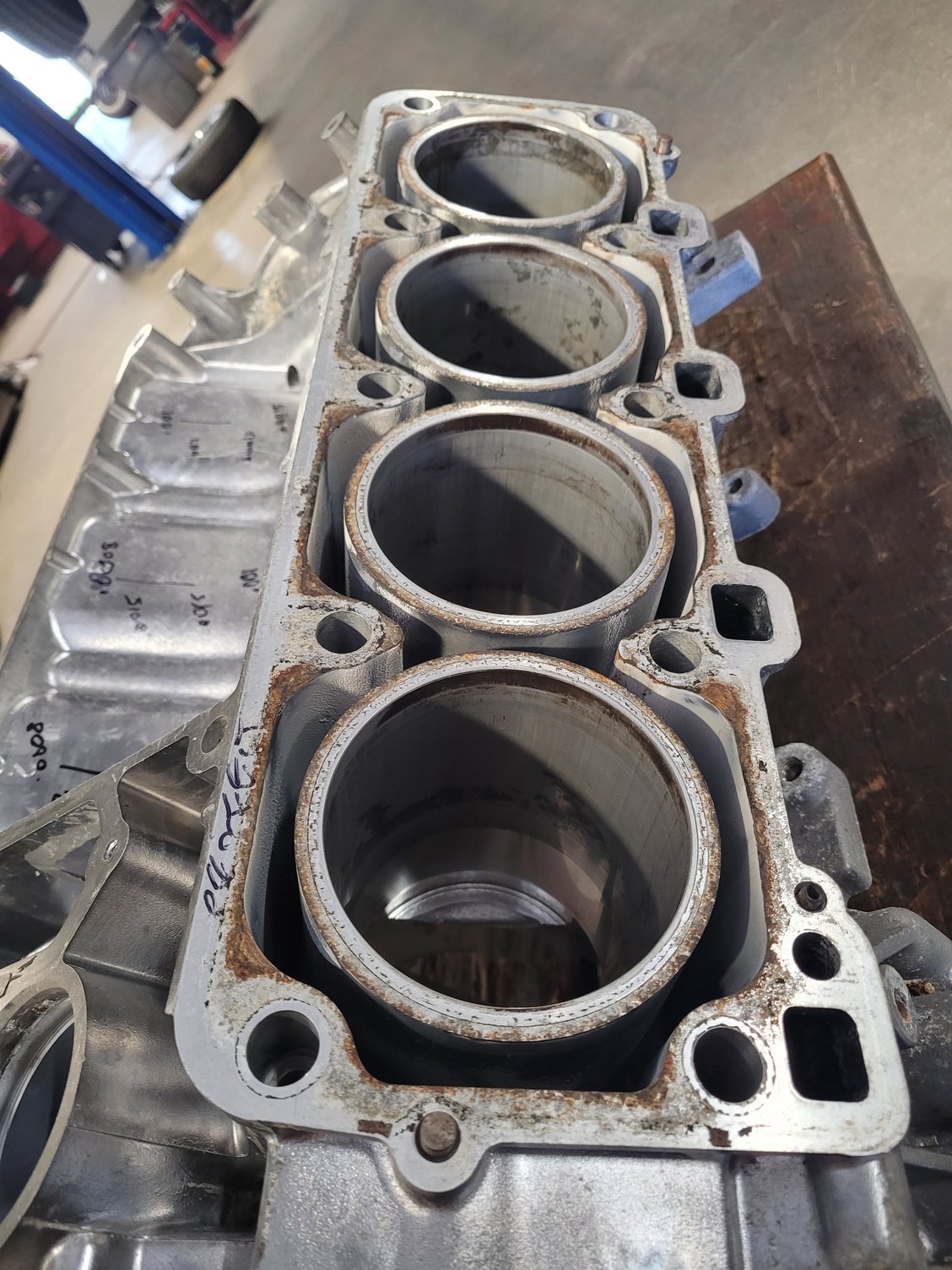
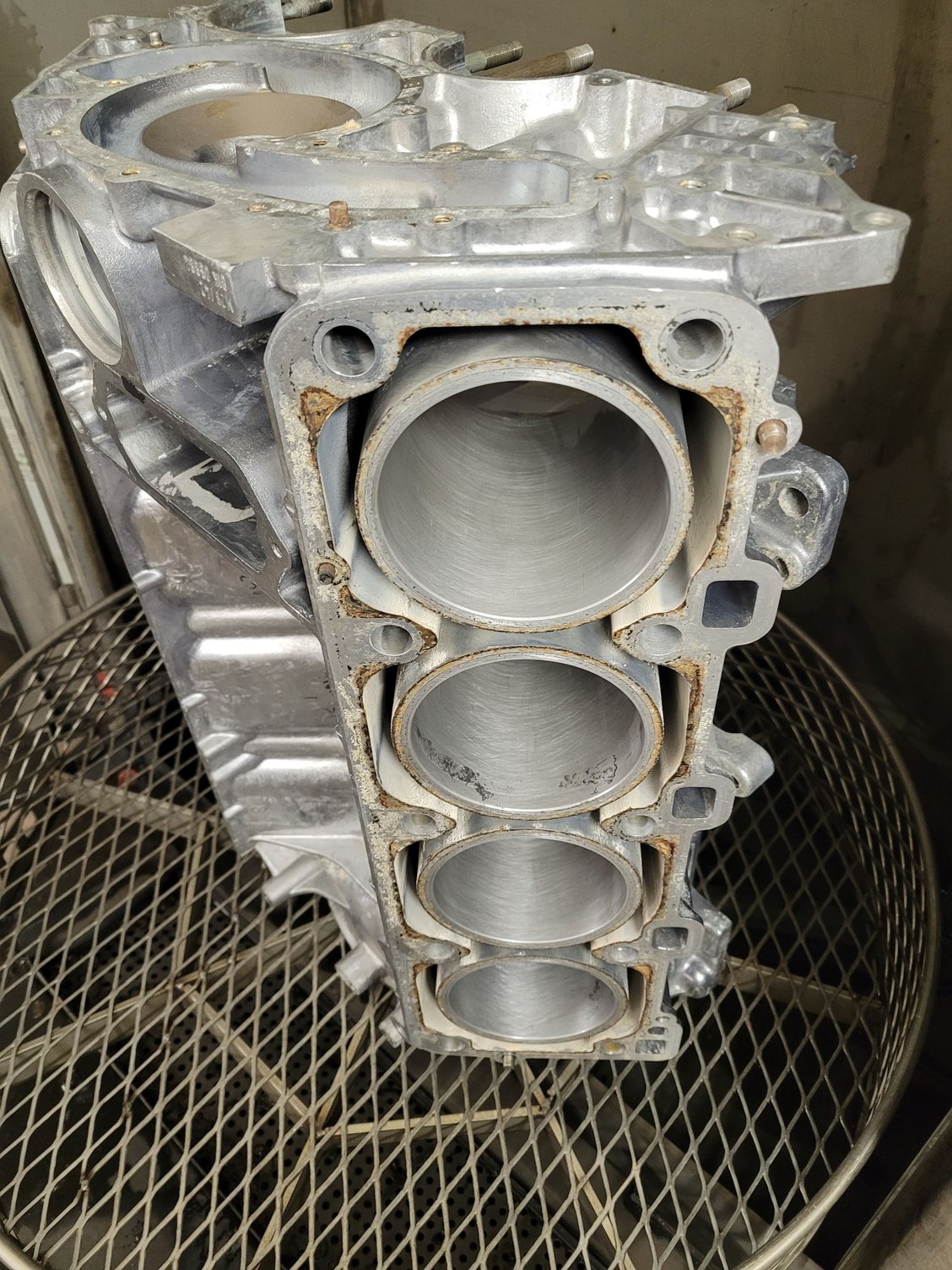
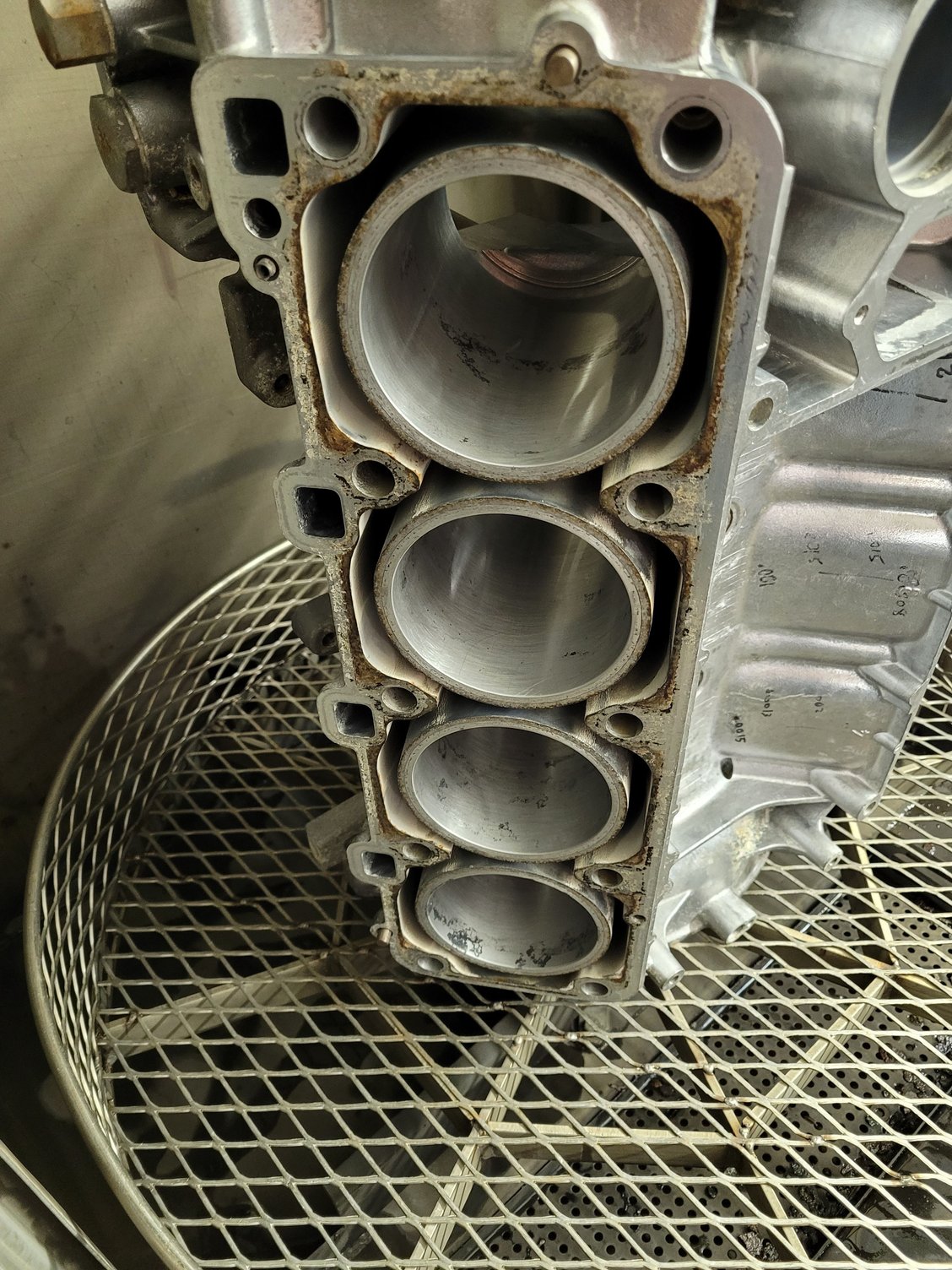
Results were encouraging. The cylinders were ok however I was still left with some discoloration resulting from the coolant and minor surface corrosion.
David, my machinist thought it might be worth honing the worst cylinder. I had Sunnen paste, Sunnen stones and felt with me.
David found the same Sunnen stones but for his Sunnen hone. Pictured here:
He used Sunnen oil to coat the cylinder, applied the paste to the stones. We took several passes turning up the pressure on the hone. The coolant stains did get lighter. The stones (M330?) are very fine.
After each pass we measured the cylinders. The reading remained the same but we were polishing not really removing a lot of material. The dial indicator moved more smoothly. But the corrosion while lighter was still there. We decided to try a circular home with ball ends aka the dingle berry hone. A couple of passes with that and most of the corrosion was gone and we had very nice cross hatching in the cylinder. We followed that with stones and we were pleased with the results.
We did the same basic process for 1-3 cylinders.
On 5-8 we lead with the ball home and finished with the stones.
I want to say you did more harm than good. The engines didn't have any cross hatching from factory.
The correct Sunnen hone has IIRC 10 or 12 felt pads and the machining paste is AN-30. It machines away a thin layer of aluminum to expose the hard silicon crystals underneath for the piston rings to ride on.
You're going to have to have the block machined and the cylinders honed. Then run 0.5mm oversized pistons to get this to work. Otherwise you are going to have a lovely complete engine failure in short order.
1. Steel sleeves
2, Overbore, properly hone and install oversized pistons (not sure any are still available), or
3. Nikasil + aftermarket aluminum pistons.
As I have advised in other threads if and when the coolant goes off it can form organic acids that can and will attack the passive film of aluminium oxide that protects the alloy form corrosion and I suspect that is the problem here.
If the staining was a surface phenomena then what you did would have polished the staining away but that has not happened thus the problem is deeper. The silica component will not have been impacted by what has been going on but the alloy clearly has and the question then becomes one of whether the substrate that has been impacted can and will hold the exposed silica particles in place. I do not know the answer to that one but I am not at all optimistic.
If boring removes those stains altogether then maybe but then you are into new pistons that may or may not be available. Just my 2 cents worth.
As I have advised in other threads if and when the coolant goes off it can form organic acids that can and will attack the passive film of aluminium oxide that protects the alloy form corrosion and I suspect that is the problem here.
If the staining was a surface phenomena then what you did would have polished the staining away but that has not happened thus the problem is deeper. The silica component will not have been impacted by what has been going on but the alloy clearly has and the question then becomes one of whether the substrate that has been impacted can and will hold the exposed silica particles in place. I do not know the answer to that one but I am not at all optimistic.
If boring removes those stains altogether then maybe but then you are into new pistons that may or may not be available. Just my 2 cents worth.
Yeah that block was toast before and even more so after this adventure.
What you have done to date makes no difference other than any $$$'s it cost you to do what you did.
Suggest you bore the worst looking cylinder to 104mm [968 bore?] and see if it cleans up OK.
If it does you are quids in as it were- if not you have a nice coffee table.
Looking at the pictures, I'd guess that this block would be fine at 100.5mm.
And as they get more requests, I'm thinking that Porsche will eventually have some oversize pistons made in that size or even in 101mm.
Looking at the pictures, I'd guess that this block would be fine at 100.5mm.
And as they get more requests, I'm thinking that Porsche will eventually have some oversize pistons made in that size or even in 101mm.
I have 2 blocks that could use oversized pistons, but I did not think they were available. I hope you are right.
Of course finding somebody on the east coast with a Sunnen machine set up for alusil is nearly impossible.
Both Sunnen machines local to me are set up to bore iron. And the time it takes to convert the tooling to aluminum cannot be justified for a single block.
If I had 10 candidates to bore and hone I might be able twist some arms. Short of that nada.
And that moot if there are no oversized pistons. Feh!
FWIW, I'm probably going the sleeve the 6.5L with steel.
Looking at the pictures, I'd guess that this block would be fine at 100.5mm.
And as they get more requests, I'm thinking that Porsche will eventually have some oversize pistons made in that size or even in 101mm.
I am thinking the surface has been "etched" rather than seriously corroded per se based on the photos and the fact that Kevin would probably have noticed something seriously amiss so yes maybe 100.5mm will work
Having paid attention to your "dearth of piston" posts and knowing Kevin's enthusiasm maybe the original S4 crank and rods could be mated to 968 pistons as an interesting upgrade to 5.4 litres with a sprinkling of GT cams?
I have 2 blocks that could use oversized pistons, but I did not think they were available. I hope you are right.
Of course finding somebody on the east coast with a Sunnen machine set up for alusil is nearly impossible.
Both Sunnen machines local to me are set up to bore iron. And the time it takes to convert the tooling to aluminum cannot be justified for a single block.
If I had 10 candidates to bore and hone I might be able twist some arms. Short of that nada.
And that moot if there are no oversized pistons. Feh!
FWIW, I'm probably going the sleeve the 6.5L with steel.
Kevin
I feel your pain.
I buy every set of 100.5 pistons I can find, regardless of the price. (And I paid dearly for the last set I found, sitting around.)
And my machinist will clean his entire Sunnen machine, put in new fluid and filters, to bore my blocks. (It's not cheap.)
BTW: My good buddy, Neil Harvey, moved his entire business to Florida and had/has a dedicated Sunnen machine that I believe he uses just for Alusil.
I am thinking the surface has been "etched" rather than seriously corroded per se based on the photos and the fact that Kevin would probably have noticed something seriously amiss so yes maybe 100.5mm will work
Having paid attention to your "dearth of piston" posts and knowing Kevin's enthusiasm maybe the original S4 crank and rods could be mated to 968 pistons as an interesting upgrade to 5.4 litres with a sprinkling of GT cams?
That's certainly an alternative (and they run extremely well), although it requires a custom length connecting rod (which I try to keep in inventory.)
That's certainly an alternative (and they run extremely well), although it requires a custom length connecting rod (which I try to keep in inventory.)
Indeed different rods would be required- senior moment!
I was thinking along the lines of Jim C's motor that you built but with the stock 5.0 litre crank rather than a 5.4 litre stroke crank if that makes sense.





 Can this block be saved?