When you click on links to various merchants on this site and make a purchase, this can result in this site earning a commission. Affiliate programs and affiliations include, but are not limited to, the eBay Partner Network.
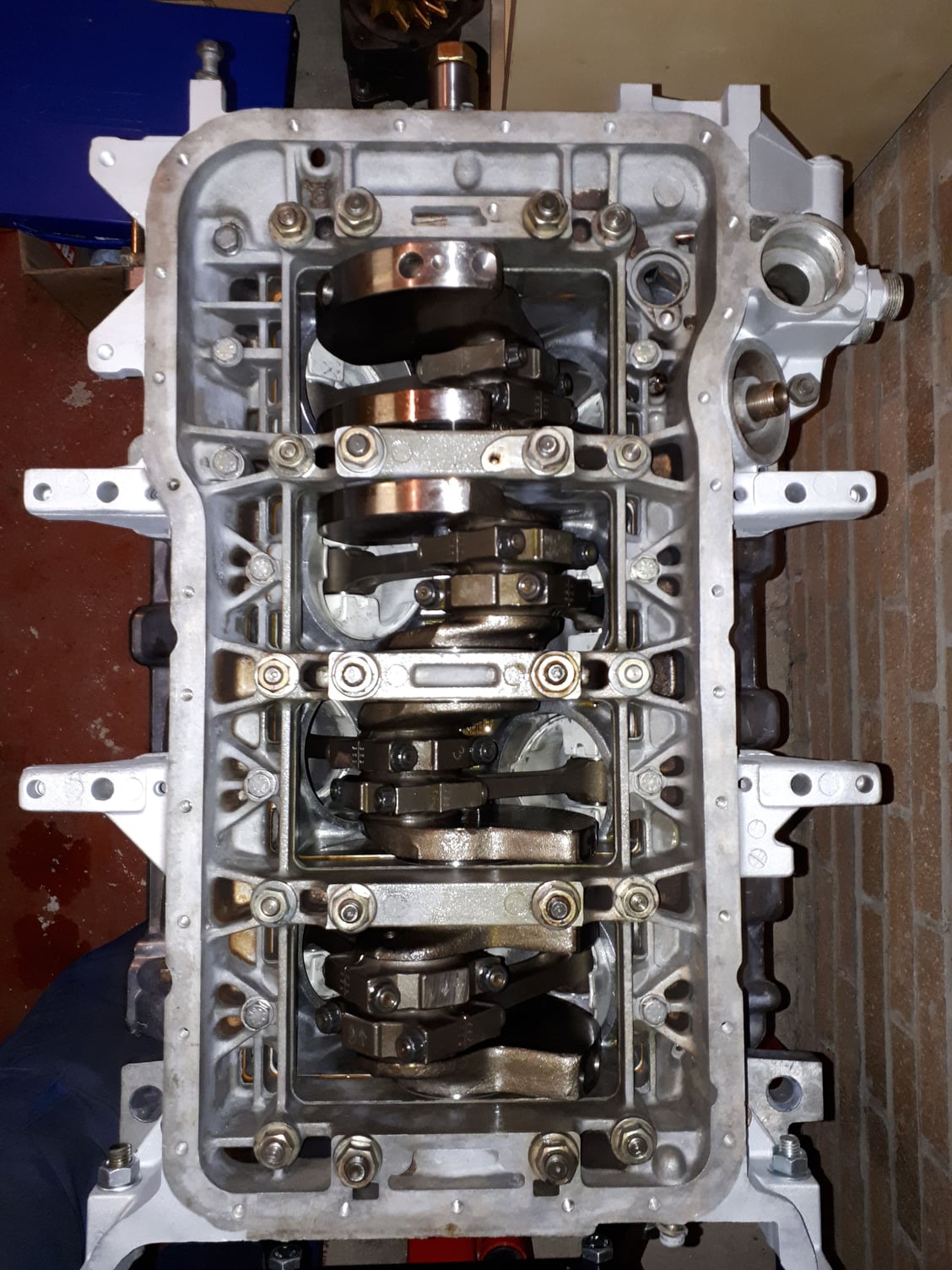
So the long saga of refreshing my Euro 16v S2 engine I am just wondering if I should redo the seal on the console having pulled it to inspect the main bearings (all good, just put then straight back). Having read a few more threads on the subject since carrying out the task I am worried that I have used too much sealant and it will leak soon after start up or to take Greg's point in another thread, not exert enough pressure on the main bearing clamps and compromise the lubrication. Good news is the engine is still on the stand and I haven't fitted the sump yet (or heads etc). What I did
Spent 1+ hours cleaning the console and mating surface on the block, carefully scrapping the surfaces free of old 574 and wiping down with preprep.
Bought a fresh bottle of Loctite 574, arrived showing a use by July 2019 date.
Bought a small velvet pile roller.
Deviation - Rather than putting the 574 in a roller tray which I didn't like the sound of I used the same technique as Porsche motorsport assembling a new gearbox that I found online - basically dispense some sealant on the casting and spread it evenly with a roller.
As one that has done it wrong and having to pull the engine to do it a second time correctly let me add this:
Too much sealant and waiting too long are the two concerns. I believe it was the latter that did me in.
The appearance of 574 on the mating edge should be translucent and the time to mate the surfaces should be short as possible. 574 cures in the absence of oxygen.
Having an assistant to quickly place the nuts on the bolts and begin the tightening process is recommended for first timers. I used a piece of thick Plexiglas to spread the 574 with the roller.
The result should be a very small bead visible from the outside once torqued down.
Anyone got any views on usability once opened? I understand the sealant is aerobic i.e. only cures in the absence of air. The squeezy bottles are only partially full when new - the rest is air to stop the sealant curing in storage. Assuming I have some left in the new bottle that I used 2 weeks ago, I can't see why this wouldn't still be perfectly usable. Thoughts?
Anyone got any views on usability once opened? I understand the sealant is aerobic i.e. only cures in the absence of air. The squeezy bottles are only partially full when new - the rest is air to stop the sealant curing in storage. Assuming I have some left in the new bottle that I used 2 weeks ago, I can't see why this wouldn't still be perfectly usable. Thoughts?
I have been testing Loctite 574 and 510 through work (we use them on metal-metal flanges in gas lines) and 510 is slower curing and will give you more time to tighten the bolts.
It is true that both are anaerobic, be aware that copper accelerate curing, so the time you have available to tighten bolts are dependent upon the alloy.
you're referencing the oil pan. they are talking about the upper and lower halves of the block after it has been separated
I also used Loctite 517 for the other halves of the block.
Advantage of Loctite 517 : it only hardens between 2 flat materials. the part of Loctite outside the pressed halves will remain slightly liquid so that
when coming in contact with oil, it will be dissolved and not harming your engine
So the long saga of refreshing my Euro 16v S2 engine I am just wondering if I should redo the seal on the console having pulled it to inspect the main bearings (all good, just put then straight back). Having read a few more threads on the subject since carrying out the task I am worried that I have used too much sealant and it will leak soon after start up or to take Greg's point in another thread, not exert enough pressure on the main bearing clamps and compromise the lubrication. Good news is the engine is still on the stand and I haven't fitted the sump yet (or heads etc). What I did
Spent 1+ hours cleaning the console and mating surface on the block, carefully scrapping the surfaces free of old 574 and wiping down with preprep.
Bought a fresh bottle of Loctite 574, can't remember the date on it but I think it was at least 12m inside it's use by date.
Bought a small velvet pile roller.
Deviation - Rather than putting the 574 in a roller tray which I didn't like the sound of I used the same technique as Porsche motorsport assembling a new gearbox that I found online - basically dispense some sealant on the casting and spread it evenly with a roller. https://www.youtube.com/watch?v=exX-YiSWds8
When I bolted the console down and torqued it there was a small bead of 574 squeezed out.
Questions, - How likely do you think it is that the joint will be bad.
- If you were in my position would you reseal it?
Feels like the whole car is one step forward 2 steps back at the moment...
D
detail shots later hopefully- this doesn't show the seal (garage is miles away...)
If you ended up with a thin, even layer (like in the video), and you tightened the hardware immediately (10 minutes) you will be fine.
I'm pretty "****" about appearance, so I wipe away the tiny bead of Loctite that squeezes out. If you can wipe away the excess as a liquid and it dud not turn pink and hard (right at the base of the split) you are golden.
Anyone got any views on usability once opened? I understand the sealant is aerobic i.e. only cures in the absence of air. The squeezy bottles are only partially full when new - the rest is air to stop the sealant curing in storage. Assuming I have some left in the new bottle that I used 2 weeks ago, I can't see why this wouldn't still be perfectly usable. Thoughts?
D
If the bottle was from fresh inventory, it will be good, for many months, once opened.
I find people's logic patterns to be one of the most interesting things about life. I enjoy standing in front of something and trying to figure out what possessed someone to do a job the way they chose to do it.
This is certainly one of those moments....
Porsche used and (and still recommends) Loctite 574 on literally thousands of engines....tens of thousands, if you count 911 engines.
I'd love to know how one takes that information and logics out that using a different product is a better idea....
Mercedes also has their special sauce as well. Its black and similar (but still, different) than RTV, and people are like "Hey, I just used RTV... I have a leak, what should I do?"
Mercedes also has their special sauce as well. Its black and similar (but still, different) than RTV, and people are like "Hey, I just used RTV... I have a leak, what should I do?"
I've used that black Mercedes sealant on oil pans, without a gasket. Pretty sure it's a product that they get from the LA Brea Tar Pits.
I'm also pretty sure that once it "hardens", one could remove the hardware and throw it away.....
Thanks for the input everyone. In hindsight I feel better about my method/materials so am not going to rework the seal now. Hell the rate I'm going it won't get tested until 2025 anyway
.........If you can wipe away the excess as a liquid and it dud not turn pink and hard (right at the base of the split) you are golden.
^^^This may be the most valuable phrases in the entire thread. If you are like me, you would be asking yourself "Did it take too long?", and you would not know until you fire up the motor, many labor hours later, when it's too late. But, based on above, at least you have a benchmark for some confidence.




 Console [ENGINE GIRDLE] sealing - do it again?