When you click on links to various merchants on this site and make a purchase, this can result in this site earning a commission. Affiliate programs and affiliations include, but are not limited to, the eBay Partner Network.
The shop says one of the bushings is shot on my upper control arm and says the others are cracking, so I have to replace one and they recommend replacing all 4. Is this normal wear and tear? I have a 2015 Turbo with 96k miles.
I've already replaced one of the lower front bushings myself. How complicated is replacing the uppers compared to the lowers?
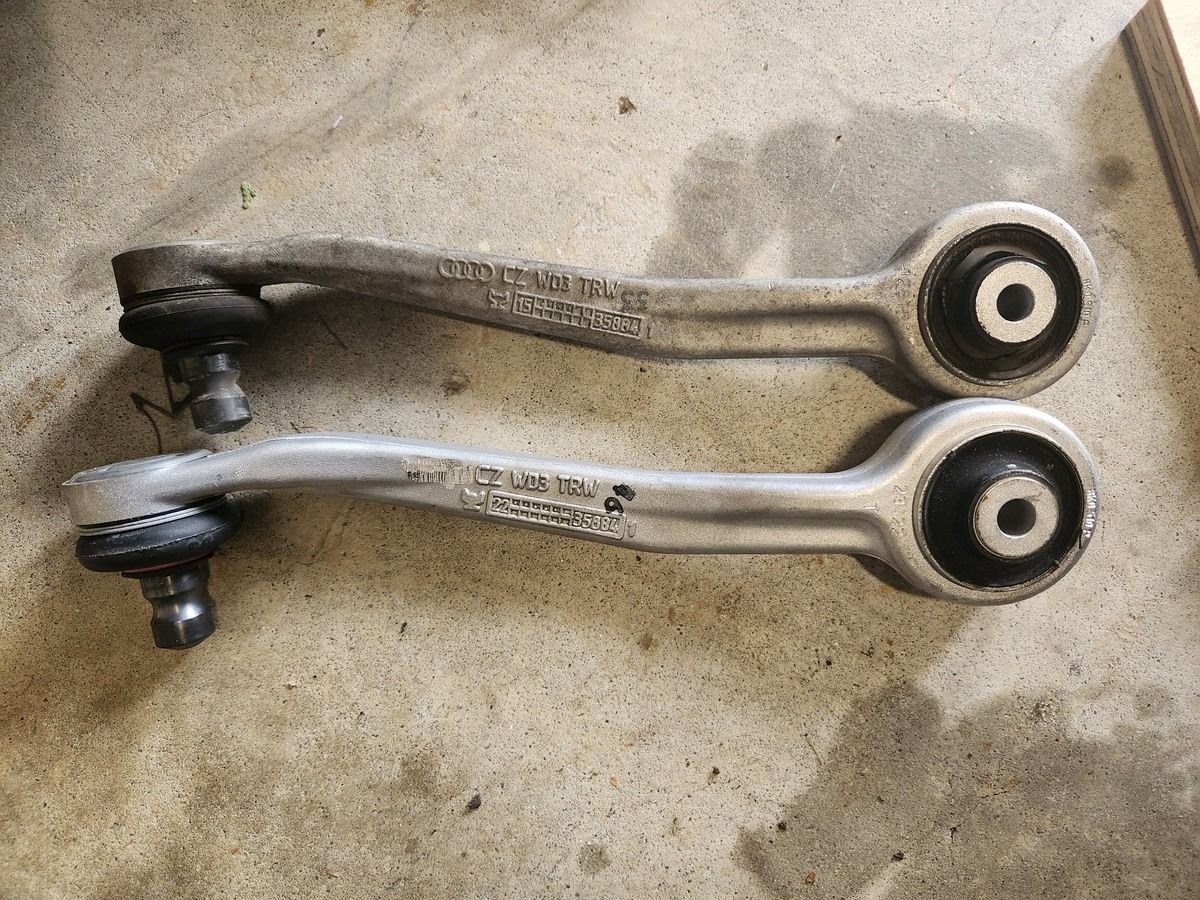
Unfortunately, due to the unique design of this front suspension, the upper arm rubber bushings don't last as long as cars with more conventional designs. This is an Audi design, and although it provides better handling, the upper bushings are under alot of stress, due to this unusual geometry that causes the bushing to be stressed laterally when the steering angle is anything but straight-ahead. On a normal A-arm suspension, the bushings are only stressed axially, this suspension stresses the bushings in two directions. This suspension design was introduced in the Audi A8, I think circa 1994, but this unique front suspension design was then later used on Audi A4, A5, A6, A7, Q5 models, and the B5 VW Passat (which was A4 based), and of course the Macan (Q5 based chassis).
All vehicles that use this suspension suffer from early bushing failure of the two upper control arms. The bushing normally starts to develop surface cracks in them, at an early mileage, around 20,000 to 30,000 miles. Audi considers these surface cracks "normal". Eventually the cracks deepen, until the bushing becomes so loose that the control arms start clunking, and the alignment suffers. It is not really a defective bushing issue, it is rather a design issue which traded-off bushing life for handling. All the replacement arms will eventually suffer cracked bushings, this is the nature of the "beast". These bushings will typically start clunking between 70,000 miles and 100,000 miles, and replacement is normal for these cars. There is no safety issue if the bushing completely fails, as the control arm is "captive", and won't disconnect even if the rubber bushing is completely missing.
There are a couple of brands of control arms (Febi, TRW, Meyle, Lemforder, Ocap), they are about equivalent. I think all are OEM manufacturers for Porsche/Audi. Meyle makes regular and Heavy Duty (HD) versions of the arms and balljoints, I recommend the "HD" versions for longer life. Pretty much everyone just replaces the whole arm, rather than replacing just the bushing.
I think that the life of these bushings might be extended by only parking the car with the wheels in the straight ahead position, but that is only my theory.
The two upper arms are usually replaced together, as both arm bushings will be both in the same degraded condition. The upper control arms are not too difficult to replace on the Macan, as long as the long bolt that retains the ball-joint ends comes out easily. With salt corrosion, this bolt is often a bear to remove. Take the nut off, and if you can rotate the bolt head with a ratchet wrench, the bolt should come out without too much fuss. DO NOT try to pry open the slots by the bolt, you can fracture the aluminum upright. When the new arms are installed, the inner bushing bolts MUST be tightened to the specced torque ONLY when the whole spindle assembly is raised to the normal ride height of the car. This insures that the rubber bushings do not have any torsional twist at the normal ride height (and angle of the arm). I suggest you buy a new "long" bolt from VW/Audi/Porsche, and grease its shaft, or apply antiseize compound, before installing it , to prevent future disassembly problems. The long bolt can be tightened to torque spec at any suspension angle. Actually, on every VW/Audi/Porsche I have bought, that uses this type of suspension, I grease this bolt when the car is new. There are plenty of Youtube videos on changing the upper control arms on various Audi models, or check the Audiworld and Audizine A4 forums to find some how-to's.
The shop says one of the bushings is shot on my upper control arm and says the others are cracking, so I have to replace one and they recommend replacing all 4. Is this normal wear and tear? I have a 2015 Turbo with 96k miles.
I've already replaced one of the lower front bushings myself. How complicated is replacing the uppers compared to the lowers?
What symptoms are you experiencing?
I would not change all 4 unless you have specific symptoms that bother you, and the symptoms relate to all four upper arms. The “cracked bushings” comment is the dealer trying to fleece you.
Upper control arms generally are not hard to remove, but it is vehicle dependent. The 9Y0 Cayenne upper arms look straightforward to remove. Depends how much of the wheel house liner needs to be removed to access fasteners, wiring, etc. UCA fasteners are sometimes accessed from the engine bay which might mean some disassembly there also. It helps to have impact tools to break the fasteners free in what could be limited space/limited leverage.
Not a bad idea to get a suspension alignment after replacing suspension components like control arms. Let your driving feel be the guide on this after reassembly with the new arm.
Unfortunately, due to the unique design of this front suspension, the upper arm rubber bushings don't last as long as cars with more conventional designs. This is an Audi design, and although it provides better handling, the upper bushings are under alot of stress, due to this unusual geometry that causes the bushing to be stressed laterally when the steering angle is anything but straight-ahead. On a normal A-arm suspension, the bushings are only stressed axially, this suspension stresses the bushings in two directions. This suspension design was introduced in the Audi A8, I think circa 1994, but this unique front suspension design was then later used on Audi A4, A5, A6, A7, Q5 models, and the B5 VW Passat (which was A4 based), and of course the Macan (Q5 based chassis).
All vehicles that use this suspension suffer from early bushing failure of the two upper control arms. The bushing normally starts to develop surface cracks in them, at an early mileage, around 20,000 to 30,000 miles. Audi considers these surface cracks "normal". Eventually the cracks deepen, until the bushing becomes so loose that the control arms start clunking, and the alignment suffers. It is not really a defective bushing issue, it is rather a design issue which traded-off bushing life for handling. All the replacement arms will eventually suffer cracked bushings, this is the nature of the "beast". These bushings will typically start clunking between 70,000 miles and 100,000 miles, and replacement is normal for these cars. There is no safety issue if the bushing completely fails, as the control arm is "captive", and won't disconnect even if the rubber bushing is completely missing.
There are a couple of brands of control arms (Febi, TRW, Meyle, Lemforder, Ocap), they are about equivalent. I think all are OEM manufacturers for Porsche/Audi. Meyle makes regular and Heavy Duty (HD) versions of the arms and balljoints, I recommend the "HD" versions for longer life. Pretty much everyone just replaces the whole arm, rather than replacing just the bushing.
I think that the life of these bushings might be extended by only parking the car with the wheels in the straight ahead position, but that is only my theory.
The two upper arms are usually replaced together, as both arm bushings will be both in the same degraded condition. The upper control arms are not too difficult to replace on the Macan, as long as the long bolt that retains the ball-joint ends comes out easily. With salt corrosion, this bolt is often a bear to remove. Take the nut off, and if you can rotate the bolt head with a ratchet wrench, the bolt should come out without too much fuss. DO NOT try to pry open the slots by the bolt, you can fracture the aluminum upright. When the new arms are installed, the inner bushing bolts MUST be tightened to the specced torque ONLY when the whole spindle assembly is raised to the normal ride height of the car. This insures that the rubber bushings do not have any torsional twist at the normal ride height (and angle of the arm). I suggest you buy a new "long" bolt from VW/Audi/Porsche, and grease its shaft, or apply antiseize compound, before installing it , to prevent future disassembly problems. The long bolt can be tightened to torque spec at any suspension angle. Actually, on every VW/Audi/Porsche I have bought, that uses this type of suspension, I grease this bolt when the car is new. There are plenty of Youtube videos on changing the upper control arms on various Audi models, or check the Audiworld and Audizine A4 forums to find some how-to's.
Thanks you so much VAGFan! FCPEuro sells a complete kit for both sides, including new hardware for $210. I have a feeling it will cost at least 5x that to have the shop do the work. I am tempted to just do it myself. Nice thing about FCPEuro is I can send them back for free replacements at any time. How do you get that bolt out if it's stuck?
My only concern is that the instructions call for a special tool to support the rotor assembly. Why is this needed? Can I just support it from underneath on the lower ball joint?
I just use a jack on the bottom of the disc, or the disc "Hat", with a small piece of wood in-between. First screw in 2 or 3 lug-bolts, with a stack of washers, to clamp the disc to the hub. I wouldn't put the jack on the lower ball joint, or either lower arm.
Then jack the whole suspension assembly up till all the weight of that corner of the car is on the jack (you will then be at nominal ride-height), then tighten the inner bolts, at the bushings, of the upper arms.
If that "devil" bolt is stuck, you can try to hammer it out with a round rod that is slightly smaller than the diameter of the threaded end of the bolt....or heat, and lots of Kroil and curse-words. I think Audi had a special dealer tool to press these troublesome bolts out. I had such a problem with that on my 1999 Audi A4 that I ended-up needing to replace the entire aluminum upright piece.....lots of $$, and a new wheel bearing too. After that ordeal, that's when I started greasing this bolt on any new Audis or VWs (or Macans) I bought that use this front suspension design. I tend to keep my cars a long time, and anticipate eventually doing the upper arms on all of them.
Thanks for all the info, I think I am going to do this myself instead of having the shop do it. The Porsche service manual says "all screws and nuts are geomet coated and must not be greased". Is this not the case? I guess I'll find out when I try to remove that long bolt.
I looked up info on the Geomet coating, I see no warnings or reasons you can't put grease on it.
Also, don't overtighten that "devil" bolt, check the torque spec in the Service Manual. Overtightening that bolt can also fracture the aluminum upright.
The shop wanted $1150 to do both sides. I can get the parts for $200 and it doesn't look to be more than an hour of labor per side? I don't understand how it's so expensive. They said the arms are $100 each but even then, they are charging over $700 in labor??
Yes, 3 hours @ $250 per hour. 1 hour per side as you mentioned, 30 minutes to pull the car in and out, wash it and 30 minutes to do paperwork and wash hands/coffee break.
Dealers are charging more than $1000 in labor (does not include parts) to replace the main 12V battery on a Cayenne with stupidly expensive LiFePO4 battery. Battery replacement is 30 minutes plus 15 minutes to register using PIWIS.
I drop mine off this morning for upper control arm replacement. I’m at 63k. No off-road. No real rough stuff over the years. Turns out GEICO’s MBI program is paying the $1000 bill leaving me with a $250 deductible. Alignment is included in the price.
NOTE: my ‘symptoms’ were like driving a new BMW. I was having trouble with on-center steering. Constantly adjusting the steering wheel to keep it on the line I want. Another analogy is a feeling that the top of the tires could ‘flex’ side-to-side so with any undulating of the road surface it would want to pull causing just enough steering adjustment to annoy me.
I did the replacement on one side this morning. The biggest pain was not the long bolt. The long bolt came out easily. The issue was the studs in the ball joints. They were stuck in the upright due to corrosion. If I didn't have a small impact air hammer I don't think I could have gotten them out.
Aligning the control arms properly was also a bit of a pain, but then I came up with this:
This allowed me to make sure the suspension was loaded properly at the correct level, and also eliminated the need for a jack stand. The orientation of the 2x4s is important because they slide a bit when lowering the car back down. Then I could use the jack to raise and lower slightly until I got it in the correct position for the bolts to come out. Wiggling the top of the upright around also helped.
How about some spherical bearings to replace the inner bushings on those upper links? Considering this, along with the inner bushing and shock mount on the main lower arm.
The inner bushings of the upper arms can't be replaced with spherical bearings, due to the geometry of this suspension, those inner bushing need to compress when the steering angle is changed.
Talos Takes Your 991 Porsche 911 GT3 to the Next Level for a Cool $1.13 Million
Slideshow: Talos Vehicles has transformed the Porsche 911 GT3 RS into a carbon-bodied, race-inspired machine that costs well over $1 million before the donor car is even included.
9 Vehicles Porsche Helped Engineer that Aren't Porsches
Slideshow: Long before engineering consulting became trendy, Porsche was quietly helping other automakers build everything from supercars to economy hatchbacks.
9 Features and Characteristics That Only Porsche People Understand
Slideshow: Some brands build cars. Porsche builds traditions, obsessions, and a few habits that stopped making sense decades ago but somehow became part of the charm.
This Builder Is Turning Heads With Its Slantnose 911 Creation
Slideshow: A small Polish tuner has reimagined the Porsche 911 Slantnose for the modern era, blending 1980s nostalgia with widebody tuning culture and serious performance upgrades.
Porsche 911 GT3 Artisan Edition Pays Homage to Japanese Culture
Slideshow: Porsche has created a Japan-only 911 GT3 Artisan Edition that blends track-ready hardware with design cues inspired by traditional Japanese craftsmanship.
Porsche Reveals Coupe Variant of the Electric Cayenne With a Fresh Look
Slideshow: Porsche's latest electric Cayenne Coupe blends dramatic styling with supercar acceleration, turning the brand's midsize SUV into a 1,139-horsepower flagship.














 Replacing upper control arms