


Gear ratios...
Rennlist Member

Joined: May 2015
Posts: 1,741
Likes: 308
From: 4MB, HYA

This is very different than driving in the less frenetic maximum torque range of my automatic Audi.

Rennlist Member
Joined: May 2012
Posts: 16,348
Likes: 8,187
From: Mid-Atlantic (on land, not in the middle of the ocean)
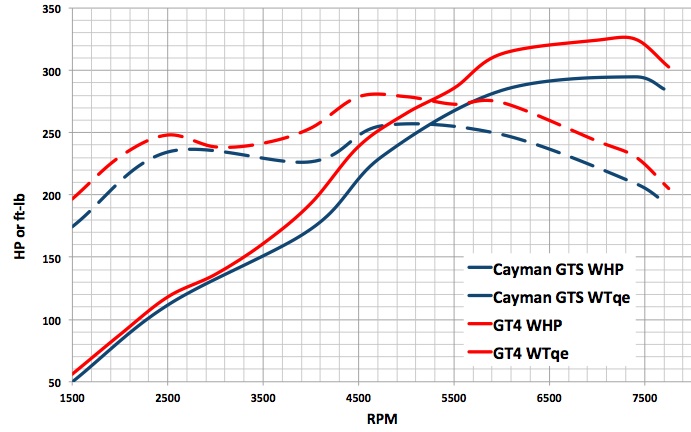
On a percentage basis, that GT4 torque dip from 2500 to 4500 rpm looks fairly pronounced, and seems tied to the issue under discussion. Over most of the rev range, the GT4 maintains about 20 ft-lb+ more torque than the GTS, but the difference dips to about zero at about 3000 rpm.
Basic Sponsor
Rennlist
Site Sponsor
Rennlist
Site Sponsor

Joined: Oct 2009
Posts: 5,224
Likes: 233
From: Loveland, CO
So far, you are giving me the same response ive heard from others, based on the lower gear, higher leverage theory application.
you are being a bit presumptuous thinking im ignoring anything here. im not. gear multiplication is as critical to the gear discussion as it is to the Hp vs torque discussion . sure, gear multiplication happens, but what is it multiplying........? yes, engine torque.... if you have constant HP, that means torque is falling at the same rate as engine RPM.. make sense?? this means, to get the same vehicle speed and increase the numerical ratio, you get a loss in engine torque of the same proportions.. there is a net net NO CHANGE in doing so. So, im not leaving anything out here. i think if you look closer, you will see im correct and change the story a bit. dont worry, many get this wrong..........a lot... i used this in my professional life for 20 years... its correct.
But, dont trust me.. show me an instance where this ISNT true and ill certainly listen.
you are being a bit presumptuous thinking im ignoring anything here. im not. gear multiplication is as critical to the gear discussion as it is to the Hp vs torque discussion . sure, gear multiplication happens, but what is it multiplying........? yes, engine torque.... if you have constant HP, that means torque is falling at the same rate as engine RPM.. make sense?? this means, to get the same vehicle speed and increase the numerical ratio, you get a loss in engine torque of the same proportions.. there is a net net NO CHANGE in doing so. So, im not leaving anything out here. i think if you look closer, you will see im correct and change the story a bit. dont worry, many get this wrong..........a lot... i used this in my professional life for 20 years... its correct.
But, dont trust me.. show me an instance where this ISNT true and ill certainly listen.
FDxgear ratiox engine torque = axle torque (ignoring tire size)
3.89x1.24 x 365Nm = 1760.6Nm
3.89x 1.125x390Nm = 1706.74Nm
The car with the shorter 4th gear is going to have more power to the ground at the speed in question.
Your examples are excessively confusing to the layman reader. Your statements that you cannot make more power, you just move around how you use are accurate to a point. That works in a theoretical space. We aren't in a theoretical space, we are in a real specific space, first with Pete's example and later with Joe and LS. The assertion that the gearing on this car is good is inaccurate in both instances and falling back to the same HP argument you always make doesn't make that untrue. Or maybe it would be more correct to say that the gearing is good, but it is very easy to make it better. On paper, the car may have the HP to do the top speed it is geared for, but in practice that leaves a lot of acceleration on the table, especially in the 75-150mph range.
Last edited by GTgears; Dec 15, 2016 at 01:00 AM. Reason: terminology correction
Basic Sponsor
Rennlist
Site Sponsor
Rennlist
Site Sponsor
Joined: Oct 2009
Posts: 5,224
Likes: 233
From: Loveland, CO
Talking about gear ratios as force or torque multipliers generally results in intuitive conclusions that are incorrect. Sure, a transmission can gain up the torque, but it does so while gaining down the speed at the same time. The result is just different combinations of torque and angular velocity at constant *power* (ignoring losses).
I recommend keeping all analysis in the power vs. speed domain, because it is simple and intuitive.
But if you want to look at things in terms of wheel force, then now you have to take into account gear ratios (and final drive ratios, and wheel radii). But comparing two scenarios isn't too difficult:
(A) 6200 RPM, 1.13 gear ratio
- Per attached dyno chart, the GT4 engine puts at 270 ft*lbs at 6200 RPM.
(B) 6800 RPM, 1.24 gear ratio
- Per attached dyno chart, the GT4 engine puts at 250 ft*lbs at 6800 RPM.
The actual FORCE at the rear tire is easy to calculate:
Force = (engine torque) * (final drive ratio) * (gear ratio) / (tire radius)
So calculate the force in each scenario:
Force_A = (270 ft*lbs) * (final drive ratio) * (1.13) / (tire radius)
Force_B = (250 ft*lbs) * (final drive ratio) * (1.24) / (tire radius)
or
Force_A = (305 ft*lbs) * (final drive ratio) / (tire radius)
Force_B = (310 ft*lbs) * (final drive ratio) / (tire radius)
Comparing Force_B to Force_A, we see that Force_B/Force_A = 310/305 = 1.016.
So scenario A puts down 1.6% more force to the ground at *that exact speed instant* than scenario B.
But we didn't need all that analysis to show that... just compare the power curves at 6200 RPM and 6800 RPM:
6200 RPM: ~317 hp
6800 RPM: ~322 hp
Comparing that power: 322 / 317 = 1.016... or 1.6% higher. Much easier than worrying about all that gearing nonsense! :P
I recommend keeping all analysis in the power vs. speed domain, because it is simple and intuitive.
But if you want to look at things in terms of wheel force, then now you have to take into account gear ratios (and final drive ratios, and wheel radii). But comparing two scenarios isn't too difficult:
(A) 6200 RPM, 1.13 gear ratio
- Per attached dyno chart, the GT4 engine puts at 270 ft*lbs at 6200 RPM.
(B) 6800 RPM, 1.24 gear ratio
- Per attached dyno chart, the GT4 engine puts at 250 ft*lbs at 6800 RPM.
The actual FORCE at the rear tire is easy to calculate:
Force = (engine torque) * (final drive ratio) * (gear ratio) / (tire radius)
So calculate the force in each scenario:
Force_A = (270 ft*lbs) * (final drive ratio) * (1.13) / (tire radius)
Force_B = (250 ft*lbs) * (final drive ratio) * (1.24) / (tire radius)
or
Force_A = (305 ft*lbs) * (final drive ratio) / (tire radius)
Force_B = (310 ft*lbs) * (final drive ratio) / (tire radius)
Comparing Force_B to Force_A, we see that Force_B/Force_A = 310/305 = 1.016.
So scenario A puts down 1.6% more force to the ground at *that exact speed instant* than scenario B.
But we didn't need all that analysis to show that... just compare the power curves at 6200 RPM and 6800 RPM:
6200 RPM: ~317 hp
6800 RPM: ~322 hp
Comparing that power: 322 / 317 = 1.016... or 1.6% higher. Much easier than worrying about all that gearing nonsense! :P

Rennlist Member
Joined: Jan 2016
Posts: 3,534
Likes: 767
From: On a pygmy pony over by the dental floss bush
This thread is very interesting, and full of useful info from some experts on the subject of the original post, but I must say, I believe it's the most exhausting thread I've found to read in the GT4 forum, ever.


Rennlist Member
Joined: Oct 2014
Posts: 5,994
Likes: 929
So "wheel horsepower" *is* the actual power measured at the wheels, but "wheel torque" is *not* the torque output about the wheel itself... to calculate the wheel torque, they would need an accurate measure of the wheel radius, and the magnitude of the torque values would be nothing like what you see on the dyno charts.
Gear ratios have nothing to do with that dyno plot...
Rennlist Member
Joined: Oct 2014
Posts: 5,994
Likes: 929
On a percentage basis, that GT4 torque dip from 2500 to 4500 rpm looks fairly pronounced, and seems tied to the issue under discussion. Over most of the rev range, the GT4 maintains about 20 ft-lb+ more torque than the GTS, but the difference dips to about zero at about 3000 rpm.
I'm not claiming that the car wouldn't be more fun on the street with different gearing. I don't have much of an opinion on that really... it's hard to say without actually driving a car with that gearing, since "fun" is a subjective thing. But I have to imagine that simply spacing the gears closer together, and increasing their ratios overall, would accomplish that task of more shifting.
Now if you want to debate what is the optimal gearing for acceleration, that is a much more straightforward calculation based on the power curves and the RPM ranges used in each gear.
Basic Sponsor
Rennlist
Site Sponsor
Rennlist
Site Sponsor
Joined: Oct 2009
Posts: 5,224
Likes: 233
From: Loveland, CO
"Wheel torque" on a dyno is a misnomer. Know how they typically measure / create that dyno curve? They measure *power* at the rear wheels (because it is invariant of gearing, other than frictional losses), and call that "wheel horsepower". Then they simply back-calculate the *engine* torque via torque = power / (angular velocity) by using the angular velocity of the engine in that calculation (engine RPM, converted to the appropriate units of course).
So "wheel horsepower" *is* the actual power measured at the wheels, but "wheel torque" is *not* the torque output about the wheel itself... to calculate the wheel torque, they would need an accurate measure of the wheel radius, and the magnitude of the torque values would be nothing like what you see on the dyno charts.
Gear ratios have nothing to do with that dyno plot...
So "wheel horsepower" *is* the actual power measured at the wheels, but "wheel torque" is *not* the torque output about the wheel itself... to calculate the wheel torque, they would need an accurate measure of the wheel radius, and the magnitude of the torque values would be nothing like what you see on the dyno charts.
Gear ratios have nothing to do with that dyno plot...
Ps. Gear ratios do have something to do with wheel dyno plots, which is why they usually run them in 4th gear and try to get close to 1:1.

Rennlist Stories
The Best Porsche Posts for Porsche Enthusiasts
9 Features and Characteristics That Only Porsche People Understand
Verdad Gallardo
I've Written 500 Rennlist Articles: Here's How Porsche Has Changed Along the Way
Joe Kucinski
10 Most Unnecessary Porsches Ever Built (And Why We Love Them)
Verdad Gallardo
Porsche 911 GT3 S/C vs 718 Spyder RS: 10 Categories, One Winner
Joe Kucinski
This Builder Is Turning Heads With Its Slantnose 911 Creation
Verdad Gallardo
Porsche 911 GT3 Artisan Edition Pays Homage to Japanese Culture
Verdad Gallardo
Porsche Reveals Coupe Variant of the Electric Cayenne With a Fresh Look
Verdad Gallardo
10 Porsche Colors That Have More Personality Than Most People
Verdad Gallardo
Guntherwerks' Final Speedster Creation Is the Ultimate Porsche Restomod
Verdad Gallardo
Rennlist Member
Joined: Oct 2014
Posts: 5,994
Likes: 929
I think you missed the point. Think about it again... Your math should have been using ENGINE power numbers but you pulled them from a WHEEL dyno. Driveline loss has already been subtracted. That loss can be as much as 15% depending on the particular dyno used. When we calculate how much power is going to be put down through the gearbox (ignoring friction) we want to base it on actual engine output.
Ps. Gear ratios do have something to do with wheel dyno plots, which is why they usually run them in 4th gear and try to get close to 1:1.
Ps. Gear ratios do have something to do with wheel dyno plots, which is why they usually run them in 4th gear and try to get close to 1:1.

Nothing about the calculations would materially change with driveline losses included, or not.
Basic Sponsor
Rennlist
Site Sponsor
Rennlist
Site Sponsor
Joined: Oct 2009
Posts: 5,224
Likes: 233
From: Loveland, CO
P:I saw your post and read it before the ninja edit.
Rennlist Member
Joined: Oct 2014
Posts: 5,994
Likes: 929
Garbage in, garbage out. That's my point, not just being argumentative as you suggest. When I calculate forces relative to gear ratios I look at an engine dyno plot. You may not consider it materially relevant but if you are going to attempt to teach me something please be accurate. It's not too much to ask. And I definitely don't need a lesson on what a dyno is or how it works. Give respect, get respect.
P:I saw your post and read it before the ninja edit.
P:I saw your post and read it before the ninja edit.

Plenty of respect for all the gear manufacturing discussions!
My point was only that I don't even need the engine torque curve or wheel force calculations to determine which gear is going to make the car accelerate at a higher rate at a given speed. I just need the horsepower vs RPM curve, and what RPM each gear would put me at. Higher power, more acceleration. Easy, intuitive.
Obviously acceleration at one specific speed is not a be all end all... the overall combination of lots of acceleration over wide ranges of speed is more indicative of overall acceleration performance. But it's hard to have that latter discussion without being on the same page on the 1st principles of what power is and how it relates to vehicle acceleration.
Basic Sponsor
Rennlist
Site Sponsor
Rennlist
Site Sponsor
Joined: Oct 2009
Posts: 5,224
Likes: 233
From: Loveland, CO
Just trying to tone it down a notch.
Plenty of respect for all the gear manufacturing discussions!
My point was only that I don't even need the engine torque curve or wheel force calculations to determine which gear is going to make the car accelerate at a higher rate at a given speed. I just need the horsepower vs RPM curve, and what RPM each gear would put me at. Higher power, more acceleration. Easy, intuitive.
Obviously acceleration at one specific speed is not a be all end all... the overall combination of lots of acceleration over wide ranges of speed is more indicative of overall acceleration performance. But it's hard to have that latter discussion without being on the same page on the 1st principles of what power is and how it relates to vehicle acceleration.
Plenty of respect for all the gear manufacturing discussions!
My point was only that I don't even need the engine torque curve or wheel force calculations to determine which gear is going to make the car accelerate at a higher rate at a given speed. I just need the horsepower vs RPM curve, and what RPM each gear would put me at. Higher power, more acceleration. Easy, intuitive.
Obviously acceleration at one specific speed is not a be all end all... the overall combination of lots of acceleration over wide ranges of speed is more indicative of overall acceleration performance. But it's hard to have that latter discussion without being on the same page on the 1st principles of what power is and how it relates to vehicle acceleration.
Rennlist Member
Joined: Oct 2014
Posts: 5,994
Likes: 929
As for torque not being relevant... for a motor, you only need the torque vs RPM curve, OR the power vs RPM curve, since either can be directly calculated from the other. They are simply related and not independent.
So when you talk about torque, you're just taking about a specific mathematical transform of the power (and RPM). Similarly, when you talk about owner, you're just talking about a transform of the torque (and RPM). Remember:
Power (in HP) = Torque (in ft*lbs) * RPM / 5252
This is why the power in HP and torque in ft*lbs dynos always cross at 5252 RPM! (an artifact of the units)
So neither is irrelevant, but you only need to talk about one of them to have all of the relevant information.
In my opinion, it's easier to use power when trying to predict performance or make tuning decisions because it is invariant with gearing (per my earlier example). You could also choose to talk torque, but then you leave yourself open to incorrect conclusions if you don't correctly factor in gearing.

Addict
Rennlist Member
Rennlist Member

Joined: May 2001
Posts: 12,823
Likes: 785
"Wheel torque" on a dyno is a misnomer. Know how they typically measure / create that dyno curve? They measure *power* at the rear wheels (because it is invariant of gearing, other than frictional losses), and call that "wheel horsepower". Then they simply back-calculate the *engine* torque via torque = power / (angular velocity) by using the angular velocity of the engine in that calculation (engine RPM, converted to the appropriate units of course).
So "wheel horsepower" *is* the actual power measured at the wheels, but "wheel torque" is *not* the torque output about the wheel itself... to calculate the wheel torque, they would need an accurate measure of the wheel radius, and the magnitude of the torque values would be nothing like what you see on the dyno charts.
Gear ratios have nothing to do with that dyno plot...
So "wheel horsepower" *is* the actual power measured at the wheels, but "wheel torque" is *not* the torque output about the wheel itself... to calculate the wheel torque, they would need an accurate measure of the wheel radius, and the magnitude of the torque values would be nothing like what you see on the dyno charts.
Gear ratios have nothing to do with that dyno plot...
there are 2 types of dyno
absorption types measure force(torque) and speed(rpm), these are the type used for tuning because the PAU(Power Absorption Unit) can be set to absorb and hold specific load. Outside the manufacturing community one of the more common absorption types is Dynapack. These eliminate the tire by bolting directly to the hub, the overall drive ratio and engine rpm needs to be correctly input for data to be meaningful.
inertial types measure the acceleration rate of a known mass and this gives the torque which is then used to calculate power. Yes these will need to have the tire rolling diameter as well as the gear ratios and rpms to derive meaningful results