


718 GT4?

Race Car

Joined: Sep 2016
Posts: 4,683
Likes: 2,969
From: California


Racer
Joined: Jan 2019
Posts: 281
Likes: 89
From: Flanders EU

I will make an exception for chalk and non-metallic slate!


Instructor
Joined: Oct 2017
Posts: 222
Likes: 6
From: RI/SC
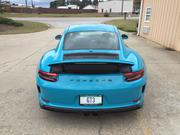
Colors in the U.S. are also very location dependent. Stopped by a dealership in S.C. in my Miami Blue GT3 and the guy basically asked if that was the only color I could get my hands on. lol When I told him I speced the car myself he looked shocked. He told me he had a MB base 911 sitting there for months with no action. He swapped it for a silver 911 from a FL dealer and both dealers sold their respective cars in a week.

Drifting

Joined: Feb 2011
Posts: 3,464
Likes: 311
From: Midtown Atlanta
Seriously, if my GT4 (or any other car of mine) was ever that clean and shiny I'm not sure I could drive it. I need a live-in garageman to get it looking like that and keep it looking like that after every drive. Like Sabrina's father...


Rennlist Member
Joined: May 2008
Posts: 17,181
Likes: 309
From: Somewhere in a galaxy far, far away....
depends on what you use the car for.
If it is a weekend warrior, collector, track day, cars n coffee *****, then a PTS or funky color is the way to go.
If it is a secondary vehicle for evenings and weekends and some daily duty then a subtle color is best.
If it is a weekend warrior, collector, track day, cars n coffee *****, then a PTS or funky color is the way to go.
If it is a secondary vehicle for evenings and weekends and some daily duty then a subtle color is best.

Rennlist Member
Joined: Apr 2018
Posts: 591
Likes: 189
From: US
This!! Some people might want a bright color and regret it shortly after having the car for a few weeks with the extra attention it brings.

Race Car
Joined: Oct 2004
Posts: 3,899
Likes: 219
Okay, so you meant "within it's own lineup, Porsche doesn't charge for these things." Still debateable but the point can be made. But compared to the outside world, Porsche most definitely charges for these things, hence the $85,000 cost of a 385hp sportscar in 2016. "Noise, feel, revs, suspension adjustability, track durability and warranty" are not "all free". They are major components of why a base GT4 doesn't cost $45,000, like a base 450-ish hp Corvette.
Remember, GT4 only looks like a screaming bargain when viewed through the prism of Porsche pricing.
As for the "pricing not based on cost, but on what the market will pay," that is standard pricing formula for all car companies. Silverado pickups with leather interiors don't cost $60,000 because they cost 48,000 to build and GM wants to make a 20% margin on them; they sell for $60,000 because even though they only cost $25,000 to build, GM knows that a large swath of people will fork out sixty-large for a leather pickup without batting an eye. Greenlighting a car or a sub model consists of a) determining what the market will pay, and b) seeing if you can build that product for cheap enough that there is acceptable margin for you as the car company. Wrangler is a great example. Amazingly, the JK Wrangler model (2007-2018) increased sales significantly nearly every year of its life, at least through 2016. That is a remarkable feat. And during that time, despite doing essentially nothing to the line (one interior upgrade, changing out the corporate minivan 3.8 for the new corporate minivan 3.6), the price climbed tremendously, to where a 2018 base stripper 2-door was about 35% over 10 years -- simply because the market kept demanding more and more of them and Jeep said, "Damn! Why were we selling this for $18,000?"
Remember, GT4 only looks like a screaming bargain when viewed through the prism of Porsche pricing.
As for the "pricing not based on cost, but on what the market will pay," that is standard pricing formula for all car companies. Silverado pickups with leather interiors don't cost $60,000 because they cost 48,000 to build and GM wants to make a 20% margin on them; they sell for $60,000 because even though they only cost $25,000 to build, GM knows that a large swath of people will fork out sixty-large for a leather pickup without batting an eye. Greenlighting a car or a sub model consists of a) determining what the market will pay, and b) seeing if you can build that product for cheap enough that there is acceptable margin for you as the car company. Wrangler is a great example. Amazingly, the JK Wrangler model (2007-2018) increased sales significantly nearly every year of its life, at least through 2016. That is a remarkable feat. And during that time, despite doing essentially nothing to the line (one interior upgrade, changing out the corporate minivan 3.8 for the new corporate minivan 3.6), the price climbed tremendously, to where a 2018 base stripper 2-door was about 35% over 10 years -- simply because the market kept demanding more and more of them and Jeep said, "Damn! Why were we selling this for $18,000?"
Silverado is GM's most profitable vehicle, but not nearly as profitable as you suggest. GM makes about $17,000 for each Silverado sold, but that's just one model, whereas Porsche makes an average of $17,250 for every car sold. See below for the average profit made by GM on each car sold. So with just a couple exceptions GM is a cost plus company.
https://www.detroitnews.com/story/bu...sler/23852189/

Three Wheelin'

Joined: Aug 2012
Posts: 1,831
Likes: 204
Drifting
Joined: Feb 2011
Posts: 3,464
Likes: 311
From: Midtown Atlanta
Porsche is the most profitable car company in the world. The following is from Motor Authority: "Porsche, whose cars sell for about $50,000 to $150,000 (with souped up and auctioned models going even higher), makes an estimated $17,250 profit for every car, according to Bloomberg, and BMW, Audi and Mercedes each make about $10,500 average per car."
Silverado is GM's most profitable vehicle, but not nearly as profitable as you suggest. GM makes about $17,000 for each Silverado sold, but that's just one model, whereas Porsche makes an average of $17,250 for every car sold. See below for the average profit made by GM on each car sold. So with just a couple exceptions GM is a cost plus company.
https://www.detroitnews.com/story/bu...sler/23852189/
Silverado is GM's most profitable vehicle, but not nearly as profitable as you suggest. GM makes about $17,000 for each Silverado sold, but that's just one model, whereas Porsche makes an average of $17,250 for every car sold. See below for the average profit made by GM on each car sold. So with just a couple exceptions GM is a cost plus company.
https://www.detroitnews.com/story/bu...sler/23852189/
In fact, they are "cost plus whatever the market will bear." Meaning that if GM could make $17,000 on every Cobalt they sold, or $30,000 for that matter, and still support the volume of cars they want to sell, they would do it. They wouldn't say, "Well, we're a cost-plus-15% company, let's hold the price at $22,000" (or whatever Cobalts sell for now.) Like my builder does on houses. He builds them for cost plus 20%. If the house costs $2MM to build he makes 20% on it. If it costs $900,000 to build, he makes 20% on it. That's not what GM does (or any other car company I'm aware of.)
Low margins are dictated by the space a model inhabits, and that includes the number of competitors making truly competitive models. Since Porsche plays in a place where margins are much more robust anyway, and since they have managed to differentiate in the minds of their customers to such an extent we'll pay much more for a Porsche than we would for an arguably equivalent (and sometimes arguably better) competitive offering, they enjoy crazy high margins on everything. So their version of Sell The Car For As Much As Possible looks very different than GM's version of the same game. But neither is building to a cost-plus model (other than in the sense that there is a minimum above cost that a model must sell for to get greenlighted in the first place.)
Cheers!
Three Wheelin'
Joined: Jan 2017
Posts: 1,596
Likes: 308
From: Tucson, AZ
