When you click on links to various merchants on this site and make a purchase, this can result in this site earning a commission. Affiliate programs and affiliations include, but are not limited to, the eBay Partner Network.
I get more done here in 2 days then at work. LOL. Perfect! I think many people will benefit from this being stuck up here and all the links, use cases, and advice that is in these posts!
Can a 2021 Cayenne E-Hybrid be charged from a 220V/20A outlet? Or even from a 120V outlet?
I know it would be slow but my 50A charger is next to my wife’s EV and the Cayenne’s battery isn’t that big.
Even if it took All night to charge that would be good enough on most days.
yes the EV Charger for your wife's EV (called an EVSE) is universal can can charge any EV or Hybrid for north america.
the 2021 Cayenne either has a 3.6 kW or 7.2 kW onboard charger - a 50 amp EVSE provides up to 9.6 kW capacity - so the limiting factor in charging your Cayenne is it's onboard charger not your wife's EVSE…
a 120 outlet provides 1.44 kW
the 2021 Cayenne has a 17.9 kWh battery
depending on what onboard charter came with your Cayenne it will either take 4 hours or 2 hours to charge from your wife's EVSE
if you plug in an EVSE into an 120V outlet it will approximately 12-16 hours to charge the hybrid.
but all of these chargers (EVSE's) are supposed to be universal and will charge any EV or PHEV.
I use a Tesla Universal Wall Charger to charge my Macan EV and 2021 Cayenne eHybrid and other PHEV's and EV that visit. The Porsche EVSE's are substandard and are packed away to be provided with the vehicle when I sell/trade it. But they would also work, but I choose to use higher quality EVSE's from other vendors - Porsche's stuff has had a lot of problems in North America.
Last edited by daveo4porsche; Jan 27, 2025 at 03:05 AM.
Can a 2021 Cayenne E-Hybrid be charged from a 220V/20A outlet? Or even from a 120V outlet?
I know it would be slow but my 50A charger is next to my wife’s EV and the Cayenne’s battery isn’t that big.
Even if it took All night to charge that would be good enough on most days.
if you have a 220/20 amp outlet you simply need an EVSE that suports 220/20 amps - Porsche does not support that particular type of North American plug - but there are other compatible EVSE's that have that support - you can buy eitehr a plug based EVSE for 220/20 amps or simply purchase a 220/20 amp EVSE and hardwire it.
220 volts with a 20 amp circut breaker will provide 220 * 16 amps = 3.5 kW or charging capacity (16 amps is 80% of 20 amps - EVSE must run at max of 80% of the rated circuit load in north america)
or you coudl simply use your wife's 50 amp EVSE - you have many choices
_IF_ your Cayenne only has the 3.6 kW on board charger that is it's max charge rate…if your Cayenne has the 7.2 kW on board charger it would benefit from a higher amp EVSE (more than 20 amps)
but the difference in charge time for 3.6 vs. 7.2 is 4-5 hours for a full charge vs. 2-3 hours for full charge for the hybrid.
my 2021 Cayenne has the 7.2 kW charger - so it's max charge time is 3 hours - this works well since we tend to use the battery twice a day - morning errands, and afternoon/evening errands - with the 2-3 hour full charge time it means after our morning errands the Cayenne's battery is full again and ready for another 25-35 miles of driving by 1 or 2 pm. So we can be fully EV twice a day for a total about 45-70 miles driving each day without using the ICE engine - if the charge time is 4-5 hours - and you finish errands at 11 am - that means you're not charged again until about 4 pm - which makes it hard to do the 3 pm soccer practice or similar…
I'm happy to answer specific questions - including advice on how to have two EVSE's that "share" the 50 amp circuit you have for the wife's EV - and you could then charge one or both of hyour cars sharing the 50 amp circuit - and the load would be dynamically adjusted based on actual usage - if only one EV is charging (hybrid or EV) full 50 amps, if two ev's ard charging then split load 25 amps each - until one finishes - at which point the remaining EV gets back to the "full load".
there are many possible paths forward so you can easily charge both the Cayenne Hybrid and the full EV.
Last edited by daveo4porsche; Jan 27, 2025 at 03:20 AM.
Can a 2021 Cayenne E-Hybrid be charged from a 220V/20A outlet? Or even from a 120V outlet?
I know it would be slow but my 50A charger is next to my wife’s EV and the Cayenne’s battery isn’t that big.
Even if it took All night to charge that would be good enough on most days.
one possible path forward is simple:
purchase a ChargePoint Flex EVSE ($600 or less)
have an electrician hardwire it to your existing 220V/20 amp circuit/outlet
using the setup tools (software) for the ChargePoint configure it for a 20 amp breaker - chargepoint flex is "adjustable" from 15-70 amp breakers - after initial installation and configuration of the breaker size - you're done - it's set - it will "just work" from that point forward and charge any EV/Hybrid you plug in at it's configured breaker capacity.
now you have a 220V/20 amp 3.6 kW EVSE to charge your Hybrid - 4-5 hours
it will also charge your wife's full EV but slower than her 50 amp existing EVSE
but both EVSE's can then charge either vehilce - the _ONLY_ difference between them is the "speed" the EVSE offers the vehicle based on amp capacity.
you can purchase any of the following wall chargers for a 220V/20 amp circuit
Enphase/ClipperCreek - sell a range of units - purchase the unit that "matches" your breaker size - not adjustable, but they have multiple units - one for each possible common breaker size - 15-100 amp breakers in 10 amp increments…purchase the model that "fits" your breaker size
at least 5 other manufacturers I'm not mentioning here…
the one's I have listed are the "top/common" choices and will charge _ANY_ North American EV or Hybrid.
Last edited by daveo4porsche; Jan 27, 2025 at 03:30 AM.
Thanks for your replies. I understand much of what you are telling me, but here's what I would like to do:
1) I know I can plug into my wife's EVSE, but she parks there and even though I have a 20-foot charging cable, I'm not sure that would be long enough to reach a Cayenne parked next to her ID.4.
2) Therefore, I'm exploring alternatives, preferably ones without altering my wiring (my garage walls are fully finished) or installing an EVSE. I know that when Chevrolet released the Volt PHEV in 2010 or so, it came with a charging cable that plugged directly into a conventional 120V outlet without any EVSE. After all, the EVSE is little more than a glorified GFI box.
3) Is such a cable available for the Cayenne E-hybrid?
4) Is there also one available for a 220V/20A outlet, of which I already have three in my garage. As someone has pointed out, 220V x 16A = 3.5 kW. Since the Cayenne only uses about 14 kWh of its battery, such a connection would charge the car in four hours or so.
Thanks for your replies. I understand much of what you are telling me, but here's what I would like to do:
1) I know I can plug into my wife's EVSE, but she parks there and even though I have a 20-foot charging cable, I'm not sure that would be long enough to reach a Cayenne parked next to her ID.4.
2) Therefore, I'm exploring alternatives, preferably ones without altering my wiring (my garage walls are fully finished) or installing an EVSE. I know that when Chevrolet released the Volt PHEV in 2010 or so, it came with a charging cable that plugged directly into a conventional 120V outlet without any EVSE. After all, the EVSE is little more than a glorified GFI box.
3) Is such a cable available for the Cayenne E-hybrid?
4) Is there also one available for a 220V/20A outlet, of which I already have three in my garage. As someone has pointed out, 220V x 16A = 3.5 kW. Since the Cayenne only uses about 14 kWh of its battery, such a connection would charge the car in four hours or so.
_ANY_ J-1772 EVSE will charge your cayenne - hardwiring a new EVSE into an existing plug will not require refinishing your walls - if you put the EVSE next to an existing outlet the wire from the plug-junction box to the EVSE would be very very short.
a picture of your 220v/20 amp outlets would help - we need to know the NEMA plug type then you can get a EVSE that has a power supply cable matching your NEMA plug type
Thanks for the response, but you're missing my point.
Why do I need an ESVE at all? There are plenty of charging cables that plug directly into an outlet with no ESVE, unless it's built into the cable itself.
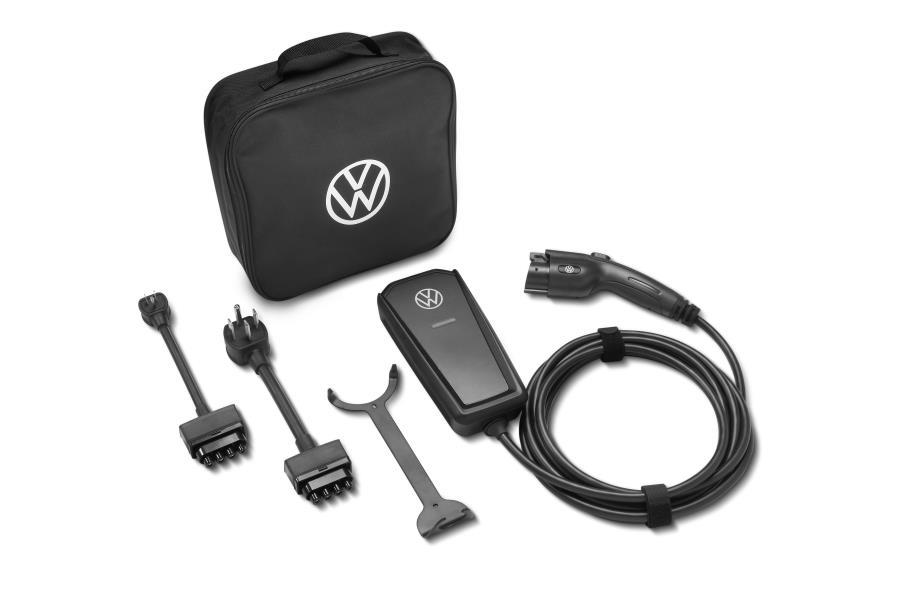
Here's one for the current VW ID.4
This one comes with two adapters. One plugs directly into a 120V outlet, the other plugs into a 220V/32A outlet. No EVSE required. I could probably modify the 32A adapter with an appropriate plug to work with my 220V/20A outlet. Presumably I can use one of these with the Cayenne.
But does the Cayenne E-Hybrid already come with some similar charging cord?
Thanks for the response, but you're missing my point.
Why do I need an ESVE at all? There are plenty of charging cables that plug directly into an outlet with no ESVE, unless it's built into the cable itself.
Here's one for the current VW ID.4
This one comes with two adapters. One plugs directly into a 120V outlet, the other plugs into a 220V/32A outlet. No EVSE required. I could probably modify the 32A adapter with an appropriate plug to work with my 220V/20A outlet. Presumably I can use one of these with the Cayenne.
But does the Cayenne E-Hybrid already come with some similar charging cord?
that _IS_ an EVSE…it's just mobile and not wall mounted - the box with the VW logo on it _IS_ the EVSE module - there is "no direct" charging with any North American EV - there is _ALWAYS_ an EVSE involved.
you need an EVSE (wall mounted or mobile) that has the right plug type - so that it advertises the correct AMP setting for a 20 amp circuit (16 amp charge rate) - EVSE's are "smart" - they adjust their advertised maximum amps to to the vehicle so that it does not overload the circuit during charging…
you need an EVSE with a power cord that matches the 220V/20 amp plug type - which will then in turn configure the EVSE to advertise a 16 amp charge rate…which is appropriate for a 20 amp north american circuit breaker.
any J-1772 EVSE can charge your hybrid - you just need to find one that has the right plug type for your 220v/20 amp outlet.
Last edited by daveo4porsche; Jan 27, 2025 at 05:13 PM.
Thanks for the response, but you're missing my point.
Why do I need an ESVE at all? There are plenty of charging cables that plug directly into an outlet with no ESVE, unless it's built into the cable itself.
Here's one for the current VW ID.4
This one comes with two adapters. One plugs directly into a 120V outlet, the other plugs into a 220V/32A outlet. No EVSE required. I could probably modify the 32A adapter with an appropriate plug to work with my 220V/20A outlet. Presumably I can use one of these with the Cayenne.
But does the Cayenne E-Hybrid already come with some similar charging cord?
if you modify the plug it will fit the plug but will not change the advertised charge rate - if you modify the 32 amp plug to "fit" your 20 amp plug - the EVSE will still advertiase 32 amp max charge rate and overload your circuit
with all due respect - you're missing my point and I'm trying to help - I am 100% confident I know precisely what you need if you'll work with me - I know quite a bit about this stuff.
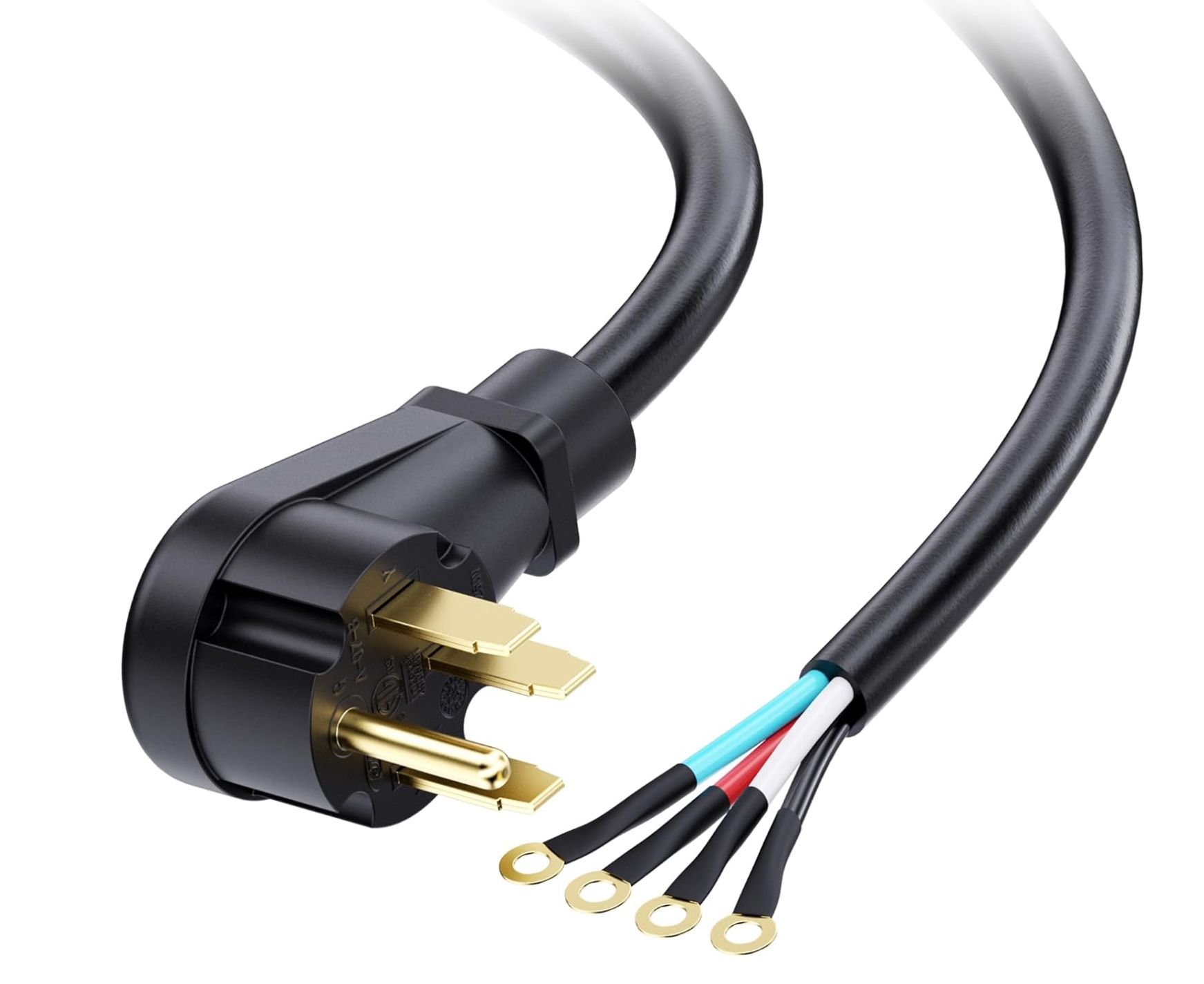
the cord above should fit your existing NEMA 6-20 outlets in your garage (NEMA 6-20 _IS_ the approved building code NEMA socket for a 220V/20 amp circuit) - one end will plug into your outlets - and the other bare wire ends are what attaches to the EVSE unit - 2 hots + ground which is how _ALL_ EVSE's are wired in north american.
you can now purchase _ANY_ hardwired EVSE that allows for 20 amps and use the cord above to wire up the wall mounted EVSE
I'd recommend the chargepoint flex (hardwired unit) or Tesla Universal Wall Charger - both units can be configured for a 20 amp circuit - and the cord I've noted (or similar) will attach/connect to the EVSE unit and then plug into your existing outlets…
a link below is for the chargePoiint flex which is known for a fact can be configured for 20 amps circuits
so you have in this post exactly the two items you need to charge _ANY_ North American EV/PHEV with a 20 amp circuit via an existing NEMA 6-20 outlets.
Basically any EVSE shipped with a plug (any plug) is simply a hardwired EVSE with the "correct" power cord already attached…so anyone can buy _ANY_ hardwired EVSE - and then buy the appropriate "power supply cable" - and boom you've taken a "hardwired" EVSE and made it a "plug-based" EVSE. These units are not complex electrical devices. They have the wiring complexity of a light switch - there are two high-voltage wires and one ground (3 wires total) to function.
here for example is a cable that will make _ANY_ hardwired 50 amp (40 amp charge rate) EVSE a "plug-based" EVSE - the following cord is what you need for a NEMA 14-50 outlet and a hardiwred EVSE unit…
I'm running one of my 3 Tesla Universal Wall Chargers off this EXACT 10ft cable - I've wired up the black/red wires (120V hots), wire capped the white wire (neutral), and the green wire ground - it provides access to my NEMA 14-50 outlet for 50 amps charging capacity @ 9.6 kW.
this is a 4 wire power supply cable: 2 hots, 1 neutral, 1 ground - the neutral is unused in EVSE devices, so you ignore it - and wire up the two hots and the ground and you're done - you now have converted a hardwired EVSE to a plug-based EVSE.
Last edited by daveo4porsche; Jan 27, 2025 at 05:41 PM.
Thanks for the response, but you're missing my point.
Why do I need an ESVE at all? There are plenty of charging cables that plug directly into an outlet with no ESVE, unless it's built into the cable itself.
Here's one for the current VW ID.4
This one comes with two adapters. One plugs directly into a 120V outlet, the other plugs into a 220V/32A outlet. No EVSE required. I could probably modify the 32A adapter with an appropriate plug to work with my 220V/20A outlet. Presumably I can use one of these with the Cayenne.
But does the Cayenne E-Hybrid already come with some similar charging cord?
the Cayenne in 2021 was provied with a either a PMC+ or PMCC unit - with two power supply cables - one for NEMA 5-15 outlet (120V household outlet) or NEMA 14-50 (240V/50 amp outlet) - Porsche does not have a NEMA 6-20 (or any 20 amp) power supply cables for their EVSE's…that's why we need to use an EVSE other than Porsche - Porsche does not have a "20 amp" setting/power-supply cables for their EVSE units - so we need to purchase an alternative J-1772 EVSE from someone else.
2) Therefore, I'm exploring alternatives, preferably ones without altering my wiring (my garage walls are fully finished) or installing an EVSE. I know that when Chevrolet released the Volt PHEV in 2010 or so, it came with a charging cable that plugged directly into a conventional 120V outlet without any EVSE. After all, the EVSE is little more than a glorified GFI box.
a few things:
that cord was still an EVSE - it just was mobile, small and not impressive, but it was a fully functional North American J-1772 120V EVSE
you're on the right track that EVSE are "glorified" GFI circuits - but they are a bit more
an EVSE does 4 primary things:
safety - GFI as you note - they are electrically "sensitive" and will cut off power if there is "a problem"
they "communicate" with the vehicle - the communication indicates to the vehicle the MAX power they are allowed to "draw" - this how all EV's "know" they can only draw 12 amps when plugged into a 15 amp 120V circuit
Taycan's can be configured from teh factory with an 80 amp 19.2 kW on board charger - yet you can still plug them in and charge off a 120V household 1.44 kW EVSE - this because the Taycan will "ask" the EVSE what it's max power is - and then not draw more than the EVSE can provide - this is an essential characteristic of the J-1772 protocol and how an EV and EVSE "negotiate" the max power that can be used during a charging session
this is one of the reasons an EVSE is more than a passive extension cord - extension cords don't provide information about their circuit capacity to the devices that are plugged into them.
they "communicate" with the car - if there is no car - there is no power - they guarantee there is no power flowing in the vehicle charging cable if they are not plugged in - this makes them safe in the rain and being dropped in puddles, and is what "cuts off the power" when they a unplugged - they are fail-safe devices that error on the side of cutting off power if they are not properly/electrically connected to and communicating with the vehicle
their checking goes "beyond" simply being "plugged" in - they actually communicate with the vehicle - if an EVSE is not actually communicating it will not let power flow - this goes beyond being passivingly "plugged in" the unit has to both be plugged in and have positive feedback/communication from the vehicle to allow power to flow
they provide remote control on/off power flow control - the vehicle sends on/off messages to control charging - the EVSE provides this "remote control" as part of the protocol.
An EVSE will never provide power on it's own - it must receive and actual "let power flow" message from the vehicle - this message can not be accidential and therefore all charging is under control of the vehilcle and not the EVSE - this is an important safety characteristic of the protocol design, it means it's nearly impossible for power to flow accidentially since it requires a very specific set of communication standards and electrical characteristics/circumstances for power to be flowing - the nano-second these characteristics are no longer true the EVSE will cut the power flow
an EVSE is nothing like charging a lap top - power is not passively provided when plugged in - power is _ONLY_ provided if the EV/vehicle is actively requesting/allowing power to flow - if your battery is full on your EV and you leave it plugged in for the entire year - power will not flow even once if the EV does not request it - so an EVSE spends most of it's life "blocking" power from flowing, and just because it's plugged into a vehicle does not mean power is flowing - it must be both plugged in to the vehicle and the vehicle has to actively be requesting power…
EVSE's are electrically "inert" for most of their life time with only brief moments in time with high voltage power actually present in the charging cord. This is a major safety characteristic and why it's safe to use these devices in wet conditions.
the north American EV charging standard is known as SAE-J1772 - and all EV's ever shipped in North America (including the EV1 and Volt) conform to and support this standard. _ALL_ EV's ever shipped have REQUIRED an EVSE - although sometimes it's been cleverly "hidden" as a bulky extension cord - trust me it's a full EVSE that conforms to the 4 points listed above and most likey was a full implementation of SAE J-1772.
Porsche has shipped at least 5 North American J-1772 EVSE's - all EV/Hybrid vehicle's porsche has ever shipped in North America conform/support the J-1772 standard - the EVSE's Porsche has shipped are:
Porsche Mobile Charger - original EVSE - PMC - mobile unit
Porsche Mobile Charger Plus - PMC+ - mobile unit
Power Mobile Charger Connect - PMCC - LED screen, wifi - mobile unit
Porsche Universal Charger - PUC - very simllar to a PMC+ - mobile unit - shipping with Macan EV's - not way to tell any actual difference vs a PMC+
Power Wall Charger Connect - PWCC - 15-100 amp hardwired
other but mild variations on the 5 items listed above
all of the porsche north American EVSE are J-1772 compliant and will charge _ANY_ other J-1772 compliant North American EV.
your wife's VW ID.4 is a J-1772 EV
your Cayenne is a J-1772 EV
the VW EVSE you provided a picture of is a J-1772 EVSE
the EVSE that comes with the Cayenne is a J-1772 EVSE
the EVSe that came with the Chevy volt was a J-1772 EVSE
the Chevy Volt is/was a J-1772 EV
public chargers in Colorado that can charge your wife's ID.4 are J-1772 EVSE's
they all have to conform to this standard otherwise they wouldn't work with all EV's.
since one of the key requirement for J-1772 is that it communicate max circuit power to the vehicle when plugged in - the EVSE has to "smart" about what type of plug/circuit-capacity it's being powered by. Therefore the EVSE is either configured diretly via a setting (hardware or software) to be "told" it's circuit breaker capacity - or it "implys" the circuit capacity from the power cord that is currently attached to the EVSE.
The VW unit you posted a picture of as two power cords - a NEMA 5-15, and a NEMA 14-50 - each of these power cords are "smart" and the EVSE "knows" which power cord is currenlty attached - when the NEMA 5-15 cord is attached the EVSE will advertise 12 amps as max power (80% of 15 amps) and when the NEMA 14-50 power supply cable is attached the EVSE will advertise 40 amps max power (80% of 50 amp circuit) - this in turn "informs" the EV/vehicle the max power it can request from the EVSE…
therefore you need a J-1772 EVSE that can advertise 16 amps max power (80% of a 20 amp circuit breaker)
NONE of Porsche's mobile EVSE's (PWC, PWC+, PWCC, PUC) support a 20 amp power supply cable - Porsche does not offer a 20 amp power supply cable
the Porsche Wall Charger Connect is a hardwired EVSE and adjustable from 15-100 amps max breaker settings - so you can wire up a PWCC and configure it for 20 amps and it support 16 amps of charging…
so you require a J-1772 EVSE that supports 20 amps circuits - porsche is not an option (unless you purchase a wall charger from Porsche, not the mobile units since the mobile units do not have a 20/16 amp setting)
there are numerous wall-mounted/hardwired or moble EVSE uniits that support NEMA 6-20 outlets - just not from Porsche.
I have provided a list of at least 5 J-1772 EVSE's that would allow you to use a 20 amp circuit - either hardwired or mobile units
I have provied you an example power supply cable that would be useful to wire up a J-1772 EVSE to a NEMA 6-20 outlet
the core 'trick" here is to get an EVSE - that will plug into a NEMA 6-20 outlet - and then subsequently advertise the correct circuit size to the vehicle you're charging so that it pulls the appropriate amount of power to avoid tripping the circuit breaker.
so you either need a:
hardwired J-1772 EVSE set to 20 amps max power
I've provied a power supply cable that is NEMA 6-20 plug that would be suitable for using with any hardwired EVSE
mobile EVSE with a NEMA 6-20 power supply cable
but in summary - there is _ALWAYS_ an EVSE involved in charging ANY hybrid or EV - it just maybe "hidden" to appears as simply a bulky extension cord, but it's goign to be a fully compliant J-1772 EVSE since that is the only way any of this stuff works.
the J-1772 standard is why all these EVSE's can charge:
prius, volt, bolt, Taycan, Macan, eTron, Range Rover hybrid, Cayenne hybrid, Panamera Hybrid, VW ID.4, leaf, Mach-3, Rivian, Tesla, Lucid, Huynda, Kia, BMW iX, etc…
any J-1772 EVSE shoudl be able to charge ANY J-1772 EV - and all EVSE's sold in north america are J-1772 EVSE's and all EV's sold (hybrid and full EV's) are J-1772 EV's…
Last edited by daveo4porsche; Jan 27, 2025 at 06:30 PM.
I fully accept your knowledge in this matter. Your description of my 220V/20A power outlet is correct. If I understand you correctly, you are saying that the VW charging cord that I referenced has the EVSE built into the cord (the box to which the adapters connect).
Do you think that when one switches adapters on that VW charging cord, the adapters somehow signal t
e EVSE about which voltage and current is available? Or do you think that the electrical information is configured via a switch on the EVSE or in the software on the car?
On the VW ID.4, it's possible to reduce the charging current on the Charging Setup Page. Though there's not much of a selection. It's either full current from the EVSE or 8 amps. Do you know if that's possible on the Cayenne?
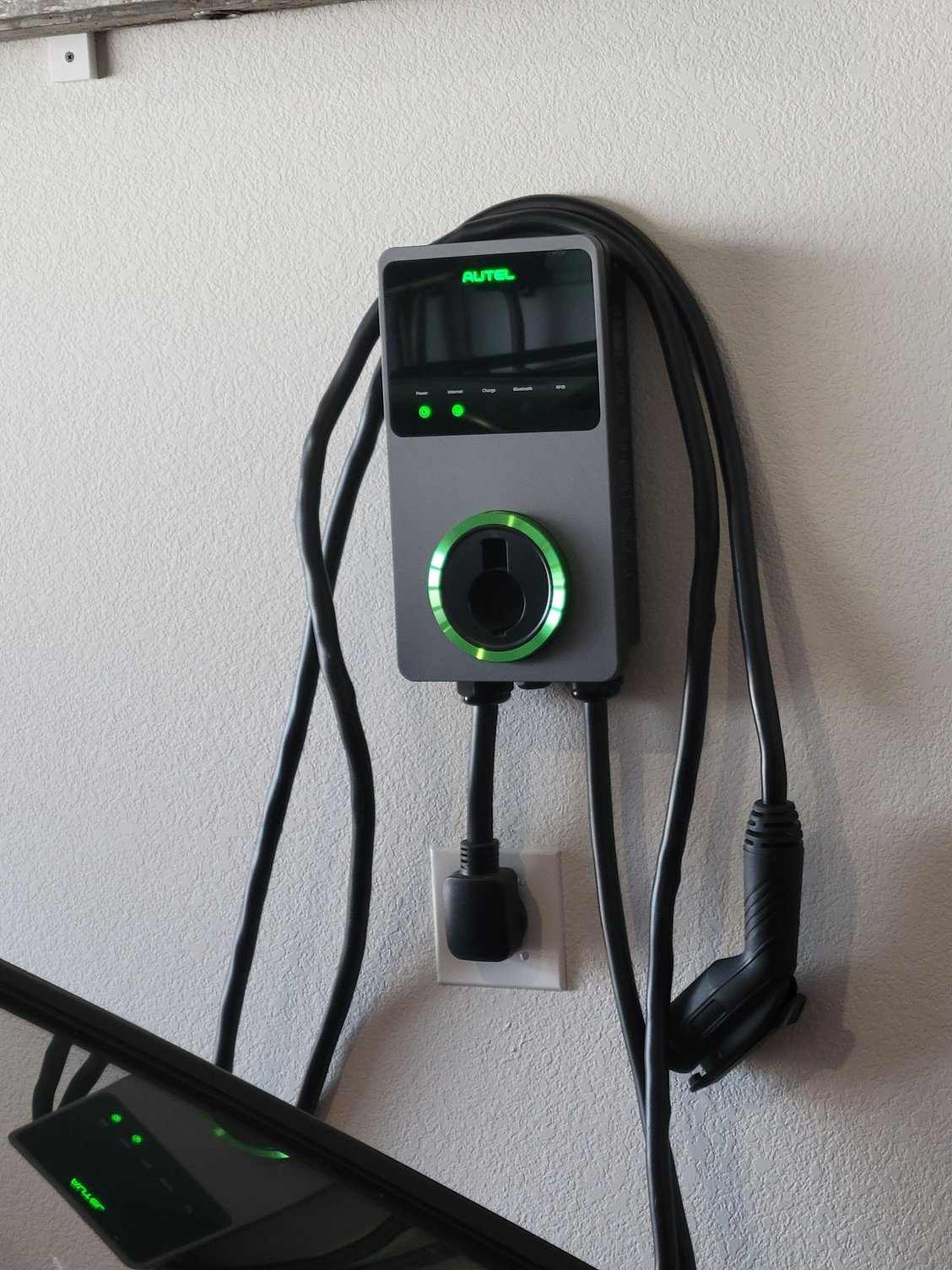
Here is my current charging setup for the VW. It's an Autel MaxiCharger connected to a 50A circuit and works very well.
It would work fine with the Cayenne if the cord will reach. Do you know which side of the Cayenne has the charging port?
Also, do you know what, if any, charging cord came standard with the Cayenne E-Hybrid?