When you click on links to various merchants on this site and make a purchase, this can result in this site earning a commission. Affiliate programs and affiliations include, but are not limited to, the eBay Partner Network.
This is on a 2011 3.6 Cayenne but I've seen diesel folks also complain about the same thing from time to time.
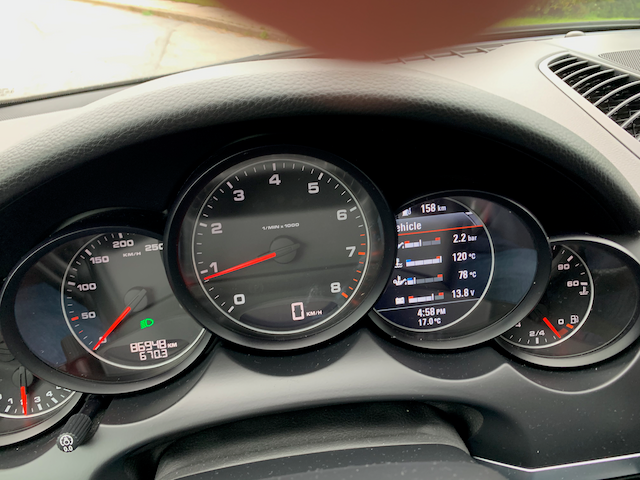
Coolant temperature will suddenly start rising past 90C (194F) and reach 120C+ (248F), within a couple of minutes. All this during normal cruising, sometimes on the highway, sometimes on city streets, no excessive load on the engine, sport mode off. Once stopped or coasting, the temperature will rapidly go back to normal, within a couple of minutes. The oil temperature stays pretty normal throughout. This has happened ~3 times in the past year and there's no pattern to it that I can see.
There are zero codes and the coolant tank is full, no coolant leaks apparent. Any ideas? Stuck thermostat or something?
i would try to verify the gauge display accuracy by a scan tool preferably icarsoft, icarscan or launch ...etc.
also when this happened again try the sport button on and see the effect.
In a normal car that might be a good guess - but not too likely in a 958.
The most common cause of this behavior is low coolant. It's been seen multiple times on not only 958's but other Porsche cars. Cure - overfill the reservoir a bit (when it's cold) go a bit above "max" - see if it reoccurs. No damage will occur since the coolant reservoir cap will vent out any excess coolant if it reaches that high (actually quite unlikely.) On my 958 turbo - the coolant level markings can only be seen by taking off the beauty cover on the left side of the engine compartment, then ducking down and looking through a maze of stuff with a very bright flashlight. What can be seen is the seam on the reservoir - about 3/4" above the max level mark. I keep mine filled to the seam. It doesn't use coolant and the light/temperature gauge don't misbehave.
Give it a try before going for more exotic causes. If that isn't it - looking at the system with a diagnostics tool would be an excellent thing, but there is no recording of overtemp conditions, and it sounds like it is so infrequent on your car that you'd have to leave the diagnostics tool connected for months at a time.
Make sure your cap is on tight. I lost a bit of coolant level filling it in the winter and was not able to tighten fully resulting in a lot more coolant loss the following month. Tightened the cap and much better now. Still smell the sweet coolant every now and then so I keep my eye on it.
We had a similar problem, turned out to be the small motor for the front grille flaps.
thanks for the suggestions guys. So I overfilled the coolant suggested, as Don suggested, and it happened again anyway yesterday. I’ll check the flaps next time it happens, good tip. Chsu74, I can’t smell coolant but I’ll double check.
thanks for the suggestions guys. So I overfilled the coolant suggested, as Don suggested, and it happened again anyway yesterday. I’ll check the flaps next time it happens, good tip. Chsu74, I can’t smell coolant but I’ll double check.
thanks for the suggestions guys. So I overfilled the coolant suggested, as Don suggested, and it happened again anyway yesterday. I’ll check the flaps next time it happens, good tip. Chsu74, I can’t smell coolant but I’ll double check.
Did the coolant level decrease after you "overfilled" it and it overheated again?
Most any car will move up in temp and overheat if the cooling system cannot maintain proper pressure.
Yeah, the level dropped down to full and it happened once more, a month later now. But it’s very much intermittent, I took the Cayenne to the local Porsche club drive today. I put a fair bit of load on it and no problem.
If the level dropped: you have a leak. If the temp climbs due to not being able to maintain pressure, you have a leak.
Personally I'd look for the usual suspects: coolant tank leak on the underside, 3 coolant lines that can pop out (unlikely since those are usually catastrophic), 2 coolant bleed lines that often crumble apart under the intake and leak into the V, and the alternator coolant feed lines.






 Overheating coolant?