


Center radiator install time


Race Car

Joined: Nov 2014
Posts: 3,890
Likes: 162
From: Melbourne, Australia

Then you can probably finish in a couple of hours.
I kept cutting a little bit out of the black plastic and refitting the bumper.
Also I kept routing and rerouting the left side hose.
If I did another, it would probably be around 3 to 3.5 hours.
Next mod for me will be installing a deep sump in a couple of weeks.
Then maybe I‘ll install a low temp thermostat and adjust my coilovers a little lower.
Thread Starter
RL Community Team
Rennlist Member
Rennlist Member

Joined: Aug 2016
Posts: 5,840
Likes: 2,975
From: Richmond, TX
Race Car
Joined: Nov 2014
Posts: 3,890
Likes: 162
From: Melbourne, Australia


Burning Brakes
Joined: Mar 2017
Posts: 876
Likes: 295
From: Asheville NC
Do any of you subscribe to this theory below? It was put forth by another member and I just cut and pasted it here from another post on a related topic. I’m debating adding a center rad over the winter. His post:
************************************************************************ ************
A friendly word of warning - there is a problem creating the right amount of radiator area for both driving around at 30 mph on a cold day and racing round a track close behind another car on a hot one.
The thermostats only control flow and if the radiator area is too much for any given situation the flow is minimal.
Because the engine only allows about 10% of the coolant to enter the cylinder block (the rest goes straight into and out of the cylinder heads) low flow can allow the cylinders to run very hot internally. You do not notice this because the coolant is mixed together again before it passes the temperature sensor or travels back to the radiators but low flow overall results in unbalanced cooling to the cylinders.
Because that makes the oil between the pistons and the cylinder walls hotter it also makes the viscosity thinner and then any free silicon particles that have become loose from the cylinder wall can impinge more on the piston coatings resulting in premature scoring.
So in conditions when you didn't need an extra radiator (which is most of the time) it can be contributing to cylinder scoring and not preventing it.
The extra radiator is only beneficial in those conditions when the standard thermostat is wide open and the engine is still getting hotter.
To sort this we made a housing that fits between the feed to the third radiator to house a thermostat set at a slightly higher temperature than the main LT thermostat so it only opens when the engine would have started to get too hot anyway. All this proven with multiple tests in different conditions - that revealed that in most normal conditions and driving - one radiator would be sufficient.
However we have not yet managed to productionise this additional thermostat for retailing but while you are figuring out how to connect them - you could allow a hose to bend away and fit to our 996 third radiator system before joining to the centre radiator and achieve the same outcome (or simply make one yourself or fit a proprietory one).
On our race cars we actually went further and split the outlet from each bank (because bank 1 ran cooler) and made a "Y" outlet housing to hold 2 thermostats (throwing the original single thermostat away) to make sure each bank ran at the same temperature and then fitted another thermostat before the third radiator and that covered all conditions maintaining good cylinder temperatures and hence reliability.
Last edited by Coopduc; Oct 22, 2018 at 08:57 AM. Reason: clarification
Race Car
Joined: Nov 2014
Posts: 3,890
Likes: 162
From: Melbourne, Australia
Yes, to some degree (pun intended Hahaha)
Admittedly I added the 3rd rad because I found one for a good price and like the look of having that centre section open rather than the plastic panel there.
I haven't experienced any overheating issues so it will stay disconnected for now.
Admittedly I added the 3rd rad because I found one for a good price and like the look of having that centre section open rather than the plastic panel there.
I haven't experienced any overheating issues so it will stay disconnected for now.
Thread Starter
RL Community Team
Rennlist Member
Rennlist Member
Joined: Aug 2016
Posts: 5,840
Likes: 2,975
From: Richmond, TX
Cool days are few and far between down here.
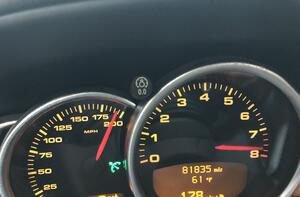
Although my drive this morning was in 60 degree weather, which is REALLY cold for Houston.
The typical winter day down here is in the 50s.
My gauge was slightly lower than normal, but I'm not sure whether it was the radiator or the cold day.
I had my Snap-On scanner attached during an extended test drive on Saturday and found that the factory temperature gauge is REALLY inaccurate.
Almost worthless really.
Although my drive this morning was in 60 degree weather, which is REALLY cold for Houston.
The typical winter day down here is in the 50s.
My gauge was slightly lower than normal, but I'm not sure whether it was the radiator or the cold day.
I had my Snap-On scanner attached during an extended test drive on Saturday and found that the factory temperature gauge is REALLY inaccurate.
Almost worthless really.
Rennlist Member
Joined: Oct 2014
Posts: 6,942
Likes: 1,291
From: L.I. NY
Can you tell me how these two are different? Thanks!
https://www.pelicanparts.com/More_In...hoCUx0QAvD_BwE
https://www.pelicanparts.com/More_In...BoCP4wQAvD_BwE
https://www.pelicanparts.com/More_In...hoCUx0QAvD_BwE
https://www.pelicanparts.com/More_In...BoCP4wQAvD_BwE

Shameful Thread Killer
Rennlist Member
Rennlist Member

Joined: Aug 2004
Posts: 19,886
Likes: 151
From: Rep of Texas, N NM, Rockies, SoCal
The bore scoring theory under conditions that are too cold is a decent theory. If they instrumented a car, all around the 6 cyl, and took point source temps, and that led to bore scoring I guess I'd move it from theory to postulate. Here's the question that I don't know the answer to which will be critical to determine if this is correct. In a typical car(not the 928) the cooling circuit will start at the discharge(pressure side) of the water pump, have a small bypass to the engine for early heat, then proceed to the heater core, then the radiator(s), then to the engine cases where thermal transfer takes place, then finally to the thermostat which regulates the engine temp at the EXIT of the heat generator(engine), and then to the low pressure side of the pump.
However, there are a few cars which do it different and place the thermostat at the beginning of the circuit, before the water enters the engine, and goes in reverse direction, through the rad, heater core, and pump. If this is the case for the 996 there is some possible merit. But - knowing that the temp stamped in the thermostat is the desired regulated engine temp, it would seem to me that the flow is in the normal direction, with the engine case maintained at the thermo regulated temp of 192F. If it is true that the regulation is done at the end of the circuit, after the heat sink(engine) then really I can't see how the limited flow would factor in to cold spots and induce bore scoring unless the outside temp were in the -20F region and the engine was run and shut off, and run and shut off with short cycles. Aside from this extreme type of use case, all of the engine will come up to temp, and the differential between the coolest and hottest parts of the liquid jacket will be a matter of a few deg F, maybe at most 20F, where the hottest parts are the heads at 192+, and the coldest part is where the rad water enters the engine at maybe 170F. This might be a problem if the delta was very confined, but the water jacket around the engine, including the heat soak of the lubricated parts leads me to consider this argument of bore scoring rather specious.
YMMV, contents have settled, objects in mirror, and may cause **** leakage.
However, there are a few cars which do it different and place the thermostat at the beginning of the circuit, before the water enters the engine, and goes in reverse direction, through the rad, heater core, and pump. If this is the case for the 996 there is some possible merit. But - knowing that the temp stamped in the thermostat is the desired regulated engine temp, it would seem to me that the flow is in the normal direction, with the engine case maintained at the thermo regulated temp of 192F. If it is true that the regulation is done at the end of the circuit, after the heat sink(engine) then really I can't see how the limited flow would factor in to cold spots and induce bore scoring unless the outside temp were in the -20F region and the engine was run and shut off, and run and shut off with short cycles. Aside from this extreme type of use case, all of the engine will come up to temp, and the differential between the coolest and hottest parts of the liquid jacket will be a matter of a few deg F, maybe at most 20F, where the hottest parts are the heads at 192+, and the coldest part is where the rad water enters the engine at maybe 170F. This might be a problem if the delta was very confined, but the water jacket around the engine, including the heat soak of the lubricated parts leads me to consider this argument of bore scoring rather specious.
YMMV, contents have settled, objects in mirror, and may cause **** leakage.