When you click on links to various merchants on this site and make a purchase, this can result in this site earning a commission. Affiliate programs and affiliations include, but are not limited to, the eBay Partner Network.
Have seen previous threads on this.
Occasionally come across terminology unintentionally interchanged with cross over pipes and misinterpreted.
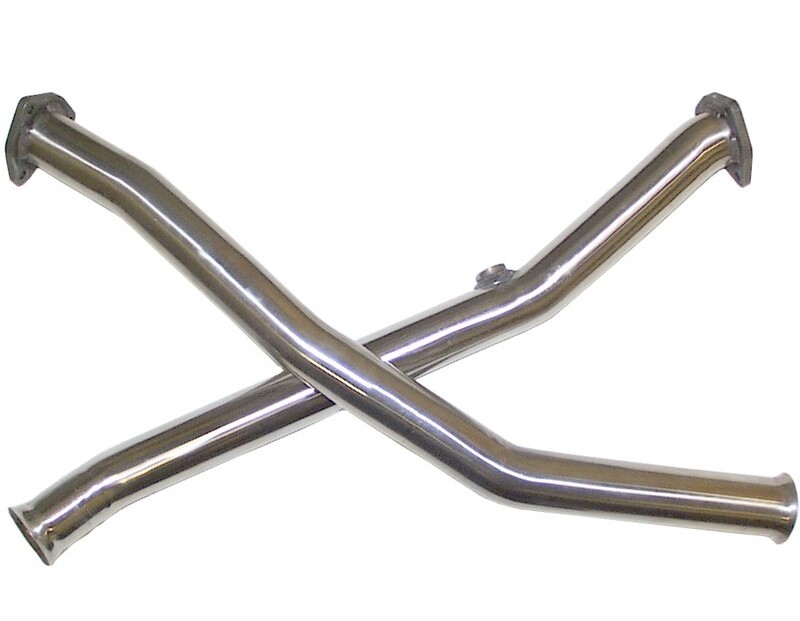
I am asking on X pipes with cats, which would look similar to this:
Currently have a stock cat housing that has been gutted and fitted with 200cel cats.
I believe my cat housing to have the central blanking plate to isolate the left and right banks of exhaust gases.
If I left the headers and back boxes untouched, would going to the X pipe design with similar 200cel cats change
a) The sound ? Would it have a higher pitch? Would it be quiter ?
b) Would I loose low end torque ?
Have seen previous threads on this.
Occasionally come across terminology unintentionally interchanged with cross over pipes and misinterpreted.
I am asking on X pipes with cats, which would look similar to this:
Currently have a stock cat housing that has been gutted and fitted with 200cel cats.
I believe my cat housing to have the central blanking plate to isolate the left and right banks of exhaust gases.
If I left the headers and back boxes untouched, would going to the X pipe design with similar 200cel cats change
a) The sound ? Would it have a higher pitch? Would it be quiter ?
b) Would I loose low end torque ?
stock '95 and all RoW are OBD1w/ a mixing chamber where both sides come together, these use a single o sensor.
The mixing process is efficient but very harmful to flow efficiency
US from '96 up have a wall between the sides and use 4 O sensors, 2 upstream and 2 downstream on each side, These OBD2 systems measure pre and post cat gas to determine combustion efficiency down to a single cylinder, flow while not the best is better than w/ the OBD1 versions
The best solution flow wise is completely separated w/ no muffler and no cat and the fewest turns/beds, The merge between the individual pipes is critical in retaining flow velocity and minimizing flow turbulence, The individual pulses are well well separated w/ a fair partial vacuum between them, this vacuum is useful at the merge in promoting flow, At each change in cross section an acoustic wave is generated, the larger the change the larger the wave signal, this wave is reflected back up the pipe and can be useful in promoting cylinder filling/evacuation if there is a reasonable amount of cam timing overlap, stock 993 cams have little overlap
The X pipe design comes from the odd fire world, Porsch flat 6 are even fire, In the odd fire world of most US V8s there are always 2 cylinders on each side the fire consecutively, this overloads the collectors unless there is an X or H to relieve the over pressure. This situation does not exist for an even fire engine.
What the X does is introduce turbulence and slow flow, this can be seen in a dyno run as oscillations around a mean curve, the magnitude of the damage depends on the geometric specifics of the X, the best designs will have around the same torque curve as a separated version but w/ a less smooth curve. There are acoustic benefits in that the sound can be muted by both side mufflers, ie its quiter all else being equal, the sound tone is also altered, the pulses are heard to be closer together, some like it some are agnostic.
Last edited by Bill Verburg; Sep 24, 2024 at 09:52 AM.
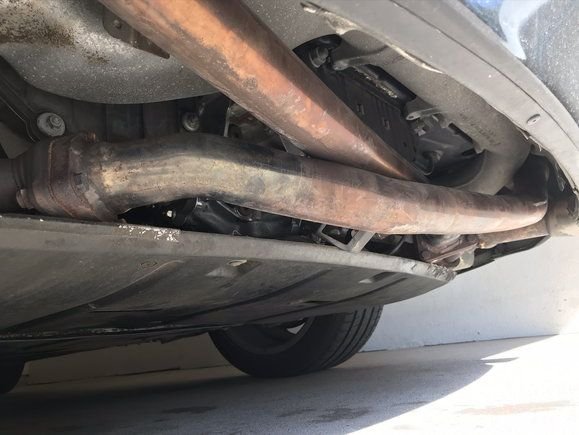
Bill, if I understood your post correctly, best would be cross over pipes like this:
Otherwise, even the best designed X pipes are no better than a stock OBD1 or OBD2 chambers ?
As I have said the better X designs will flow about the same as the separates, the thing I don't like is the fluctuations introduced by the X
the things to avoid in an X are near head on collisions between the separated flows and bid sharp turns, the latter is almost impossible to avoid
here is a stock '95, a split design and an Z all done on the same car and dyno
here's a close up of a stock 993 flow
imagine the pulse from #2 slamming into the vacuum gap between #6 & #4, it's bad enough that the very helpful vacuum is destroyed but imagine what a near head on collision of the two flows will do.
As I have said the better X designs will flow about the same as the separates, the thing I don't like is the fluctuations introduced by the X
the things to avoid in an X are near head on collisions between the separated flows and bid sharp turns, the latter is almost impossible to avoid
here is a stock '95, a split design and an Z all done on the same car and dyno
here's a close up of a stock 993 flow
imagine the pulse from #2 slamming into the vacuum gap between #6 & #4, it's bad enough that the very helpful vacuum is destroyed but imagine what a near head on collision of the two flows will do.
Bill,
I always appreciate your input. Any advise on how to do catless separates without throwing a CEL on a 1997?
As I have said the better X designs will flow about the same as the separates, the thing I don't like is the fluctuations introduced by the X
the things to avoid in an X are near head on collisions between the separated flows and bid sharp turns, the latter is almost impossible to avoid
here is a stock '95, a split design and an Z all done on the same car and dyno
here's a close up of a stock 993 flow
imagine the pulse from #2 slamming into the vacuum gap between #6 & #4, it's bad enough that the very helpful vacuum is destroyed but imagine what a near head on collision of the two flows will do.
Bill, if comparing X pipe to stock '95, then according to your graph, the X pipe generates more torque but with fluctuations.
Your graph for the X, shows torque dips at approx 4250 and 5750rpm.
Are these dips significant that it can be felt when driving ?
I suppose what I am asking is, would the X pipe be better than a stock '95 ?
also what I’m wondering, as it looks like it makes a decent amount more torque and I assume hp, than the oem stock setup, with some fluctuation?
Originally Posted by listnner
Bill, if comparing X pipe to stock '95, then according to your graph, the X pipe generates more torque but with fluctuations.
Your graph for the X, shows torque dips at approx 4250 and 5750rpm.
Are these dips significant that it can be felt when driving ?
I suppose what I am asking is, would the X pipe be better than a stock '95 ?
Bill, if comparing X pipe to stock '95, then according to your graph, the X pipe generates more torque but with fluctuations.
Your graph for the X, shows torque dips at approx 4250 and 5750rpm.
Are these dips significant that it can be felt when driving ?
I suppose what I am asking is, would the X pipe be better than a stock '95 ?
you’re comparing cat to no cat…that’s the source of the difference in the graph between the xpipe and stock
Bill, if comparing X pipe to stock '95, then according to your graph, the X pipe generates more torque but with fluctuations.
Your graph for the X, shows torque dips at approx 4250 and 5750rpm.
Are these dips significant that it can be felt when driving ?
I suppose what I am asking is, would the X pipe be better than a stock '95 ?
Never had an opportunity to drive far back to back
I doubt that you would feel a difference between separate and merged.
sound wise there is much more difference, through the drivers window there is more separation between pulses from the split system, the merged s more of a hmmm


 X pipe