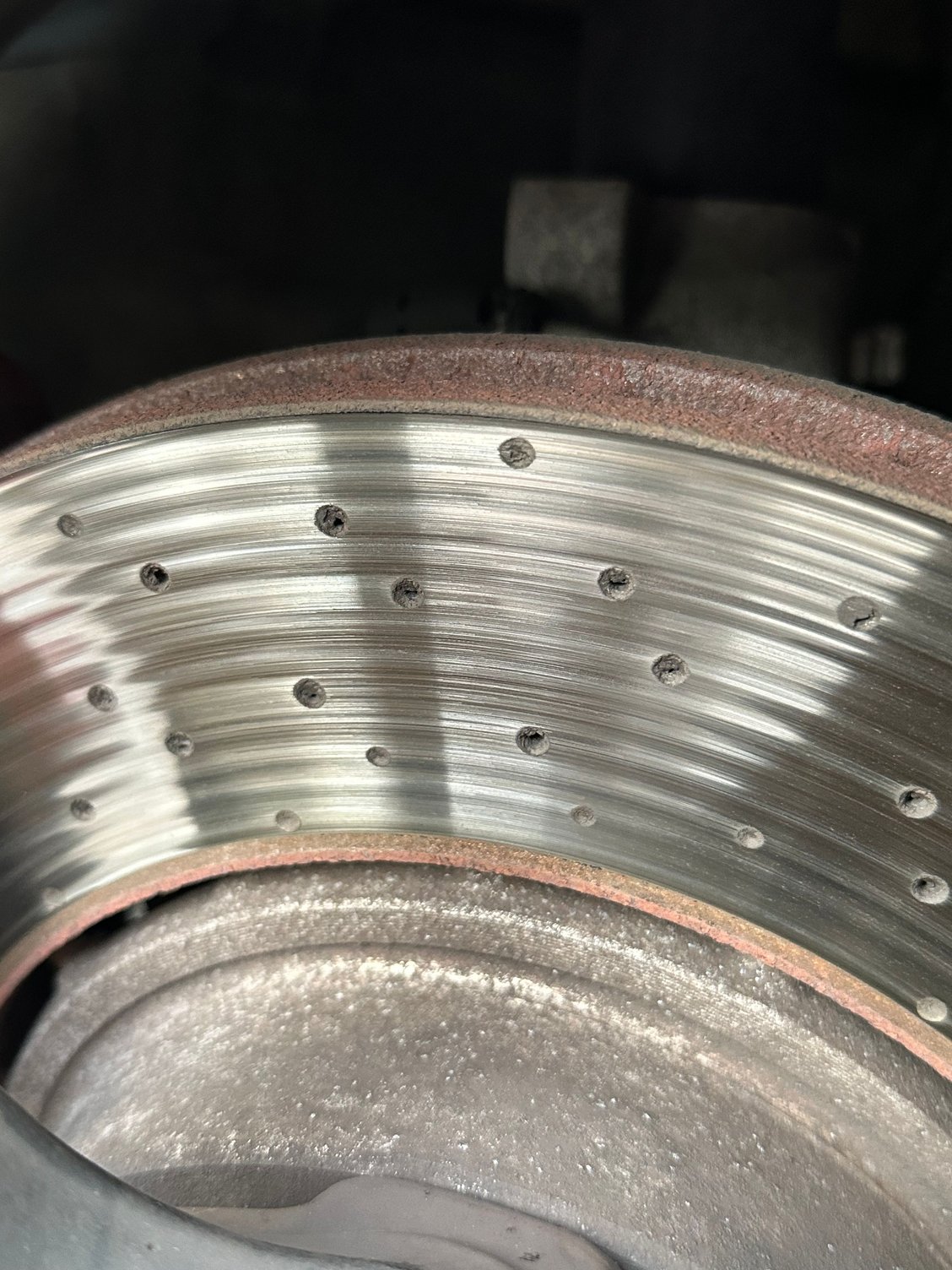
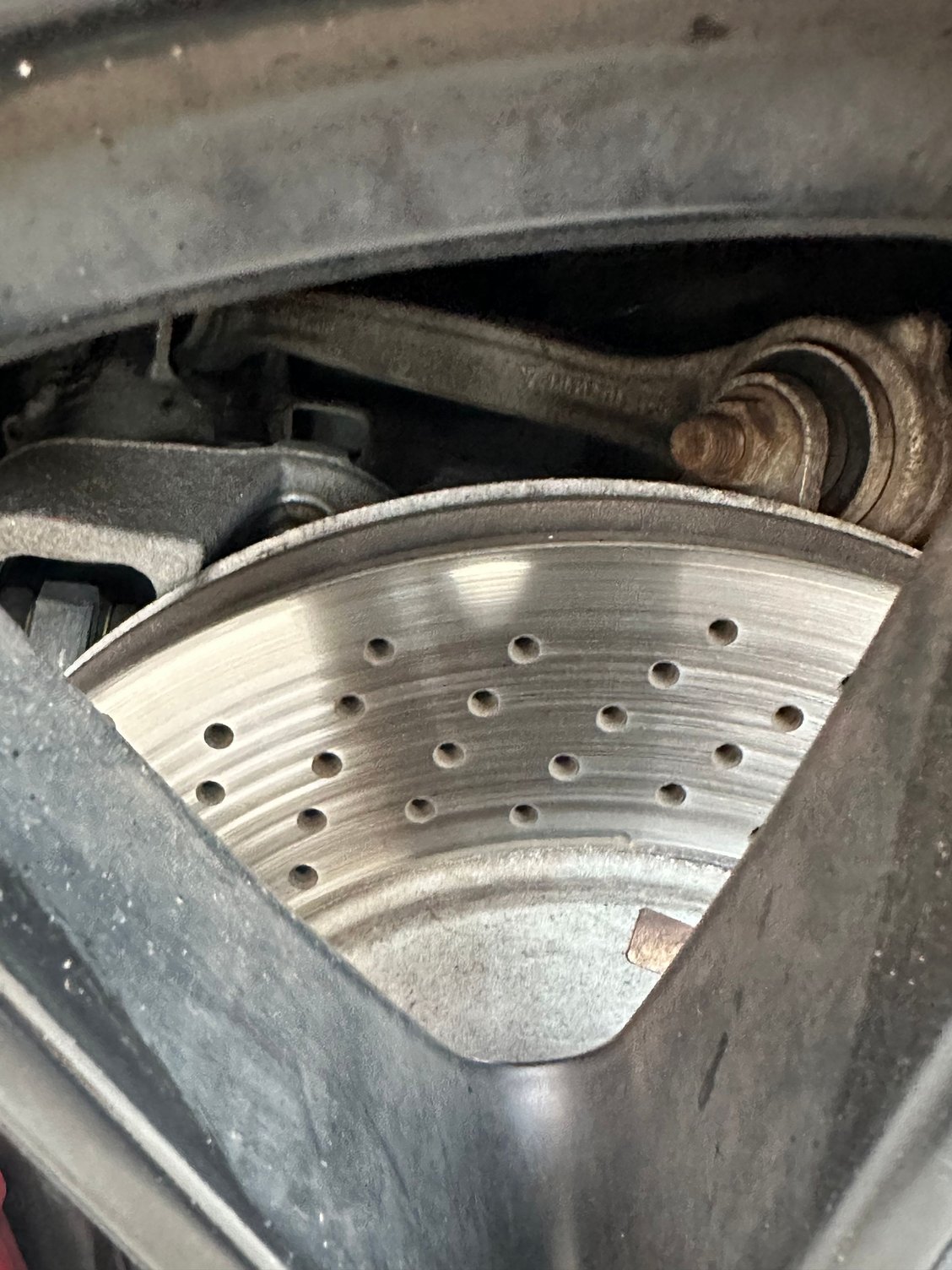
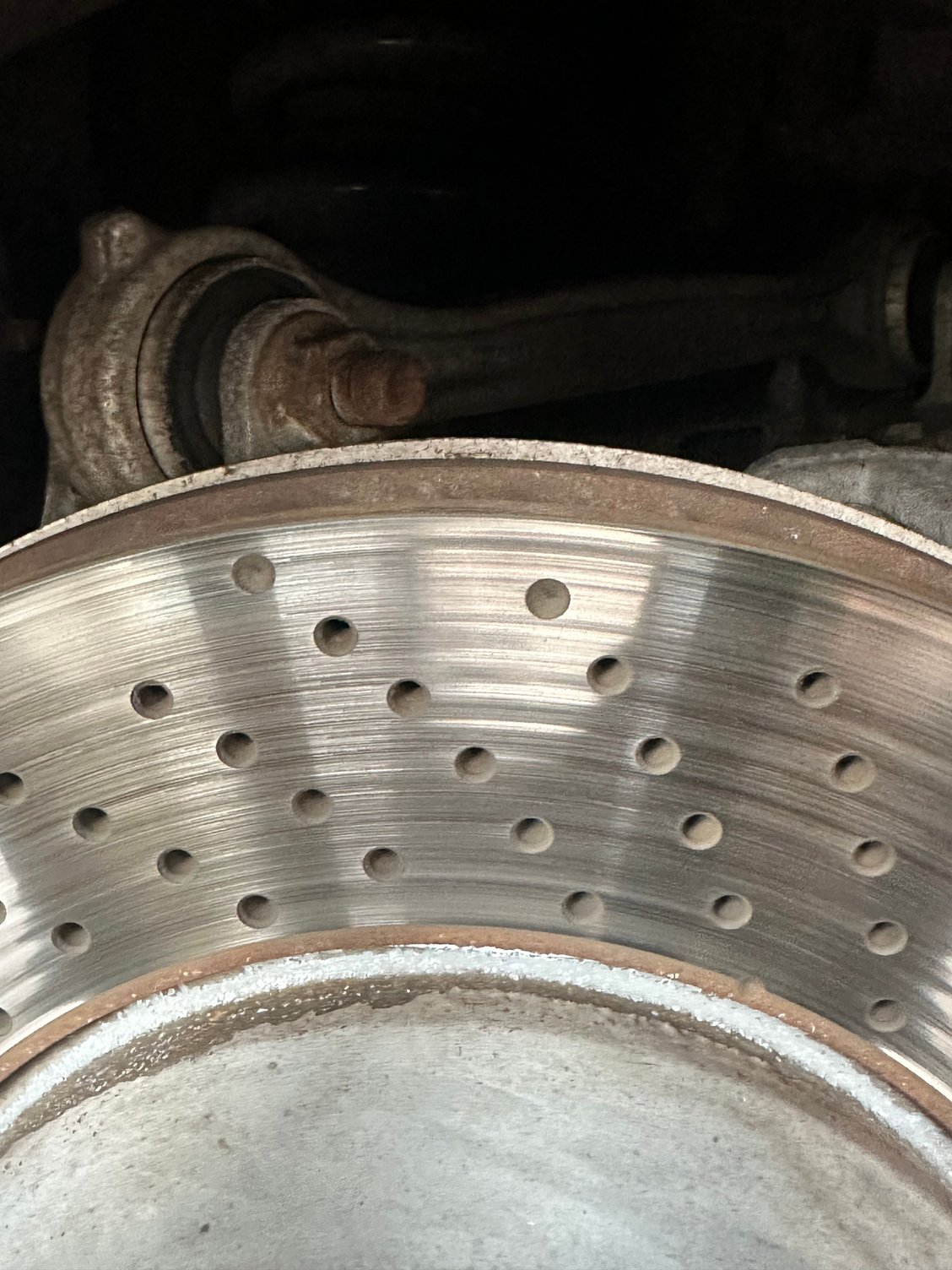
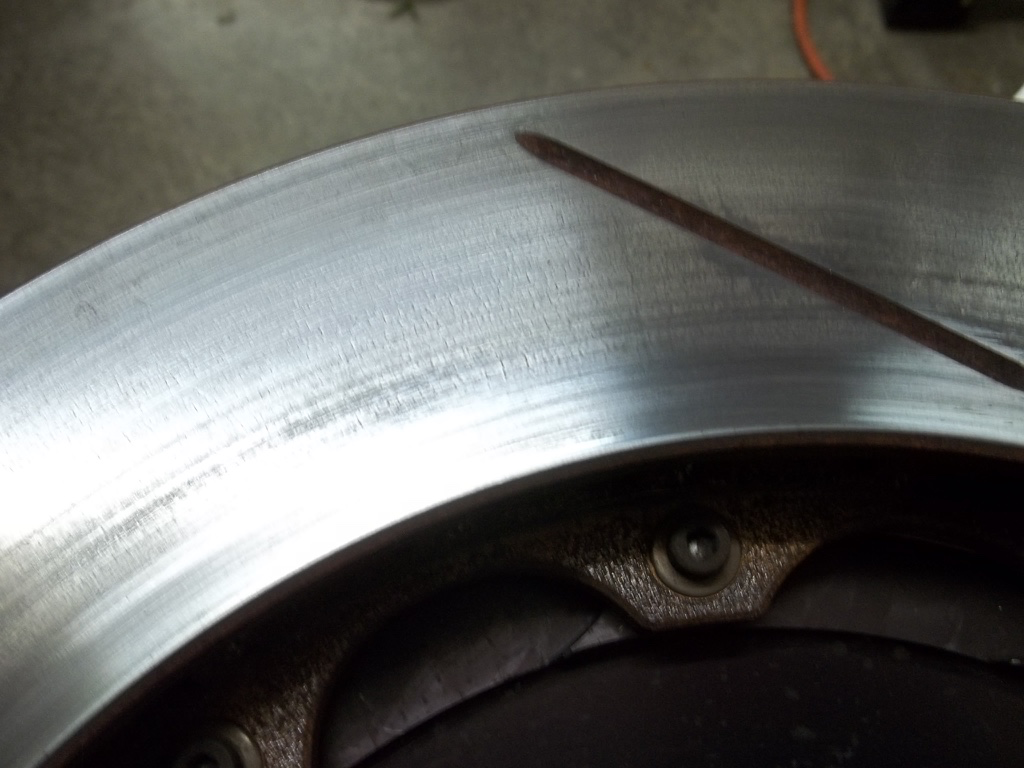
Hi, fellow Rennlist members, I am rather new to the car scene, and driving on the track, I have done about total 3 track days on these rotor and pads, the car-991.2 C4s now has 39k miles, the pads has about 4k miles, they were Ferodo DS2500
And I have a 2 day track event this coming up weekend, 16th & 17th, I know it's probably too late to ask this, (looking for a sense of security) but does my rotor needs replacement or they will be fine for this 2 day event, I am hoping it will last at least through this event, I am most worried about the wave pattern on the rotor, it feels up and down like a wave when I touch over it.
thanks for your input! Have a nice day
I agree with the others who have opined that your rotors look fine. I have a 2017 C2S. My rotors look similar, perhaps with somewhat less "waviness" pattern. My rotors have 32k miles total and 10 track days, and am about to do 3 more. However, I did check the thickness of my rotors using a micrometer at several locations around and radially across each disc to confirm their thickness being above the minimum specification. That minimum should be engraved or stamped on each rotor. I don't recall what it is for the rear rotors on my car but for the front rotors new thickness is 32mm and fully worn thickness is 30. My front rotors were at least 31.3mm when I checked them. Also, it's common practice for the depth [the bottom] of the chamfers on the cross drilled holes to correspond to the minimum thickness specification for the rotors. In other words, if you cannot see any of the chamfer remaining and just a cylindrical hole, the rotors are worn out.
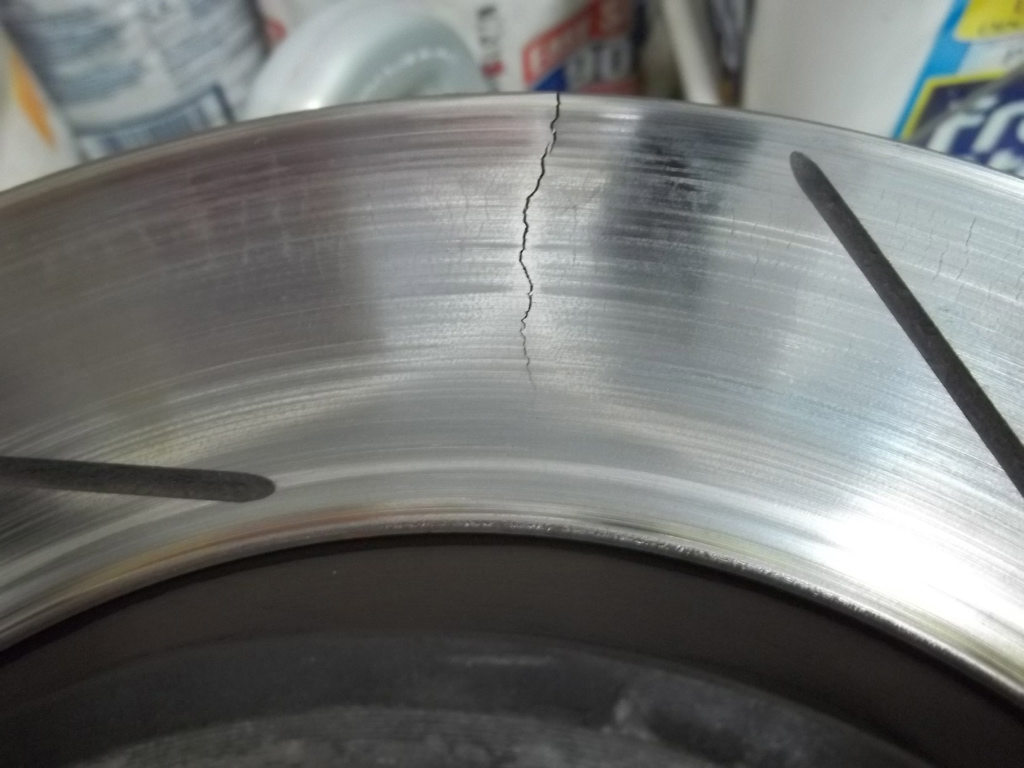
Much more important is to watch for cracks emanating from the cross-drilled holes, and cracking in general.
Cracked rotor from BMW E36 M3. There was no sign of any problem when on track; I only heard a slight ticking sound as I was on my cool down lap without other cars around mine. This could have become a disaster if a piece of the rotor chunked out and locked the wheel when on track at speed. StopTech ST-60 brake 355mm rotor from front of 2011 Audi S4. Sorry for the poor photo quality -- taken before I got an iPhone, but note the slight development of radial cracks in the mid-section of the radial span.
Hi, fellow Rennlist members, I am rather new to the car scene, and driving on the track, I have done about total 3 track days on these rotor and pads, the car-991.2 C4s now has 39k miles, the pads has about 4k miles, they were Ferodo DS2500
And I have a 2 day track event this coming up weekend, 16th & 17th, I know it's probably too late to ask this, (looking for a sense of security) but does my rotor needs replacement or they will be fine for this 2 day event, I am hoping it will last at least through this event, thanks for your input! Have a nice day
Assuming minimum thickness is still left on the disc, no cracking is present so should be ok. The waviness is a bit surprising but if you are still running the same pads then should be fine. I would, however, make sure you blow out the brake dust in all of the cross-drilled holes prior to the event. That can help prevent cracks.
Assuming minimum thickness is still left on the disc, no cracking is present so should be ok. The waviness is a bit surprising but if you are still running the same pads then should be fine. I would, however, make sure you blow out the brake dust in all of the cross-drilled holes prior to the event. That can help prevent cracks.
Yeah, the waviness pattern is what’s concerning me, and I have the same pads since this has been going on, it almost feels like a wave when I touch over it, but I don’t feel any abnormal braking
I agree with the others who have opined that your rotors look fine. I have a 2017 C2S. My rotors look similar, perhaps with somewhat less "waviness" pattern. My rotors have 32k miles total and 10 track days, and am about to do 3 more. However, I did check the thickness of my rotors using a micrometer at several locations around and radially across each disc to confirm their thickness being above the minimum specification. That minimum should be engraved or stamped on each rotor. I don't recall what it is for the rear rotors on my car but for the front rotors new thickness is 32mm and fully worn thickness is 30. My front rotors were at least 31.3mm when I checked them. Also, it's common practice for the depth [the bottom] of the chamfers on the cross drilled holes to correspond to the minimum thickness specification for the rotors. In other words, if you cannot see any of the chamfer remaining and just a cylindrical hole, the rotors are worn out.
Much more important is to watch for cracks emanating from the cross-drilled holes, and cracking in general.
Cracked rotor from BMW E36 M3. There was no sign of any problem when on track; I only heard a slight ticking sound as I was on my cool down lap without other cars around mine. This could have become a disaster if a piece of the rotor chunked out and locked the wheel when on track at speed. StopTech ST-60 brake 355mm rotor from front of 2011 Audi S4. Sorry for the poor photo quality -- taken before I got an iPhone, but note the slight development of radial cracks in the mid-section of the radial span.
Keep an eye on the rotor thickness of the first two pics. The thinner the rotor the harder it will be dissipate heat. Do your sessions but keep a close eye on those two. As someone mentioned clear the holes out of debris either with a pressure washer or better yet with air, (wear a mask if you go the air route, you don't want to breath that dust in)
you'll want to measure the thickness of them. the lips on the edge, from what I can see, make them look like they're near their service limit, if not already beyond it. this should fail your tech inspection.
Why do 911’s form these grooves on the rotors? That seems to happens consistently on a lot of the 911’s I’ve looked at over the years, but I don’t notice as much with other sports cars. The brakes don’t seem as affected by it, but if my Tacoma or Camry had rotors like that they’d be completely shot and drive terribly.
drilled, but not slotted, rotors tend to wear like this in my experience.
but again, it's not the pattern that concerns me. it's the thickness.
yeah, thanks for your input, as for right now, I am gonna have to go with the car tomorrow and l let them inspect it if they will let me run or not, and then if I do run, I'll definitely keep an eye out for the thickness in between sessions
There won't be enough time for me to swap out a new rotor, I'll just have to get a new one after this track weekend hoping it will perform one last time for me
Why do grooves in the discs occur?
The culprit is the drilled holes. When you engage the brakes, pad material that is torn from the pad puck builds up on the edges of the drilled holes. As the disc spins and you reengage the brakes, that material is then dragged along the face of the disc in between the drill holes. With heat and pressure that material digs into the relatively soft iron brake disc face and creates a groove/channel. The severity of the groove depends on a number of factors such as the pad material, disc material, heat introduced, etc. Sometimes the discs end up looking like a Pringles wavy potato chip!
With a slotted or plain-faced disc, it's not as common to see grooves of that depth, and many times you don't see any at all. With certain slot patterns on the face of the disc, you'll see a different pattern. For example, one of the AP Racing J Hook Disc patterns we offer is called the GA groove pattern. We always see a groove develop where two J Hook face slots terminate. The pad material that gets scraped off the pad face with each rotation disc rotation fills up the slots. If you think about the direction the disc is spinning, the 'back' of the J hook (the arced part) is leading into the pad. That pad material then exits at the tapered ends of the slots (see the red arrows in the image below). In the spot where that groove is, you're getting pad material exiting from both ends of adjacent J Hook slots. In other words, at that spot in the center of the disc face, you have pad material exiting the 'top' of the J from the slot closest to the hub, and the 'bottom' of the J on the adjacent slot closest to the OD of the disc. As that pad material exits the slots, it rides along under the pad squeezing the disc, and digs a little groove into the disc face.
Should I worry about this?
No. This is normal and the severity of this type of grooving varies wildly. When tracking your car, you will likely crack your discs long before you ever wear them thin or embed grooves deep enough to cause any problems. As others have noted, your primary concern is cracks.
Several years ago I wrote a guide on evaluating discs that you may find handy. It examines various stages of disc destruction and helps you identify when you need to replace them. Please see "When should I replace my brake discs?"
We have a bunch of other helpful brake-related articles that will help you get the most out of your brakes: the Essex Learning Center.
Slideshow: For a company obsessed with engineering precision, Porsche has occasionally named its cars in ways that left even loyal enthusiasts scratching their heads.
Slideshow: Pogea Racing's latest Porsche 964 project blends carbon-fiber construction, modern chassis upgrades, and up to 500 horsepower while keeping the air-cooled 911 experience firmly analog.
Slideshow: Talos Vehicles has transformed the Porsche 911 GT3 RS into a carbon-bodied, race-inspired machine that costs well over $1 million before the donor car is even included.
Slideshow: Long before engineering consulting became trendy, Porsche was quietly helping other automakers build everything from supercars to economy hatchbacks.
Slideshow: Some brands build cars. Porsche builds traditions, obsessions, and a few habits that stopped making sense decades ago but somehow became part of the charm.