When you click on links to various merchants on this site and make a purchase, this can result in this site earning a commission. Affiliate programs and affiliations include, but are not limited to, the eBay Partner Network.
I know it's not as exciting as discussing wheels or lowering the suspension, but I think it's something valuable to know and worth being documented - cleaning the drains in a 987 series car (Cayman and Boxster). There have been a few diagrams I've seen that are excellent, but unfortunately - not complete. What I'm posting here is directly from the mothership in Stuttgart - so I think it might be taken as gospel.
Why is cleaning the drains important? Because Porsche mounted expensive electronic modules right on the passenger compartment floor - where flooding will damage them, and likely the connectors from the wiring harness to them. Repairs in the multi-thousand dollar range are not uncommon. Due to it's nature - the soft-top of the Boxster makes this more common - and there are multiple drains involved specifically for the soft-top. But - the Cayman isn't immune. It shares the same drains in the cowl area that the Boxster has and they're equally susceptible to plugging up and causing flooding. It's particularly likey this time of year as the leaves start falling.
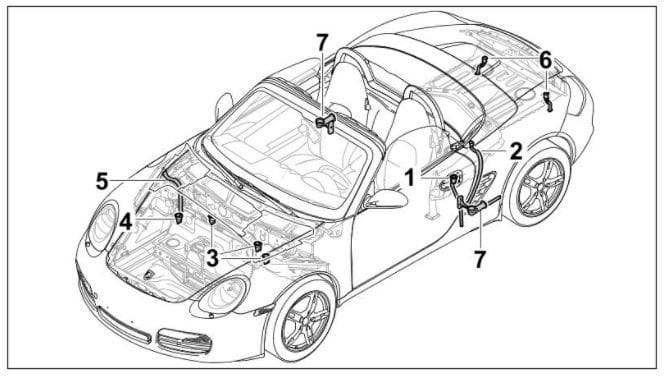
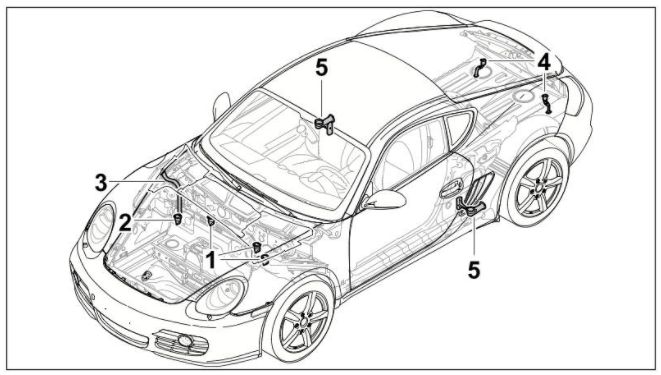
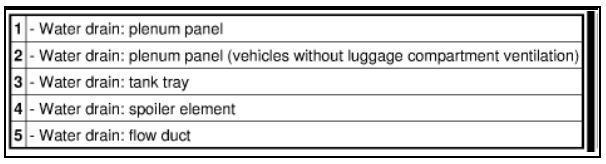
So below are two diagrams and two number-guides. You might want to print them out and toss the one that applies in your glovebox, or car documentation.
BOXSTER:
CAYMAN:
There are lots of techniques discussed in other posts about tools and techniques used. For the under-hood cowl drains - they're accessible by removing the beauty panel over the battery and the two cowl end panels. Cleaning the area of leaves is helpful, and many people find it helpful to simply remove the rubber one-way drains that Porsche uses in the cowl drain holes. The rubber drains tend to clog up with debris, especially leaves and whirligigs (oak tree seeds). Removing them gives a better chance of the debris passing through without clogging. A good cleaning of the area is helpful, and you don't have to remove the battery to clean this area.
The other drains - Boxster and Cayman are toward the rear of the car, and in the Boxster in the top compartment. There are more there than most people know of - some are rather subtle - a drain that runs right through the rubber trim the top seals to is seemingly unknown by most owners. Compressed air is good to clean these, provided you don't use too much pressure (which may blow the drains apart at a joint). The Boxster top drains are easier to see with the rear wheel-well liners removed. You can see the output and by pouring water into the drain from the top, confirm that they're open. There are two drains in the top compartment, visible if the top is partly opened (clamshell up and rear of top lifted). These go into the rubber membrane that lines this compartment and may have to be looked for. Once you find them - they're pretty obvious. Porsche sells a screen for these drains that keep it from clogging if something like a leaf land on top of it - before having the screen this was very likely to happen since the water going to and down the drain would carry debris and leaves right to the drain. The screen sticks up about 1/2" - and effectively stops that from happening.
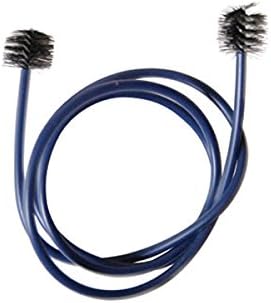
A cleaning tool I've seen mentioned but I haven't tried (I might for my Cayenne drains - same problems) - is a trombone (or bore) brush:
You can find these easily, and probably even locally by just Googling it. Amazon of course has a bunch of them.
For the moment I'll sticky this thread - and hopefully, members will have some input for it. If we ever get a dedicated 987 DIY forum - it will be copied there.
I just bought the below on Amazon which looks like a perfect tool to clean the drains on my 987.2 CS MT.
I expect that using the smaller of the two brushes on 67" "hose pipe" should do the trick.
Last week, I discovered that my sister's 2017 TT was totaled after clogged drains led to massive electronics failures. I bought these brushes within minutes of hearing her story :-)
I looked at a 2008 yesterday sitting on a used lot. It was very clean, but in the hatch, right where the spoiler element drains are, the car had brown sludge and signs of moisture. I have not seen a ton of issues with the rear drains, but I assume that would be the cause for this particular cayman.
New (as of April) 987S owner here. Just got back from a month in Mexico and car was snow covered when we got home. When I got the snow off, there was fog on windshield and rear window. The carpet behind the seats (back wall, not floor) was wet, so I put it in service mode and checked the roof drains. There was a little water on each side puddled up and when I removed the small amount of debris there the water seemed to drain out.
I was going to use a speaker wire (fully jacketed, no metal showing) to push down through the drain tube to clear it out, but it doesn't go straight down. If I put my pinky in there, the hole seems to open up to a small cavity and then there's another hole on the rear side which seems to go down.
Is this right? Should there be a tube attached directly to the hole visible when the top open? Or is this cavity thing right?
Thanks,
Brent
Last edited by safetyjoe; Feb 8, 2022 at 12:16 PM.
In the case of a drain with a screen, the standard cleaning procedure would include checking for and clearing any debris found on the screen. Any small debris, smaller than the screen, should be able to pass through clean. To test, pour some water in the drain and check to see if it exits under the car. If so, no further action required.
If there are symmetric drains (i.e. one of the same on both sides of the vehicle), make sure the flow appears similar from both drains when testing.
I’ve got an issue with water leaking into the very front part of my passenger side compartment, close to the center console. Does anyone have any ideas? I don’t think any of the drains near the battery are clogged, though I could be wrong.
Possible it’s the A/C condensation drain being clogged? If so, one might hear some “sloshing” of water in the area of the heater box under the dash when car is in motion.
IIRC, one can find the drain under the car, and perhaps blow it out with a bit of compressed air.
Possible it’s the A/C condensation drain being clogged? If so, one might hear some “sloshing” of water in the area of the heater box under the dash when car is in motion.
IIRC, one can find the drain under the car, and perhaps blow it out with a bit of compressed air.
Just a thought.
I’ll look into that, but it’s still cold here and I haven’t run the AC much if at all. I’ve noticed the moisture after it rains.
Does anyone have a solid idea of how the frunk battery area drains function/where the water goes?
I tried to hose down the car to see if I could isolate a leak. Nothing. The car then stayed dry through a major rain storm overnight. Though I had solved the problem.
But then I drove to work and parked on an incline. When I came back at the end of the day I had some water coming into the passenger footwell. I'm puzzled, because the battery/frunk area itself seems to drain very quickly.
Bought new for me 2006 Boxster S two weeks ago. Cleaning drains was the first item on my todo list.
Did it today. Rear drains were in pretty good state, water flowing trough with no issues. Used a trombone brush from the first post, easily cleaned through.
Front drains were in worse state. Lots of debris. Was able to clean using the brush, water is getting through with no issues.
I don't have drain screens on my car. The rubber cap on front drains seems to perform the same function though. I found a D20 roll die, I guess one of previous owners was into dungeon and dragons
What's the consensus on using screens? Should I get them for my drains?
Theon Goes Full Carbon Fiber With Stunning New Build
Slideshow: Built around a carbon-bodied 964 and a naturally aspirated 4.0-liter flat-six, this bespoke commission highlights how far the restomod formula has evolved.
Tuner Is Converting Porsche 911s Into Shooting Brakes
Slideshow: A Polish Porsche specialist is moving ahead with one of the most unusual 911 conversions in recent memory: a shooting brake version of the 991-generation sports car.
This Coachbuilt Creation Is A Modern Take on the Legendary Porsche 917
Slideshow: A Porsche Carrera GT has been transformed into a one-off coachbuilt machine that blends analog supercar engineering with styling inspired by the legendary 917 race cars.
Is This Convertible Cayenne A Steal, Or A Returnless Investment?
Slideshow: A heavily modified Porsche Cayenne convertible with faux wood trim and a long list of flaws recently sold at auction for surprisingly little money.
















 Cleaned your drains lately?