When you click on links to various merchants on this site and make a purchase, this can result in this site earning a commission. Affiliate programs and affiliations include, but are not limited to, the eBay Partner Network.
I changed my spark plugs this spring. With the old plugs, the car had a 75 degree thermostat until last year when I put a 83 degree. The car is definitely running warmer with the 83 degree.
Which is I think a good thing. Where it's designed to run. With the 75, it was most of the time right after the first white line on the gauge. It even stayed under the first line on an entire trip with an outside temperature of about 2 degree C! Now, it's always right before the second white line.
I think that with the 75 degree thermostat, the car was running too rich most of the time. Not 100% sure on this but...
I never found anywhere a good reason to put a 75 degree thermostat.
If I remember well, I thought, like you say, that it would be a good thing to do so.
Now, I don't think it was a very good idea...
I suspect you are right to use the 83 unit...i just like a little heads up on the gauge (space). I hope you sort out your issue soon
Lower head temperature = lower detonation threshold
Higher combustion temperature = increased engine efficiency and better overall emissions (this is why you want your engine as hot as possible for emission testing)
Everything is a balance, I go with the lower temps in my cars.
I also run colder plugs than stock, same reason, detonation threshold is lower. IMO this is especially important in cars without knock sensors.
I put the pressure tester on the car at 7:00am this morning at 14 psi.
It dropped to about 11 psi in about 10 hours. Hum!
Don't know if this is normal or not.
Yup. Totally fine.
Originally Posted by Bertrand Daoust
One thing I know though, I'm not 100% sure the tester itself is leak free. The cap, the hose, the gauge, the pump...
Almost nothing is leak free.
The purpose of leaving the pressure on overnight was to give a pin-hole leak enough time to leave visible evidence. Which ...
I removed the spark plugs tonight and look in every cylinder with my camera.
... you didn't find.
Let me know what you think.
You don't have a head gasket leak.
Originally Posted by Kiwi'79
Not to get off the subject, i became nervous when I first took a look at my sparkplugs, the insulators were white like yours, is this NORMAL?
Give those plugs another 10 or 20 thousand miles and they won't be white.
Originally Posted by NoVector
+1. When my head gasket failed on my 84, the associated spark plug looked steam cleaned. To quote Sesame Street, it was clear that "one was not like the others."
Exactly. A big leak will steam clean the plugs and head. A pin-hole leak won't.
Originally Posted by Bertrand Daoust
I never found anywhere a good reason to put a 75 degree thermostat.
There isn't. The opening temperature of the thermostat determines when it begins to open and has nothing to do with the steady state operating temperature. All the 75 degree thermostat does is to prolong the warm-up period.
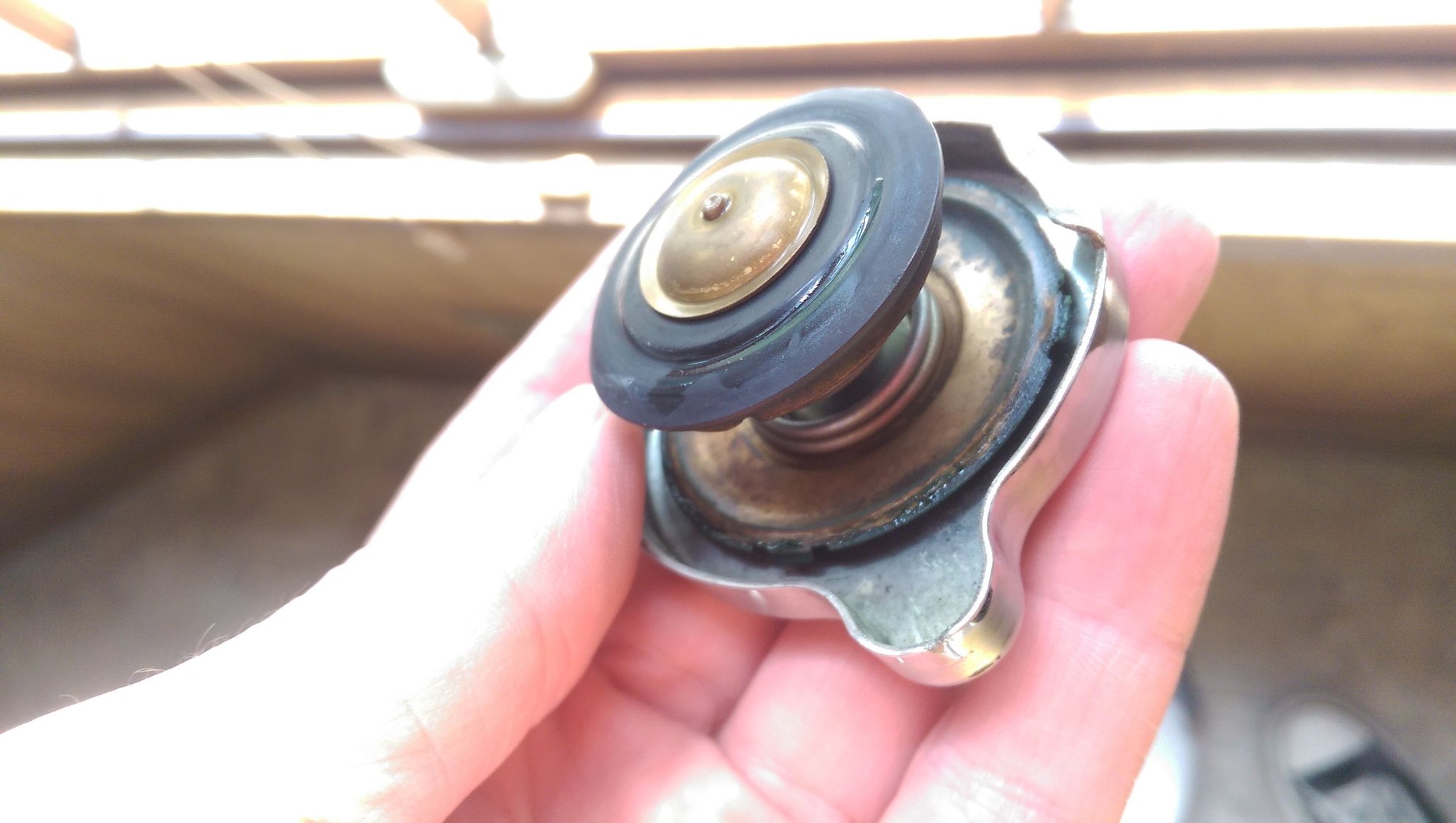
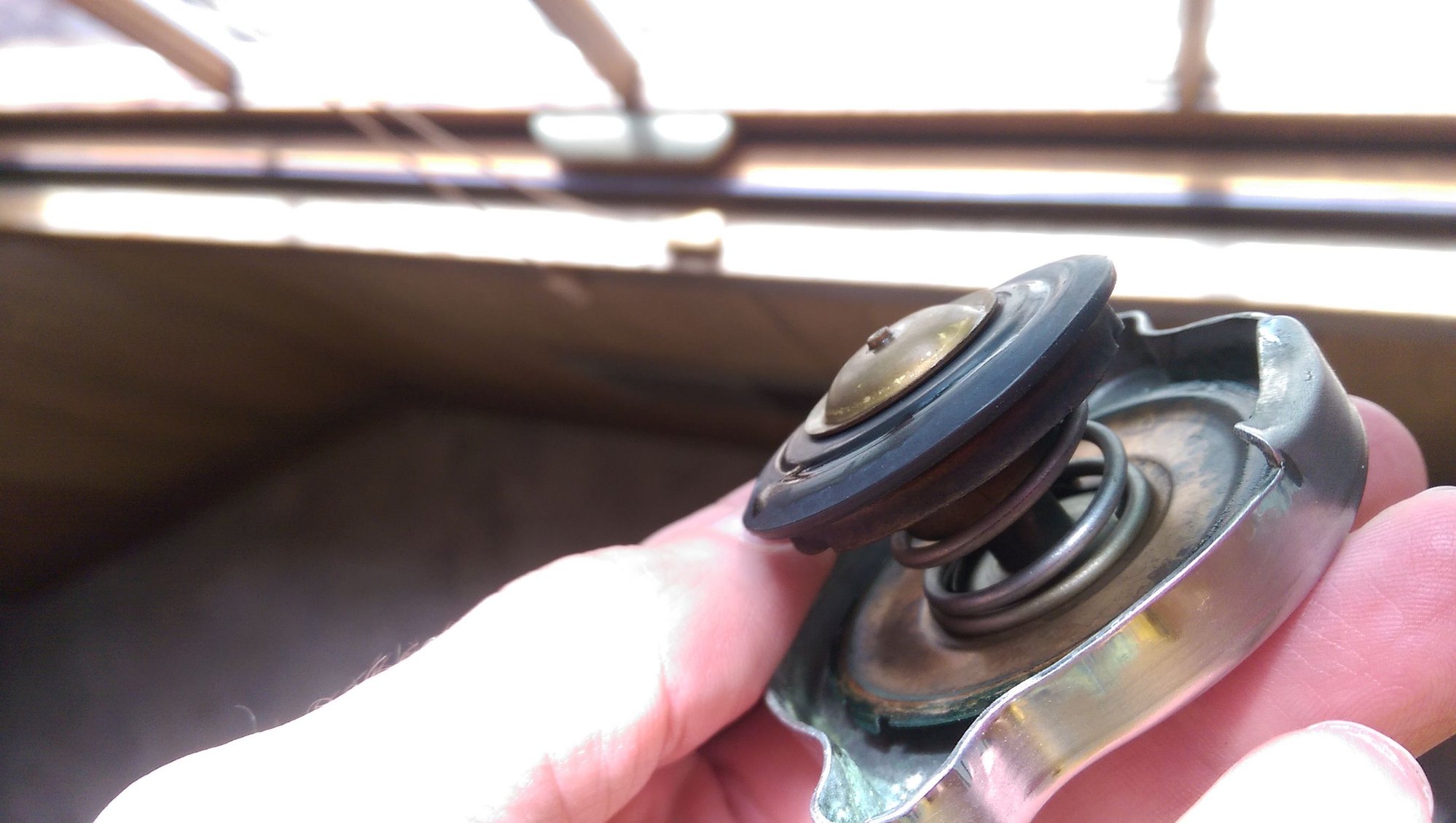
So I sprung for a Behr correct-for-our-cars radiator cap...the old one didn't look terrible...I didn't think...
Apparently it was overdue for replacement. Not only does the car run cooler...the needle is more stable...less movement up and down...really had no idea the cap was in that bad of shape.
For $15 bucks it's definitely getting replaced much more often now that I saw first hand the difference it made..
When I did my water bridge I replaced everything. i never really paid any attention to the temp marked on the new thermostat. That said my car's indicator is just right of the last white indicator line (as is normal). But there is only 2mm of distance before the indicator hits the red...and that I don't like. I wish the engine ran a little cooler and the indicator was closer to the middle of the gauge.
Kent,
Not wishing to put the ******* up you but if my experience is anything to go by living in a very hot climate the "normal position" is a couple of needles width to the left of the last white line. With a stock cooling system on hot summer days [over 40C] the needle would move to the position you describe when pushing the motor hard. With my modified systeM [radiator, fans, water wetter, leaner coolant mix] the system seems able to hold the temperature stable [I do not drive like I used to either].
That being said you may also have a system with a slightly different calibration on the sender and the only true measure of what is happening is with a good temperature gun. When I visited Canada on my final day driving from Kamloops to Vancouver via the Frasier Canyon the ambient temperature hit 40C- now that might explain your temperature indication.
So I sprung for a Behr correct-for-our-cars radiator cap...the old one didn't look terrible...I didn't think...
This is an outside, but interesting possibility.
Bertrand, many testers have an adapter to test the rad/tank cap. Test your cap. If it isn't holding at least 4-5 PSI then that might be a contributing factor. No pressure in the system will cause the boiling point to go way down and coolant will boil out of the reservoir.
One thing to note is that putting on a new ~14 PSI cap in place of an ancient degraded-to-5-to-9 PSI cap is that all of your cooling system will see higher pressure. For some seals this is not a good thing. Radiator tank seals come to mind.
The tester I have do have the cap tester adapter.
I tried it but couldn't sealed the cap well. So wasn't able to get anything out of it.
I think the adapter wasn't good.
Thanks for the advice.
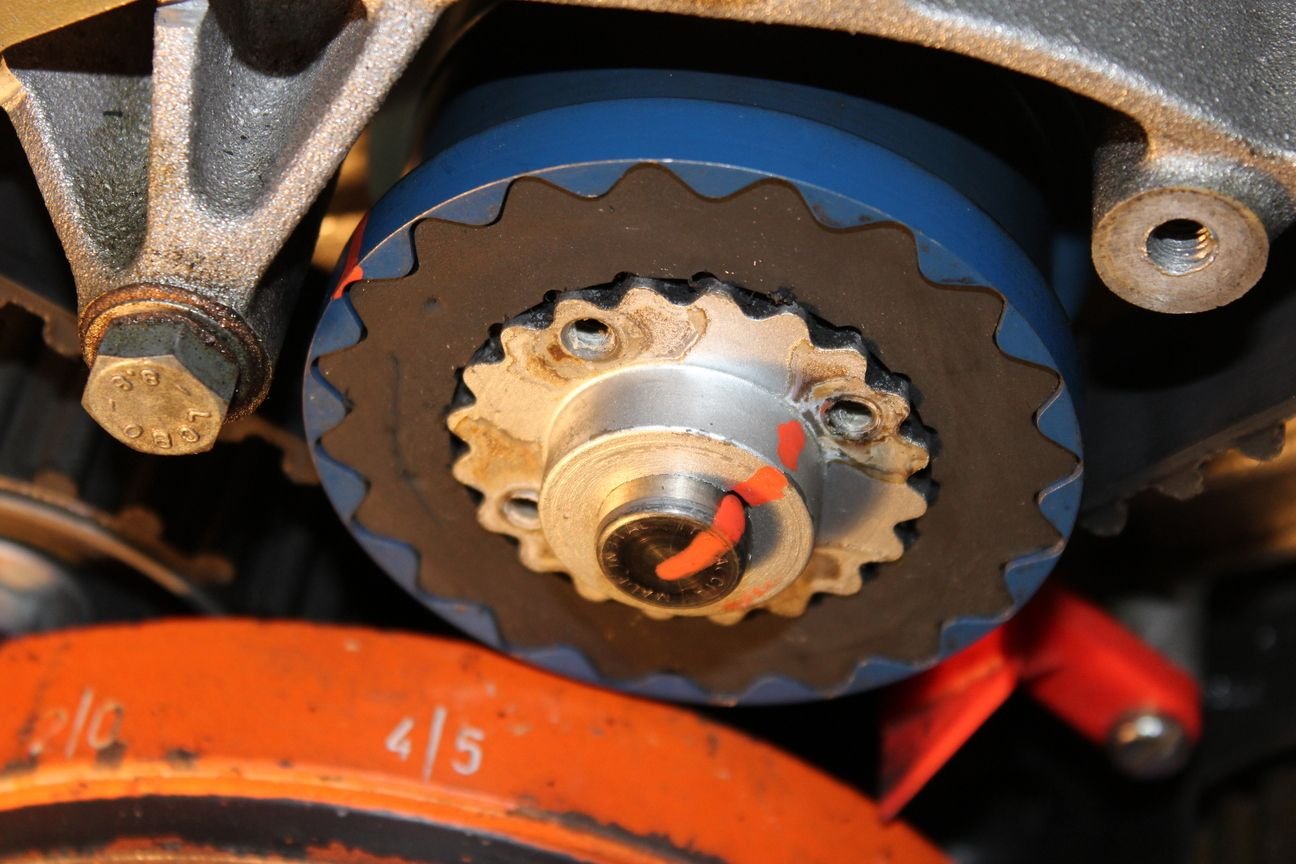
Ok, I spent some time in the garage and dig deep enough to get to the pump. Removed the pulley cover and...
The coupler did let go.
Don't know why but obviously this is why the car overheated.
One thing I did see is that the pulley is turning. So not seized.
Next step is to remove the crank bolt and all the pulleys and remove the pump and put a new one.
My goal is to be ready to go to Pittsburg for the PVGP.
Very doable I think.
Thanks again to all for your advices and encouragements.
Now time for a Blue.
Last edited by Bertrand Daoust; Jun 22, 2017 at 10:03 PM.
Bertrand, glad that it's repairable so you can get to Pittsburgh. Wonder why the coupling let go. I'm sure Ed would like to analyze. How old was the pump, mileage on it? See you in Pittsburgh.
Hey Bertrand was wondering if you are going to use another similar water pump? I am intrigued by the technology but naturally maybe a little more gun shy reading about your adventure so curious about where you stand with the product.
Maybe there's nothing wrong with the pump, and the coupler material was overcome by all the heat cycles, and the thousands of acceleration/deceleration events. I'd regard the coupler as a maintenance item, purely because of the material and purpose, and the fact it has to be 'on the edge' to be able to shear when necessary.
I'd be interested to hear of Eds analysis but, considering the components and testing that goes into his pumps, I'd be surprised if you couldn't just put in a new coupler and get another 35 K km out of it. If the bearings and seal are still good, and everything is still located correctly, I'd be comfortable putting it back in after checking everything and fitting a new coupler. If everything, apart from the coupler, is still OK then that seems to be a pretty good test of its functional reliability.
Talos Takes Your 991 Porsche 911 GT3 to the Next Level for a Cool $1.13 Million
Slideshow: Talos Vehicles has transformed the Porsche 911 GT3 RS into a carbon-bodied, race-inspired machine that costs well over $1 million before the donor car is even included.
9 Vehicles Porsche Helped Engineer that Aren't Porsches
Slideshow: Long before engineering consulting became trendy, Porsche was quietly helping other automakers build everything from supercars to economy hatchbacks.
9 Features and Characteristics That Only Porsche People Understand
Slideshow: Some brands build cars. Porsche builds traditions, obsessions, and a few habits that stopped making sense decades ago but somehow became part of the charm.
This Builder Is Turning Heads With Its Slantnose 911 Creation
Slideshow: A small Polish tuner has reimagined the Porsche 911 Slantnose for the modern era, blending 1980s nostalgia with widebody tuning culture and serious performance upgrades.
Porsche 911 GT3 Artisan Edition Pays Homage to Japanese Culture
Slideshow: Porsche has created a Japan-only 911 GT3 Artisan Edition that blends track-ready hardware with design cues inspired by traditional Japanese craftsmanship.
Porsche Reveals Coupe Variant of the Electric Cayenne With a Fresh Look
Slideshow: Porsche's latest electric Cayenne Coupe blends dramatic styling with supercar acceleration, turning the brand's midsize SUV into a 1,139-horsepower flagship.