


Crank Case Scoring


Rennlist Member

Joined: Jun 2008
Posts: 4,715
Likes: 89
From: Tasmania, Australia
Under the Lift
Lifetime Rennlist
Member
Lifetime Rennlist
Member

Joined: Mar 2002
Posts: 18,648
Likes: 52
From: Buckeye, AZ

Let me add this....if the scoring is worse on one side and the thrust bearing is worn thin on that side, then, sure, this could be TBF. The first picture appears to show the thrust bearing and it does look thin to me compared to this shot....So, yes, it could be a bad TB, but TBF damage looks a lot worse than the factory machining, at least on S4s. There have been many pictures posted here of this "scoring" discovered when people pulled the oil pan in engines with good crank endplay and intact TBs.
So, compare the thrust bearing thickness and scoring on each side and check the crank endplay.
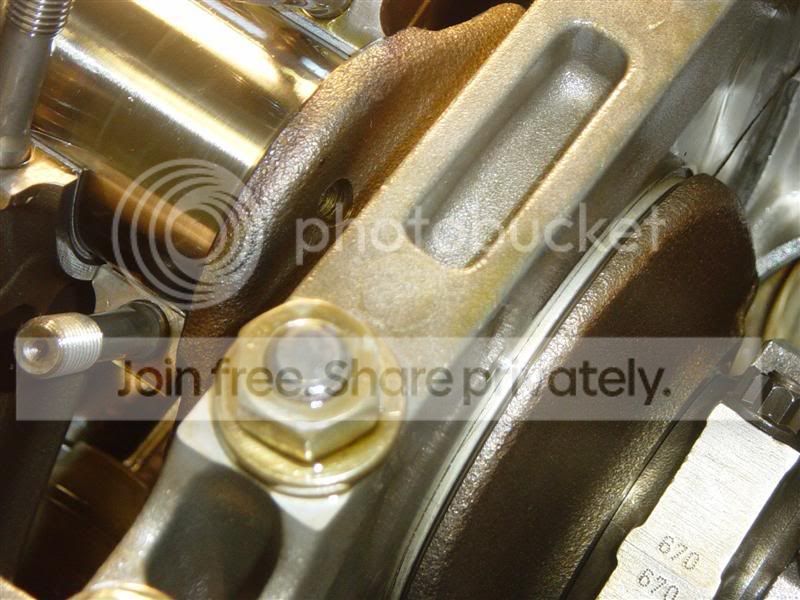
So, compare the thrust bearing thickness and scoring on each side and check the crank endplay.
Rennlist Member
Joined: Jun 2008
Posts: 4,715
Likes: 89
From: Tasmania, Australia
Looking at my 82 block the machining was centred on the crank line, and there were concentric machining circles of ever increasing diameter going outwards from there.
Notice in the first photo that the machining marks are not perfect concentric circles like that, but it looks like they've had several goes at facing those areas. If all blocks had perfect concentric machining to start with, you would expect that crank throw scoring should follow the same radial lines, as they are running from the same centre point.
There can be only two explanations for the multiple sets of maching/scoring circles:
1. Spot face machining was off center to the crank centre line, and the crank throws then scored the block concentric to the centre line (edit: although the 'scores' look a bit too neat for that) ... or
2. Spot face machining was done in two or more passes, and they didn't line each one up to be concentric to the crank centre line.
Notice in the first photo that the machining marks are not perfect concentric circles like that, but it looks like they've had several goes at facing those areas. If all blocks had perfect concentric machining to start with, you would expect that crank throw scoring should follow the same radial lines, as they are running from the same centre point.
There can be only two explanations for the multiple sets of maching/scoring circles:
1. Spot face machining was off center to the crank centre line, and the crank throws then scored the block concentric to the centre line (edit: although the 'scores' look a bit too neat for that) ... or
2. Spot face machining was done in two or more passes, and they didn't line each one up to be concentric to the crank centre line.
Last edited by Dave928S; Dec 10, 2011 at 05:03 AM.
Instructor
Joined: Jun 2001
Posts: 247
Likes: 1
From: Sydney, Australia
It's been on every one I've seen, although I only have dealt with S4s motors. Also, they are on both sides which would be hard to explain as thrust bearing wear/failure. Anyway, it's well known to be normal. Endplay check will confirm it. My motor, which has those marks and has never been apart and has good endplay supports this.


Addict
Rennlist Member
Rennlist Member
Joined: Nov 2003
Posts: 2,608
Likes: 12
From: Sydney AUS
Simples
If the marks aren't perfect circles around the centreline of the main bearings (difficult to tell from the photo) then they are machining marks. (Or the crank is bent more than a banana - you would notice this!)
And another plus point that oil is far too clean for oil in an engine with TBF. It would look like aluminium slurry if the crank had been "machining" the block.
If the marks aren't perfect circles around the centreline of the main bearings (difficult to tell from the photo) then they are machining marks. (Or the crank is bent more than a banana - you would notice this!)
And another plus point that oil is far too clean for oil in an engine with TBF. It would look like aluminium slurry if the crank had been "machining" the block.
Captain Obvious
Super User
Super User
Joined: Aug 2003
Posts: 22,846
Likes: 348
From: Cambridge, Ontario, Canada
And if the cranks touched the block, there would be material transfer to the counterweights too or at least some marks that match the block. As I said before, these are manufacturing machining marks, nothing more.


Rest in Peace
Rennlist Member
Rennlist Member
Joined: May 2006
Posts: 9,903
Likes: 2
From: Bird lover in Sharpsburg

Drifting
Joined: Sep 2006
Posts: 3,379
Likes: 128
From: Stratford-upon-Avon
I've been busy with other stuff on the project so just got out from under the car with the end play results.
And the nominations are.....
I measured twice after getting good "clunks" prying to and fro. Used digital micrometer measuring between same flywheel tooth and flat end of crankcase each time.
1st result play = 0.12mm
2nd result play = 0.13mm
I released clamp for measurement but noticed no movement based on paint marks from last check, and the flexplate was flat.
And the nominations are.....
I measured twice after getting good "clunks" prying to and fro. Used digital micrometer measuring between same flywheel tooth and flat end of crankcase each time.
1st result play = 0.12mm
2nd result play = 0.13mm
I released clamp for measurement but noticed no movement based on paint marks from last check, and the flexplate was flat.