





Shift points and dyno graph???
Thread Starter
Race Director
Joined: Sep 2004
Posts: 16,271
Likes: 82
From: Stockton, CA
 Shift points and dyno graph???
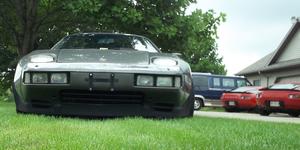
Here is the latest dyno from the 928 Estate....
Since the power curve is DYING past 5500rpm, it makes me wonder why I shift out of 2nd at 6000rpm riding out a dying power curve?
Yes I have an automatic so my gear ratios are 5.3064 in 2nd (overall) and 3.1592 in 3rd. It seems worthless to spin more rpm to just make 160whp-140torque? Since the bulk of the powerband if between 3500-5000 anyway..
Maybe shift at 5700rpm since its still above 175whp which gives a nice powerband between 4000-5700 where its still above 175whp....
I WISH I had a 2:54 automatic for a later 89+ car....it has a much smaller step between 2-3 than the 2.20....of course an LSD and 5 speed would be nice too...
Since the power curve is DYING past 5500rpm, it makes me wonder why I shift out of 2nd at 6000rpm riding out a dying power curve?
Yes I have an automatic so my gear ratios are 5.3064 in 2nd (overall) and 3.1592 in 3rd. It seems worthless to spin more rpm to just make 160whp-140torque? Since the bulk of the powerband if between 3500-5000 anyway..
Maybe shift at 5700rpm since its still above 175whp which gives a nice powerband between 4000-5700 where its still above 175whp....
I WISH I had a 2:54 automatic for a later 89+ car....it has a much smaller step between 2-3 than the 2.20....of course an LSD and 5 speed would be nice too...

Supercharged
Rennlist Member
Rennlist Member

Joined: May 2002
Posts: 18,926
Likes: 88
From: Back in Michigan - Full time!
What would be the the RPM drop if you shifted at 5700RPM?
I think you need to keep in mind where you'll be in the powerband once the shift occurs. Don't want to get caught at 3k. I would think you'd want to end up somewhere between 3500 and 4000. But if the step is too big, maybe it's worth running up the RPMs a bit to come in at the right point?
I think you need to keep in mind where you'll be in the powerband once the shift occurs. Don't want to get caught at 3k. I would think you'd want to end up somewhere between 3500 and 4000. But if the step is too big, maybe it's worth running up the RPMs a bit to come in at the right point?
Supercharged
Rennlist Member
Rennlist Member
Joined: May 2002
Posts: 18,926
Likes: 88
From: Back in Michigan - Full time!
Here's the transmission diagram from the 1984 owner's manual.
It looks like if you shift from 2nd at 5700 RPM, you'll end up at about 3750 in 3rd which is at peak torque. So I (with my zero years of experience) that this is where you want to shift. No?

It looks like if you shift from 2nd at 5700 RPM, you'll end up at about 3750 in 3rd which is at peak torque. So I (with my zero years of experience) that this is where you want to shift. No?
Rennlist Member
Joined: Feb 2003
Posts: 29,828
Likes: 218
From: saratoga, ca
just give me the rpm % drop from the two gears you spend the most time in. look at the HP curve and see how you can shift and make the "arc" flat. meaning, your pre shift rpm HP value will equal your post shft rpm value. However, skew it slightly to the right, due to the longer time you will be in the higher rpm. 
Rennlist Member
Joined: Feb 2003
Posts: 29,828
Likes: 218
From: saratoga, ca
max torque doenst meean anything, what does mean something is your 58% rpm drop. SO the answer is.................... shift at redline. even 6000rpm drops down to 3500rpm, which is lower power than 6000rpm shift. huge benifit vs shifting at 5700rpm, as far as racing goes.
Trending Topics
Rennlist Member
Joined: Feb 2003
Posts: 29,828
Likes: 218
From: saratoga, ca
for that last second or two in the rpm range, you basically have 30-40 more HP. you want 30-40 more hp with the push of the pedal??? shift at 6000rpm. however, it wont pay to shift much higher which is good for engine wear.
Rennlist Stories
The Best Porsche Posts for Porsche Enthusiasts

Six Genius Porsche-Themed Gifts That'll Make Any Dad or Grad Smile
Joe Kucinski
10 Used Porsches Are Selling for Way Too Cheap
Joe Kucinski
Tuner Is Converting Porsche 911s Into Shooting Brakes
Verdad Gallardo
This Coachbuilt Creation Is A Modern Take on the Legendary Porsche 917
Verdad Gallardo
Is This Convertible Cayenne A Steal, Or A Returnless Investment?
Verdad Gallardo
10 Best Non-Flat Six Porsches You Can Buy For Under $100K
Joe Kucinski
Porsche's Top 5 Most Questionable Naming Decisions
Verdad Gallardo
Pogea Racing's 964 Porsche 911 Reimagination Stands Out in a Crowded Field
Verdad Gallardo
6 Convertible Top MYTHS Most People Don't Understand!
Michael S. Palmer
Addict
Lifetime Rennlist
Member
Lifetime Rennlist
Member
Joined: Feb 2009
Posts: 18,061
Likes: 10
You need a 5 speed .....and yes the early USA cars all you make is more noise above 5,000 RPM . does keep you from shifting into too tall a gear however and on some tracks avoids an "extra" upshift downshift into certain corners.
.....and yes the early USA cars all you make is more noise above 5,000 RPM . does keep you from shifting into too tall a gear however and on some tracks avoids an "extra" upshift downshift into certain corners.
Rennlist Member
Joined: Feb 2003
Posts: 29,828
Likes: 218
From: saratoga, ca
they make noise, but more power than what you would end up by shifting at 5000rpm. shifting at 5000rpm 200hp, would bring you down to near 115hp at 2900rpm. shifting at 6000rpm (160hp) gives you more HP-seconds to accelerate with, because the post shift point is near equal at 150hp.
This description of 'more noise" is what gets most racers into trouble in trying to maximize their performance. sure torque is plummeting, hp is plunging, BUT, its better than the alternative.............the shift!
This description of 'more noise" is what gets most racers into trouble in trying to maximize their performance. sure torque is plummeting, hp is plunging, BUT, its better than the alternative.............the shift!
Thread Starter
Race Director
Joined: Sep 2004
Posts: 16,271
Likes: 82
From: Stockton, CA
we really need some type of testing to figure this out......my "butt-o-meter" tells me that anything past about 5500 is just making noise...& the acceleration at 3000 vs 3500 (shift points) isn't that much since I regularly drop to 3000rpm or less in 3rd since its SO tall....thats where the benefit of the 89 box would help immensely a 41% rpm drop in the 2.2 vs only 36% drop in the 89 (2-3 shift)
Rennlist Member
Joined: Feb 2003
Posts: 29,828
Likes: 218
From: saratoga, ca
Testing????? Ahhhh!! you have the dyno runs for cripes sake. you go ahead and believe your butt. BUT, you know what that is filled with!!
yes, 5500rpm makes noise, but more accelerative forces than the next gear, at a 41% loss in torque, PLUS a drop in power after the shift as well.
go back, study the curves and plot in the rpm drops in each gear. i did one of them for you already.
mk
yes, 5500rpm makes noise, but more accelerative forces than the next gear, at a 41% loss in torque, PLUS a drop in power after the shift as well.
go back, study the curves and plot in the rpm drops in each gear. i did one of them for you already.
mk
we really need some type of testing to figure this out......my "butt-o-meter" tells me that anything past about 5500 is just making noise...& the acceleration at 3000 vs 3500 (shift points) isn't that much since I regularly drop to 3000rpm or less in 3rd since its SO tall....thats where the benefit of the 89 box would help immensely a 41% rpm drop in the 2.2 vs only 36% drop in the 89 (2-3 shift)
Nordschleife Master
Joined: Jan 2009
Posts: 5,609
Likes: 84
From: MA
just give me the rpm % drop from the two gears you spend the most time in. look at the HP curve and see how you can shift and make the "arc" flat. meaning, your pre shift rpm HP value will equal your post shft rpm value. However, skew it slightly to the right, due to the longer time you will be in the higher rpm.
I think skewing it to the right is wrong.
For the purposes of computing the average acceleration or the terminal speed, I think you have to take into account the time you spend at each point of the dyno graph. In contrast, for picking the optimal shift points, you don't have to make such adjustments and making them will give the wrong result.
There's even an error inside your error! Even if your weighing/skewing logic would be correct (it's not), it would go the other way around. If you shift at the optimal point (pre-shift and post-shift hp are the same), then the engine (not car) accelerates slower at the low, post-shift rpm. The car spends more time per rpm range at high gear, post-shift, low rpm than at low gear, pre-shift, high rpm. But that is irrelevant for shift points.
Best, tuomo

Racer
Joined: Feb 2006
Posts: 320
Likes: 0
From: Madrid, Spain
Theoretical optimal: Pre and post shift HP are equal.
Real life optimal: The later (higher) the better.
Reason: Shifting, even in an auto, leaves you with reduced HP for a brief time, around 0,3s. In a WOT acceleration, the car upshifting later will reduce the time it spends at a "reduced" speed.
Say you have two identical cars accelerating along. Say they hit 5500 (theoretical optimal) 500m before the corner, and one of them upshifts, it looses 3kph vs his rival, until his rival upshifts. The rival revs it up to the redline, at 6300, only 200m before the corner. In those 300m, the redline-shifter driver will have gained progressively an advantage, due to equal pre and post hps and accelerations but unequal initial speed. In the last 200m before the corner, both will travel at equal speeds, but redliner in front a constant distance.
Only if power drops long long before redline, the calculation is more complex, and optimal shifting is lower than redline. Usually, only restricted turbo engines with enormeus flat power graph need that. In a typical WRC, top power is somewhere at 5200, while redline is around 8500.
Real life optimal: The later (higher) the better.
Reason: Shifting, even in an auto, leaves you with reduced HP for a brief time, around 0,3s. In a WOT acceleration, the car upshifting later will reduce the time it spends at a "reduced" speed.
Say you have two identical cars accelerating along. Say they hit 5500 (theoretical optimal) 500m before the corner, and one of them upshifts, it looses 3kph vs his rival, until his rival upshifts. The rival revs it up to the redline, at 6300, only 200m before the corner. In those 300m, the redline-shifter driver will have gained progressively an advantage, due to equal pre and post hps and accelerations but unequal initial speed. In the last 200m before the corner, both will travel at equal speeds, but redliner in front a constant distance.
Only if power drops long long before redline, the calculation is more complex, and optimal shifting is lower than redline. Usually, only restricted turbo engines with enormeus flat power graph need that. In a typical WRC, top power is somewhere at 5200, while redline is around 8500.
Nordschleife Master
Joined: Jul 2003
Posts: 7,743
Likes: 78
From: Minneapolis
Try some experiments. Holding on to those last few hundred RPMs is exciting but isn't always the right option.

