


TB Hypothetical Question


Thread Starter
Three Wheelin'

Joined: Dec 2002
Posts: 1,497
Likes: 64
From: Canada
 TB Hypothetical Question
Last weekend I took the shark for a 2500 mi road trip with no issues. However, there were occasions when I was very very far away from any major cities or garages equiped to fix a 928. If I had a TB light come on and had to check a TB tension and the local shop only had a "universal" type tool for checking this tension, what would be my course of action? Use the manual method (which is it 45 or 90 degrees deflection)? I see that the Kempf Tool readings are 5.0 to 5.3 (what units are these numbers referring to?) and Porsche Tool probably gives another rerading. I checked with a few gas stations in my area and found universat tools called Kriket Model 91107, a Baum model and another universal tool that all gave measurements in lbs or in-lbs or something like that. Based on this fear I will be ordering my own Kempf Tool immediately because I love driving this car for on long distances but the fear of a breakdown always is at the back of my mind. Thanks for any info.
Hessank
Hessank


Three Wheelin'
Joined: Jan 2007
Posts: 1,466
Likes: 0
From: not where you think I am

the lame answer would be:
"if you're scared of it, don't drive it."
as long as you are within the recommended 5 year/50,000 mile replacement guideline, and the tension/belt has been checked/adjusted per spec guidelines....you should not fear driving it anywhere--long trips or short.
continue on----
--Russ
"if you're scared of it, don't drive it."
as long as you are within the recommended 5 year/50,000 mile replacement guideline, and the tension/belt has been checked/adjusted per spec guidelines....you should not fear driving it anywhere--long trips or short.
continue on----
--Russ
Rennlist Member
Joined: May 2001
Posts: 4,871
Likes: 40
From: Puyallup, WA
Road-side timing belt tension kit:
Kempf tool - set t-belt tension
Stubby 17mm wrench - loosen tensioner lock nut
Ratcheting 17mm wrench - tighten tensioner bolt
Ratcheting 8mm - remove passenger distributor cap bolts
10mm socket - remove passenger t-belt cover
Kempf tool - set t-belt tension
Stubby 17mm wrench - loosen tensioner lock nut
Ratcheting 17mm wrench - tighten tensioner bolt
Ratcheting 8mm - remove passenger distributor cap bolts
10mm socket - remove passenger t-belt cover

Three Wheelin'

Joined: Sep 2006
Posts: 1,269
Likes: 107
From: Arvada, CO
It could be useful in a pinch, like what you've said, to know the correct tension measurement in a standard unit. Better still, though, is the Kempf tool in the glovebox. Even if someone isn't inclined to measure and adjust it himself, the tool and its instructions are easy enough to hand over to a mechanic to do.
Matt

Thread Starter
Three Wheelin'
Joined: Dec 2002
Posts: 1,497
Likes: 64
From: Canada
Not sure I get your lame answer Russ. Pay attention to this forum and you will read about problems people get with well maintained cars, even those with recent TB changes where the TB lights still flicker and cause heart murmers. As Adam wrote, it would be nice to know what to do in a pinch. That was the context for the inquiry. I just drove my car 2500 miles away from home so obviously it is very well maintained. Yes, I will be ordering a kempf tool very soon. Hessank
Trending Topics

Rennlist Member
Joined: Jul 2001
Posts: 6,560
Likes: 113
From: New York
Not sure I get your lame answer Russ. Pay attention to this forum and you will read about problems people get with well maintained cars, even those with recent TB changes where the TB lights still flicker and cause heart murmers. As Adam wrote, it would be nice to know what to do in a pinch. That was the context for the inquiry. I just drove my car 2500 miles away from home so obviously it is very well maintained. Yes, I will be ordering a kempf tool very soon. Hessank
Note to Adam's list, that would be a "roadside" tensioning, b/c you need the 27 mm socket to set the crank to proper position for the measurement, TDC, right?

Inventor
Rennlist Member
Rennlist Member
Joined: Sep 2002
Posts: 10,212
Likes: 465
You have to check your timing belt tension? 

Check the timing belt tension between cam and crankshaft. This is where the belt has the least amount of tension. The timing belt should be twisted 90° with your index finger and thumb. It is necessary that while you do this there is a strong force present and it increases while twisting the belt. (The engine should be positioned for this test as described in reference number 2.)
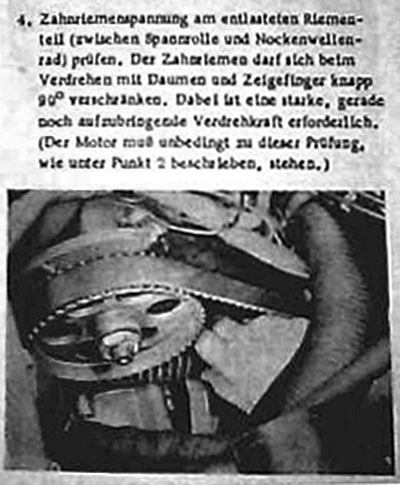
Check the timing belt tension between cam and crankshaft. This is where the belt has the least amount of tension. The timing belt should be twisted 90° with your index finger and thumb. It is necessary that while you do this there is a strong force present and it increases while twisting the belt. (The engine should be positioned for this test as described in reference number 2.)

Rennlist Member
Joined: Dec 2004
Posts: 5,670
Likes: 1
Jager Engineering has long advocated setting belt tension by tuning it like a guitar string. But we used to check Fiat belts like P'Kens picture shows above.
In the Fiat days, I never saw a loose belt situation that was fixable by just retensioning. Come to think of it, every tension issue I have had on a 928 had another part causing it as well. Bad shoulder bolt, shot water pump, roller bearing worn out. Seems like I had a massive oil leak from a bad front seal as well.
I guess there are probably situations where a retension might get you home, I just haven't experienced that. Preventative Maintenance is where I put my money.
In the Fiat days, I never saw a loose belt situation that was fixable by just retensioning. Come to think of it, every tension issue I have had on a 928 had another part causing it as well. Bad shoulder bolt, shot water pump, roller bearing worn out. Seems like I had a massive oil leak from a bad front seal as well.
I guess there are probably situations where a retension might get you home, I just haven't experienced that. Preventative Maintenance is where I put my money.



Drifting
Joined: Nov 2006
Posts: 2,973
Likes: 1
From: Farmington Hills, MI
Use the Kempf tool to tension it correctly. Once tensioned, learn by hand what it feels like by doing the twist test on it. After that, you should be good to go out on the road since you know from feel what's it's supposed to be. On my old Audi, the factory procedure is twisting the belt by hand 90 degrees. It actually tells you what that's supposed to feel like.
Ideally just run one of Porken's tensioners. It's a much better solution.
Ideally just run one of Porken's tensioners. It's a much better solution.