



1985 + 928s on Low Octane Fuel?
Thread Starter
Addict
Rennlist Member
Rennlist Member

Joined: Jul 2002
Posts: 2,694
Likes: 55
From: AZ
 1985 + 928s on Low Octane Fuel?
There are a lot of comments about fuel costs rising eveywhere. As fuel prices continue to climb it may be necessary that some 928 owners re-fit their 928s to run on lower octane fuel. This is a timely topic that could save 928 owners money and keep the cars on the road.
All US 928s from 1977 to 1984 are designed to run on regular grade fuel. So if you own one, don't waste your money on premium or mid-grade fuel, that is just burning your hard earned money for no reason.
All the later models 928 models, from 1985 onward are capable of being wired to run on "low-octane" fuel, as was necessary for the Australian market at that time.
Can anyone comment about what the "low octane" requirement is in terms of RON or (RON + MON)/2 - what was it in Australia at that time?
Has someone made the "low octane" modification and can you report on the loss of power or adverse affects?
All US 928s from 1977 to 1984 are designed to run on regular grade fuel. So if you own one, don't waste your money on premium or mid-grade fuel, that is just burning your hard earned money for no reason.
All the later models 928 models, from 1985 onward are capable of being wired to run on "low-octane" fuel, as was necessary for the Australian market at that time.
Can anyone comment about what the "low octane" requirement is in terms of RON or (RON + MON)/2 - what was it in Australia at that time?
Has someone made the "low octane" modification and can you report on the loss of power or adverse affects?
Rennlist Member
Joined: Oct 2003
Posts: 7,210
Likes: 17
From: Nova Scotia
My '80 runs better on regular that high test - as Rich said, it was designed for that - so it takes advantage of a faster burning ( flame front speed) fuel. The standard 23 Deg timing is fine.
Nordschleife Master
Joined: Jul 2003
Posts: 9,613
Likes: 0
I have always put the cheap stuff in my 83.
I put the expensive stuff in my 85 (that's when I don't take it apart and tinker with it).
But I have put a few tanks of cheap gas in the 85 euro and noticed no difference at all.
I put the expensive stuff in my 85 (that's when I don't take it apart and tinker with it).
But I have put a few tanks of cheap gas in the 85 euro and noticed no difference at all.
Banned
Joined: Jul 2005
Posts: 2,066
Likes: 1
From: Philly
If you advance timing and use high octane you WILL gain horsepower(all the high oct. does is reduce volatility and prevent detonation).
If you retard timing and use low octane, you WILL lose horsepower.
How much depends on the cc's, but it is a truism.
If you retard timing and use low octane, you WILL lose horsepower.
How much depends on the cc's, but it is a truism.
Last edited by m21sniper; Sep 3, 2005 at 02:22 PM.
Rennlist Member
Joined: Feb 2003
Posts: 29,828
Likes: 218
From: saratoga, ca
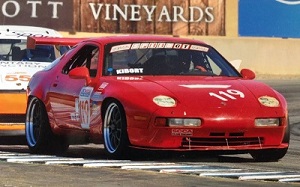
thats what so nice about racing my 87 with 91 octane. no pings, runs great and 91 even at $3.15 a gal is a lot better than what Anderson , Fan and Hanson have to spend for 110 octane (i think they use a 50/50 mix.) however, has anyone seen the cost of 110 lately. I think its $8 a gal now!
although, a racing weekend with double or tripple the gas bill is only $60 vs $120 . I think there are more costly things we spend money on while racing. gas is CHEAP! tires, brakes, general wear and tear, entry fees, etc!
MK
although, a racing weekend with double or tripple the gas bill is only $60 vs $120 . I think there are more costly things we spend money on while racing. gas is CHEAP! tires, brakes, general wear and tear, entry fees, etc!
MK

Three Wheelin'
Joined: Nov 2004
Posts: 1,372
Likes: 1
From: Gatineau/Ottawa Canada 84 928S triple black
Originally Posted by Rich9928p
All US 928s from 1977 to 1984 are designed to run on regular grade fuel. So if you own one, don't waste your money on premium or mid-grade fuel, that is just burning your hard earned money for no reason.
I don't have the owner's manual with me but dosn't say "premium" in there?

Trending Topics

Inventor
Rennlist Member
Rennlist Member
Joined: Sep 2002
Posts: 10,219
Likes: 469
With 2 degrees (crank) advance valve timing, and 30 degrees ignition advance, I had to run Plus. I would still get pinging, but only if accelerating after sitting in traffic for a while.
I reset the valve timing to zero, and the ignition to 26 for the cheap gas. I may try retarding the valve timing a bit, if I can get a little better mileage than my usual 13/20.*
I can tell already, that with the same amount of light pedal, she doesn't pull herself up hills like she used to.
*What I need to do though, is get on the ball, and make a variable valve timing system.
I reset the valve timing to zero, and the ignition to 26 for the cheap gas. I may try retarding the valve timing a bit, if I can get a little better mileage than my usual 13/20.*
I can tell already, that with the same amount of light pedal, she doesn't pull herself up hills like she used to.
*What I need to do though, is get on the ball, and make a variable valve timing system.
Rennlist Stories
The Best Porsche Posts for Porsche Enthusiasts

Every Era of 911 Owner Explained in One Sentence
Verdad Gallardo
Thinking of Buying a Porsche? Do These 10 Things First
Joe Kucinski
Pixar Pals Turned Into 1-of-1 Porsches!
Michael S. Palmer
Theon Goes Full Carbon Fiber With Stunning New Build
Verdad Gallardo
Genius Porsche-Themed Gifts That'll Make Any Dad or Grad Smile
Joe Kucinski
10 Used Porsches Are Selling for Way Too Cheap
Joe Kucinski
Tuner Is Converting Porsche 911s Into Shooting Brakes
Verdad Gallardo
This Coachbuilt Creation Is A Modern Take on the Legendary Porsche 917
Verdad Gallardo
Is This Convertible Cayenne A Steal, Or A Returnless Investment?
Verdad Gallardo
Three Wheelin'
Joined: Nov 2004
Posts: 1,372
Likes: 1
From: Gatineau/Ottawa Canada 84 928S triple black
+ RON 91 +
Here is data from the workshop manual. The # in (braquets) are US/CDN values. RON 91 unleaded for MY84. I don't read # on gas pumps, I just assumed that it took premium. What grade is RON 91?
Thanks
Thanks
Three Wheelin'
Joined: Nov 2004
Posts: 1,372
Likes: 1
From: Gatineau/Ottawa Canada 84 928S triple black
Did a google and the answer is : (from PetroCanada site)
Regular 87 octane
Mid-grade 89 octane
Premium 91 octane
Super premium 94 octane
*
SuperClean 94, available in Montreal, Vancouver and Victoria
Regular 87 octane
Mid-grade 89 octane
Premium 91 octane
Super premium 94 octane
*
SuperClean 94, available in Montreal, Vancouver and Victoria
Thread Starter
Addict
Rennlist Member
Rennlist Member
Joined: Jul 2002
Posts: 2,694
Likes: 55
From: AZ
Originally Posted by DANdeMAN
Did a google and the answer is : (from PetroCanada site)
Regular 87 octane
Mid-grade 89 octane
Premium 91 octane
Super premium 94 octane
*
SuperClean 94, available in Montreal, Vancouver and Victoria
Regular 87 octane
Mid-grade 89 octane
Premium 91 octane
Super premium 94 octane
*
SuperClean 94, available in Montreal, Vancouver and Victoria
Addict
Rennlist Member
Rennlist Member
Joined: Jan 2003
Posts: 3,537
Likes: 1
From: Mountains of GA!
Our US regular @87 is equal to a RON of about 92!
I found this by googling...
Octane rating
The most important characteristic of gasoline is its Research Octane Number (RON) or octane rating, which is a measure of how resistant gasoline is to premature detonation (knocking). It is measured relative to a mixture of 2,2,4-trimethylpentane (an octane) and n-heptane. So an 87-octane gasoline has the same knock resistance as a mixture of 87% isooctane and 13% n-heptane.
There is another type of Octane, called "Motor Octane Number" (MON), which is a better measure of how the fuel behaves when under load. Its definition is also based on the mixture of isooctane and n-heptane that has the same performance. Depending on the composition of the fuel, the MON of a modern gasoline will be about 10 points lower than the RON. Normally fuel specifications require both a minimum RON and a minimum MON.
In most countries (including all of Europe and Australia) the 'headline' octane that would be shown on the pump is the RON: but in the United States and some other countries the headline number is the average of the RON and the MON, sometimes called the "roaD Octane Number" or DON, or (R+M)/2. Because of the 10 point difference noted above this means that the octane in the United States will be about 5 points lower than the same fuel elsewhere: 87 octane fuel, the "normal" gasoline in the US and Canada, would be 92 in Europe.
I found this by googling...
Octane rating
The most important characteristic of gasoline is its Research Octane Number (RON) or octane rating, which is a measure of how resistant gasoline is to premature detonation (knocking). It is measured relative to a mixture of 2,2,4-trimethylpentane (an octane) and n-heptane. So an 87-octane gasoline has the same knock resistance as a mixture of 87% isooctane and 13% n-heptane.
There is another type of Octane, called "Motor Octane Number" (MON), which is a better measure of how the fuel behaves when under load. Its definition is also based on the mixture of isooctane and n-heptane that has the same performance. Depending on the composition of the fuel, the MON of a modern gasoline will be about 10 points lower than the RON. Normally fuel specifications require both a minimum RON and a minimum MON.
In most countries (including all of Europe and Australia) the 'headline' octane that would be shown on the pump is the RON: but in the United States and some other countries the headline number is the average of the RON and the MON, sometimes called the "roaD Octane Number" or DON, or (R+M)/2. Because of the 10 point difference noted above this means that the octane in the United States will be about 5 points lower than the same fuel elsewhere: 87 octane fuel, the "normal" gasoline in the US and Canada, would be 92 in Europe.
Pro
Joined: Oct 2002
Posts: 620
Likes: 124
From: chesapeake va 23322
I've jumpered the octane selector to use "reg" unleaded for long trips that are at light throttle,light load for hours on end with good results.It does not feel any different at normal driving levels and fuel consumption is a little better on long trips.When I get back home I change back to the normal fuel selection.I have never ran the car hard while using reg. unlead.This is on a 86 5.0 32 valve motor.
Thread Starter
Addict
Rennlist Member
Rennlist Member
Joined: Jul 2002
Posts: 2,694
Likes: 55
From: AZ
I found this information in WKS 200-020 dated 3/87 regarding 25 pin LH/EZFs (1984 - 1986 ROW and 1985 - 1986 US).
Note: (M 240) (for France, Saudi Arabia, Great Britain, Belgium, Luxemburg, Spain, Portugal and Greece)
A plug connection is provided on the wiring harness in the area of the 25-pin plug connection of the ignition control unit. These plug connections must be connected with each other on cars for the above mentioned countries.
Connecting these plugs will retard the ignition timing by about 3 degrees in upper partial throttle and full throttle range due to the fuel grade available and the danger of engine knock.
In all other cars these plugs are disconnected and can be connected if required (for example when travelling in countries with poor grade fuel).
>> So, for this series of 928s the magic number is 3 degrees timing retard in mid to high RPM ranges.
Note: (M 240) (for France, Saudi Arabia, Great Britain, Belgium, Luxemburg, Spain, Portugal and Greece)
A plug connection is provided on the wiring harness in the area of the 25-pin plug connection of the ignition control unit. These plug connections must be connected with each other on cars for the above mentioned countries.
Connecting these plugs will retard the ignition timing by about 3 degrees in upper partial throttle and full throttle range due to the fuel grade available and the danger of engine knock.
In all other cars these plugs are disconnected and can be connected if required (for example when travelling in countries with poor grade fuel).
>> So, for this series of 928s the magic number is 3 degrees timing retard in mid to high RPM ranges.

Burning Brakes
Joined: May 2001
Posts: 1,124
Likes: 11
Rich9928p
RON numbers in Australia are as follows:
Regular Unleaded Petrol
Regular unleaded petrol (ULP) was introduced to market in 1986, to enable new vehicles to operate with a catalytic converter, a device designed to reduce exhaust emissions. ULP is the recommended fuel for the majority of passenger cars made since 1986.
Under the National Fuel Quality Standards, regular unleaded petrol is required to have a minimum Research Octane Number (RON) of 91.
Premium Unleaded Petrol
Premium unleaded petrol (PULP) is designed for engines that have a high compression ratio. Therefore, it is formulated with a higher-octane level to prevent knocking and to optimise performance. Under the National Fuel Quality Standards PULP is required to have a minimum RON of 95, however a number of premium unleaded products are formulated with a RON of 98.
Currently fuel price in my area were as follows:
1st Sept A$1.27.9 ULP A$133.9 PULP per litre
2rd Sept Lowest price in my area $1.20.5 to $1.25.9 for ULP and ususlly around 6 cents more pre litre for PULP.
At A$1.33.9 per litre (PULP 98 RON) it equates to approximately US$3.85 per US Gallon
Tails 1990 928 S4 Auto
RON numbers in Australia are as follows:
Regular Unleaded Petrol
Regular unleaded petrol (ULP) was introduced to market in 1986, to enable new vehicles to operate with a catalytic converter, a device designed to reduce exhaust emissions. ULP is the recommended fuel for the majority of passenger cars made since 1986.
Under the National Fuel Quality Standards, regular unleaded petrol is required to have a minimum Research Octane Number (RON) of 91.
Premium Unleaded Petrol
Premium unleaded petrol (PULP) is designed for engines that have a high compression ratio. Therefore, it is formulated with a higher-octane level to prevent knocking and to optimise performance. Under the National Fuel Quality Standards PULP is required to have a minimum RON of 95, however a number of premium unleaded products are formulated with a RON of 98.
Currently fuel price in my area were as follows:
1st Sept A$1.27.9 ULP A$133.9 PULP per litre
2rd Sept Lowest price in my area $1.20.5 to $1.25.9 for ULP and ususlly around 6 cents more pre litre for PULP.
At A$1.33.9 per litre (PULP 98 RON) it equates to approximately US$3.85 per US Gallon
Tails 1990 928 S4 Auto