




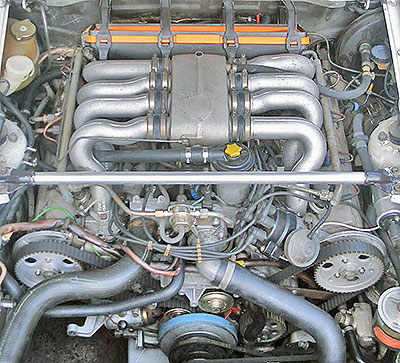
Air Intake tubes?
Burning Brakes
Joined: Jan 2002
Posts: 842
Likes: 0
From: Springfield, MO

Originally Posted by PorKen
Hey! I resemble than remark! 
Mine's a bit noisy, when I open 'er up...
Mine's a bit noisy, when I open 'er up...
Nordschleife Master

Joined: Jul 2003
Posts: 7,742
Likes: 78
From: Minneapolis
Ross Perot hears it all the time.
I tried the open filter approach and actually lost power in an actual dyno test. It was hot in the garage that day and the fans were small. (Search!)
Upshot is that the tubes are not restrictive and it's more important to get cool air to the engine or access the high-pressure pool at the base of the windshield. A number of racers duct the air through the firewall "bacskwards" to the engine to get cool, dense air to the engine.
I don't think bigger tubes will show much. Someone should do a test, though.
I tried the open filter approach and actually lost power in an actual dyno test. It was hot in the garage that day and the fans were small. (Search!)
Upshot is that the tubes are not restrictive and it's more important to get cool air to the engine or access the high-pressure pool at the base of the windshield. A number of racers duct the air through the firewall "bacskwards" to the engine to get cool, dense air to the engine.
I don't think bigger tubes will show much. Someone should do a test, though.
Rennlist Member
Joined: Feb 2002
Posts: 7,060
Likes: 42
From: Cambridge England
You should remember that the LH ECU was mapped with the standard intake system. ANY change, will affect the airflow through the MAF, and affect the fuelling.
A particular modification may (by chance) cause the MAF to give a slightly higher output voltage and thus richen the mixture, and compensate for an aged MAF. But equally it may weaken out the mixture under some consditions, reducing the power.
The screens on the MAF are there to improve ther airflow pattern over the sensor.
A particular modification may (by chance) cause the MAF to give a slightly higher output voltage and thus richen the mixture, and compensate for an aged MAF. But equally it may weaken out the mixture under some consditions, reducing the power.
The screens on the MAF are there to improve ther airflow pattern over the sensor.
Drifting
Joined: May 2002
Posts: 2,777
Likes: 2
From: New Zealand
porsche did eventualy drop the plastic venturi intake tube. they went to a straight foam insulated one instead with negligible change in noise output. this is what ive got on my 1986.
what about a twin throttle setup like the dual plenum carbonfibre intakes, added in to the front/sides of the S4 intake? the strut brace would also need modifying to accomodate. can you have too large of a throttle body?
what about a twin throttle setup like the dual plenum carbonfibre intakes, added in to the front/sides of the S4 intake? the strut brace would also need modifying to accomodate. can you have too large of a throttle body?
Rennlist Member
Joined: Jul 2001
Posts: 6,561
Likes: 113
From: New York
Mark: Further to Nicole's quote: Don't ask me the page and I know you don't put much value on Porsche's claims, but one of the bulletins states that the vent from the tubes to the cam covers is to provide cooling to the TB. If this is true, cooling air is flowing TO the belt and not away from it, and would of course result in some small diminution of flow to the air box. Out of all this discussion, I'm convinced on a stock sys, the only significant item is the venturi design and if Porsche later changed it to a straight pipe I would take the venturi with a grain of salt, but that is what they say. Dyno is the only test here all other things being equal.
Addict
Rennlist Member
Rennlist Member
Joined: Jul 2002
Posts: 2,322
Likes: 18
From: Comox, BC
And speaking about the TB venting part...... I would guess that induction depression would be drawing the air FROM the TB covers, as opposed to ramming it into them, from the intake tube. Does anyone consider this a TB longevity issue in a S/C car (which all seem to eliminate that feature)?
Racer
Joined: Jan 2004
Posts: 287
Likes: 0
From: Laguna Beach, CA. USA
Air temperatures were taken from various points along the intake system from the air tubes to the air filter (89 S4).
Conditions: K type thermocouple, measured at center top of air filter, middle of intake tube, front of air tube, ambient 70F, at idle for 5 minutes, and at 60 MPH.
1) stock air tubes, middle of air filter, top side; idle = 157F, 60 MPH = 75F
2) GTS air tubes, middle of air filter, top side; idle = 155F, 60 MPH = 74F
3) [same configuration as 2)] hood open; idle = 119F
4) middle of air tube, hood down; idle = 150F
5) front of air tube, hood down; idle = 150F
The majority of the intake charge heat at idle comes from air being drawn over the radiator. At 60 MPH the air intake charge up to the air filter is near ambient. This factor is significant for street driven cars (especially during city driving which is where I spend most of my time). So the temp delta at idle from the pre filter area is ~ +85F. BTW, the measured temperatures did not change much with the car standing still and engine at 3000 RPM.
The next step will be to determine what the temperature deltas are within the MAF, TB, and intake manifold. There is a vacuum port on the drivers side intake cover that will be used to place a thermocouple inside of a port.
Conditions: K type thermocouple, measured at center top of air filter, middle of intake tube, front of air tube, ambient 70F, at idle for 5 minutes, and at 60 MPH.
1) stock air tubes, middle of air filter, top side; idle = 157F, 60 MPH = 75F
2) GTS air tubes, middle of air filter, top side; idle = 155F, 60 MPH = 74F
3) [same configuration as 2)] hood open; idle = 119F
4) middle of air tube, hood down; idle = 150F
5) front of air tube, hood down; idle = 150F
The majority of the intake charge heat at idle comes from air being drawn over the radiator. At 60 MPH the air intake charge up to the air filter is near ambient. This factor is significant for street driven cars (especially during city driving which is where I spend most of my time). So the temp delta at idle from the pre filter area is ~ +85F. BTW, the measured temperatures did not change much with the car standing still and engine at 3000 RPM.
The next step will be to determine what the temperature deltas are within the MAF, TB, and intake manifold. There is a vacuum port on the drivers side intake cover that will be used to place a thermocouple inside of a port.
Rennlist Stories
The Best Porsche Posts for Porsche Enthusiasts

Porsche Reveals Coupe Variant of the Electric Cayenne With a Fresh Look
Verdad Gallardo
10 Porsche Colors That Have More Personality Than Most People
Verdad Gallardo
Guntherwerks' Final Speedster Creation Is the Ultimate Porsche Restomod
Verdad Gallardo
10 Reasons I Hate Going to the Porsche Dealership (& the 1 Reason I Stay)
Joe Kucinski
Porsche Shakes Up The Nürburgring Lap Record Table Once Again
Verdad Gallardo
6 Ways the Porsche 911 GT3 S/C Redefines Performance
Joe Kucinski
10 Wildest Homologation Specials Porsche Ever Sold
Verdad Gallardo
Super Rare RUF BTR III Comes Out of Hibernation, Looking For a New Home
Verdad Gallardo
10 Porsche Opinions That Can Start a Fight
Joe Kucinski


Rennlist Member
Joined: Feb 2002
Posts: 7,060
Likes: 42
From: Cambridge England
Interesting results for the temps ! The MAF is temperature compensated, but someone with the maths can work out possible loss of power due to that hot air.
Also, at the same time in traffic, the engine temp 2 reading will rise, and tell the LH ECU to lean out the mixture some more. So when you first hit the throttle hard, the car will be lacking power.
Also, at the same time in traffic, the engine temp 2 reading will rise, and tell the LH ECU to lean out the mixture some more. So when you first hit the throttle hard, the car will be lacking power.
Last edited by John Speake; Dec 31, 2004 at 05:18 PM.
Racer
Joined: Jan 2004
Posts: 287
Likes: 0
From: Laguna Beach, CA. USA
Thanks John,
You are right on the money. The design was optimized for continuous higher speed cruising. That limitation can be changed. Mark Kibort mentioned a rear hood air box vent. I am thinking of something similar. Cooler air and more air, but diffused before it enters the MAF.
You are right on the money. The design was optimized for continuous higher speed cruising. That limitation can be changed. Mark Kibort mentioned a rear hood air box vent. I am thinking of something similar. Cooler air and more air, but diffused before it enters the MAF.
Rennlist Member
Joined: Feb 2002
Posts: 7,060
Likes: 42
From: Cambridge England
Sounds interesting... ! It might alter the fuelling somewhat due to modified airflow, but that could be remapped if required.
Under street crawling conditions, the O2 loop will hold the mixture OK, it's when you go off loop that the problems will start.
I will be interested to see your next set of results... now I'm going to celebrate the New Year !
Under street crawling conditions, the O2 loop will hold the mixture OK, it's when you go off loop that the problems will start.
I will be interested to see your next set of results... now I'm going to celebrate the New Year !

Cottage Industry Sponsor
Lifetime Rennlist
Member
Lifetime Rennlist
Member
Joined: Oct 2001
Posts: 25,818
Likes: 167
From: SF Bay Area, CA
Originally Posted by FlyingDog
The tubes may not be a restriction on a 220HP 1981, but could be on the 300, 400, 500+ HP cars.
Burning Brakes
Joined: Jan 2002
Posts: 842
Likes: 0
From: Springfield, MO
Nice work pappy  Thats quite a bit of difference between the hood open/ hood closed idle temp in the air box.
It would be nice to get rid of that minute fraction of a delay when punching the gas from a complete stop.
Thats quite a bit of difference between the hood open/ hood closed idle temp in the air box. It would be nice to get rid of that minute fraction of a delay when punching the gas from a complete stop.

