When you click on links to various merchants on this site and make a purchase, this can result in this site earning a commission. Affiliate programs and affiliations include, but are not limited to, the eBay Partner Network.
currently my FD is undergoing a full test at a professional shop because my plunger inside the FD is rising after 1h when engine at full stop.
Shop discovered that the pressure drops too fast and this could create a kind of vacuum, because of fuel flowing back to tank via the exit at the primary pressure regulator
and creating a sucking effect on the plunger.
They already replace the O-rings of the primary pressure regulator but problem is still not solved.
Now they will try to raise the fuel system pressure by shimming the regulator (more pressure against the spring and top O-ring that should seal of)
If this doesn't work, they told me I need a new FD.....is this possible ?
Wouldn't it be better to completely replace the primary pressure regulator by a new one ?
Couldn't it just be that the springs of this primary pressure regulator have become weaker during the years ?
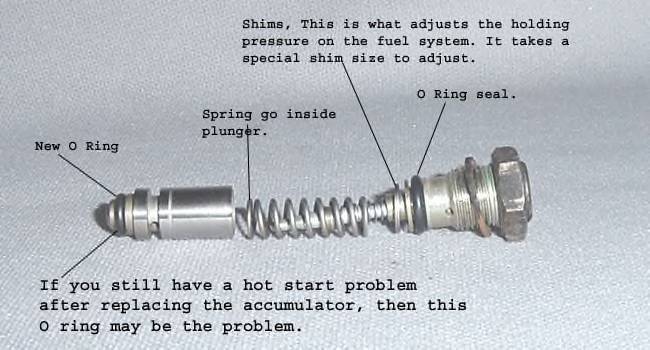
This is an example of the primary pressure regulator
Why not just add a manual push button to run the fuel pump before you start, that should pressurize the whole system and if the WUR is hot the pressure above the plunger should push it down.
Why not just add a manual push button to run the fuel pump before you start, that should pressurize the whole system and if the WUR is hot the pressure above the plunger should push it down.
That will not work since plunger is sucked in upper position after 1 hour. So when priming pump, fuel will be pushed along the plunger the first seconds and thus the injectors are receiving full system pressure and will spray the first seconds before engine starts. So unburnt fuel on top of pistons and thus hard start
Well your injector will not flow until about 35psi during that time the pressure should be pushing your plunger down, with no air flow the the sensor plate arm should not be pushing the plunger up so there will be no pressure on the plunger. This will be based on everything moving freely. An O-ring should seat right away, it will slowly take a set and conform to the seat and seal until age makes it hard and it starts cracking.
How do you know the plunger is being “sucked up” when you can’t see it?
what year?
Well your injector will not flow until about 35psi during that time the pressure should be pushing your plunger down, with no air flow the the sensor plate arm should not be pushing the plunger up so there will be no pressure on the plunger. This will be based on everything moving freely. An O-ring should seat right away, it will slowly take a set and conform to the seat and seal until age makes it hard and it starts cracking.
How do you know the plunger is being “sucked up” when you can’t see it?
what year?
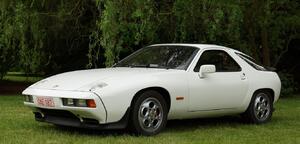
it is a CIS kjet 928S 4.7L 300HP of 1980
When I loosen the fuel line from WUR to FD (fuel line on top of FD above plunger) I can hear the plunger drop on its resting point.
So there is vacuum drawn inside the fuel line. This can only caused by fuel flowing back too fast towards the tank.
Have you tried running the engine with the gas cap off to see what happens? Also maybe trying a jumper and see if turning on the pump and see if you hear the plunger drop?
Have you tried running the engine with the gas cap off to see what happens? Also maybe trying a jumper and see if turning on the pump and see if you hear the plunger drop?
Yes I tried that also to make sure my tank is properly vented. Same result.
Once pump is activated , it will first pump fuel at full system pressure towards the FD…but since my plunger is not yet in the correct position, my injectors will receive full system pressure first 2 seconds and will spray before engine starts….result a start with flooded engine
After these 2 sec, system is pressurized and plunger is put in correct position since there is control pressure in fuel line from WUR to FD
currently my FD is undergoing a full test at a professional shop because my plunger inside the FD is rising after 1h when engine at full stop.
Shop discovered that the pressure drops too fast and this could create a kind of vacuum, because of fuel flowing back to tank via the exit at the primary pressure regulator
and creating a sucking effect on the plunger.
They already replace the O-rings of the primary pressure regulator but problem is still not solved.
Now they will try to raise the fuel system pressure by shimming the regulator (more pressure against the spring and top O-ring that should seal of)
If this doesn't work, they told me I need a new FD.....is this possible ?
Wouldn't it be better to completely replace the primary pressure regulator by a new one ?
Couldn't it just be that the springs of this primary pressure regulator have become weaker during the years ?
This is an example of the primary pressure regulator
UPDATE : the rest pressure is dropped to 0,5 bar (7,2 Psi) already after 30 min ! It should at least be 2,5 bar (36 Psi)
So renewal of O-rings did not work. They will try to replace complete pressure regulator by a new one and see if this solves the problem
The only thing I came up with is that the tension of the spring (pushing against little plunger) has become weak...but wouldn't the system pressure than also become too low ???
When my CIS wouldn't hold rest pressure, it was a bad check valve at the rear wheel well fuel pump.
In this case the FD is tested on a workbench in a professional shop. So I suppose they know what they are doing.
I tested the FD hold test pressure before in my car and it was still holding 2,5 bar after 30 min
Check valve in pump is new, as well as pump and accumulator.
But after an hour the plunger inside my FD was sucked upwards in the FD ( kind of vacuum in line from WUR to top of FD )
This caused hard start , that’s why I sent it to a professional workshop
I suspected a too fast flow back to the tank causing a suction effect
In this case the FD is tested on a workbench in a professional shop.
The Porsche dealership in Toronto charged me to repair my loss of rest pressure. They said they repaired it, but didn't and took my money. I am skeptical of all shops.
Rest pressure in the CIS (or at least for a '78 US model) is maintained by 3 check vales, one at the rear fuel pump, one in the FD, and one in the WUR.
My issue was called out by a Rennlist member (and I am forever grateful to him) and resolved by replacing the rear fuel pump check valve for $45.
I hope you are able to get your issue resolved.
The Porsche dealership in Toronto charged me to repair my loss of rest pressure. They said they repaired it, but didn't and took my money. I am skeptical of all shops.
Rest pressure in the CIS (or at least for a '78 US model) is maintained by 3 check vales, one at the rear fuel pump, one in the FD, and one in the WUR.
My issue was called out by a Rennlist member (and I am forever grateful to him) and resolved by replacing the rear fuel pump check valve for $45.
I hope you are able to get your issue resolved.
You are right, I would not fully trust any dealership in this matter.
But in my case it is not a dealership. The workshop is only repairing kjet systems for several other car brands such as Mercedes, VW, BMW who had the same kjet system
They also take their time to investigate and check thooughly
I know that the FD and check valve of the fuelpump are important for holding rest pressure
I don't recall all the specifics, it was 25 years ago. But the CIS FI needs to be tested as a system, installed on the vehicle. And a set of CIS FI pressure gauges are a must to isolate components (fuel pump check valve / accumulator / FD / WUR / leaky injectors / etc) to determine why you are losing rest pressure.
After my problem was solved, I bought the Ben Watson book "How to Tune & Modify Bosch Fuel Injection" to educate myself and never have to involve a mechanic again. The book explains the diagnostic procedures.
Also, I rebuilt my FD and never had an issue with it leaking.
Why not just add a manual push button to run the fuel pump before you start, that should pressurize the whole system and if the WUR is hot the pressure above the plunger should push it down.
When a hot CIS injected engine loses rest fuel pressure, the fuel vaporizes and you get vapor lock. So just running the fuel pump doesn't work.
Porsche's Top 5 Most Questionable Naming Decisions
Slideshow: For a company obsessed with engineering precision, Porsche has occasionally named its cars in ways that left even loyal enthusiasts scratching their heads.
Pogea Racing's 964 Porsche 911 Reimagination Stands Out in a Crowded Field
Slideshow: Pogea Racing's latest Porsche 964 project blends carbon-fiber construction, modern chassis upgrades, and up to 500 horsepower while keeping the air-cooled 911 experience firmly analog.
Talos Takes Your 991 Porsche 911 GT3 to the Next Level for a Cool $1.13 Million
Slideshow: Talos Vehicles has transformed the Porsche 911 GT3 RS into a carbon-bodied, race-inspired machine that costs well over $1 million before the donor car is even included.
9 Vehicles Porsche Helped Engineer that Aren't Porsches
Slideshow: Long before engineering consulting became trendy, Porsche was quietly helping other automakers build everything from supercars to economy hatchbacks.
9 Features and Characteristics That Only Porsche People Understand
Slideshow: Some brands build cars. Porsche builds traditions, obsessions, and a few habits that stopped making sense decades ago but somehow became part of the charm.





 Primary Pressure regulator in FD