



928 Quench/Squish Sensitivity
Thread Starter
Pro
Joined: Jan 2004
Posts: 513
Likes: 0
From: SOCAL
 928 Quench/Squish Sensitivity
as most of you may know (and I recently discovered), increasing head gasket thickness or increasing deck clearance on a quench designed motor can actually lead to increased detonation...some motor builders claim anything over .060" total squish (gasket & deck clearence) can SEVERELY INCREASE detonation....http://www.speedomotive.com/Building%20Tips.htm
potentially bad news for the stroker crowd trying to lower compression for a bit of extra FI HP...
this only leaves reducing the stroke/volume while keeping the same compresson ht or using a much larger dish (50cc) to lower compression for FI motors starting out at 10+:1 compression (strokers etc)....so much for just "slapping in" a lower compression ht piston....yep, even the angles count....
anyone know what the total squish/deck clearance limits are for the 928 or if it is squish sensitive?
as always, thx for any and all of your squishy/sensitive comments...
potentially bad news for the stroker crowd trying to lower compression for a bit of extra FI HP...
this only leaves reducing the stroke/volume while keeping the same compresson ht or using a much larger dish (50cc) to lower compression for FI motors starting out at 10+:1 compression (strokers etc)....so much for just "slapping in" a lower compression ht piston....yep, even the angles count....
anyone know what the total squish/deck clearance limits are for the 928 or if it is squish sensitive?
as always, thx for any and all of your squishy/sensitive comments...

Addict
Rennlist Member
Rennlist
Site Sponsor
Rennlist Member
Rennlist
Site Sponsor
Joined: Jul 2001
Posts: 11,542
Likes: 4
From: Anaheim California
Rob the 16 valve head / piston is probably much more sensitive due to the offset location of the spark plug and flat top pistons . The 85-86 32 valve has a medium dish but with a pentroof (nearly hemi head) with the spark plug in the middle . The 87> piston is almost fully dished (no squish ) and spark plug centered on a shallower pentroof (Hemi) . The 32 valve is a crossflow head with big ports and valves and alloy to resist detonation ........ this is not your father's Oldsmobile ... 
Thread Starter
Pro
Joined: Jan 2004
Posts: 513
Likes: 0
From: SOCAL
thx jim & lag (yet again!) don't feel bad zman - although I occasionally can correctly parrot what I've been told or read, even w/an engineering degree - HP motor design is riddled w/counter-intuitive phenomena...theory and religion get thick, and even a slight materials change can often cause dramatic & surprising results...
thats why when there is a generally accepted theory in motor building, it may not apply to every make, model or combination of stuff - hence my sensitivity question on the 32V w/S4 heads....some motors are more "resistant" than others due to materials, design, etc...
I just wondered if anyone knew the limits for this particular situation, ie had run ok w/.060" or more deck clearance on an S4 head w/104mm bore, etc...
In fact, I suspect that unless the head gets opened up to match the extra piston surface area, and the dish gets re-matched to the head for an OEM type total combustion chamber profile, more squish and all kinds of weird stuff CAN result - it's just determining where the theory meets the metal that is usually the big question....
probably will just hog out some more on the pistons & call it a day, although some top 928 builders seem to think it would be ok for a bit more squish volume via more deck clearance...would be a lot easier...
overall lowering the piston ht/increasing deck clearance/bigger head gasket is not the theoretically ideal way to drop compression due to combustion/compression pulse inefficencies - although some builders claim better turbulance/mixing w/more squish volume...lots of little trade-offs only can be settled on a dyno or w/lots of testing...
although entertaining at times, meddling w/Dr. P's stuff, a stray cat, or mother nature is never considered "safe" fun...
thats why when there is a generally accepted theory in motor building, it may not apply to every make, model or combination of stuff - hence my sensitivity question on the 32V w/S4 heads....some motors are more "resistant" than others due to materials, design, etc...
I just wondered if anyone knew the limits for this particular situation, ie had run ok w/.060" or more deck clearance on an S4 head w/104mm bore, etc...
In fact, I suspect that unless the head gets opened up to match the extra piston surface area, and the dish gets re-matched to the head for an OEM type total combustion chamber profile, more squish and all kinds of weird stuff CAN result - it's just determining where the theory meets the metal that is usually the big question....
probably will just hog out some more on the pistons & call it a day, although some top 928 builders seem to think it would be ok for a bit more squish volume via more deck clearance...would be a lot easier...
overall lowering the piston ht/increasing deck clearance/bigger head gasket is not the theoretically ideal way to drop compression due to combustion/compression pulse inefficencies - although some builders claim better turbulance/mixing w/more squish volume...lots of little trade-offs only can be settled on a dyno or w/lots of testing...
although entertaining at times, meddling w/Dr. P's stuff, a stray cat, or mother nature is never considered "safe" fun...
Thread Starter
Pro
Joined: Jan 2004
Posts: 513
Likes: 0
From: SOCAL
0.0 is the number I've seen banted around for 928 deck clearance, S4 comp ht is 2.2047", rod is 5.9095"+/-, stroke is 3.106"/throw=1.553", or 9.6672"/245.415mm total deck height if the clearance is 0.0...
have to look at gasket thickness (.039"/1mm std), gasket dia, and area (dish/chamber dia - piston dia) to figure squish volume...
it's different btwn stock S4 and a custom 968 and S4 head combo...guys claim to be doing it, but details are engine builder trade secrets at times...been tricky to determine who's strategy is best, and there just haven't been a lot of these built either (ie over 100/500/1000 etc)...
using the much touted 95.25" stroke, w/104mm, 1.428" 968 comp ht pistons, it's possibly looking like I'd need a 6.35 rod, w/the 3.75"/1.875 throw for the 9.66 deck ht, but - I WAS thinking about offsetting the wristpin a bit or a shorter rod/stroke to lower the piston for less compression...
still awake? then just dig out the calculus book for some old fashion volume under a curv junk, unless someone has it handy or it really just won't matter...or you fall asleep re-visiting integration calcs...
lots of junk to wade through on this one...or just hand lots of money over, close your eyes and hope you don't get a 30 hour mtbf monster paperweight...
have to look at gasket thickness (.039"/1mm std), gasket dia, and area (dish/chamber dia - piston dia) to figure squish volume...
it's different btwn stock S4 and a custom 968 and S4 head combo...guys claim to be doing it, but details are engine builder trade secrets at times...been tricky to determine who's strategy is best, and there just haven't been a lot of these built either (ie over 100/500/1000 etc)...
using the much touted 95.25" stroke, w/104mm, 1.428" 968 comp ht pistons, it's possibly looking like I'd need a 6.35 rod, w/the 3.75"/1.875 throw for the 9.66 deck ht, but - I WAS thinking about offsetting the wristpin a bit or a shorter rod/stroke to lower the piston for less compression...
still awake? then just dig out the calculus book for some old fashion volume under a curv junk, unless someone has it handy or it really just won't matter...or you fall asleep re-visiting integration calcs...
lots of junk to wade through on this one...or just hand lots of money over, close your eyes and hope you don't get a 30 hour mtbf monster paperweight...
Trending Topics

928 Collector
Rennlist Member
Rennlist Member

Joined: Jan 2003
Posts: 17,270
Likes: 5
From: Seattle
No easy answers ... yet ... til Rob figures some of it out ;-) Well I don't have it in me to calculate that schtuff ... at least not without my handy-dandy doctorate, which I'm not about to go get 
Rennlist Stories
The Best Porsche Posts for Porsche Enthusiasts
9 Features and Characteristics That Only Porsche People Understand
Verdad Gallardo
I've Written 500 Rennlist Articles: Here's How Porsche Has Changed Along the Way
Joe Kucinski
10 Most Unnecessary Porsches Ever Built (And Why We Love Them)
Verdad Gallardo
Porsche 911 GT3 S/C vs 718 Spyder RS: 10 Categories, One Winner
Joe Kucinski
This Builder Is Turning Heads With Its Slantnose 911 Creation
Verdad Gallardo
Porsche 911 GT3 Artisan Edition Pays Homage to Japanese Culture
Verdad Gallardo
Porsche Reveals Coupe Variant of the Electric Cayenne With a Fresh Look
Verdad Gallardo
10 Porsche Colors That Have More Personality Than Most People
Verdad Gallardo
Guntherwerks' Final Speedster Creation Is the Ultimate Porsche Restomod
Verdad Gallardo
Rennlist Member
Joined: May 2001
Posts: 5,280
Likes: 16
From: Austin, TX
I've read 45/1000" quench pad clearance as a minimum rule of thumb. Start swinging bigger slugs longer ways and I'd worry about the piston kissing the cylinder head. I also read that keeping this clearance as little as possible is EXTREMELY important in detonation control.
Rennlist Member
Joined: May 2001
Posts: 5,280
Likes: 16
From: Austin, TX
Originally posted by Dan Perez
I've read 45/1000" quench pad clearance as a minimum rule of thumb.
I've read 45/1000" quench pad clearance as a minimum rule of thumb.

Addict
Rennlist Member
Rennlist
Site Sponsor
Rennlist Member
Rennlist
Site Sponsor
Joined: Jul 2001
Posts: 11,542
Likes: 4
From: Anaheim California
Lifted from another discussion "Quench, or squish area is typically the flat area on the top of the piston that's almost level with the top of the block deck. It must have a corresponding flat area on the deck surface of the head to qualify as quench. " This was my point from a much earlier post the 32 valve engine the 85-86 has almost ZERO quench area the 87> even less as the piston has a much bigger dished out area . This discussion has little to do with the Porsche 32 valve engine because there is almost no Quench !! Why ? in my opinion , not NEEDED the centrally located spark plug and 4 valve cross flow head eliminated the need to shove all the gasses to one side just to be near a spark plug .

Addict
Lifetime Rennlist
Member
Lifetime Rennlist
Member
Joined: May 2001
Posts: 14,697
Likes: 598
From: Las Vegas
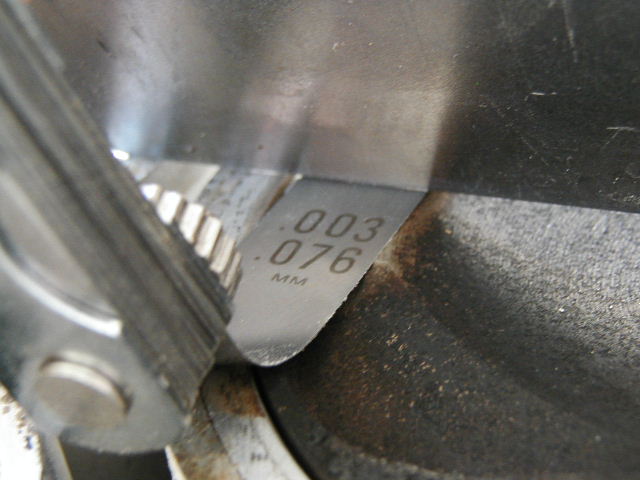
add that to your head gasket thickness. As Jim said, with so much dish in the piston the squish (in the S4 atleast) isnt nearly as critical as it could be if you were dealing with more flat surface area . However, to be safe and to leave "well enough alone" when i machined my pistons i kept the same amount of squish and just altered the slope of the dish to increase the volume slighlty. If my calcs are right i should be around 8.75:1
HTH

Thread Starter
Pro
Joined: Jan 2004
Posts: 513
Likes: 0
From: SOCAL
thx guys! this is just so much better than talking to myself in the bathroom... tony's work/pics are always a big help & SOOO cool... (no, I don't bring those into the bathroom though)
did some research on my own - apparently, w/S4 heads, and w/my 104mm, "stepdown" Finite Element Analysis designed pistons (FEA: let the supercomputer do the work!) - there is NO squish (I know Jim, you've been trying to pound that into my thick little head from the beginning - but I'm SOOO slow sometimes)
apparently, unlike dad's olds or even Dr P's 32V successors, the perimeter of my forged JE has an angle - eliminating squish while creating more turbulance/atomization & the "stepped down" flat bottom promotes better flame travel and complete combustion - guess the quench thing got handled somehow... (nope, I didn't test them yet or figure ANYTHING out- I just regurgitated what JE, KB, mahle and manley say)
don't worry tony - I don't think dished pistons will stop working all of a sudden & shortly after I get my motor running, I'm sure someone will verify your design is actually better - after the FEA guys upgrade their software - just like it always rains after I wax my car...
http://kb-silvolite.com/index2.php has some good examples & helpful engine modeling calculators....
also "discovered" some cool stuff about piston design improvements since our 928's were built - http://www.babcox.com/editorial/ar/eb40354.htm
an interesting read for anyone considering an overhaul....
thought it was odd that although mahle was mentioned as a leading piston designer - they only offer OEM stuff for the 928...(maybe THATS what the custom group does for $275/slug?)
sure gives me a lot more respect for state of the art HP builders (ie keith black, greg brown, phil threshie, etc)...probably should stop 2nd guessing them to death - someday...
as a side note from my travels, I "discovered" that some OEM mahles had offset wrist pins - presumably to aid w/thrust/side loading... but some motors have had the same pin offset on both banks - so 1 side will have a "proper" offset, and the other side will be just the opposite....think I'll address that one w/bushing offsets and centered wrist pins...
interestingly enough, I haven't read or heard of this being an issue in terms of premature piston failure - but it might explain some scuffing issues...and it does help the case to upgrade the pistons/bore during an overhaul or prior to going boost crazy (if less friction, more power, better heat dissapation, and saving 3200 grams (pistons:453g vs 750g OEM & rods 600g vs 700g OEM - per cylinder!) of recprical mass doesn't get your attention).... of course, with tony's setup, I'd have $$$ to burn in vegas...
as always - thx again!
did some research on my own - apparently, w/S4 heads, and w/my 104mm, "stepdown" Finite Element Analysis designed pistons (FEA: let the supercomputer do the work!) - there is NO squish (I know Jim, you've been trying to pound that into my thick little head from the beginning - but I'm SOOO slow sometimes)
apparently, unlike dad's olds or even Dr P's 32V successors, the perimeter of my forged JE has an angle - eliminating squish while creating more turbulance/atomization & the "stepped down" flat bottom promotes better flame travel and complete combustion - guess the quench thing got handled somehow... (nope, I didn't test them yet or figure ANYTHING out- I just regurgitated what JE, KB, mahle and manley say)
don't worry tony - I don't think dished pistons will stop working all of a sudden & shortly after I get my motor running, I'm sure someone will verify your design is actually better - after the FEA guys upgrade their software - just like it always rains after I wax my car...
http://kb-silvolite.com/index2.php has some good examples & helpful engine modeling calculators....
also "discovered" some cool stuff about piston design improvements since our 928's were built - http://www.babcox.com/editorial/ar/eb40354.htm
an interesting read for anyone considering an overhaul....
thought it was odd that although mahle was mentioned as a leading piston designer - they only offer OEM stuff for the 928...(maybe THATS what the custom group does for $275/slug?)
sure gives me a lot more respect for state of the art HP builders (ie keith black, greg brown, phil threshie, etc)...probably should stop 2nd guessing them to death - someday...
as a side note from my travels, I "discovered" that some OEM mahles had offset wrist pins - presumably to aid w/thrust/side loading... but some motors have had the same pin offset on both banks - so 1 side will have a "proper" offset, and the other side will be just the opposite....think I'll address that one w/bushing offsets and centered wrist pins...
interestingly enough, I haven't read or heard of this being an issue in terms of premature piston failure - but it might explain some scuffing issues...and it does help the case to upgrade the pistons/bore during an overhaul or prior to going boost crazy (if less friction, more power, better heat dissapation, and saving 3200 grams (pistons:453g vs 750g OEM & rods 600g vs 700g OEM - per cylinder!) of recprical mass doesn't get your attention).... of course, with tony's setup, I'd have $$$ to burn in vegas...
as always - thx again!

Three Wheelin'
Joined: Mar 2003
Posts: 1,286
Likes: 1
From: New Berlin
Originally posted by Jim bailey - 928 International
in my opinion , not NEEDED the centrally located spark plug and 4 valve cross flow head eliminated the need to shove all the gasses to one side just to be near a spark plug .
in my opinion , not NEEDED the centrally located spark plug and 4 valve cross flow head eliminated the need to shove all the gasses to one side just to be near a spark plug .
Originally posted by Rob
there is NO squish (I know Jim, you've been trying to pound that into my thick little head from the beginning - but I'm SOOO slow sometimes)
there is NO squish (I know Jim, you've been trying to pound that into my thick little head from the beginning - but I'm SOOO slow sometimes)
Ford with their kick-*** 4.6L 32v engine has constantly tweaked the squish areas on their various heads they have produced over it's current 9 year lifespan. Some of them resemebled clover-leafs as the squish followed the contours of the 4 valves, while others resembled the 928 32v where it didn't follow the valves.
On a side-note, people remark and say that they would consider dropping a Chevy engine in their 928; however, I think a more interesting candidate would be the 4.6L 32v Ford. The STOCK 2003/4 Ford Cobra engine is good for 1000 hp at the crank from the factory; iron block (..closed deck, siamesed cylinders), steel crank, Manley rods, forged pistons. All of that straight from the factory with a modern programmable computer to boot, all one has to do is up the boost!
Last edited by Lagavulin; Apr 28, 2004 at 09:20 AM.
Addict
Rennlist Member
Rennlist
Site Sponsor
Rennlist Member
Rennlist
Site Sponsor
Joined: Jul 2001
Posts: 11,542
Likes: 4
From: Anaheim California
Rob the offset is really just to limit piston slap and it is not a large amount and as you point out one bank is "backwards" . It is not significant in my opinion .......... not worth fixing .