


Tensioner operating logic


Thread Starter
Rennlist Member
Joined: Dec 2002
Posts: 5,283
Likes: 52
From: Australia
 Tensioner operating logic
Maybe I have missed it, but I cant find an explanation of how the stock tensioner operates. There have been a few changes, from early units without oil filler and vent, and changes in the no of Belleville washers along the way, and how oil is supplied to it, but how does it do its job? I have seen it described as actually being a detensioner, in that it reduces the belt load as the block heats up and less tension is needed to keep things in place - how does it do this? How do the washers behave as they heat up?
thanks
jp 83 Euro S AT 57k
thanks
jp 83 Euro S AT 57k


Team Owner

Joined: May 2004
Posts: 31,151
Likes: 4,153
From: Philly PA
the discs are bent to the shape of a pressure plate spring,
when they heat up they flatten out,
this will reduce the pressure applied to the tensioner Idler wheel.
Based on the stacks of the washers
when they heat up they flatten out,
this will reduce the pressure applied to the tensioner Idler wheel.
Based on the stacks of the washers
Rennlist Member
Joined: Jun 2005
Posts: 10,569
Likes: 1,027
From: Oman
JP,
The Belleville pack is a very clever piece of kit and as a whole I have a feeling the action of the tensioner may well be misunderstood by many so you raise a good question. For starters Porsche took out two patents for their design- one for the original design and one for the revised design. One presumes they had a good reason for doing so given patents cost money to secure.
As I am concerned the tensioner does two basic things- it acts as a detensioner as the motor heats up and it also acts as a hydraulic damper to some extent. When I studied this piece of kit initially I expected that it was just a rod putting elastic pre-tension into the belt and the belt alone did the "dynamic thing". However I quickly realised there was way more to it than that. The Belleville pack, although it seems like a rigid block when one looks at the washers themselves, is in fact quite springy and on the later model tensioner as used in my 32 valve 928 motor, one can slightly compress the complete spring pack in one's hand using finger pressure [or so I perceived]. For Belleville packs there is a formula for working out the relative compressive strength of the total pack considering the washer arrangement and using that formula it works out that the total compressive resistance for the later model spring pack is 0.6 of that for one washer [as I mentally recall] but having so many washers in the construct the distance it can travel at that spring resistance is much greater than a single washer. Needless to say I was impressed by this relatively simple mechanical concept that has been around for quite some time.
As the cam belt travels the valve spring resistance varies quite considerably depending on the position of the crankshaft and as the belt tensions and de-tensions with such position, it is not difficult to visualise why there is a need for some kind of dampener. Further research on the belt manufacturer's website indicated that the actual belt tension needed for the belt to work correctly is specified by the belt manufacturer and for a given system that has to be met irrespective of how the belt is tensioned or damped. Assuming this to be a correct statement of fact this would imply that the belt tension ought to be the same irrespective of whether one uses the stock Porsche tensioner or the PKT device Ken designed. I am not vaguely interested in discussion about the relative merits of the two systems, I use the stock unit and am happy with it- I have no experience of the PKT and when installed correctly it seems to work perfectly OK. As I can tell the principal difference between the two systems is that with the PKT one does not have to pre-set the cold tension as the unit does this by itself when the pin is pulled and is a well tried and tested concept on more modern vehicles such as the ones the Audi unit is fitted to OEM.
Finally, if one studies the two model variants of the tensioner, the later model appears to be more complex in that there is what appears to be a check valve built into the back wall of the tensioner [it is like a brass insert]. Why they made this modification or perceived a need to do so around 1983/4 I do not know but make it they did. As I can fathom out it seems they did this to ensure a directional flow of oil around the passageways. Initially I wondered if this was to do with introduction of the 32 valve models but the timeline suggests otherwise. I then concluded that perhaps it was made to improve performance given some folks have noted belt flutter under certain conditions and thus tries to achieve such by keeping a more constant temperature of the system oil charge perhaps. Whatever the case the later tensioner seemingly does not eliminate the belt flutter but perhaps decreases such tendency a bit- who knows?
As to what is factually correct and what is supposition remains to be seen. I calculated the thermal growth of the engine and measured the shrinkage of the Belleville pack and lo and behold it worked out one and the same figure. The engine takes about 3 minutes to warm up and there is a 3 minute delay before the belt tension warning light sets. I also concluded that there is far to much concern placed on a timing belt warning alarm when it goes off. When it does go off the warning states "toothed belt service" it does not say "tough luck pal you have just bent 32 valves". If and when something has catastrophically failed the warning light is not going to do much for you! Most alarms are probably false alarms but it is not something one dicks around with. What I have noticed is that on the couple of alarms I have seen over 20 years of ownership in both cases neither of them repeated - had the belt tension been genuinely low the alarm should have repeated after acceptance but it did not thus why I was not too worried at the time. Subsequent checks suggested there was nothing untoward but it was prudent to check. The alarm being a neat feature of the stock tensioner system.
The Belleville pack is a very clever piece of kit and as a whole I have a feeling the action of the tensioner may well be misunderstood by many so you raise a good question. For starters Porsche took out two patents for their design- one for the original design and one for the revised design. One presumes they had a good reason for doing so given patents cost money to secure.
As I am concerned the tensioner does two basic things- it acts as a detensioner as the motor heats up and it also acts as a hydraulic damper to some extent. When I studied this piece of kit initially I expected that it was just a rod putting elastic pre-tension into the belt and the belt alone did the "dynamic thing". However I quickly realised there was way more to it than that. The Belleville pack, although it seems like a rigid block when one looks at the washers themselves, is in fact quite springy and on the later model tensioner as used in my 32 valve 928 motor, one can slightly compress the complete spring pack in one's hand using finger pressure [or so I perceived]. For Belleville packs there is a formula for working out the relative compressive strength of the total pack considering the washer arrangement and using that formula it works out that the total compressive resistance for the later model spring pack is 0.6 of that for one washer [as I mentally recall] but having so many washers in the construct the distance it can travel at that spring resistance is much greater than a single washer. Needless to say I was impressed by this relatively simple mechanical concept that has been around for quite some time.
As the cam belt travels the valve spring resistance varies quite considerably depending on the position of the crankshaft and as the belt tensions and de-tensions with such position, it is not difficult to visualise why there is a need for some kind of dampener. Further research on the belt manufacturer's website indicated that the actual belt tension needed for the belt to work correctly is specified by the belt manufacturer and for a given system that has to be met irrespective of how the belt is tensioned or damped. Assuming this to be a correct statement of fact this would imply that the belt tension ought to be the same irrespective of whether one uses the stock Porsche tensioner or the PKT device Ken designed. I am not vaguely interested in discussion about the relative merits of the two systems, I use the stock unit and am happy with it- I have no experience of the PKT and when installed correctly it seems to work perfectly OK. As I can tell the principal difference between the two systems is that with the PKT one does not have to pre-set the cold tension as the unit does this by itself when the pin is pulled and is a well tried and tested concept on more modern vehicles such as the ones the Audi unit is fitted to OEM.
Finally, if one studies the two model variants of the tensioner, the later model appears to be more complex in that there is what appears to be a check valve built into the back wall of the tensioner [it is like a brass insert]. Why they made this modification or perceived a need to do so around 1983/4 I do not know but make it they did. As I can fathom out it seems they did this to ensure a directional flow of oil around the passageways. Initially I wondered if this was to do with introduction of the 32 valve models but the timeline suggests otherwise. I then concluded that perhaps it was made to improve performance given some folks have noted belt flutter under certain conditions and thus tries to achieve such by keeping a more constant temperature of the system oil charge perhaps. Whatever the case the later tensioner seemingly does not eliminate the belt flutter but perhaps decreases such tendency a bit- who knows?
As to what is factually correct and what is supposition remains to be seen. I calculated the thermal growth of the engine and measured the shrinkage of the Belleville pack and lo and behold it worked out one and the same figure. The engine takes about 3 minutes to warm up and there is a 3 minute delay before the belt tension warning light sets. I also concluded that there is far to much concern placed on a timing belt warning alarm when it goes off. When it does go off the warning states "toothed belt service" it does not say "tough luck pal you have just bent 32 valves". If and when something has catastrophically failed the warning light is not going to do much for you! Most alarms are probably false alarms but it is not something one dicks around with. What I have noticed is that on the couple of alarms I have seen over 20 years of ownership in both cases neither of them repeated - had the belt tension been genuinely low the alarm should have repeated after acceptance but it did not thus why I was not too worried at the time. Subsequent checks suggested there was nothing untoward but it was prudent to check. The alarm being a neat feature of the stock tensioner system.

Nordschleife Master
Joined: Dec 2003
Posts: 5,965
Likes: 360
From: TX
Article:
https://www.leespring.com/learn-abou...eville-washers

Lee Spring Standard Series Belleville Washers are manufactured from 300 Series Stainless Steel. Additionally, Lee Spring Standard Series Belleville Washers are passivated in accordance with specification ASTM A967 (supercedes QQ-P35) to remove contaminants and further improve resistance to corrosion. 300 Series Stainless Steel is slightly magnetic and is recommended for applications with temperatures up to 500°F (260 °C).
The Lee Spring DIN Belleville Washer Series offers metric disc spring washers to meet global demand for sizes specified by DIN 2093. Lee Spring also expand on size options past DIN 2093’s standard size tables, made to DIN manufacturing and quality specifications to provide component flexibility for product designers. DIN Belleville Washers are made with 51CrV4 spring steel (AISI 6150) and finished with a phosphate and oil surface for general protection from corrosion.
DIN Belleville Washer Series designs are classified into three groups based on the material thickness:
Group 1 – This range applies to disc spring washers with material thickness less than 1.25mm. Lee Spring DIN Belleville Washer Series include 88 sizes in Group 1, over a selection of outside diameters from 6mm (0.236”) to 40mm (1.575”) with inside diameters from 3.2mm (0.126”) to 20.4mm (0.803”).
Group 2 – This range applies to disc spring washers with material thickness from 1.25mm through 6mm. Lee Spring DIN Belleville Washer Series include 161 sizes in Group 2, over a selection of outside diameters from 20mm (0.787”) to 200mm (7.874”) with inside diameters from 10.2mm (0.402”) to 102mm (4.016”).
Group 3 – This range applies to disc spring washers with material thickness over 6mm through 14mm. Lee Spring DIN Belleville Washer Series include 41 sizes in Group 3, over a selection of outside diameters from 100mm (3.937”) to 250mm (9.843”) with inside diameters from 51mm (2.008”) to 127mm (5.000”).
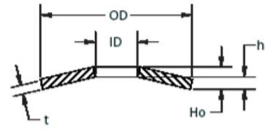

Single: One Washer

Parallel: All washers stacked the same way to increase load

Series: All washers stacked opposite each other to increase deflection

Series-Parallel: A combination of the two
Additional load flexibility can be achieved by stacking Belleville Washers in various configurations. As shown in the diagrams above, Belleville Washers can be used in four different ways.
https://www.leespring.com/learn-abou...eville-washers
Belleville Washers
High Loads in Small Spaces
When your compression spring application requires a high load in small spaces, Lee Spring's Belleville Washers can be the solution. Their conical configuration enables them to support high loads with relatively small deflections and solid heights compared to helical springs. Belleville Washers are often used to solve vibration, thermal expansion, relaxation and bolt creep problems.Lee Spring Standard Series Belleville Washers are manufactured from 300 Series Stainless Steel. Additionally, Lee Spring Standard Series Belleville Washers are passivated in accordance with specification ASTM A967 (supercedes QQ-P35) to remove contaminants and further improve resistance to corrosion. 300 Series Stainless Steel is slightly magnetic and is recommended for applications with temperatures up to 500°F (260 °C).
The Lee Spring DIN Belleville Washer Series offers metric disc spring washers to meet global demand for sizes specified by DIN 2093. Lee Spring also expand on size options past DIN 2093’s standard size tables, made to DIN manufacturing and quality specifications to provide component flexibility for product designers. DIN Belleville Washers are made with 51CrV4 spring steel (AISI 6150) and finished with a phosphate and oil surface for general protection from corrosion.
DIN Belleville Washer Series designs are classified into three groups based on the material thickness:
Group 1 – This range applies to disc spring washers with material thickness less than 1.25mm. Lee Spring DIN Belleville Washer Series include 88 sizes in Group 1, over a selection of outside diameters from 6mm (0.236”) to 40mm (1.575”) with inside diameters from 3.2mm (0.126”) to 20.4mm (0.803”).
Group 2 – This range applies to disc spring washers with material thickness from 1.25mm through 6mm. Lee Spring DIN Belleville Washer Series include 161 sizes in Group 2, over a selection of outside diameters from 20mm (0.787”) to 200mm (7.874”) with inside diameters from 10.2mm (0.402”) to 102mm (4.016”).
Group 3 – This range applies to disc spring washers with material thickness over 6mm through 14mm. Lee Spring DIN Belleville Washer Series include 41 sizes in Group 3, over a selection of outside diameters from 100mm (3.937”) to 250mm (9.843”) with inside diameters from 51mm (2.008”) to 127mm (5.000”).
Single: One Washer
Parallel: All washers stacked the same way to increase load
Series: All washers stacked opposite each other to increase deflection
Series-Parallel: A combination of the two
Belleville Washers in Use and Stacking
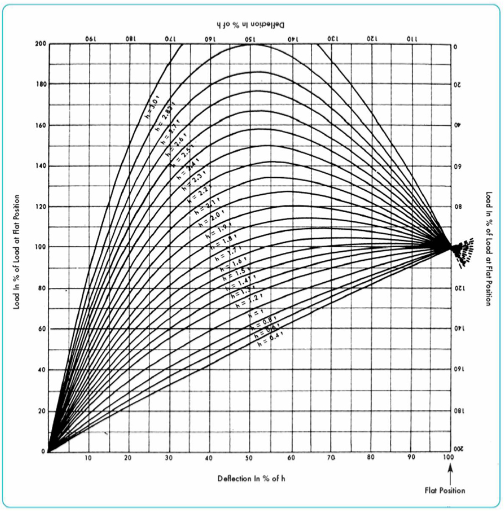
A single Belleville Washer has a specific load for a given deflection. Two washers stacked in parallel will yield double the load of a single washer for the same deflection; three washers will yield triple the load; four washers will yield four times the load, etc. Alternatively, two washers stacked in series will yield double the deflection of single washer for the same load; three washers will yield triple the deflection; four washers will yield four times the deflection, etc. Various series-parallel combinations therefore can provide a wide variety of combined results of load versus deflection for the stack. Consequently, depending upon the application, the designer can:- Stack in "parallel" to increase load
- Stack in "series" to increase deflection
- Adjust the load and deflection of a washer stack by adding or removing individual washers and/or the sequence in which they are used, whether in series or parallel
Additional load flexibility can be achieved by stacking Belleville Washers in various configurations. As shown in the diagrams above, Belleville Washers can be used in four different ways.
Load Deflection Diagram
Trending Topics
Rennlist Member

Joined: Feb 2012
Posts: 1,431
Likes: 215
From: Under Cruella's Thumb
totally cool...and yes Fred your comment about the belt tension warning system for those that missed it is a pre-emptive notification....enough flutter tripped the alarm...Mine is in good working order and recently after about 4 1/2 years my Conti belt went to 3 1/2, per the shop and I had 3 alarms in about 2 weeks so I took it in and we got it adjusted up.
My shop told me also that a lot of them can have false alarms or not function correctly in other ways....the system is pretty simple so I wouldn't think it would be a big deal to fix ones that aren't.
Personally for me it isn't an option to have the warning system not working properly...in my case the system did exactly as designed so i'm not driving around with the belt at 3 1/2....
Those with interference engines need to get theirs in working order...they're worth their weight in something more expensive than gold.,,,helium?
My shop told me also that a lot of them can have false alarms or not function correctly in other ways....the system is pretty simple so I wouldn't think it would be a big deal to fix ones that aren't.
Personally for me it isn't an option to have the warning system not working properly...in my case the system did exactly as designed so i'm not driving around with the belt at 3 1/2....
Those with interference engines need to get theirs in working order...they're worth their weight in something more expensive than gold.,,,helium?